A – Z Guide to Paul Bunyan's Evolution

How a Gentle Giant Became America's Most Beloved Folk Hero
From Folk Hero to Film Icon: The Story of Paul Bunyan & His Place in American Myth-Making traces a journey that feels almost magical. A story that started around campfires in logging camps grew into one of America's most treasured legends. Here's what you'll find:
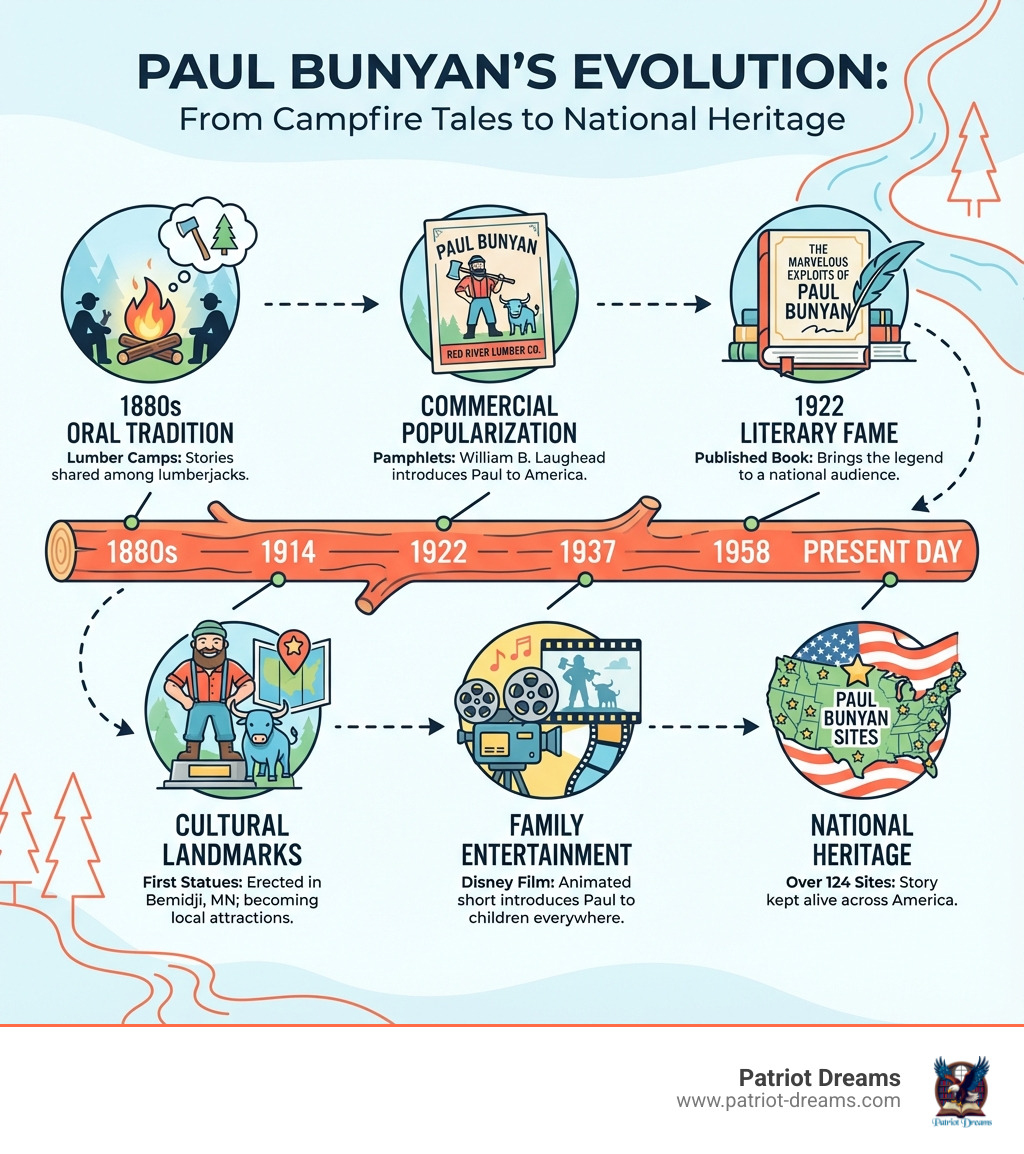
Paul Bunyan's Journey to American Icon:
- 1880s-1890s: Stories shared among lumberjacks in Great Lakes lumber camps
- 1914: William B. Laughead introduces Paul to America through Red River Lumber Company pamphlets
- 1922: The Marvelous Exploits of Paul Bunyan brings the legend to a national audience
- 1937: First giant statues erected in Bemidji, Minnesota
- 1958: Disney's animated short introduces Paul to children everywhere
- Today: Over 124 Paul Bunyan sites across America keep his story alive
Paul Bunyan isn't just a tall tale. He's a story about kindness, hard work, and community.
He represents the best of what Americans aspire to be — strong but gentle, powerful but caring, larger than life yet deeply human. His companion, Babe the Blue Ox, shows us the beauty of loyal friendship. Together, they remind us that the greatest strength comes from helping others and working together.
The story of Paul Bunyan teaches us something wonderful: our shared stories connect us. They remind us of values that never go out of style — perseverance, humor in hard times, and the power of imagination.
Quick From Folk Hero to Film Icon: The Story of Paul Bunyan & His Place in American Myth-Making terms:
- The Frontier Myth Today: What the Old West Tells Us About Modern America
- The Real Life Behind the Legend: Casey Jones and the Making of an American Railroad Hero
- When Film Becomes History: How Movies Shape Our View of America
From Campfire Whispers to National Legend
Imagine a time when the vast, whispering forests of America were being tamed by hardworking lumberjacks. These were strong, resourceful people who spent long, isolated months deep in the woods. After a day of felling towering trees, they would gather around crackling campfires, sharing stories to pass the time and lift their spirits. It was in these very settings, amidst the camaraderie and the glow of the flames, that the first tales of Paul Bunyan began to take root.

The origins of the Paul Bunyan folktale are as rich and earthy as the forests he is said to have cleared. These stories first emerged from the oral tradition of North American loggers, particularly in the Upper Midwest. We know that by the close of the 19th century, Paul Bunyan tales appeared to have spread to every logging camp in North America. These weren't stories written down in books; they were living, breathing narratives, passed from one logger to another, growing grander and more fantastic with each telling.
These early stories, often shared by timber cruisers in places like Wisconsin during the winter of 1885–1886, helped build community and provided a much-needed outlet for humor and imagination in the demanding life of a lumberjack. They served a valuable purpose, giving every hardship and tough problem a whimsical turn. It's a beautiful example of how shared stories can make even the hardest work a little bit lighter. This fascinating period of our nation's past, where cultural traditions were forged in daily life, reminds us of the profound impact of American Cultural History.
The Real-Life Inspirations Behind the Legend
When we hear about a hero as larger-than-life as Paul Bunyan, it’s natural to wonder if there was a real person who inspired such grand tales. Was Paul Bunyan a real individual, a flesh-and-blood giant who walked among us? The truth, as it often is with folklore, is a little more nuanced and, in its own way, even more wonderful.
While there’s no definitive historical figure we can point to as the Paul Bunyan, historians believe the legend is a beautiful blend of inspiration from several real people. One prominent theory suggests that the character might have drawn inspiration from a French-Canadian logger named Fabian Fournier. Born around 1845, Fournier was known for his impressive physical presence — he was a brawny man, around 6 feet tall, which was quite imposing for the mid-19th century when the average American male stood about 5 feet. He had a reputation for strength and a spirited nature, making him a memorable figure in the Michigan logging camps where he worked.
Another possible influence was a French-Canadian war hero named Bon Jean. It’s thought that the tales of Bon Jean and Fabian Fournier, perhaps combined with other stories of powerful lumberjacks, began to intertwine and evolve. The name "Bunyan" itself is believed to be a melding of different sounds and names from this rich cultural exchange. So, while we may not find a single "Paul Bunyan" in history books, we can appreciate that his legend is a tribute to the collective strength, resilience, and storytelling spirit of the diverse loggers who shaped our nation. It's a reminder that our heroes often embody the best qualities of many individuals, creating a composite figure that inspires generations. You can learn more about the fascinating individuals who shaped our past in our exploration of Historical American Figures.
The Storyteller Who Shared Paul with the World
For decades, the tales of Paul Bunyan lived and breathed solely within the confines of the logging camps, whispered from seasoned loggers to wide-eyed newcomers. These stories circulated for at least thirty years before finding their way into print, a testament to the power of oral tradition. The first mention of Paul Bunyan to people outside of the lumberjacking world came in 1910, marking a pivotal moment in his journey.
But it was a gifted individual named William B. Laughead, a graphic designer and advertising man, who truly became the legendary lumberjack's greatest publicist. In 1914, the Red River Lumber Company, a prominent lumber business, developed an advertising campaign featuring Bunyan. Laughead, working for the company, penned an advertising pamphlet in 1916 that would change everything. He took the scattered, colorful anecdotes from the camps and wove them into coherent, captivating stories, complete with the first pictorial representations of Paul Bunyan.
Laughead's stroke of genius wasn't just in writing engaging tales; it was also in his strategy. He intentionally left his marketing materials uncopyrighted, allowing the stories to spread far and wide without restriction. This deliberate act of generosity ensured that Paul Bunyan’s fame grew exponentially. A revised version of these pamphlets was published in a 1922 booklet titled The Marvelous Exploits of Paul Bunyan. This publication, widely reviewed and distributed, introduced Paul Bunyan to a national audience, changing him from a regional folk hero into a widely recognized American icon. Laughead’s work was a true gift to American folklore, taking the spirit of the lumber camps and sharing it with every household, proving that a good story, well told, can truly capture the heart of a nation.
The Birth of Babe the Blue Ox
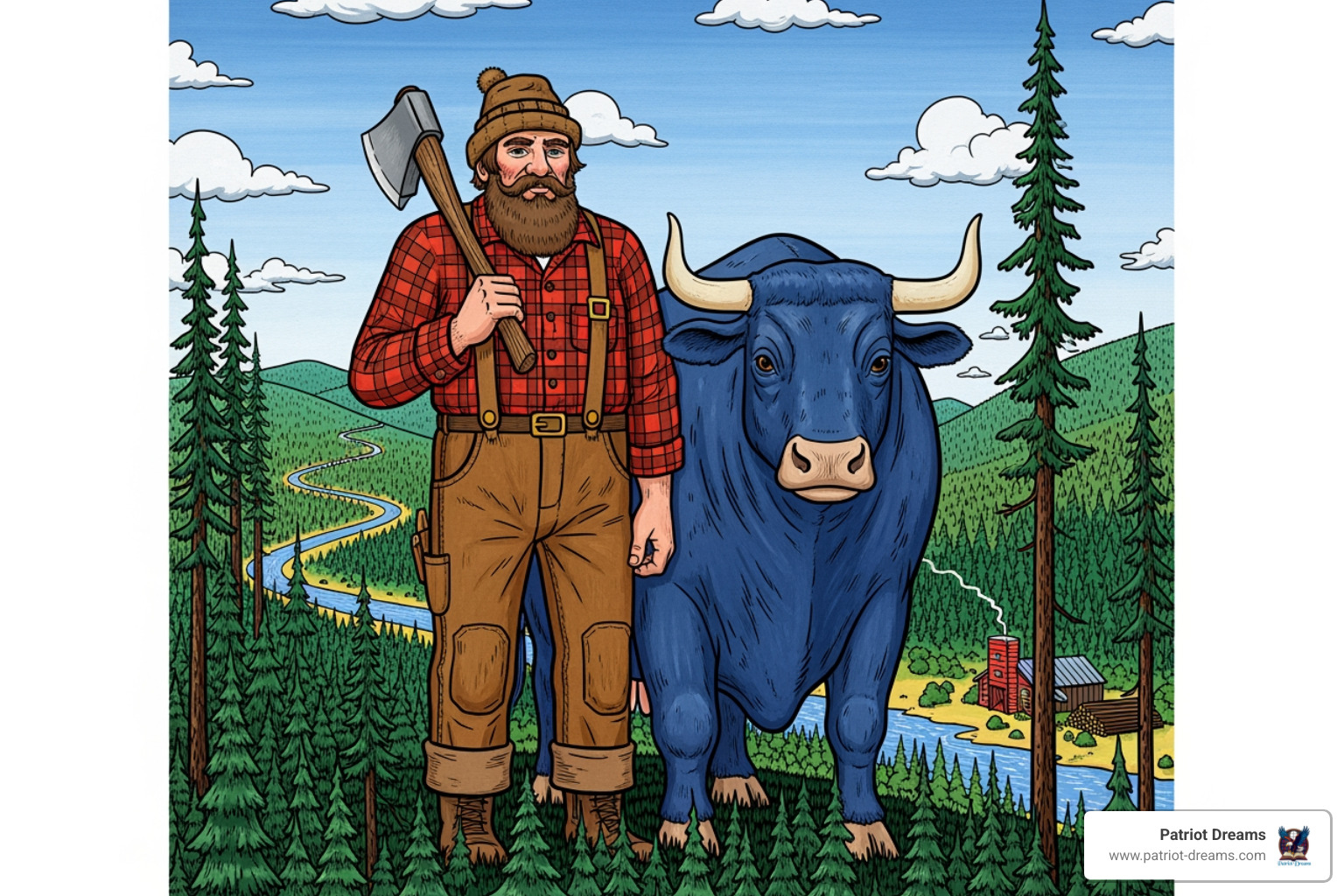
No story of Paul Bunyan is complete without his faithful companion, Babe the Blue Ox. Babe isn't just an animal; she's an extension of Paul's spirit, a loyal friend whose feats are as legendary as his own. Their bond is one of the most heartwarming aspects of the entire mythos.
According to the tales, Babe entered Paul's life during the infamous "Winter of the Blue Snow." This was a winter so cold that everything turned blue, and it was in this magical, frosty landscape that Paul finded a tiny blue ox calf. Babe was no ordinary ox, even from the start. She grew to an enormous size, her strength matching Paul's own incredible power. Laughead, in his efforts to popularize the stories, lovingly named her "Babe," a name he felt was "about as cute of a name as you could get for a great big ox."
Babe became Paul's constant companion, his partner in every grand endeavor. She was instrumental in many of his legendary feats, from helping clear vast forests to creating geographical formations across the American landscape. Her strength, loyalty, and gentle nature solidified her place not just as Paul's sidekick, but as a beloved character in her own right. Their unbreakable bond teaches us about the power of friendship and how, with a trusted companion by our side, even the biggest challenges can be overcome. It's a beautiful story of companionship that resonates deeply with the values we cherish.
From Folk Hero to Film Icon: The Story of Paul Bunyan & His Place in American Myth-Making
The journey of Paul Bunyan from a folk hero of the lumber camps to a beloved film icon is a testament to the enduring power of his story. As his tales became more widely known through Laughead's pamphlets and subsequent books, Paul Bunyan's image and narrative began to evolve, adapting to new audiences and new media. This evolution was particularly significant in adaptations for children and popular culture, changing him into a family-friendly hero for generations.
One of the most notable steps in this journey to film icon status came in 1958 with the release of the Disney animated short, aptly titled 'Paul Bunyan.' This charming cartoon introduced Paul and Babe to a vast new audience of children and families, bringing his larger-than-life adventures to vivid, colorful life on screen. The film, nominated for an Academy Award, cemented Paul Bunyan's place in the hearts of many young Americans.
Beyond film, Paul Bunyan has been interpreted and adapted in a myriad of ways. He has graced the pages of countless children's books, where his incredible feats are simplified and celebrated, inspiring wonder and imagination. His story has also been adapted into literature for adults, with notable poets like Robert Frost, Carl Sandburg, and Richard Wilbur exploring his themes of man's relationship with nature and the American spirit. Even an operetta by W.H. Auden and Benjamin Britten has been inspired by his adventures.
These adaptations, from animated shorts to literary works, have allowed Paul Bunyan to transcend his origins and become a truly versatile character. They show us how stories can grow and change, finding new ways to connect with people across different ages and interests. This process of adapting and reinterpreting historical and mythical figures is a fascinating aspect of When Film Becomes History: How Movies Shape Our View of America.
Paul Bunyan's Enduring Place in American Culture
The enduring popularity of Paul Bunyan reveals something profound about American identity, myth-making, and nostalgia. He is often considered the only truly all-American myth, a hero whose exploits are deeply rooted in the American landscape and experience. Paul Bunyan symbolizes bigness, strength, and vitality – qualities often associated with the American spirit. He embodies ingenuity and a can-do attitude, reflecting a time when hard work and perseverance were seen as the keys to changing the frontier.
Paul's tales resonate with a sense of frontier tall tales, where challenges were met with extraordinary solutions and the impossible became merely an opportunity for a grander feat. He represents the American pride in taming the wilderness and making way for progress. Even as our understanding of "progress" evolves, the core appeal of Paul Bunyan — his indefatigable energy, his cheerfulness in the face of adversity, and his ability to accomplish the seemingly impossible — continues to inspire us. He reminds us of a simpler time, evoking a warm nostalgia for the foundational stories of our nation. His legacy is deeply intertwined with The Frontier Myth Today: What the Old West Tells Us About Modern America.
From Folk Hero to Film Icon: The Story of Paul Bunyan & His Place in American Myth-Making
The journey of Paul Bunyan to becoming a From Folk Hero to Film Icon: The Story of Paul Bunyan & His Place in American Myth-Making is a rich mix woven through various media. Beyond the Disney animated short, his presence in popular culture continues to evolve. He has been depicted in live-action films, such as Disney's 1995 movie 'Tall Tale,' where Paul, though average height, possessed a larger-than-life personality. His influence extends to literature, with his character even appearing in Stephen King's horror novels, showcasing the myth's versatility.
Paul Bunyan's lasting influence is also seen in more subtle ways. For instance, a 2024 advertisement for Apple Pay featured "Babe the blue ox" as a commemorative plate, subtly nodding to the iconic duo and their ingrained place in American cultural memory. The fact that he has inspired poets, operettas, and even modern advertising campaigns speaks to his profound and adaptable nature. He is a character who represents the best of our aspirations, a symbol of the creative spirit and the enduring power of American storytelling to find new forms and new audiences.
A Giant's Footprint Across America
Paul Bunyan's adventures didn't just entertain; they also offered playful explanations for some of America's most striking natural formations. These tales weave a whimsical geography, where the immense scale of Paul and Babe’s work literally shaped the land. It’s a wonderful way to connect our imagination with the world around us.
For instance, legend tells us that the mighty Grand Canyon was formed simply by Paul dragging his enormous axe behind him as he walked. And those famous 10,000 lakes of Minnesota? They're said to be the water-filled footprints left by Babe the Blue Ox as she ambled across the landscape. Other stories credit Paul and Babe with creating Puget Sound and even the Black Hills. These tales are a beautiful example of how folklore can provide a sense of wonder and explanation for the natural world.
It's no wonder that different regions and communities across the United States proudly claim Paul Bunyan as their own. These claims are often rooted in the historical logging industries of these areas and are a source of great local pride. Minnesota, for example, truly accepts its connection to the legendary lumberjack, boasting over 124 Paul Bunyan-related locations! California has 34 sites, Michigan 27, and Wisconsin 20. These numbers reflect how deeply Paul Bunyan is woven into the fabric of these states, becoming a beloved part of their identity. The Wisconsin Historical Society - Paul Bunyan offers a fascinating look into this regional connection.
From Folk Hero to Film Icon: The Story of Paul Bunyan & His Place in American Myth-Making
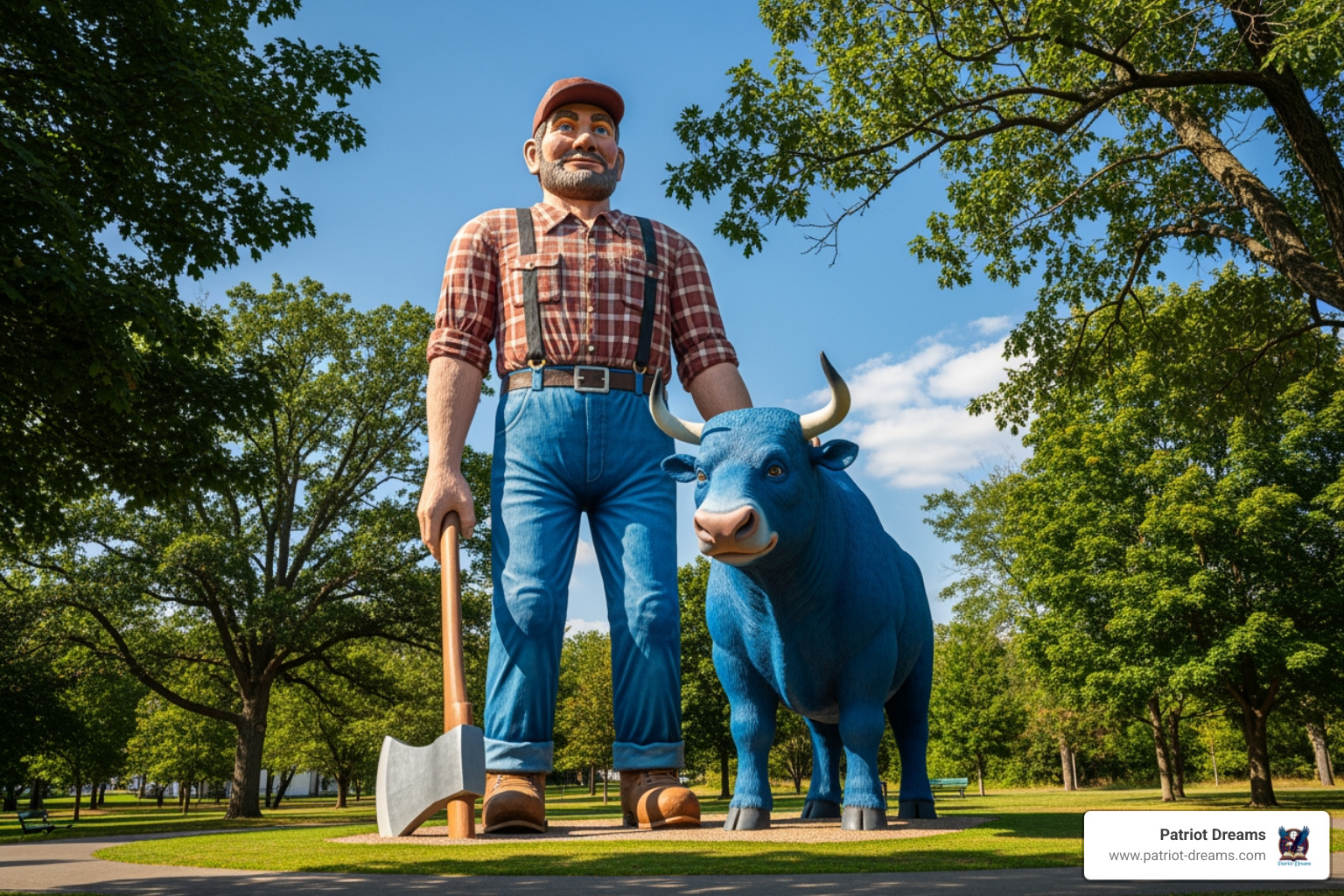
The tangible legacy of Paul Bunyan can be seen in the numerous statues and attractions dedicated to him and Babe across the country. These roadside giants are not just tourist attractions; they are monuments to a shared cultural heritage, celebrating the spirit of hard work and the joy of storytelling.
Here are some of the famous Paul Bunyan statues and their hometowns:
- Bemidji, Minnesota: Home to one of the most iconic Paul and Babe statue pairs, standing proudly since 1937.
- Brainerd, Minnesota: Another key location, with a Paul Bunyan Amusement Center that opened in 1950.
- Akeley, Minnesota: Features a large statue of Paul Bunyan kneeling, where visitors can sit in his hand. Akeley has hosted Paul Bunyan Days annually since 1949.
- Bangor, Maine: Claims to be Paul’s birthplace and features a towering 31-foot statue.
- Klamath, California: Another impressive statue marking the entrance to a local attraction.
- Hayward, Wisconsin: Home to a large Paul Bunyan statue and a logging museum.
- Manistique, Michigan: Features a statue that welcomes visitors to the region.
These statues and their accompanying festivals, like Akeley's Paul Bunyan Days, foster a wonderful sense of community and regional pride. We even have a National Paul Bunyan Day on June 28th, a special time to celebrate this incredible American hero. They remind us that our local stories, when shared with love and enthusiasm, can become a part of the greater American narrative.
Frequently Asked Questions about Paul Bunyan
We often hear wonderful questions about Paul Bunyan, showing just how much his story touches people's hearts. Here are some of the most common ones we receive:
Was Paul Bunyan a real person?
It’s a lovely thought, isn’t it, to imagine a giant lumberjack truly walking our lands! While there’s no definitive proof of a single, real Paul Bunyan, his legend is beautifully inspired by the spirit of real lumberjacks. We believe his story is a blend of tales about strong, hardworking individuals like Fabian Fournier, a French-Canadian logger known for his brawn. So, while he wasn’t a single historical figure, Paul Bunyan represents the collective strength, humor, and resilience of many real people. He's a character embodying the strength of a nation, a wonderful testament to the human spirit.
Why is Paul Bunyan always with a blue ox?
Ah, Babe the Blue Ox! She’s Paul’s best friend and loyal partner, and their companionship is one of the most heartwarming parts of the legend. Babe is said to have been found during the "Winter of the Blue Snow," a time of such intense cold that everything, including a newborn ox, turned blue! She grew to be an enormous and incredibly strong ox, perfectly matched to Paul's own size and power. Babe isn't just a helper; she's a symbol of unwavering friendship and loyalty, demonstrating that having a true companion makes any task, no matter how big, a joy. It’s a beautiful story of animal companionship that teaches us about devotion.
What are Paul Bunyan's most famous feats?
Paul Bunyan's feats are legendary, designed to inspire wonder and imagination! He was known for clearing vast forests with a single swing of his axe, making way for farms and towns. Some of his most famous accomplishments include:
- Creating the Grand Canyon: Legend says he carved this immense chasm by simply dragging his axe behind him on a particularly long walk.
- Forming Minnesota's 10,000 lakes: These beautiful bodies of water are said to be the giant footprints left by Babe the Blue Ox, filled with water.
- Logging the Dakotas: He’s credited with logging off North Dakota, leaving it treeless.
- Making Puget Sound: Another geographical marvel attributed to his powerful work.
These tales paint a picture of a hero who could do anything, shaping the very landscape with his strength and ingenuity.
Conclusion
Paul Bunyan's journey, from the crackling campfires of 19th-century logging camps to the vibrant screens of animated films and the towering statues that dot our American landscape, is truly remarkable. It's a story that has grown and adapted, always retaining its core message of strength, kindness, and community.
He stands as a cherished symbol of the American spirit, reminding us of the values that have always made our nation special: hard work, ingenuity, a playful sense of humor, and the power of enduring friendship. Paul and Babe show us that even the biggest challenges can be overcome with a good heart and a loyal companion.
At Patriot Dreams, we believe deeply in the enduring power of storytelling to connect us to our past, to each other, and to the best parts of ourselves. Paul Bunyan's story, like so many others in our nation's rich mix, reminds us that our shared narratives are treasures that inspire hope, resilience, and a quiet pride in who we are. It’s a gentle reminder that the stories we tell, and how we tell them, truly matter.
We invite you to Explore more stories of America's journey and find the countless heroes and everyday wonders that have shaped our nation.

Join the Patriot Dreams Community
Download the app today and start your journey through American history and personal legacy.

Explore Our Latest Insights
Dive into stories that shape our American legacy.