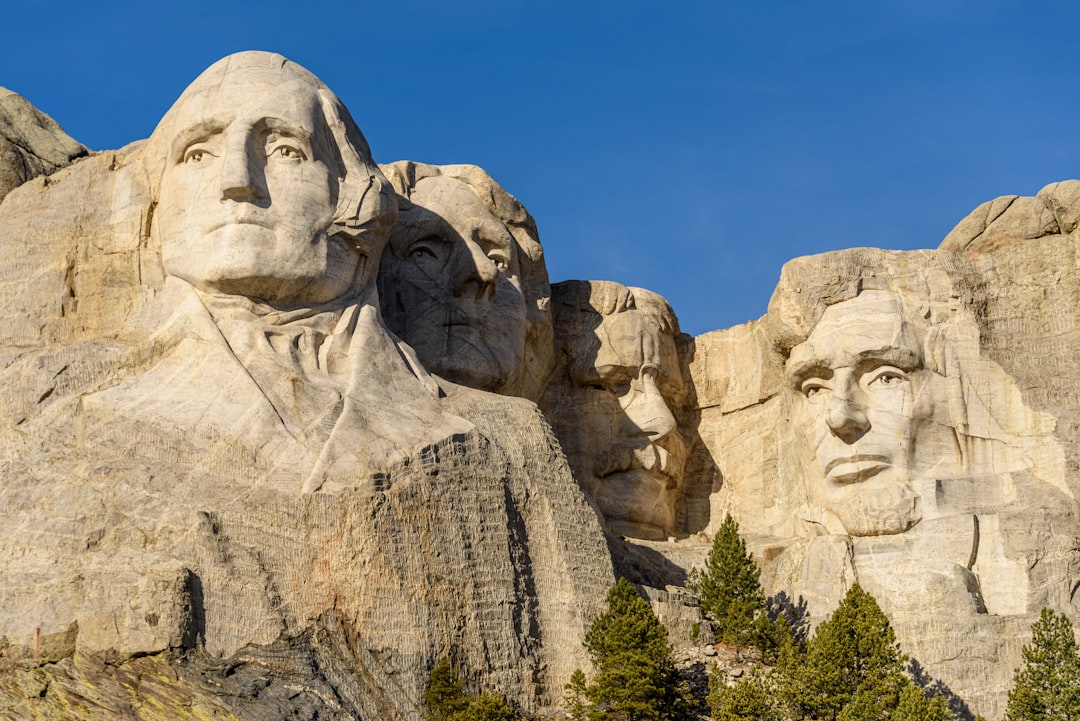
The 56 Signers of the Declaration of Independence
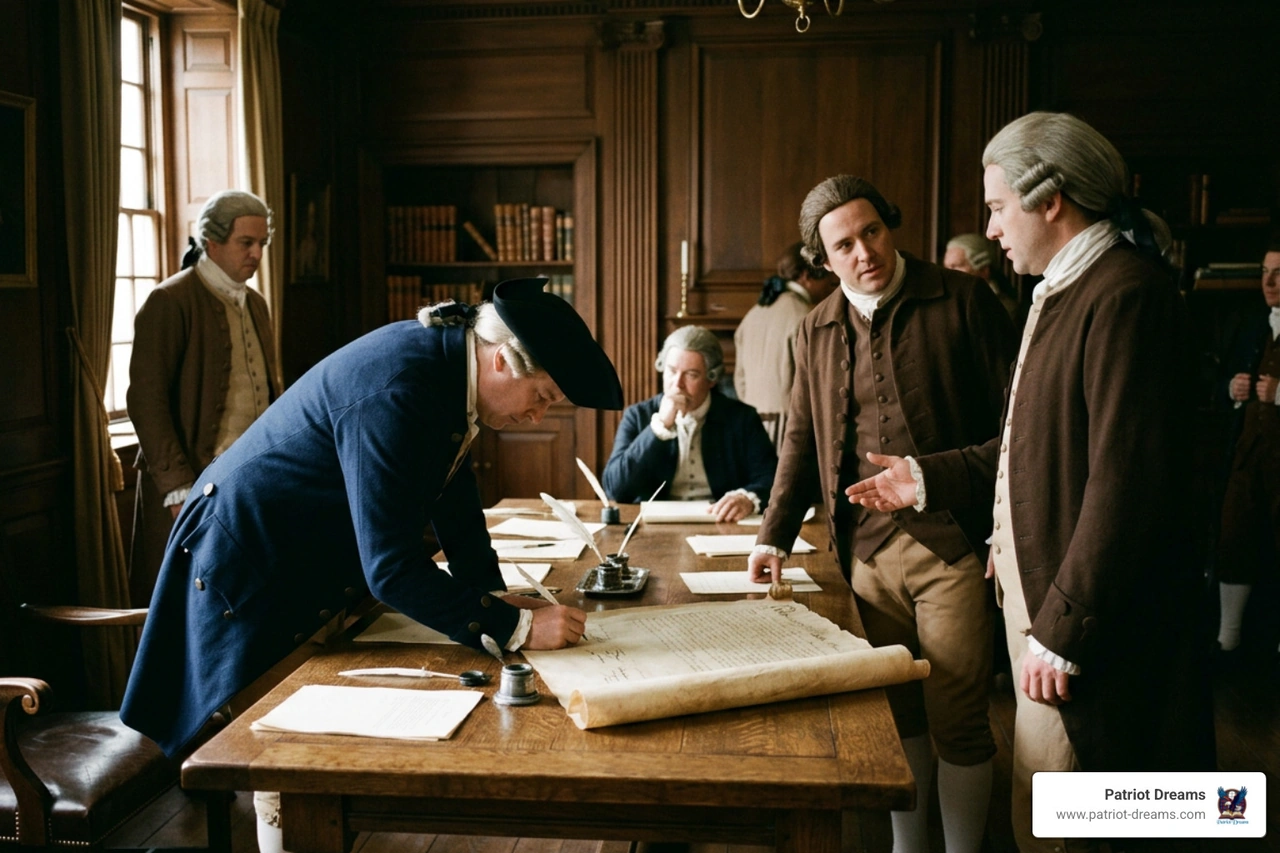

Complete List the Signers of the Declaration of Independence by State
#
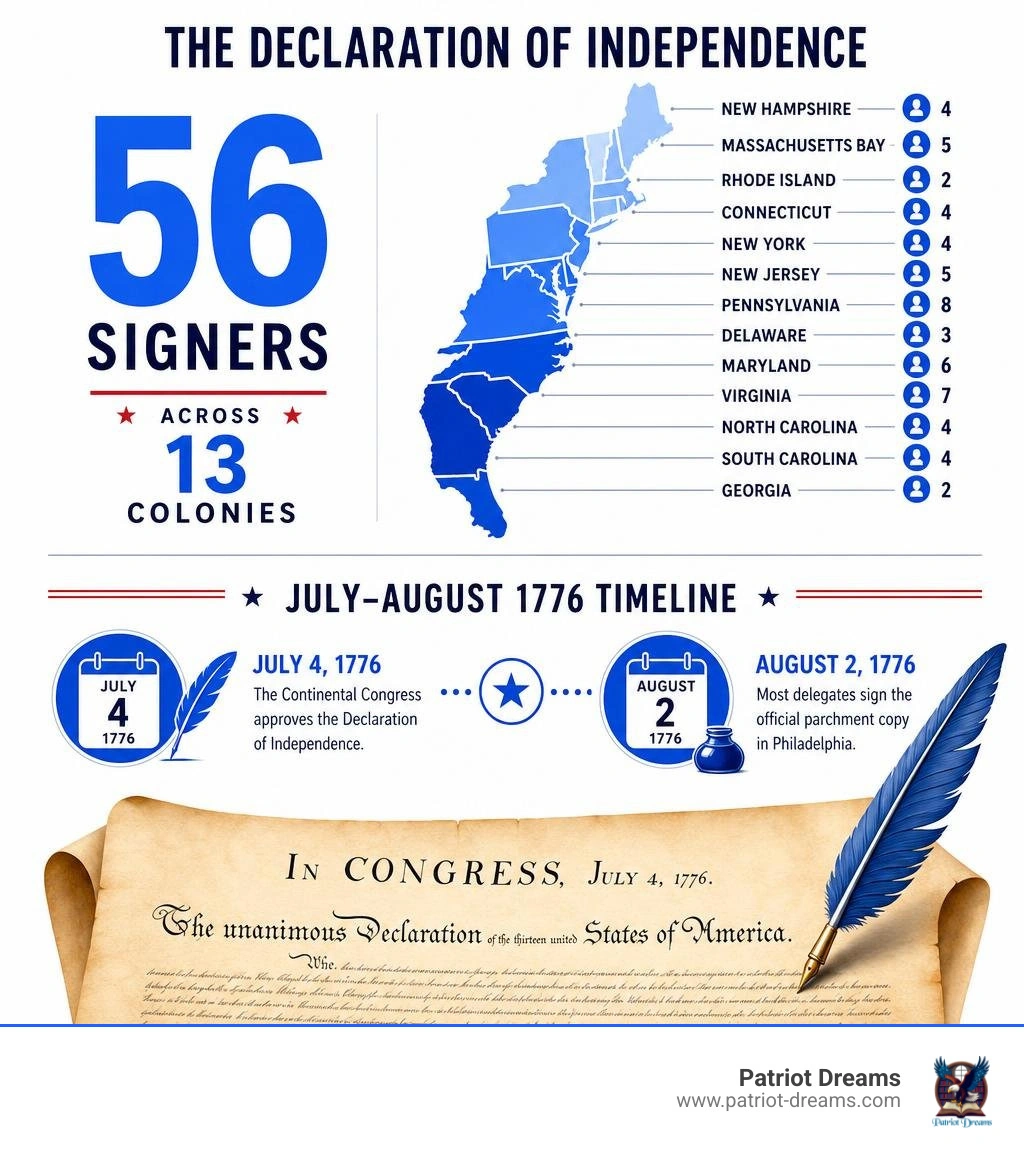
Here is the quick answer: 56 delegates signed the Declaration of Independence for the 13 colonies. Their names are usually listed by colony, from Georgia in the south to New Hampshire in the north, with John Hancock's signature at the top.
This guide will list the signers of the Declaration of Independence by state and help you see the people behind the famous names. They included lawyers, merchants, physicians, farmers, ministers, and plantation owners. Benjamin Franklin was the oldest signer at 70, while Edward Rutledge was the youngest at 26.
July 4, 1776, marks the day Congress approved the Declaration's text. Most delegates signed the formal parchment copy later, on August 2, in Philadelphia. That shared act of resolve became one of the best-known moments in American history.
Patriot Dreams invites you to meet the 56 men whose names became part of America's founding story.
List the signers of the declaration of independence definitions:
When delegates gathered inside the Pennsylvania State House in Philadelphia during the summer of 1776, they represented thirteen distinct colonies, each with its own local culture, economy, and traditions. Bringing these varied delegations together under one unified resolution required extraordinary cooperation.
Official records maintained in the Second Continental Congress journals show that fifty-six men affixed their names to the official parchment. To understand who they were, it helps to see how their signatures were arranged on the document itself.
Why We List the Signers of the Declaration of Independence from South to North
If you look closely at the original parchment document, you will notice an orderly geographic structure. Congress followed a traditional legislative custom of calling the roll from south to north.
As President of the Continental Congress, John Hancock signed prominently in the center. Directly beneath and to the left, the state delegations lined up geographically, beginning with Georgia in the southernmost column and moving northward through the Carolinas, Virginia, the Middle Colonies, and ending with New England.
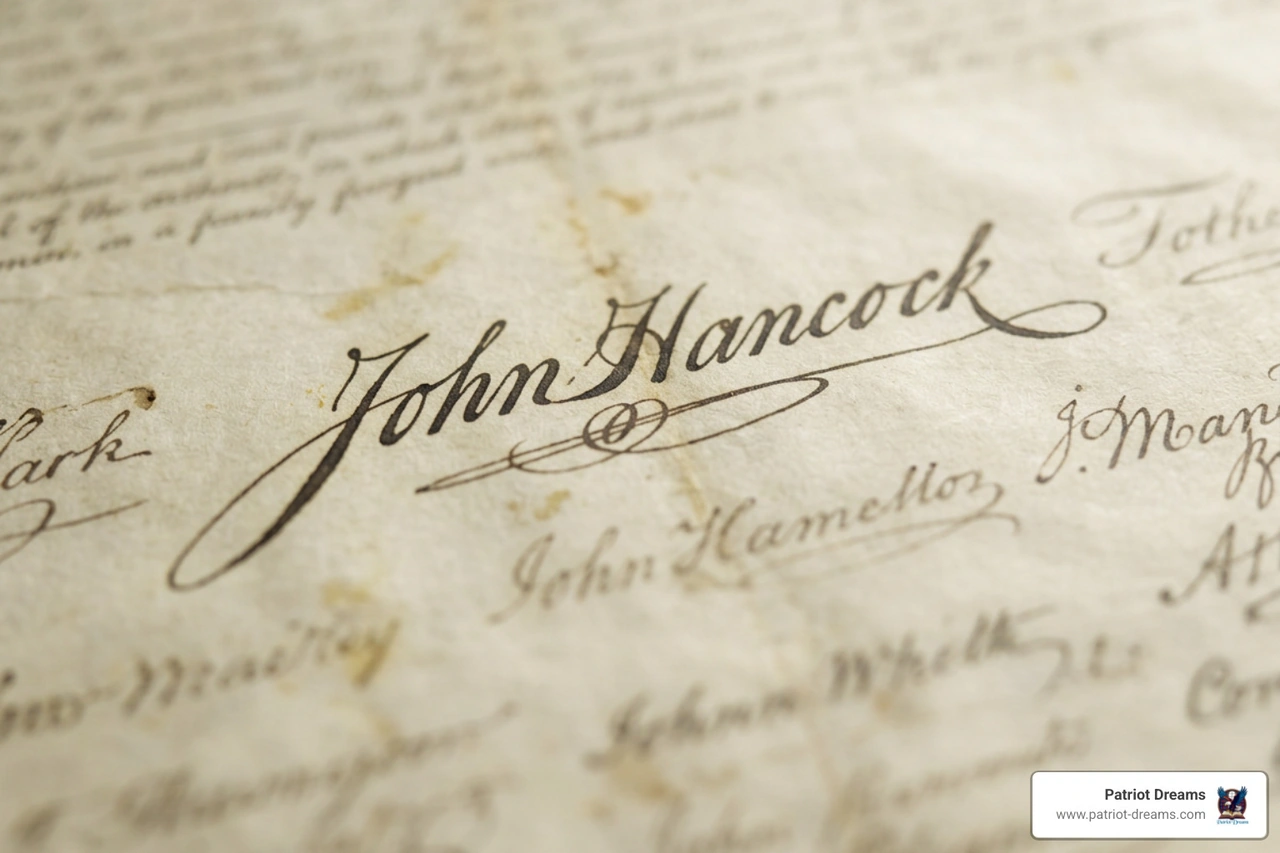
Button Gwinnett of Georgia led the southern signers, while Matthew Thornton of New Hampshire added his name on the far right. John Hancock’s bold signature measures nearly five inches long, written with flourish using the historic Syng inkstand. Archival records from the US House of Representatives: History, Art & Archives preserve this traditional roll-call order for researchers today.
All 56 Delegates Organized Across the 13 Colonies
Here is the complete roster of all fifty-six Declaration Signers, grouped by their colonial delegation alongside their ages in 1776, primary occupations, and lifespans:
ColonySigner NameAge in 1776Occupation / ProfessionLifespanGeorgiaButton Gwinnett41Merchant / Planter1735–1777Lyman Hall52Physician1724–1790George Walton35Lawyer1741–1804South CarolinaEdward Rutledge26Lawyer1749–1800Thomas Heyward, Jr.30Lawyer / Judge1746–1809Thomas Lynch, Jr.26Planter / Lawyer1749–1779Arthur Middleton34Planter1742–1787North CarolinaWilliam Hooper34Lawyer1742–1790Joseph Hewes46Merchant1730–1779John Penn36Lawyer1740–1788VirginiaGeorge Wythe50Lawyer / Jurist1726–1806Richard Henry Lee44Planter / Statesman1732–1794Thomas Jefferson33Lawyer / Planter1743–1826Benjamin Harrison50Planter / Politician1726–1791Thomas Nelson, Jr.37Merchant / Planter1738–1789Francis Lightfoot Lee41Planter / Farmer1734–1797Carter Braxton39Merchant / Planter1736–1797MarylandSamuel Chase35Lawyer / Jurist1741–1811William Paca35Lawyer / Jurist1740–1799Thomas Stone33Lawyer1743–1787Charles Carroll of Carrollton38Planter / Merchant1737–1832DelawareCaesar Rodney47Lawyer / Politician1728–1784George Read42Lawyer / Jurist1733–1798Thomas McKean42Lawyer / Jurist1734–1817PennsylvaniaRobert Morris42Merchant / Financier1734–1806Benjamin Rush30Physician1746–1813Benjamin Franklin70Printer / Scientist / Diplomat1706–1790John Morton51Surveyor / Jurist1725–1777George Clymer37Merchant1739–1813James Smith56Lawyer1719–1806George Taylor60Ironmaster1716–1781James Wilson33Lawyer / Jurist1742–1798George Ross46Lawyer / Jurist1730–1779New JerseyRichard Stockton45Lawyer / Jurist1730–1781John Witherspoon53Minister / College President1723–1794Francis Hopkinson38Author / Musician / Lawyer1737–1791John Hart65Farmer / Politician1711–1779Abraham Clark50Surveyor / Lawyer1726–1794New YorkWilliam Floyd41Farmer / Soldier1734–1821Philip Livingston60Merchant1716–1778Francis Lewis63Merchant1713–1802Lewis Morris50Landowner / Jurist1726–1798Rhode IslandStephen Hopkins69Merchant / Jurist1707–1785William Ellery48Lawyer / Merchant1727–1820ConnecticutRoger Sherman55Lawyer / Merchant1721–1793Samuel Huntington45Lawyer / Jurist1731–1796William Williams45Merchant / Politician1731–1811Oliver Wolcott49Lawyer / Jurist1726–1797MassachusettsJohn Hancock39Merchant / Statesman1737–1793Samuel Adams53Merchant / Politician1722–1803John Adams40Lawyer / Statesman1735–1826Robert Treat Paine45Lawyer / Jurist1731–1814Elbridge Gerry31Merchant1744–1814New HampshireJosiah Bartlett46Physician / Jurist1729–1795William Whipple46Merchant / Jurist1730–1785Matthew Thornton62Physician1714–1803
Demographics, Ages, and Backgrounds of the Founders
The signers were not career politicians in the modern sense. They came from everyday colonial professions and diverse walks of life. Among the fifty-six delegates, twenty-three were practicing lawyers, twelve were merchants, twelve were plantation owners or farmers, four were physicians, and others served as printers, surveyors, ironmasters, and ministers.
The age differences inside the assembly were striking. Benjamin Franklin was the senior statesman of the Continental Congress at 70 years of age. At the other end of the room sat young South Carolina delegates Edward Rutledge and Thomas Lynch, Jr., both just 26 years old. The average age across all delegates was approximately 44.5 years.
Biographical records maintained by the National Archives and historical directories of our Founding Fathers showcase the deep personal ties and shared commitment these men carried into the assembly hall.
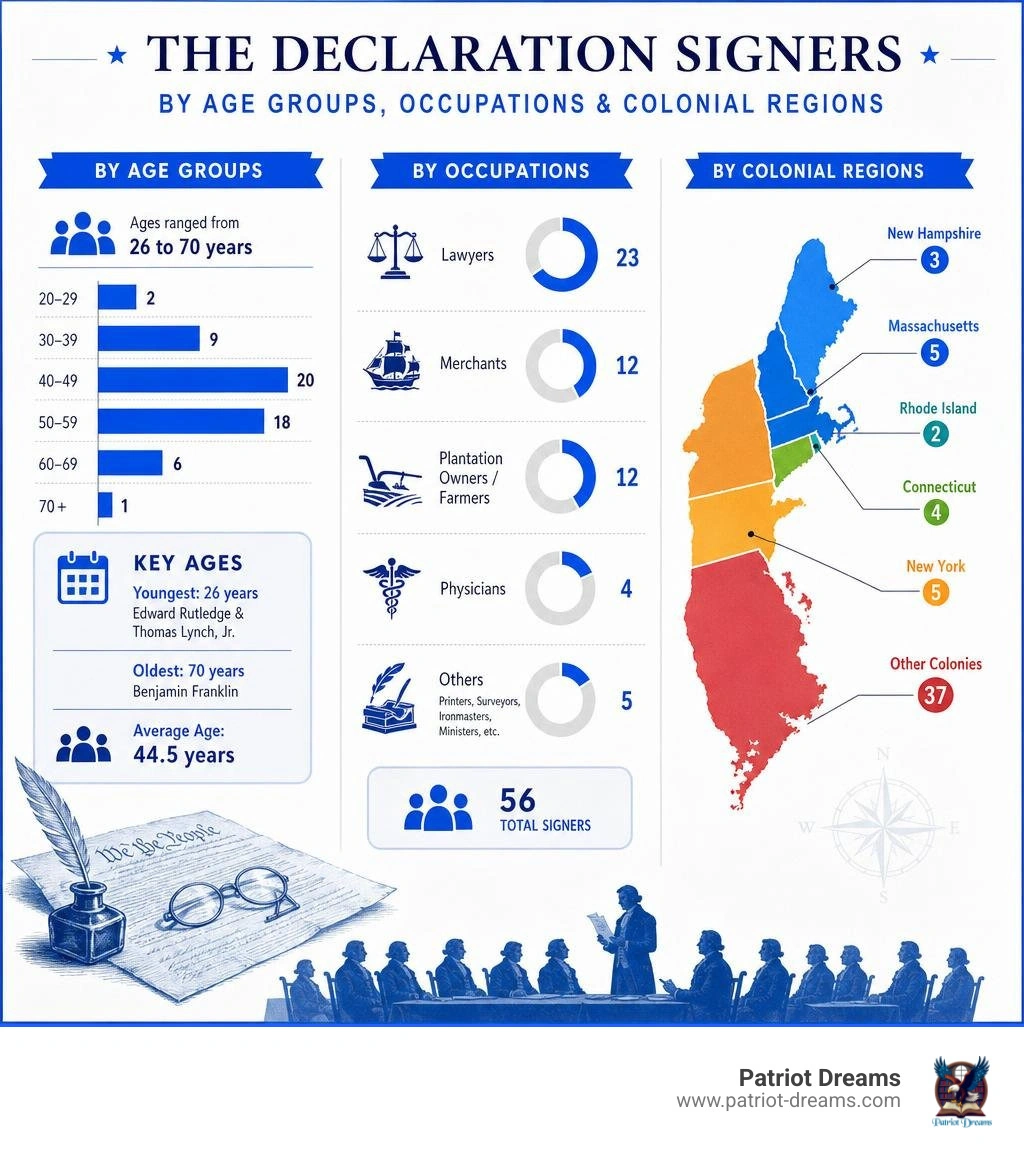
Key Insights When You List the Signers of the Declaration of Independence
Looking across the roster reveals several fascinating details about the delegates:
- Immigrant Roots: Eight of the 56 signers were born across the Atlantic. Button Gwinnett and Robert Morris were born in England; Francis Lewis was born in Wales; James Wilson and John Witherspoon hailed from Scotland; and James Smith, George Taylor, and Matthew Thornton were born in Ireland or Northern Ireland.
- Large Families: Many signers raised remarkably large families. Carter Braxton of Virginia fathered 18 children across two marriages, William Ellery had 16, and Roger Sherman had 15.
- Religious Diversity: Charles Carroll of Carrollton was the only Catholic signer on the document, joining an assembly largely composed of various Protestant denominations.
- Dual Framers: Only six men achieved the distinction of signing both the Declaration of Independence in 1776 and the United States Constitution in 1787: Benjamin Franklin, George Clymer, James Wilson, George Read, Roger Sherman, and Robert Morris.
To discover more about the total delegation makeup, read our companion breakdown on how many delegates signed the Declaration of Independence.
The Real Signing Timeline: Debunking the July 4 Myth
One of the most widespread myths in American folklore is that all 56 delegates gathered on July 4, 1776, to sign the parchment in a single ceremony. The actual sequence of events was a deliberate, multi-week legislative journey.
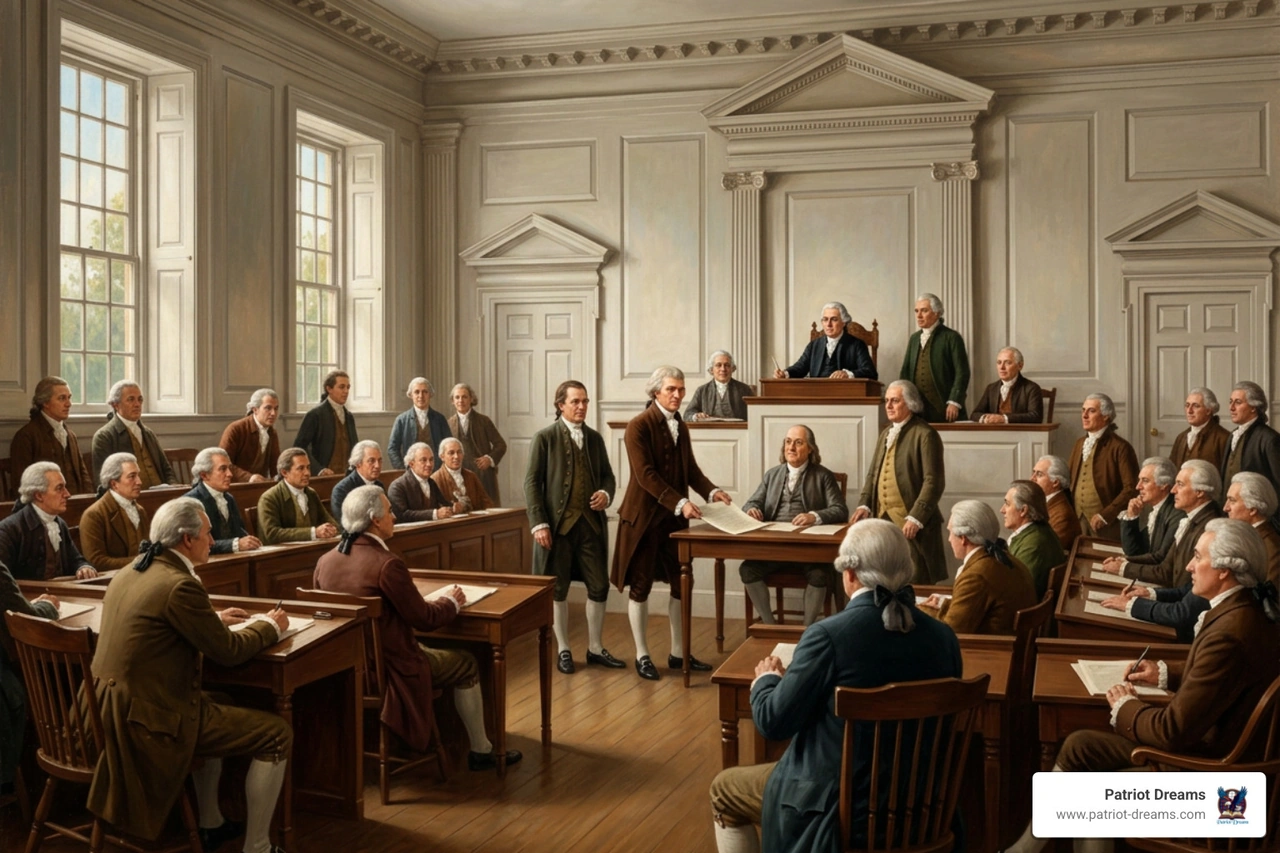
John Trumbull’s famous painting inside the U.S. Capitol Rotunda (and on the back of the two-dollar bill) actually depicts the five-man drafting committee presenting their initial draft to Congress on June 28, 1776, not the signing ceremony.
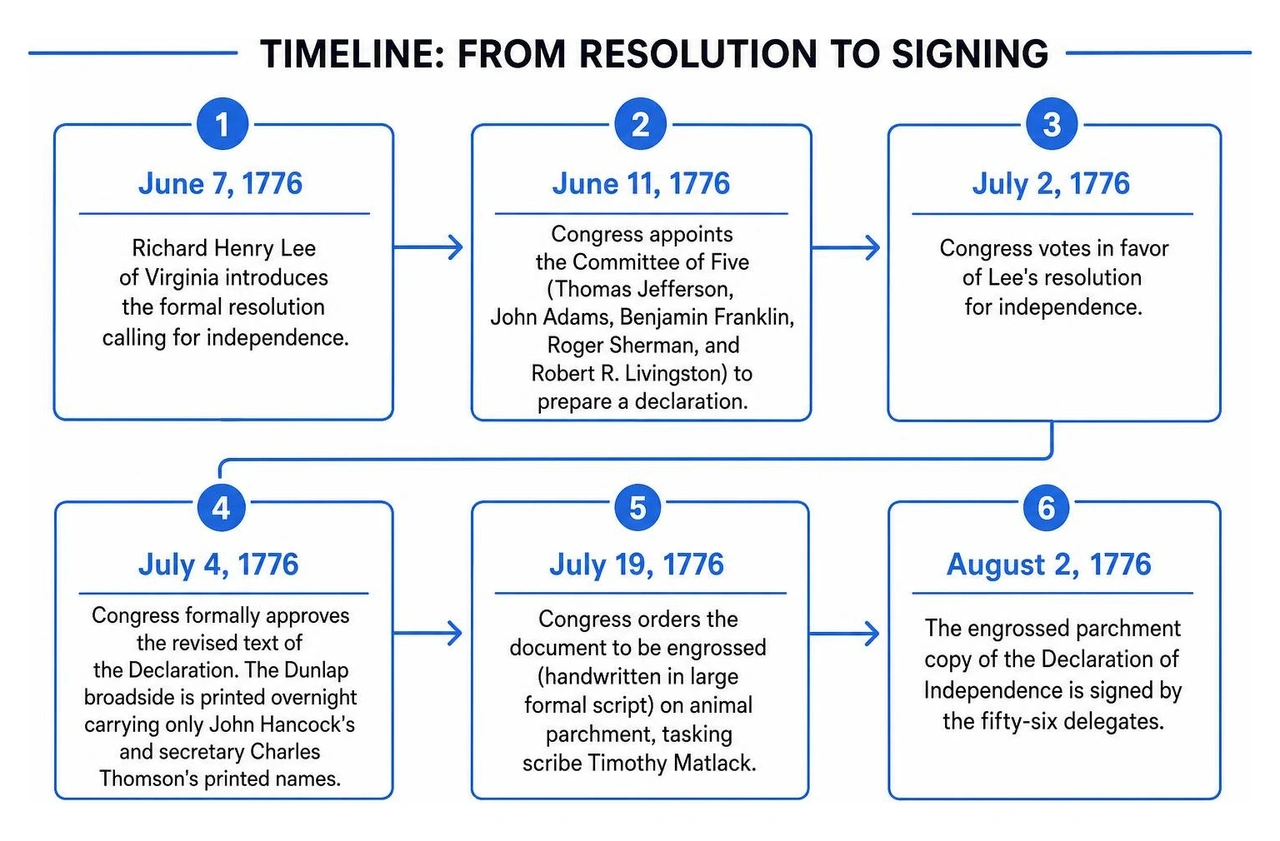
- June 7, 1776: Richard Henry Lee of Virginia introduces the formal resolution calling for independence.
- June 11, 1776: Congress appoints the Committee of Five (Thomas Jefferson, John Adams, Benjamin Franklin, Roger Sherman, and Robert R. Livingston) to prepare a declaration.
- July 2, 1776: Congress votes in favor of Lee's resolution for independence.
- July 4, 1776: Congress formally approves the revised text of the Declaration. The Dunlap broadside is printed overnight carrying only John Hancock's and secretary Charles Thomson's printed names.
- July 19, 1776: Congress orders the document to be engrossed (handwritten in large formal script) on animal parchment, tasking scribe Timothy Matlack.
- August 2, 1776: The formal parchment signing begins in Philadelphia, with roughly 49 delegates affixing their signatures.
- January 1777: The Goddard Broadside, printed by Mary Katharine Goddard in Baltimore, becomes the first public printing to reveal the names of the signers to the public.
To explore the enduring words of the document itself, see The Declaration of Independence: What It Really Says and Why It Still Matters.
Delegates Who Signed Late or Refused to Sign
Not every delegate present during the July debates signed the final parchment, and several men who signed were not even in Congress on July 4:
- Robert R. Livingston: A member of the drafting committee who supported independence, Livingston believed the July declaration was premature and departed before the August parchment signing.
- John Dickinson: An eloquent Pennsylvania delegate who argued passionately for continued reconciliation with Britain, Dickinson honorably stepped aside during the vote and refused to sign, though he later took up arms in the militia to defend his home state.
- Late Signers: Eight delegates signed the Declaration who were not seated in Congress until after July 4. Matthew Thornton took his seat in November 1776 and, finding no blank space next to New Hampshire, signed at the bottom of the right-hand column. Delaware's Thomas McKean likely signed last, possibly as late as 1777 or 1781.
To learn how the drafting committee came together, explore our story on Thomas Jefferson and the Declaration of Independence: How a Nation Found Its Voice.
Wartime Sacrifices, Political Legacies, and Lifespans
When the delegates signed the Declaration, they pledged "our Lives, our Fortunes and our sacred Honor." Under British law, this act constituted high treason against the Crown. As Pennsylvania physician Benjamin Rush later recalled, the signing room was filled with a "pensive and awful silence" as delegates stepped forward to sign what many understood could be their death warrant.
While no signer was executed, many endured tremendous hardships:
- Imprisonment & Capture: Several signers were captured by British forces during the war, including Richard Stockton of New Jersey, and South Carolina delegates Edward Rutledge, Thomas Heyward, Jr., and Arthur Middleton following the Siege of Charleston in 1780.
- Destruction of Homes: The estates of William Floyd, Francis Lewis, and John Hart were looted, damaged, or occupied by British troops.
- Financial Ruin: Wealthy merchants like Carter Braxton and Robert Morris poured fortunes into financing the Continental Navy and supplying American troops, facing steep financial losses later in life.
Many signers went on to shape the young American republic. John Adams and Thomas Jefferson both served as Vice President and President of the United States. In one of history's most poetic milestones, both Adams and Jefferson passed away on the exact same day: July 4, 1826—the fiftieth anniversary of the Declaration of Independence.
The dual legacy of these statesmen is explored further in the directory of constitutional signers maintained by the National Constitution Center.
Frequently Asked Questions About the 56 Signers
Who was the oldest and youngest signer of the Declaration of Independence?
Benjamin Franklin of Pennsylvania was the oldest signer at 70 years old. The youngest signers were Edward Rutledge and Thomas Lynch, Jr., both representing South Carolina, who were 26 years old in the summer of 1776.
Did all delegates sign on July 4, 1776?
No. Congress adopted the text on July 4, but the physical signing of the formal engrossed parchment began on August 2, 1776. Several delegates who were away on military or legislative duties signed in the autumn months of 1776 and early 1777.
Who was the last surviving signer of the Declaration?
Charles Carroll of Carrollton was the last surviving signer. Representing Maryland, Carroll passed away on November 14, 1832, at the age of 95, outliving all other 55 signatories and witnessing the early growth of the nation he helped create.
Conclusion
The fifty-six signers of the Declaration of Independence were neighbors, farmers, doctors, and civic leaders who stepped forward together during an uncertain chapter in our nation's story. Their willingness to unite across regional differences helped forge the foundations of American liberty.
At Patriot Dreams, our interactive digital history audio platform brings these timeless stories directly to your family. By blending engaging digital storytelling with an interactive map, we help you discover the everyday heritage and enduring moments that built America.
Continue exploring their inspiring lives with our guide to the Declaration Independence Signers.

Join the Patriot Dreams Community
Download the app today and start your journey through American history and personal legacy.

Explore Our Latest Insights
Dive into stories that shape our American legacy.