
Beginner's Guide to the Founding Fathers

Why the Founding Fathers Matter to All Americans
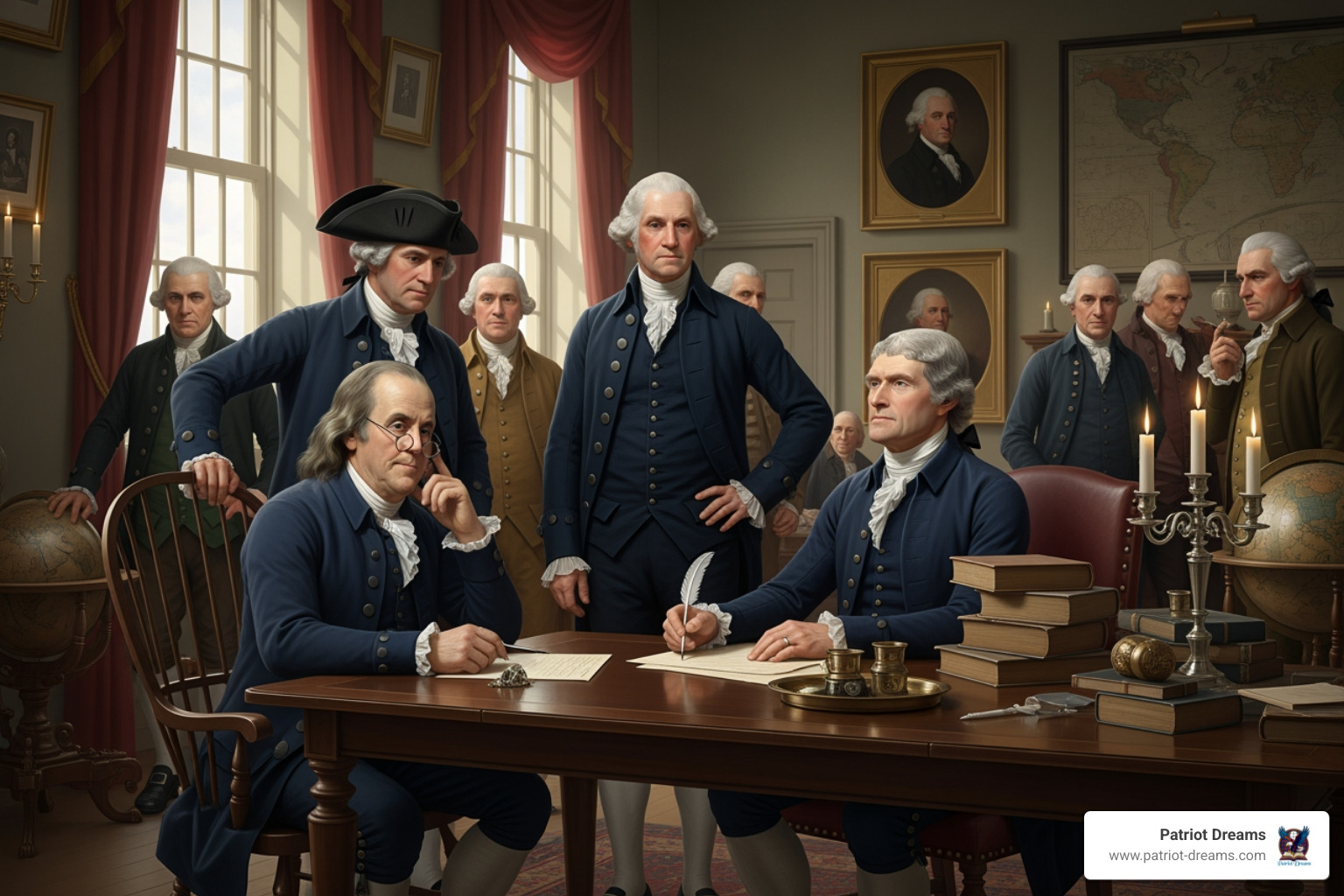
The Founding Fathers were the remarkable group of leaders who united 13 separate colonies, fought for independence from Britain, and created the United States of America. While there's no official list, the term typically includes those who signed the Declaration of Independence, helped draft the Constitution, or played key leadership roles during the Revolutionary era.
The Core Founding Fathers:
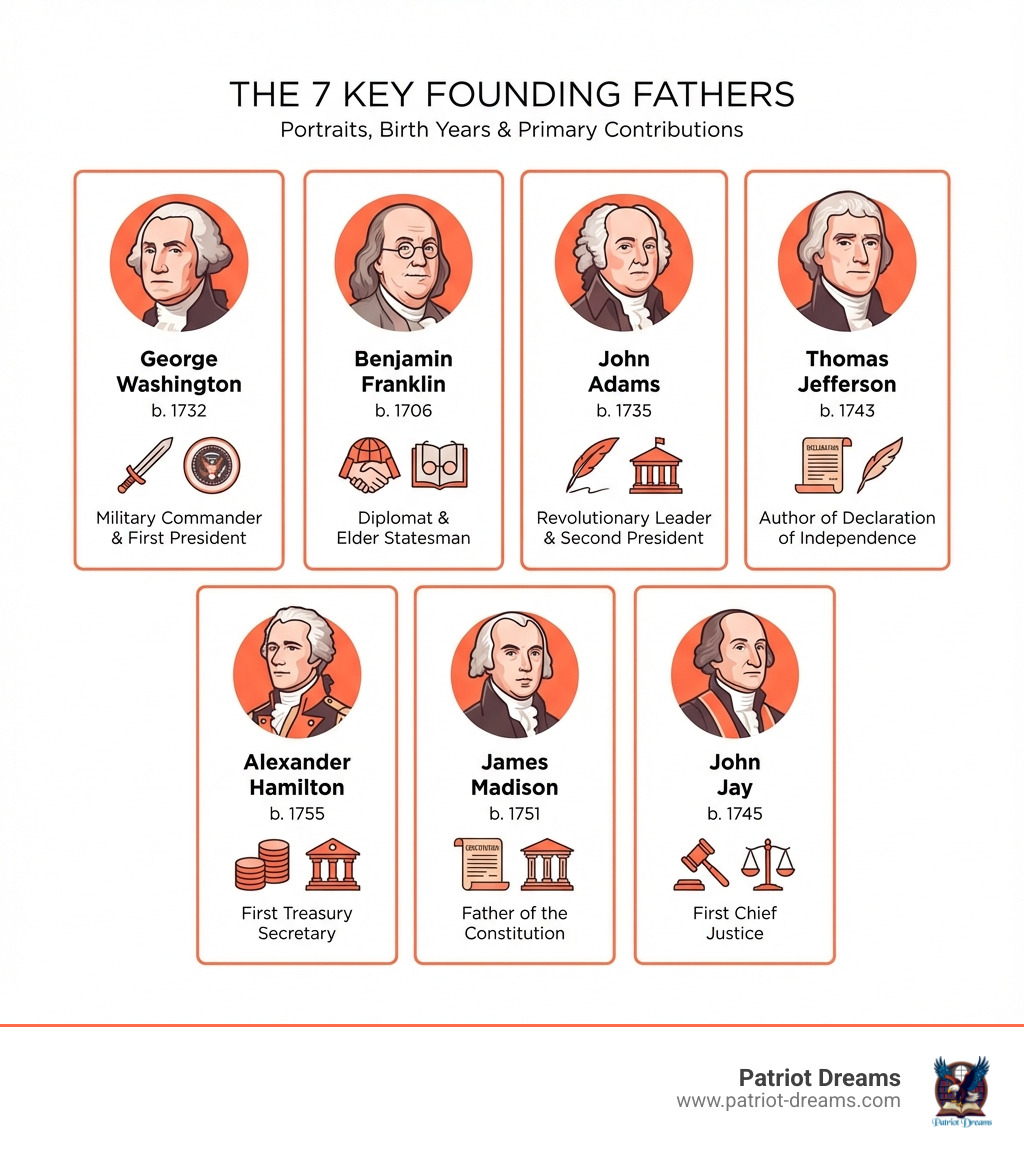
- George Washington - Commander of the Continental Army and first President
- Thomas Jefferson - Primary author of the Declaration of Independence
- John Adams - Revolutionary leader and second President
- Benjamin Franklin - Diplomat, inventor, and elder statesman
- James Madison - "Father of the Constitution" and architect of the Bill of Rights
- Alexander Hamilton - First Secretary of the Treasury and author of the Federalist Papers
- John Jay - First Chief Justice of the Supreme Court
The story of America's Founding Fathers is a deeply human one. These weren't mythical figures or perfect heroes. They were real people with different backgrounds, ages, and ideas who came together during an extraordinary time. Some were young visionaries in their thirties. Others, like Benjamin Franklin at 81, brought decades of wisdom.
What made them special wasn't perfection. It was their shared dream of creating something new—a nation where people could govern themselves, where liberty mattered, and where the future could be better than the past.
When 56 brave souls signed the Declaration of Independence, they knew they were risking everything. When 39 delegates signed the Constitution, they were crafting a framework that would last for generations. These acts of courage and vision still inspire us today.
Their legacy lives on in every American community, in every family gathering, in the values we hold dear. Understanding their story helps us understand ourselves and the nation we all share.
Know your Founding Fathers terms:
- Benjamin Franklin’s Greatest Inventions That Changed the World
- Thomas Jefferson and the Declaration of Independence: How a Nation Found Its Voice
- Revolutionary War heroes
Who Were the Founding Fathers?
When we talk about the Founding Fathers, we're not referring to a formal title or an exclusive club with a strict membership list. Instead, it's a way we honor the leaders of America's Revolutionary generation—men who played pivotal roles in securing independence from Great Britain and establishing the United States as a new nation. The term itself gained widespread popularity thanks to President Warren G. Harding in the early 20th century.
These individuals were instrumental in the American Revolution, engaging in fierce debates, drafting groundbreaking documents, and leading armies. They were the architects of our government, whose courage and vision laid the groundwork for the freedoms we cherish today. As the American Battlefield Trust reminds us, these were the men who created our government and forged our new Nation. You can learn more about them and their contributions through resources like the American Battlefield Trust - 10 Facts: The Founding Fathers.
The Core Group of Key Founding Fathers
While many contributed, a select few are often highlighted for their profound impact and leadership across multiple critical junctures. These seven individuals are frequently recognized as the principal Founding Fathers:
- George Washington: A true leader, George Washington was the Commander of the Continental Army, guiding the nascent nation through the trials of the Revolutionary War. His leadership was crucial for military victory. Later, he unanimously became the first President of the United States, setting precedents for the office and ensuring a peaceful transition of power. He was 43 years old when he took command of the American Army.
- John Adams: A passionate advocate for American independence, John Adams played a vital role in the Continental Congress. He argued forcefully for independence and served on the committee that drafted the Declaration of Independence. He was 40 years old when he argued for American independence. His diplomatic efforts in Europe were also key to securing foreign support, and he later served as the second President.
- Thomas Jefferson: The eloquent primary author of the Declaration of Independence, Thomas Jefferson articulated the ideals of liberty and self-governance that defined the new nation. He was just 33 years old when he penned those immortal words. His contributions extended to serving as the first Secretary of State and later as the third President.
- James Madison: Often called the "Father of the Constitution," James Madison was the driving force behind the creation of our governing document. He carefully prepared for the Constitutional Convention, proposing many of the ideas that shaped our system of government. He was 36 years old when he was at the Constitutional Convention and later championed the Bill of Rights.
- Alexander Hamilton: A brilliant and ambitious statesman, Alexander Hamilton was a key aide to Washington during the war and a fervent advocate for a strong federal government. He wrote the majority of the highly persuasive Federalist Papers and, as the first Secretary of the Treasury at 33 years old, established the nation's financial system.
- Benjamin Franklin: A true polymath, Benjamin Franklin was a renowned author, printer, scientist, inventor, and diplomat. He served on the committee that drafted the Declaration of Independence, secured crucial French assistance during the war, and was an elder statesman at the Constitutional Convention, bringing a wealth of experience at 70 years old to the Second Continental Congress.
- John Jay: A gifted diplomat and jurist, John Jay helped negotiate the Treaty of Paris, which formally ended the Revolutionary War. He also authored several Federalist Papers and became the first Chief Justice of the U.S. Supreme Court at 43 years old, laying the foundation for our judicial system.
These men, through their combined efforts, leadership, and vision, were central to the birth and early development of the United States.
A Wider Circle of Influence
Beyond these seven, the circle of Founding Fathers widens considerably to include dozens of other dedicated individuals who contributed to the nation's birth. These were the statesmen, patriots, and military leaders whose collective efforts made independence and nationhood possible.
Consider figures like:
- Samuel Adams: A powerful political firebrand from Massachusetts, Samuel Adams was a key organizer of resistance against British policies, a leader in the Sons of Liberty, and likely a planner of the Boston Tea Party. His activism helped ignite the spirit.
- Patrick Henry: A fiery orator from Virginia, Patrick Henry's famous cry, "Give me liberty, or give me death!" embodied the fervor of the time. He was a vocal opponent of British tyranny and a strong advocate for states' rights.
- John Marshall: Though younger than many, John Marshall served in the Continental Army and later became a towering figure in American law as the fourth Chief Justice of the Supreme Court. His decisions shaped the interpretation of the Constitution and strengthened the federal government.
- George Mason: A fellow Virginian, George Mason was a prominent anti-Federalist who advocated for strong protections of individual liberties. His Virginia Declaration of Rights heavily influenced the U.S. Bill of Rights.
The definition of Founding Fathers also includes the 56 signers of the Declaration of Independence and the 39 delegates who signed the United States Constitution. These were men from all thirteen states (except Rhode Island, which didn't send delegates to the Constitutional Convention) who dedicated themselves to the monumental task of creating a new government. Their diverse roles—from local activists and military officers to state legislators and delegates to the Continental and Constitutional Conventions—underscore the broad and inclusive nature of the founding effort.
A Mix of Talents and Ideas
Imagine gathering a group of people from different walks of life, with varied experiences and opinions, and asking them to build a new nation from scratch. That's precisely what our Founding Fathers did! They were a fascinating mosaic of talents and ideas, coming together to forge a common future.
They hailed from diverse backgrounds: some were brilliant lawyers, carefully crafting legal arguments; others were shrewd merchants, understanding commerce and trade; many were hardworking farmers, deeply connected to the land; and of course, brave soldiers who fought for freedom. We also had incredible minds like Benjamin Franklin, who was an inventor and scientist, constantly seeking to improve the world around him. This blend of unique skills and perspectives was crucial. It meant that different challenges were met with different strengths, and the resulting solutions were often stronger because they incorporated a wider range of thought. It was through the power of compromise, often after intense debate, that they managed to weave these disparate threads into the rich mix of our nation.
Diverse Ages and Perspectives
One of the most heartwarming aspects of the Founding Fathers is the incredible age diversity among them. It wasn't just a group of seasoned elders or fiery young radicals; it was a beautiful blend of both.
At the Constitutional Convention, for instance, the delegates ranged dramatically in age. Jonathan Dayton, a representative from New Jersey, was a mere 26 years old, bringing youthful energy and fresh perspectives to the table. On the other end of the spectrum was the venerable Benjamin Franklin, who at 81, brought decades of invaluable experience, wisdom, and a calm demeanor to the proceedings. It's said that he was so infirm he had to be carried to sessions in a sedan chair, yet his mind remained sharp and his influence profound.
This mix of young visionaries and experienced statesmen created a dynamic environment. The younger members often pushed for bold, innovative ideas, while the older, more cautious figures provided historical context and tempered enthusiasm with practical wisdom. Of course, this led to many differing viewpoints and passionate debates. The Federalists, who favored a stronger central government, often clashed with the Anti-Federalists, who prioritized states' rights and individual liberties. Yet, despite these often conflicting viewpoints, their shared commitment to the future of the nation allowed them to find common ground and shape the new American nation.
The Influence of Enlightenment Ideals
The intellectual bedrock upon which the United States was built was deeply influenced by the Enlightenment, a powerful philosophical movement that swept across Europe in the 17th and 18th centuries. Our Founding Fathers were avid readers and thinkers, absorbing these radical new ideas about human rights, government, and society.
Thinkers like John Locke, with his theories of natural rights—life, liberty, and property—profoundly shaped the Declaration of Independence. Thomas Jefferson's assertion that "all men are created equal" and endowed with "unalienable Rights" directly echoed Locke's philosophy. Another influential figure was Montesquieu, whose ideas on the separation of powers into legislative, executive, and judicial branches became a cornerstone of the U.S. Constitution, designed to prevent any single branch from becoming too powerful.
These Enlightenment ideals provided the philosophical blueprint for the American experiment. The Founding Fathers believed that government should be based on the consent of the governed, that power should be distributed, and that individual liberties should be protected. This wasn't just abstract theory; it was the practical philosophy that guided their decisions, leading to the creation of a government for the people, by the people.
Key Contributions and Defining Moments
The journey from a collection of colonies to a unified nation was filled with momentous decisions and pivotal events, each shaped by the vision and determination of the Founding Fathers. From the first stirrings of rebellion to the creation of a lasting government, their contributions defined an era.
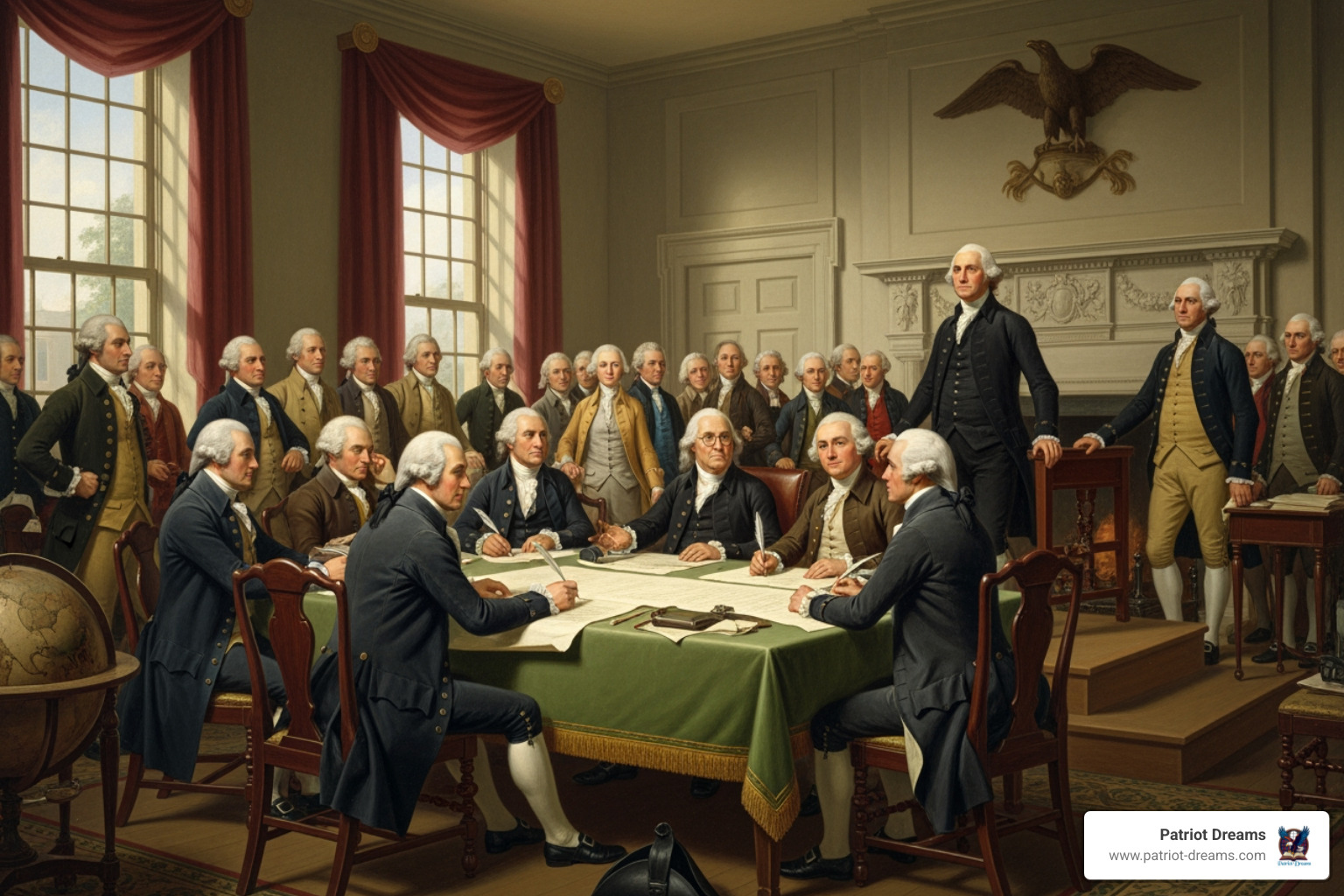
The American Revolution itself was a testament to their unwavering spirit. It began with the Continental Congresses, where delegates from the colonies first gathered to address grievances and then to declare independence. The initial attempt at a unified government, the Articles of Confederation, proved insufficient, leading to the crucial Constitutional Convention. The resulting debates were then famously explained and defended in The Federalist Papers, paving the way for the ratification of the Constitution and, eventually, the Bill of Rights. Each of these steps represents a monumental effort in nation-building.
The Declaration of Independence: A Bold Statement
Perhaps no document better encapsulates the spirit of the American Revolution than the Declaration of Independence. On July 4, 1776, a date etched forever in our national memory, this powerful statement was adopted. It was primarily penned by Thomas Jefferson, whose eloquent words declared the colonies' separation from Great Britain and articulated the fundamental rights and ideals upon which the new nation would be founded.
Fifty-six brave individuals, the signers of the Declaration, put their names to this document, knowing full well the immense personal risk involved. By declaring their independence, they were committing an act of treason against the British Crown, a decision that could have cost them their lives, fortunes, and sacred honor. Yet, they stood united in their belief in "Life, Liberty and the pursuit of Happiness." This document was not just a declaration of war; it was a declaration of ideals, a promise of a new kind of society. You can explore this foundational text and other crucial historical documents at America's Founding Documents.
The U.S. Constitution: Crafting a Government
After the hard-won victory of the Revolutionary War, the Founding Fathers faced the immense challenge of creating a stable and effective government. The Articles of Confederation had proven too weak, leading to a call for a new system. This led to the 1787 Constitutional Convention in Philadelphia, a gathering of extraordinary minds tasked with shaping the future of the nation.
Seventy individuals were appointed to attend, but 55 delegates ultimately attended the sessions, engaging in months of intense debate and compromise. Their goal was to create a framework that would balance power, protect individual liberties, and ensure the long-term stability of the United States. From this dedicated group, 39 delegates actually signed the Constitution, giving birth to a document that has stood the test of time.
James Madison, with his meticulous preparation and profound understanding of political theory, played such a central role in drafting and advocating for the Constitution that he is rightfully remembered as the "Father of the Constitution." The document he helped create established a system of government with three distinct branches—legislative, executive, and judicial—each with checks and balances on the others, ensuring no single branch could become tyrannical. This ingenious design created a framework for enduring governance, a system that has served our nation for over two centuries.
The Unsung Heroes of the Founding Era
While we rightly celebrate the prominent Founding Fathers, the birth of our nation was a collective effort, a true community project. Many individuals, often overlooked in traditional narratives, played crucial roles, contributing their strength, intelligence, and unwavering spirit to the cause of liberty.
The spirit of community and family was palpable during this era. It wasn't just about grand speeches and battles; it was about countless acts of support, sacrifice, and perseverance on the home front and in the shadows. The vision of a free America was nurtured by many hands and hearts, truly embodying the idea of a collective dream.
The Vital Role of Founding Mothers
Behind every great man, there are often equally great women, and the American Revolution was no exception. While the term "Founding Fathers" has historically dominated the narrative, we are increasingly recognizing the vital role played by "Founding Mothers"—women who influenced politics, managed households and businesses under immense pressure, and provided essential support and counsel.
One of the most articulate of these women was Abigail Adams, wife of John Adams. Her letters provide invaluable insight into the challenges of the era and her sharp political mind. She famously urged her husband to "Remember the Ladies" when drafting new laws, advocating for women's rights and a more equitable society. Her courage and foresight were remarkable.
Other notable Founding Mothers include:
- Dolley Madison: Wife of James Madison, she was a skilled political hostess and socialite who helped shape Washington D.C.'s social scene and played a crucial role in building consensus and fostering political alliances in the early republic. Her quick thinking also saved important artifacts from the White House during the War of 1812.
- Mercy Otis Warren: A prolific writer and satirist, Mercy Otis Warren used her pen to advocate for the Patriot cause, critiquing British policies and inspiring sentiment. Her political writings and historical accounts provided important perspectives on the founding era.
These women, and countless others, were not just spectators; they were active participants, ensuring the survival and success of the new nation through their intelligence, resilience, and unwavering dedication. You can learn more about influential figures like Abigail Adams through resources such as this Biography of Abigail Adams.
Other Voices in the Revolution
The fight for American independence was a broad movement that drew strength from diverse communities. Beyond the well-known figures, many others contributed significantly, often facing additional hardships and struggles.
African American patriots, both enslaved and free, played a crucial role. Figures like Crispus Attucks, who is considered the first casualty of the Boston Massacre, symbolized the early resistance against British oppression. James Armistead Lafayette, an enslaved African American, served as a spy for the Continental Army, providing invaluable intelligence to General Lafayette that contributed to the American victory at Yorktown. Their bravery and commitment to liberty, even when their own freedom was denied, were profound.
While often complex and sometimes adversarial, some Indigenous leaders and nations also played roles in the shifting alliances and conflicts of the Revolutionary War, impacting its outcome. Moreover, the broader community—farmers, artisans, laborers, and homemakers—all contributed to the cause through their daily efforts, their sacrifices, and their steadfast belief in a better future. Their collective spirit and dedication remind us that the founding of America was a testament to the power of unity and shared purpose.
The Lasting Legacy of the Founding Fathers
The Founding Fathers left us with more than just a country; they bequeathed a set of enduring ideals and a blueprint for a self-governing society. Their legacy is not a static monument but a living, breathing testament to the power of ideas and the pursuit of a "more perfect Union." It's a story that continues to unfold, inviting each generation to participate in the great American experiment.
A Blueprint for American Governance
One of the most remarkable achievements of the Founding Fathers was the creation of a stable and enduring system of government. The U.S. Constitution, born from their debates and compromises, established a framework that has been admired and emulated around the world.
Key elements of this blueprint include:
- The three branches of government: By dividing power among the legislative (Congress), executive (President), and judicial (Supreme Court) branches, they created a system of checks and balances designed to prevent tyranny and promote accountability.
- The concept of federalism: This innovative approach balanced power between the national government and individual state governments, allowing for both national unity and local self-determination.
- Protection of individual rights: The Bill of Rights, added shortly after the Constitution's ratification, enshrined fundamental civil liberties, such as freedom of speech, religion, and the press, ensuring that the government would serve the people, not dominate them.
This ingenious system has not only provided stability for our nation but has also served as an inspiration for countless democracies worldwide, demonstrating that a government "of, by, and for the people" is indeed possible.
How We Remember the Founding Fathers Today
The Founding Fathers continue to hold a special place in the American heart and imagination. Their stories are woven into the fabric of our national identity, reminding us of the courage, vision, and perseverance required to build a nation.
We see their enduring presence in:
- Monuments and memorials: From the towering Washington Monument to the iconic Jefferson Memorial, their images and words are etched into our landscape, inviting reflection and remembrance.
- National holidays: Days like Independence Day and Presidents' Day encourage us to pause and celebrate the momentous events and the leaders who shaped them.
- Their stories in books and film: Countless narratives, both historical and fictional, continue to explore their lives, struggles, and triumphs, keeping their legacy alive for new generations.
These acts of remembrance are more than just historical exercises; they are a source of national identity and pride, connecting us to the foundational values they championed: liberty, self-governance, and the pursuit of a better future for all.
Frequently Asked Questions about the Founding Fathers
Who are the 7 main Founding Fathers?
While there's no official list, the seven individuals most frequently cited as the principal Founding Fathers due to their leadership, longevity, and statesmanship are: George Washington, Thomas Jefferson, John Adams, Benjamin Franklin, James Madison, Alexander Hamilton, and John Jay. These men played central roles in both the Revolutionary War and the establishment of the U.S. government.
How did the Founding Fathers handle their disagreements?
The Founding Fathers were not a monolithic group; they held vastly different opinions and engaged in passionate debates on critical issues. They handled their disagreements primarily through extensive public and private debate, negotiation, and ultimately, compromise. A prime example is the Constitutional Convention, where delegates from different-sized states and those with differing views on issues like slavery found common ground through mechanisms like the Great Compromise. Their shared commitment to the future and stability of the new nation often allowed them to transcend their differences and work towards a common goal.
What is the most important document the Founding Fathers created?
While both are immensely significant, if we had to choose one, the U.S. Constitution is arguably the most important document the Founding Fathers created. The Declaration of Independence brilliantly articulated the nation's ideals and justified independence, but it was the Constitution that established the enduring framework for American government, defining its powers, limits, and structure. It created a practical, working system that is still in use today, providing the foundation for our laws and institutions.
Conclusion
The story of our Founding Fathers is a story of incredible courage, profound vision, and the enduring power of community. They were, in many ways, imperfect people, struggling with the complexities of their time, including the deeply troubling issue of slavery. Yet, they dared to dream of a perfectible nation, one founded on the principles of liberty, justice, and self-governance.
Their legacy is not just etched in historical documents or monumental statues; it lives on in the American ideals we strive for every day. It's in the kindness we show our neighbors, the perseverance we exhibit in the face of challenges, and the strong communities we build together. Their journey reminds us that the American story is one of continuous effort, a shared dream passed down through generations.
At Patriot Dreams, we believe that understanding these stories connects us to the heart of what it means to be American. We invite you to dig deeper into the rich mix of our nation's past and Explore more inspiring stories from American history.

Join the Patriot Dreams Community
Download the app today and start your journey through American history and personal legacy.

Explore Our Latest Insights
Dive into stories that shape our American legacy.