How James Madison Shaped the U.S. Constitution

The Quiet Scholar Who Built a Nation
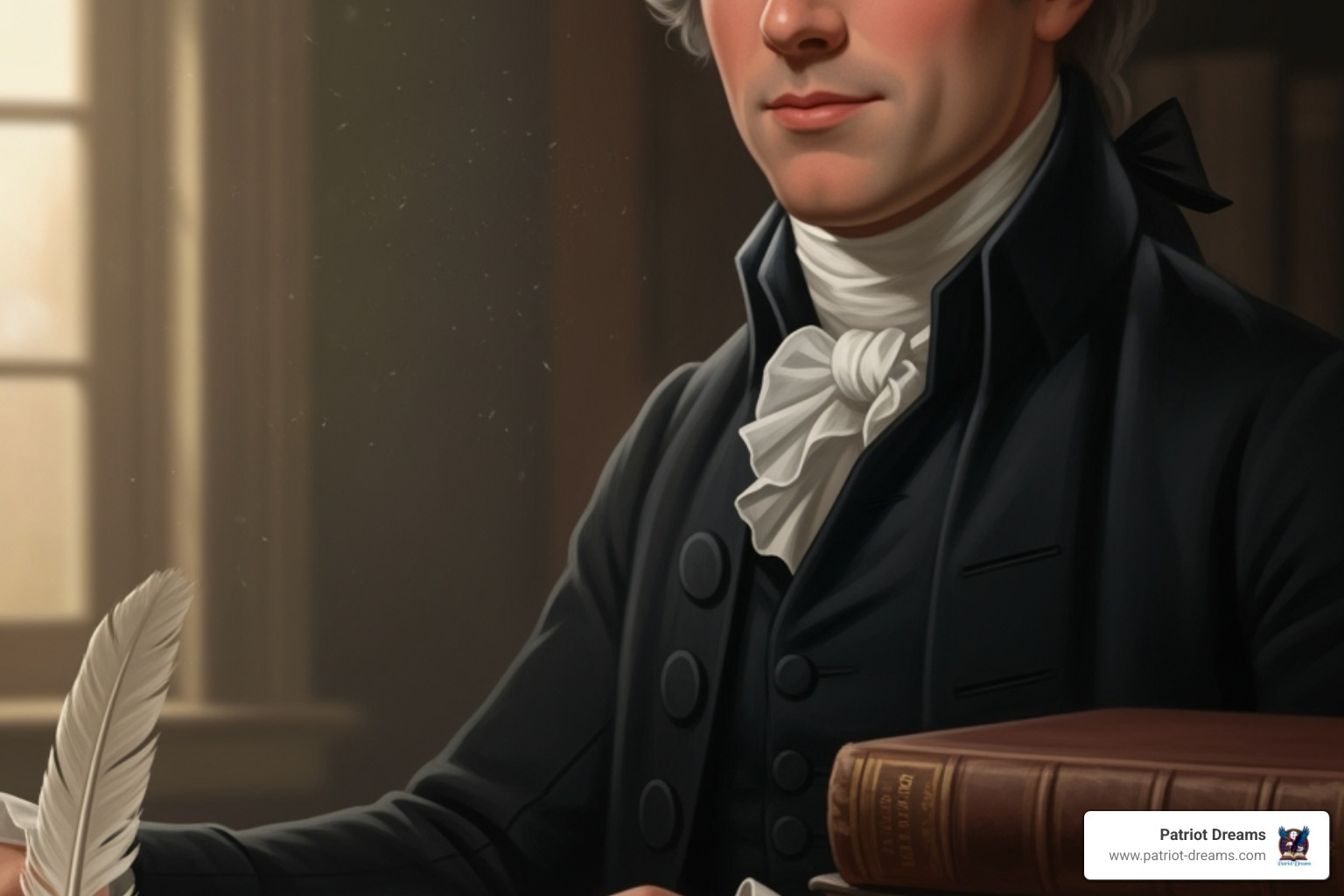
When we think of America's founding fathers, we often picture commanding generals or fiery orators. But the James Madison Constitution story begins with a different kind of hero – a quiet, thoughtful young man who spent his days reading ancient history and dreaming of a better government for his beloved country.
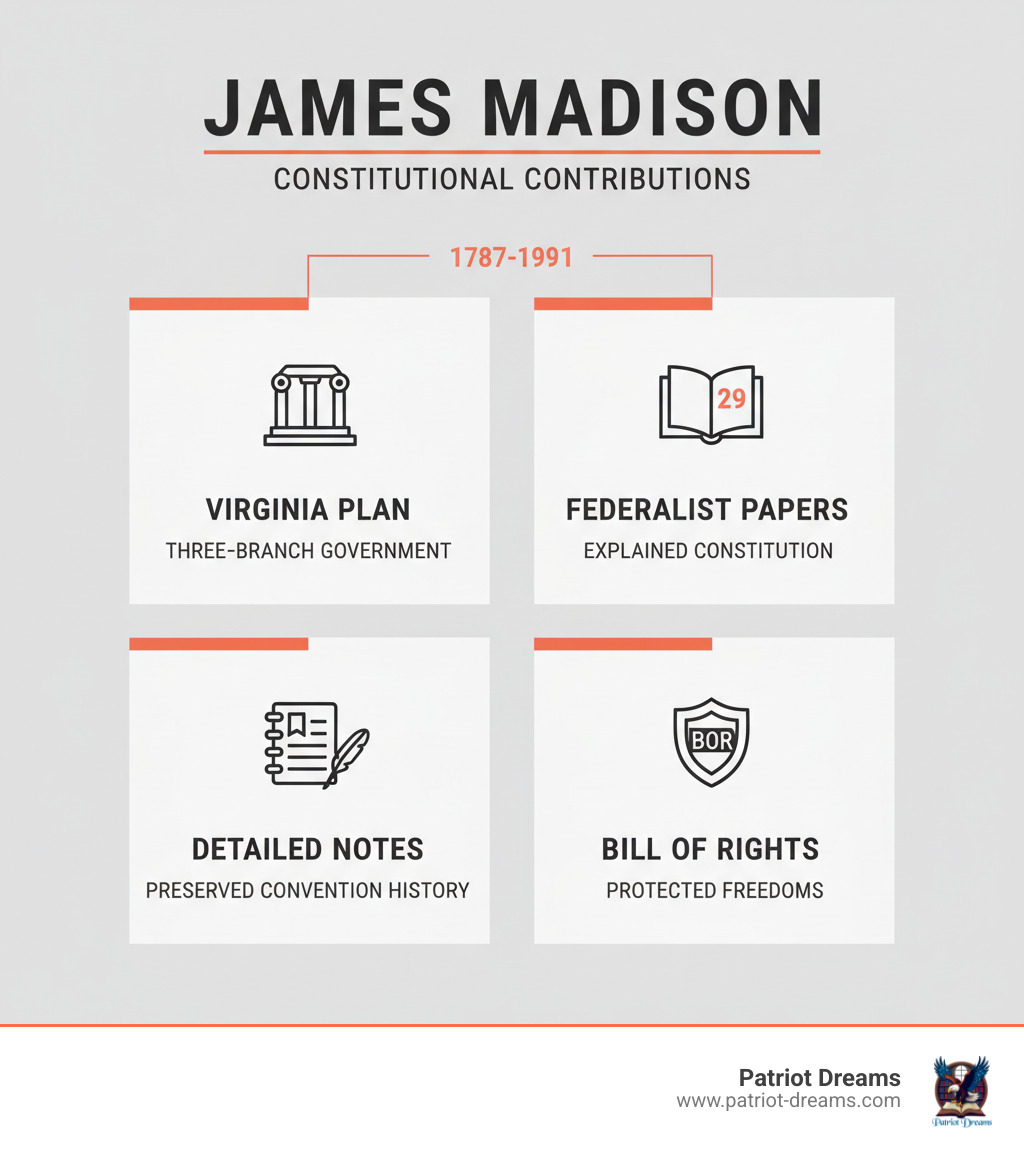
James Madison's key contributions to the U.S. Constitution:
- Virginia Plan - Provided the basic framework and structure for the new government
- Constitutional Convention Leadership - Spoke over 200 times and took detailed notes of all proceedings
- The Federalist Papers - Wrote 29 of 85 essays defending the Constitution to the American people
- Bill of Rights - Introduced and championed the first 10 amendments protecting individual freedoms
Madison wasn't the tallest or loudest voice in the room during that sweltering summer of 1787 in Philadelphia. At just 5 feet 4 inches tall, this shy Virginia planter might have seemed an unlikely candidate to reshape a nation. Yet his gentle persistence, deep study of history, and genuine care for his fellow Americans would produce something remarkable.
While other founders grabbed headlines with bold speeches and military victories, Madison did something perhaps even more important. He listened. He studied. He took notes. And from his quiet corner at the Constitutional Convention, he helped weave together the ideas that would become the Constitution we still live under today.
As delegate William Pierce observed, Madison was "always the best-informed man of any point in debate" and possessed "a remarkable sweet temper." This wasn't a man seeking personal glory – this was someone who truly believed that good government could make life better for ordinary families across America.
The Visionary: Why a New Constitution Was Needed
Picture a young nation, barely a decade old, struggling to find its footing. The James Madison Constitution story begins not with triumph, but with a gentle scholar's growing concern for his beloved country. After the Revolution's victory bells had faded, America faced a troubling truth: winning independence was only the first step. Now came the harder task of learning how to govern itself.
James Madison watched this struggle with the careful eye of someone who truly cared. The Articles of Confederation, America's first attempt at national government, reminded him of a wagon with wobbly wheels – it could move forward, but barely, and everyone worried it might fall apart on the next rough patch.
A Young Man with a Great Mind
At Montpelier, his family's Virginia plantation, young James Madison was quite different from his peers. Born March 16, 1751, he was the eldest of twelve children, though heartbreakingly, only seven would live to adulthood. While other boys his age might have been more interested in horses or hunting, James found his greatest joy in books.
His tutor, Donald Robertson, opened up worlds of knowledge for the curious boy. Classical languages, mathematics, geography, and philosophy – Madison soaked it all up like a sponge. Later, Reverend Thomas Martin continued nurturing this remarkable young mind.
When it came time for college, Madison made an unusual choice. Instead of attending Virginia's own College of William & Mary, he traveled north to Princeton. The climate in Williamsburg worried his family, and Princeton's reputation for serious scholarship called to him.
At Princeton, something wonderful happened. Madison finded the great thinkers of the Scottish Enlightenment – men like David Hume and Adam Smith whose ideas about human nature and government would shape his thinking forever. As one scholar noted, Madison "was immersed in the liberalism of the Enlightenment and converted to eighteenth-century political radicalism." You can explore a look at Madison's intellectual roots to see how these brilliant minds influenced our future president.
What made Madison special wasn't just his intelligence – it was his passion for liberty. He didn't study government as an abstract exercise. He wanted to understand how nations could protect the freedoms that make life meaningful for ordinary families.
A Nation in Need of a Plan
By the 1780s, Madison's worst fears were coming true. The Articles of Confederation had created a national government so weak it could barely function. Imagine trying to run a household where nobody had the authority to make important decisions – that's what America looked like under the Articles.
The problems were heartbreaking to watch. Our national government couldn't collect taxes, which meant it couldn't pay the brave soldiers who had won our independence. States squabbled with each other like siblings, putting up trade barriers that hurt everyone. When Shays' Rebellion erupted in Massachusetts – farmers so desperate they took up arms against their own government – it became clear that something had to change.
Madison documented these troubles in a paper he called the "Vices of the Political System of the U. States" in April 1787. With the careful attention of a doctor diagnosing a patient, he listed everything that was going wrong: states ignoring federal laws, breaking treaties, and creating chaos through what he worried was "excessive democracy" without proper checks and balances.
But Madison wasn't the type to simply complain about problems. He was a builder, a dreamer who believed in solutions. His partnership with George Washington proved crucial – together, they convinced others that America needed more than minor repairs. The Articles needed to be completely reimagined.
You can read Madison's detailed analysis in his original Vices of the Political System of the U. States and see how his careful thinking laid the groundwork for the Constitutional Convention. It's a reminder that even in our nation's darkest moments, thoughtful people were working toward brighter solutions. If you enjoy stories of American ingenuity overcoming challenges, you'll love exploring more of America's innovative history.
Madison saw what others might have missed – that this crisis was also an opportunity. America had a chance to create something the world had never seen: a government strong enough to protect its people, but limited enough to preserve their freedom.
The Architect: Crafting the James Madison Constitution
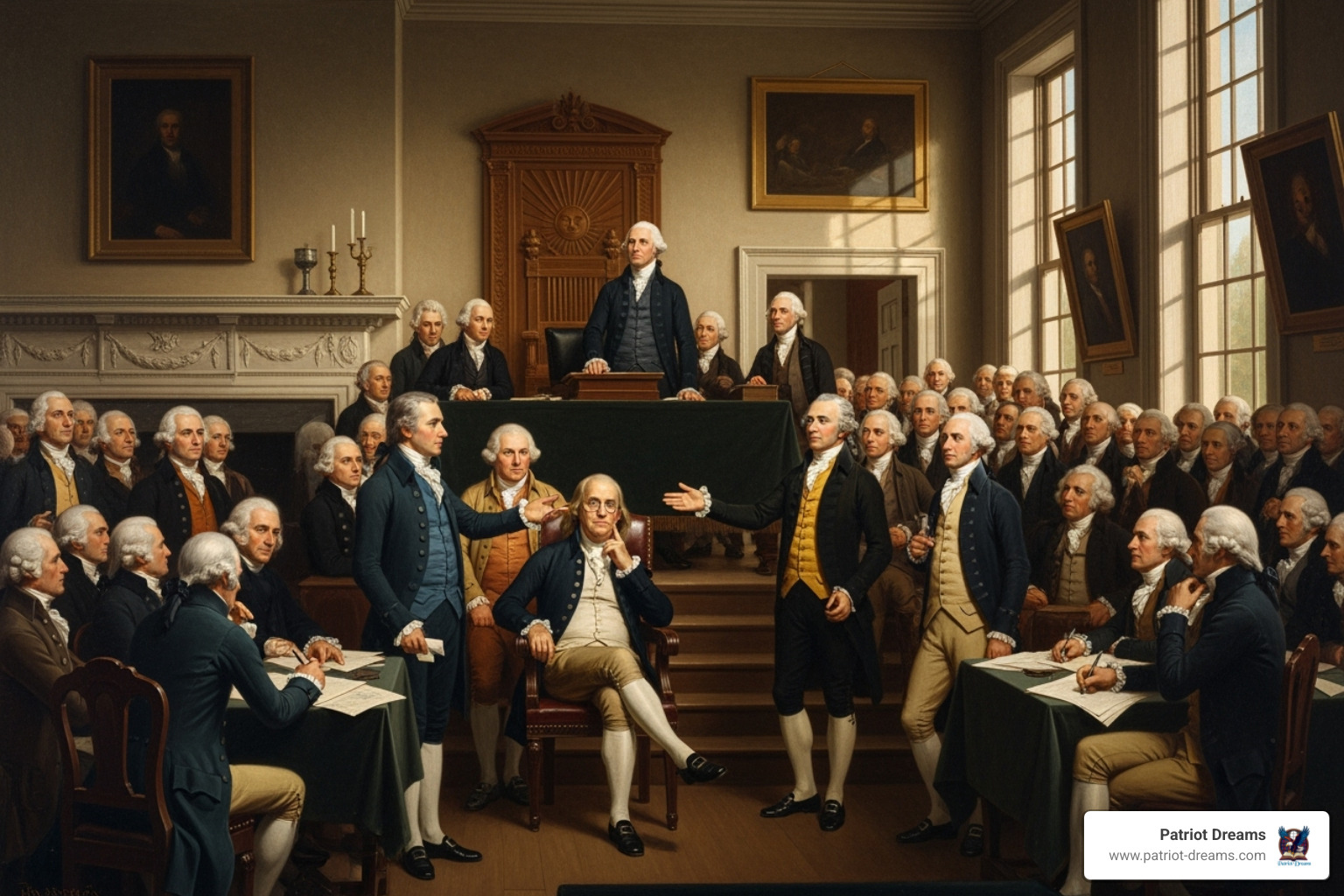
Picture Philadelphia in the summer of 1787. The air hung thick with humidity, but it was even heavier with hope and uncertainty. Delegates from across our young nation had gathered, wondering if they could truly create something that would last. In this pressure-filled room, James Madison stepped forward – not as a commanding general or silver-tongued speaker, but as a gentle thinker who had done his homework and truly believed in what America could become.
This is where the James Madison Constitution really began to take shape, through the patient work of a man who understood that great things often come from quiet preparation and thoughtful collaboration.
The Virginia Plan: A Blueprint for America
Madison arrived in Philadelphia early, his saddlebags packed not with grand speeches, but with careful research. For months, he had been studying governments throughout history – what worked, what failed, and why. He pored over books about ancient Greece and Rome, examined modern European systems, and thought deeply about what would serve the American people best.
All of this preparation led to something remarkable: the Virginia Plan. This wasn't just a list of suggestions scribbled on paper. It was a thoughtful blueprint that would set the entire convention's agenda and give them a real starting point for their discussions.
The plan called for something bold - three branches of government that would work together while keeping each other in balance. There would be a legislative branch to make laws, an executive branch to carry them out, and a judicial branch to interpret them fairly. Madison had learned from history that when all power sits in one place, it tends to go badly for ordinary people.
He also proposed that this new federal structure should be truly representative, with states having a voice based on their population. It was a big leap from simply fixing the Articles of Confederation – Madison was suggesting they build something entirely new from the ground up.
You can read Madison's original thoughts in A Plan of Government and see how his careful preparation gave the other delegates something concrete to work with. It was like he had drawn up the architectural plans, and now they could all work together to build the house.
A Tireless Voice and a Faithful Scribe
Once the convention began, this quiet scholar surprised everyone. Madison wasn't content to just present his plan and sit back. He became one of the most active debaters in the room, speaking over 200 times throughout that long, hot summer. But here's what made him special – he always spoke with a spirit of compromise, genuinely listening to others and looking for ways to bring different ideas together.
While other delegates focused on winning arguments, Madison was doing something else entirely. Day after day, he sat with his quill and paper, taking meticulous notes of everything that was said. He captured the debates, the disagreements, the moments of breakthrough, and the careful compromises that slowly built the Constitution word by word.
These weren't just casual meeting minutes. Madison's notes became the most complete record we have of how our Constitution came to be. He was literally preserving history for future generations – including us. Without his patient work, we would have lost so much of the story behind the document that still guides our nation today.
Years later, when people wanted to call him the "Father of the Constitution," Madison gently protested. He insisted it was "the work of many hands" – and that's exactly the kind of humble, generous spirit that made him so effective in that room full of strong personalities.
Thanks to his dedication, we can now read Madison's detailed convention notes and understand not just what the founders decided, but how they thought through each difficult question. It's like having a window into the room where it all happened, preserved by someone who cared enough to write it all down.
The Advocate: From The Federalist Papers to the Bill of Rights
Creating the Constitution was just the beginning of Madison's journey. Once the delegates left Philadelphia that sweltering summer, the real work began - convincing the American people that this new framework deserved their trust. This part of our story shows Madison's unwavering dedication to seeing the James Madison Constitution succeed, first by explaining its virtues to the public and then by keeping his promise to add protections for individual freedoms.
The Power of Persuasion: The Federalist Papers

The country was buzzing with debate. Coffee houses, taverns, and town squares filled with passionate discussions about whether this new Constitution was a blessing or a threat. Many Americans worried that a strong central government might crush the very freedoms they had fought so hard to win.
Madison knew that good ideas needed good explanations. Teaming up with Alexander Hamilton and John Jay, he set out to write a series of essays that would help ordinary Americans understand why the Constitution deserved their support. Writing under the shared pen name "Publius," these three men produced 85 essays that became known as The Federalist Papers.
Madison contributed 29 of these essays, each one carefully crafted to address specific concerns. His writing wasn't filled with fancy legal language – instead, he spoke directly to people's hearts and minds. Among all his contributions, Federalist No. 10 became his masterpiece, tackling what he called the problem of factions.
Madison understood something profound about human nature. People naturally form groups based on shared interests, and sometimes these groups might work against the common good. Rather than trying to eliminate these factions (which would destroy liberty itself), Madison argued that the virtue of a large republic lay in its diversity. With so many different groups and interests spread across a vast country, no single faction could dominate everyone else.
His logic was both simple and brilliant: the bigger the republic, the more voices at the table, and the harder it would be for any one group to silence the others. You can read Federalist No. 10 for yourself and see how Madison's gentle wisdom still speaks to us today. These papers didn't just help win ratification – they became a treasured part of our understanding our shared American Cultural History.
A Promise Kept: The Bill of Rights
Here's where Madison's story takes a beautiful turn that shows his character. Initially, Madison wasn't convinced that a separate Bill of Rights was necessary. He believed the Constitution already protected people's liberties by carefully limiting what the government could do. Why list specific rights, he wondered, when that might accidentally suggest that unlisted rights didn't matter?
But Madison was, above all, a listener. His dear friend Thomas Jefferson wrote to him from Paris, gently arguing that explicit protections for individual freedoms would serve as important safeguards. More importantly, Madison heard the concerns of everyday Americans who worried about government overreach.
During his campaign for Congress against James Monroe in Virginia, Madison made a promise to the people – if they elected him, he would work to add amendments that would protect their most cherished freedoms. It was a promise he intended to keep.
True to his word, Madison took the lead in introducing amendments in Congress. He faced skepticism from some colleagues who thought the issue was settled, but Madison persevered with his characteristic gentle persistence. He crafted amendments that addressed the deepest concerns Americans had expressed.
The first ten amendments that emerged became our beloved Bill of Rights, establishing a firm foundation for liberty. These amendments guaranteed freedom of religion, speech, and press – the very freedoms that allow us to worship as we choose, speak our minds, and seek truth. They protected the right to bear arms, to be secure in our homes, and to receive fair treatment under the law.
Madison had evolved from skeptic to champion, showing that true leadership sometimes means changing your mind when you hear the wisdom of the people you serve. His Bill of Rights wasn't just a political compromise – it was a heartfelt response to the genuine concerns of his fellow Americans, ensuring that the James Madison Constitution would protect both the power to govern and the freedom to live.
The Man Behind the Masterpiece: Madison's Life and Legacy
To truly understand the James Madison Constitution, we need to step beyond the political achievements and find the gentle soul who created it. Madison's story becomes even more beautiful when we see him not just as a founding father, but as a devoted husband, a thoughtful leader, and a man who wrestled with the complexities of his time while never losing sight of his love for America.
A Partnership of Heart and Mind: James and Dolley Madison

In 1794, something wonderful happened that would change James Madison's life forever. At age 43, this quiet scholar found love with Dolley Payne Todd, a vibrant Quaker widow seventeen years younger. Their marriage wasn't just a union of two hearts – it was a perfect partnership that brought out the best in both of them.
Where James was thoughtful and reserved, Dolley sparkled with warmth and social grace. She had this remarkable gift for making everyone feel welcome, from the humblest farmer to the most powerful senator. When they moved into the White House, Dolley transformed it into a place where people actually wanted to visit. She understood something profound about democracy – that sometimes the most important conversations happen over a cup of tea rather than in a formal debate.
Her finest moment came during the dark days of the War of 1812. As British troops marched toward Washington in 1814, most people fled in panic. But not Dolley. With remarkable courage, she stayed behind to rescue precious government documents and George Washington's portrait before the White House was set ablaze. Her quick thinking and brave heart saved pieces of our nation's heritage for future generations.
Their 42-year marriage was a testament to deep love and mutual respect. James found in Dolley not just a wife, but a partner who helped him connect with the American people in ways his shy nature might never have allowed.
The Enduring Legacy of the James Madison Constitution
Madison's journey didn't end with the Constitution's ratification. As America's fourth President from 1809 to 1817, he faced challenges that would test everything he had helped create. The War of 1812, sometimes called our "Second War of Independence," brought British ships to our shores and foreign armies to our capital. Yet through these trials, Madison's steady leadership helped forge a stronger sense of what it meant to be American.
The war years were difficult. Madison watched as the very White House where he and Dolley had created such warmth was burned by enemy forces. But from these ashes came renewed national pride and unity. After the conflict ended, Madison supported policies he had once opposed – like a national bank and protective tariffs – because he had learned that sometimes principles must bend to serve the greater good of the people.
In 1817, at age 65, James and Dolley retired to their beloved Montpelier. These should have been peaceful golden years, but financial struggles clouded their later life, largely due to his stepson's gambling debts. Still, Madison spent his time carefully editing those precious notes from the Constitutional Convention, knowing they would help future Americans understand the intentions behind their government.
Madison's relationship with slavery remains one of the most difficult aspects of his story to reconcile. Like many of his generation, he lived with contradictions that seem heartbreaking today. He owned over 100 enslaved people while writing eloquently about liberty and freedom. He spoke against slavery in theory but never freed those he held in bondage, even in his will. This painful reality reminds us that even our most admired leaders were human beings, shaped by their times yet still responsible for their choices.
When Madison passed away on June 28, 1836, at age 85, he left behind final words about preserving the Union he had worked so hard to create. His legacy lives on in every peaceful transfer of power, every protected right, and every moment when Americans choose to work together despite their differences.
His life teaches us that greatness often comes not from perfection, but from persistent dedication to ideals larger than ourselves. At Patriot Dreams, we believe these stories of imperfect people striving toward perfect ideals are exactly what make America's story so deeply human and ultimately hopeful. Learn more about our mission to preserve and share these important American stories.
Conclusion: The Enduring Gift of a Thoughtful Founder
When we close the book on James Madison's remarkable life, we're left with a story that feels both extraordinary and wonderfully human. His wasn't a tale of battlefield glory or thunderous speeches that shook the rafters. Instead, it's the story of a quiet, persistent man who believed deeply that good ideas, carefully considered and lovingly crafted, could change the world.
Madison was a scholar who listened - really listened - to the concerns of his fellow Americans. He was a leader who collaborated, understanding that the best solutions come when thoughtful people work together. Most importantly, he was a founder who gave us the framework for a government built on ideas and ideals rather than the whims of any single person or group.
The James Madison Constitution he helped create wasn't just a document; it was a living, breathing promise to future generations. It said, in essence, "We believe you can govern yourselves wisely, and here are the tools to help you do it." That promise has guided us through more than two centuries of triumph and challenge, growth and change.
What strikes us most about Madison's story is how it reminds us that the greatest acts of patriotism can come from a thoughtful heart and a mind dedicated to the well-being of all. He didn't seek fame or fortune. He sought understanding. He wanted to create something that would help ordinary families live better lives, pursue their dreams, and raise their children in freedom.
His legacy teaches us the value of deep study, the importance of careful deliberation, and perhaps most beautifully, the courage to evolve our thinking for the greater good. When Madison changed his mind about the Bill of Rights, he showed us that true wisdom sometimes means admitting when we need to reconsider our positions.
At Patriot Dreams, we cherish these stories of the quiet builders and thinkers who shaped our nation. Madison's gentle spirit reminds us that every person, no matter how humble or soft-spoken, can contribute to something truly grand. His story whispers to us across the centuries that thoughtful dedication, more than loud proclamations, builds lasting foundations.
We hope Madison's story has helped you feel a little more connected to the incredible journey of our nation's founding. His life shows us that the most profound changes often come not from those who shout the loudest, but from those who think the deepest and care the most. That's a lesson worth carrying with us, whether we're citizens or founders, parents or children, dreamers or builders of the American story.
Explore more inspiring stories from American history and find how the quiet heroes of our past continue to light the way forward.

Join the Patriot Dreams Community
Download the app today and start your journey through American history and personal legacy.

Explore Our Latest Insights
Dive into stories that shape our American legacy.