Sojourner Truth's Unforgettable Stand for Equality
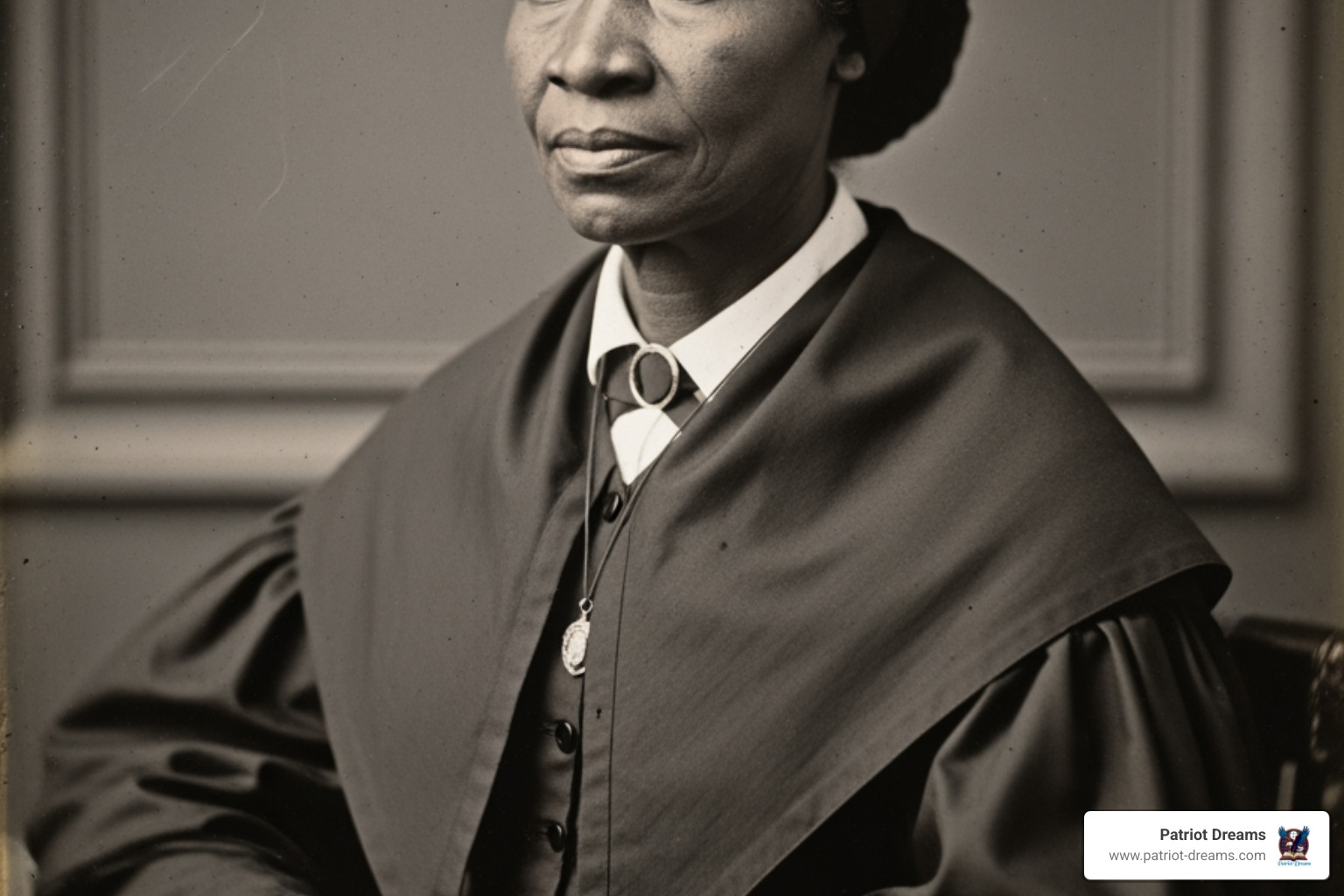

A Voice That Echoes Through Time
The Sojourner Truth speech, delivered at the 1851 Women's Rights Convention in Akron, Ohio, stands as one of the most powerful calls for equality in American history. In just a few minutes, a formerly enslaved woman challenged a nation to live up to its highest ideals.
Quick Facts About the Sojourner Truth Speech:
- When: May 29, 1851
- Where: Women's Rights Convention, Akron, Ohio
- Famous Title: "Ain't I a Woman?" (though this phrase appears only in later versions)
- Main Message: Women and Black Americans deserve equal rights and dignity
- Why It Matters: It challenged both racial and gender inequality at a pivotal moment in American history
- The Controversy: Two very different versions exist—one published weeks after the speech, another 12 years later
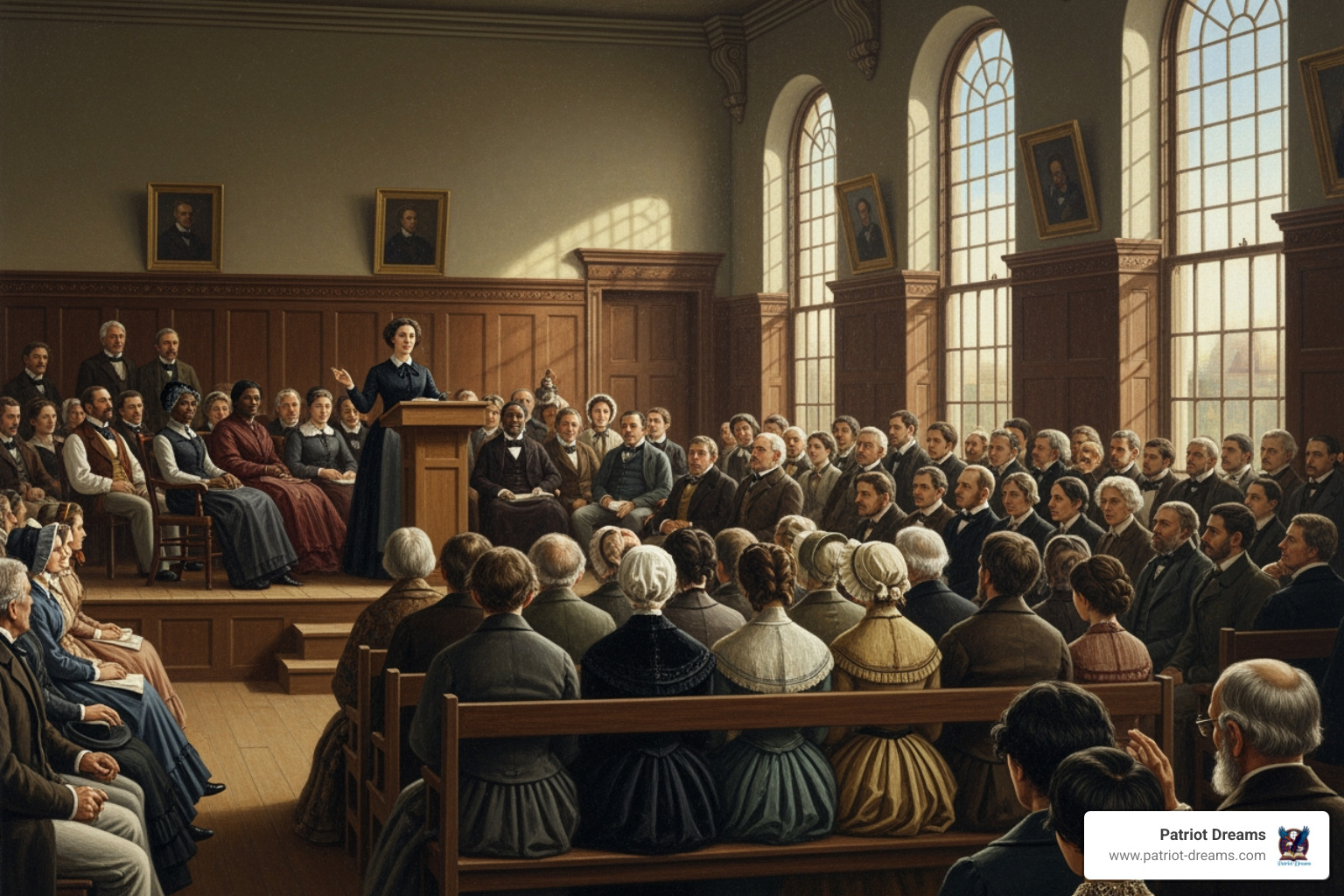
Imagine standing in a crowded church in 1851. The room buzzes with heated debate about women's rights. Then a tall woman rises. She's lived through unimaginable hardship—born into slavery, separated from her children, denied basic human dignity. Yet her voice rings out with clarity and strength.
This was Sojourner Truth. And the words she spoke that day would echo through generations.
Her speech wasn't just about women's rights or just about ending slavery. It was about something deeper—the basic truth that all people deserve respect, dignity, and freedom. She spoke from her heart, from her lived experience, and from her deep faith that justice would prevail.
What makes her story even more remarkable is how it's been remembered. The version most people know today—with its famous "Ain't I a Woman?" refrain—was actually written down 12 years after the event. The original account, published just weeks after her speech, tells a somewhat different story. Both versions, however, capture the fierce spirit of a woman who refused to be silenced.
This is the story of how one woman's courage sparked change across America—and how her words still inspire us today.
From Slavery to Sojourner: The Journey of a Remarkable Woman
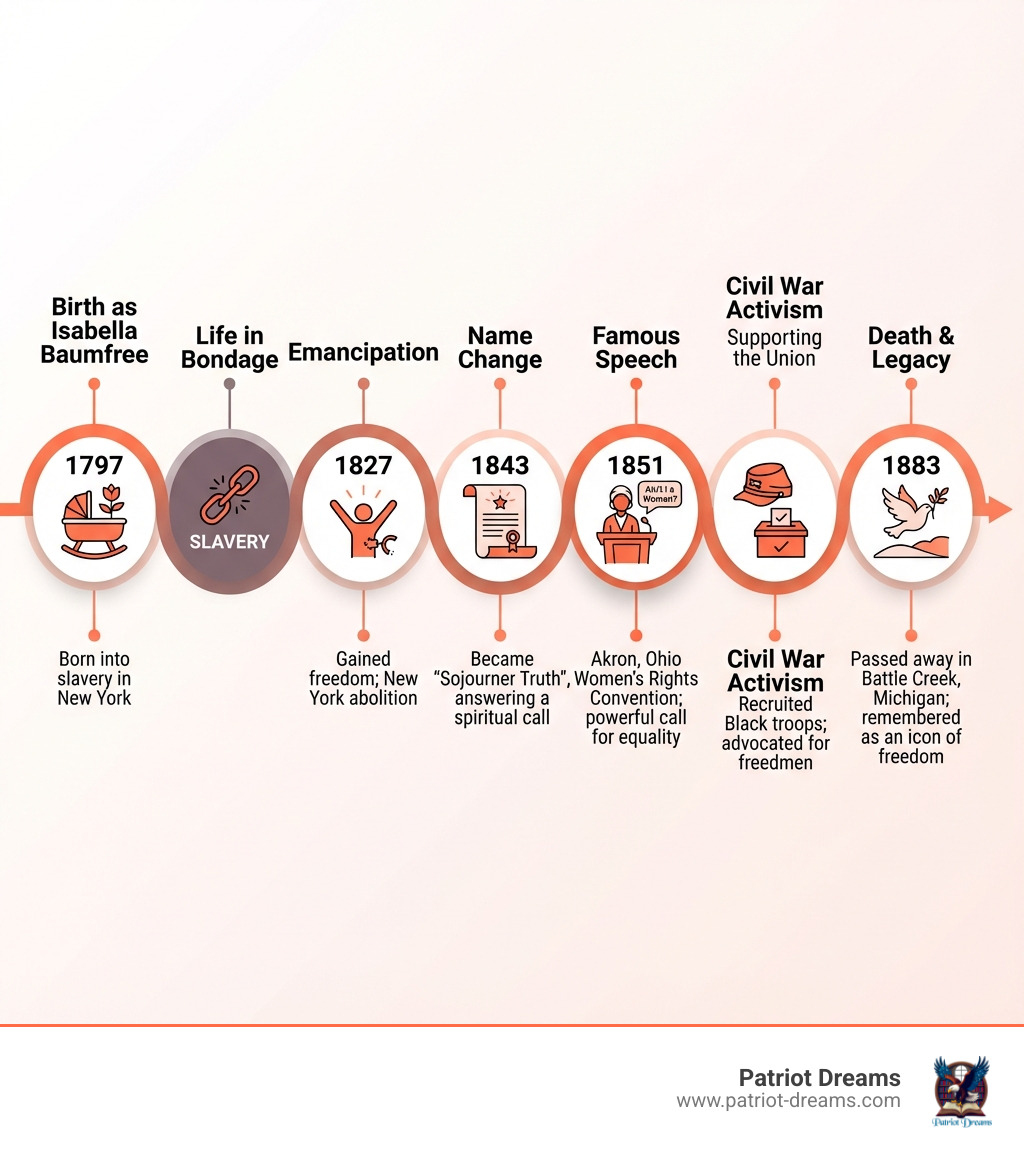
Before she became the iconic Sojourner Truth, she was Isabella Baumfree, born into slavery in Ulster County, New York, in 1797. Her early life was marked by the harsh realities of bondage, a common experience for many Americans in that era. We often reflect on the rich mix of American history, and figures like Isabella remind us of the profound struggles and triumphs that shaped our nation.
Growing up, Isabella spoke Dutch, her first language, until she was about nine years old, reflecting the Dutch influence in parts of colonial New York. This heritage is a unique thread in her story, one that sometimes gets lost in later interpretations of her public persona. Her life took a turn towards freedom with the passage of the New York Gradual Abolition Act, and she ultimately gained her freedom in 1827.
Isabella's deep religious faith was a cornerstone of her being. It was this faith that compelled her to undergo a profound change in 1843. She changed her name to Sojourner Truth, a name that perfectly encapsulated her new calling. "Sojourner," because she was to travel up and down the land, and "Truth," because she was to declare the truth unto the people. She became an itinerant preacher, traveling and speaking about abolition and women's rights, sharing her experiences and her deep convictions with anyone who would listen.

(For more about inspiring American figures, we invite you to explore other stories on Historical American Figures here at Patriot Dreams.)
A Mother's Strength
Sojourner Truth's personal experiences as an enslaved woman profoundly shaped the content and impact of her Sojourner Truth speech. She was a mother, a role that brought her both joy and unimaginable sorrow. She bore thirteen children, most of whom were cruelly sold off to slavery, tearing her family apart. We can only imagine the depth of that pain, a pain she carried with her and channeled into a powerful call for justice.
In a remarkable act of courage and determination, Sojourner Truth sued to have her son returned to her after he was illegally sold by her former owner. And she won. This made her the first Black woman to win such a case against a white man in American history. Her victory was a testament to her unwavering spirit and her belief in the possibility of justice, even in the face of overwhelming odds. These deeply personal experiences of suffering, resilience, and triumph formed the bedrock of her advocacy, giving her words an authenticity and emotional weight that resonated deeply with her audiences.
A New Name, A New Purpose
When Isabella Baumfree acceptd the name Sojourner Truth in 1843, it was more than just a name change; it was a declaration of purpose. She proclaimed, "The Lord gave me the name Sojourner, because I was to travel up and down the land showing people their sins and being a sign to them, and Truth because I was to declare the truth unto the people." This new identity marked the beginning of her public life as a powerful advocate for human rights.
A lesser-known but equally inspiring aspect of her work was her entrepreneurial spirit. Sojourner Truth famously stated, "I sell the shadow to support the substance." This meant she sold cartes de visite—small photographic portraits of herself—to earn money and support her activism. By selling her "shadow" (her image), she funded her "substance" (her life's work of speaking truth and fighting for justice). This innovative approach not only sustained her but also helped spread her image and message, making her a recognizable figure across the nation.
The Famous Sojourner Truth Speech: A Stand for Humanity in Akron
The year 1851 was a pivotal time in America, a period of intense social and political ferment. The abolitionist movement was gaining momentum, pushing for the end of slavery, while the nascent women's suffrage movement was beginning to articulate its demands for equal rights. It was against this backdrop that the Ohio Women's Convention convened in Akron on May 29, 1851.
The atmosphere was charged with debate. Many attendees, including some male ministers, expressed strong opposition to women's rights, often citing religious texts or traditional gender roles. It was, as Sojourner Truth herself observed, "where there is so much racket there must be something out of kilter." She recognized the growing tension between the "negroes of the South and the women at the North, all talking about rights," sensing that "the white men will be in a fix pretty soon." This recognition of the interconnectedness of these struggles, and the discomfort they caused the established order, is a key part of the historical context of her powerful address.
What Did She Say? The Powerful Message of Equality
When Sojourner Truth rose to speak, she employed powerful rhetorical strategies to connect with her audience and convey her message. Her speech was extemporaneous, delivered from the heart, and deeply rooted in her personal experiences. She didn't mince words, directly challenging the prevailing stereotypes of womanhood that depicted women as delicate, weak, and intellectually inferior.
She used her own life as irrefutable evidence against these notions. "I have ploughed and planted, and gathered into barns, and no man could head me!" she declared, highlighting her immense physical strength and capacity for hard labor. She vividly contrasted her reality with the idealized image of white women who were "helped into carriages, and over mud-puddles, and given the best place everywhere." With a simple, yet profound question, she cut through the hypocrisy: "And ain't I a woman?" She asked why she, a woman who had endured so much physical hardship, was denied the courtesies and rights afforded to others.
Sojourner Truth also addressed the argument that women were intellectually inferior, using a brilliant analogy that still resonates today. "If my cup won't hold but a pint, and yours holds a quart," she reasoned, "wouldn't you be mean not to let me have my little half measure full?" This simple yet profound statement argued that even if one believed women had less intellectual capacity (a belief she clearly refuted through her own intellect), it was still unjust to deny them the rights they could handle. Her use of personal testimony, direct questioning, and relatable analogies made her arguments accessible and impossible to ignore.
Answering with Faith and Wit
Beyond challenging physical and intellectual stereotypes, Sojourner Truth deftly countered religious arguments used to justify the subjugation of women. When a minister argued that women couldn't have equal rights because "Christ wasn't a woman," she responded with powerful biblical references and undeniable logic. "Where did your Christ come from?" she asked, then answered triumphantly, "From God and a woman! Man had nothing to do with Him." This witty and faith-filled rebuttal turned the tables, highlighting the essential role of women in divine creation.
She further invoked the story of Eve, often used to blame women for humanity's fall, and ingeniously spun it into an argument for women's collective power. "If the first woman God ever made was strong enough to turn the world upside down all alone, these women together ought to be able to turn it back, and get it right side up again!" This powerful call to action underscored her belief in women's capacity to bring about positive change.
The Sojourner Truth speech brilliantly addressed the intersectionality of race and gender in 19th-century America. As a Black woman, she experienced both racial discrimination and gender inequality, a unique double burden that many white suffragists, and even some male abolitionists, failed to fully grasp. Her words highlighted that the fight for women's rights could not be separated from the fight for racial justice, as both were fundamental to achieving true human dignity and equality for all. Her experiences as a formerly enslaved woman, a mother whose children were sold, and a laborer who performed grueling work, gave her a perspective that transcended the often-limited scope of the women's rights discourse of her time.
A Tale of Two Speeches: How History Remembers a Powerful Voice
The challenge of historical documentation, especially for oral histories like Sojourner Truth's extemporaneous speeches, is a fascinating and complex one. When we dig into the story of the Sojourner Truth speech, we encounter a compelling illustration of how narrative can be shaped and reshaped over time. Without audio recordings, we rely on the accounts of those who were present, and their interpretations, biases, and motivations can profoundly influence what is remembered.
The controversy surrounding the different versions of the Sojourner Truth speech reveals much about these challenges. It reminds us that history is not always a perfectly preserved record but often a mosaic constructed from various perspectives, sometimes with differing accuracy. The power of narrative, particularly a compelling one, can sometimes overshadow the nuances of historical fact.
(For a thoughtful look at how stories change over time, we invite you to explore more on American Cultural History at Patriot Dreams.)
The Marius Robinson Version (1851)
Just weeks after the Akron convention, on June 21, 1851, Marius Robinson, the secretary of the convention and editor of the Anti-Slavery Bugle, published his account of the Sojourner Truth speech. This version is widely considered by historians to be the most accurate contemporary record. Robinson and Truth were friends and had worked together, and it is believed that Truth herself reviewed his transcription before its publication. This vetting process lends significant credibility to Robinson's account. You can read both versions of the speech and compare them for yourself at The Sojourner Truth Project.
Notably, Robinson's version does not contain the famous refrain “Ain't I a Woman?”. It is a succinct, powerful account that captures Sojourner Truth's directness and her critique of the men who opposed women's rights. Her closing, as reported by Robinson, was a potent warning: “But man is in a tight place, the poor slave is on him, woman is coming on him, and he is surely between a hawk and a buzzard.” This version emphasizes the dual pressure on white men from both the abolitionist and women's rights movements.
The Frances Gage Version (1863)
Twelve years later, in 1863, amid the Civil War, Frances Dana Barker Gage published a significantly different version of the Sojourner Truth speech in The Independent and National Anti-Slavery Standard. Gage, who had presided over the Akron convention, recounted the speech with the now-famous “Ain't I a Woman?” refrain repeated throughout. Her version also added a prominent Southern dialect to Truth's words and included more dramatic details, such as the claim that Truth had borne thirteen children, all sold into slavery (historians believe she had five children, with one sold away).
This version became incredibly popular and cemented the “Ain't I a Woman?” phrase in public memory. However, historians, most notably Nell Irvin Painter, have pointed out that Truth was from New York and spoke Dutch, not a Southern dialect. Gage's embellishments, while perhaps well-intentioned to evoke sympathy for enslaved people during the Civil War, created a powerful but ultimately less accurate portrayal of Sojourner Truth's actual words and background. The popularity of Gage's version highlights the power of narrative and how a compelling story can sometimes overshadow historical accuracy, even if it diverges from the original event.
Comparing the Key Phrases and Tone: Robinson vs. Gage Versions
| Feature | Marius Robinson Version (1851) | Frances Gage Version (1863) - |
|---|---|---|
| Title | "On Woman's Rights" | "Ain't I a Woman?" - |
| Source | Anti-Slavery Bugle, June 21, 1851 | New York Independent, April 23, 1863 - |
| Key Phrase | "I am a woman's rights." | "Ain't I a Woman?" - |
| Dialect | No specific dialect mentioned, suggesting her standard New York accent. | Written in a Southern dialect, which was not her natural way of speaking. - |
| Children Mentioned | Mentions having children and seeing them sold into slavery, but does not specify the number thirteen. | Claims she "borne thirteen children, and seen most all sold off to slavery." - |
| Impact | Considered more historically accurate by scholars. | Became the more famous and widely quoted version, shaping public memory. - |
The Lasting Echo: Why Sojourner Truth’s Words Still Inspire Us
The Sojourner Truth speech, in both its documented forms, has left an indelible mark on American history and continues to resonate with us today. Its legacy is not just about the words spoken but about the courage of the speaker and the enduring power of her message. Over time, the interpretation and legacy of the speech have evolved. What began as a powerful plea for justice at a specific convention transformed into a universal symbol of resilience, intersectionality, and the fight for human dignity.
Historians like Nell Irvin Painter have carefully examined the different versions, helping us understand the complexities of historical memory and the challenges of accurately capturing oral tradition. This scholarly work has enriched our appreciation for Sojourner Truth, allowing us to see her not just as a symbol, but as a complex, intelligent, and strategic orator. The speech has become a foundational text for understanding the unique struggles faced by Black women, highlighting how racism and sexism intersect to create distinct forms of oppression.
Today, the Sojourner Truth speech remains incredibly relevant. In our ongoing conversations about civil rights, gender equality, and social justice, her words serve as a powerful reminder that the fight for freedom is interconnected. Her courage to speak truth to power, to stand up for herself and others when it was difficult and unpopular, is a timeless inspiration. She reminds us that every voice matters, and that true progress requires recognizing the full humanity of every individual, regardless of race or gender. Her call for universal dignity is a guide that continues to guide movements for equality and justice around the world.
(We believe that understanding these pivotal moments helps us appreciate the journey of our nation. Find more about America’s cultural history in our stories on American Cultural History at Patriot Dreams, and explore the legacy of other inspiring figures like Martin Luther King Jr. The Dream, The Struggle, The Legacy.)
Frequently Asked Questions about the Sojourner Truth Speech
What is the main controversy surrounding the “Ain’t I a Woman?” speech?
The main point of discussion is that two different versions exist. The most famous version, with the “Ain’t I a Woman?” refrain, was written 12 years after the event by Frances Gage. An earlier version, published just weeks after the speech by her friend Marius Robinson, is considered by many historians to be more accurate and does not include the famous phrase. The controversy highlights the challenges of historical documentation and how later narratives can shape popular memory.
How did Sojourner Truth’s personal experiences shape her speech?
Her speech is deeply personal. She drew upon her experiences of hard labor, the pain of having her children sold into slavery, and the lack of courtesies afforded to white women to powerfully argue that she was indeed a woman deserving of equal rights. Her lived reality as an enslaved Black woman provided an undeniable foundation for her arguments against both racial and gender inequality, making her an incredibly compelling and authentic voice.
What is the significance of the speech today?
Today, the speech is a foundational text for understanding the intersection of race and gender in America. It reminds us of the power of a single voice to speak truth to power and continues to inspire movements for equality and justice around the world. It stands as a powerful example of how personal testimony can challenge systemic injustices and call a society to live up to its highest ideals of freedom and equality for all.
A Legacy of Truth and Courage
Sojourner Truth's life story, culminating in her unforgettable Sojourner Truth speech, is a testament to the power of the human spirit. From the chains of slavery to the podiums of justice, she embodied resilience, courage, and an unwavering commitment to truth. Her message was a unifying one, advocating for the fundamental humanity and dignity of every person, irrespective of their skin color or gender.
At Patriot Dreams, we believe that stories like Sojourner Truth's are not just historical facts; they are vital threads in the fabric of who we are as Americans. They remind us of the strength found in kindness, the power of perseverance, and the enduring hope for a more just world. Her voice, once hushed by the indignity of slavery, now echoes through time, inspiring us to continue the work of building a more inclusive and compassionate society.
Her journey teaches us that even in the face of immense adversity, one person's courage can illuminate the path for countless others. It’s a story that fills our hearts with warmth and pride, a reminder of the best of the American spirit.
(We invite you to Explore more inspiring stories from American history on Patriot Dreams. and find the rich mix of our shared heritage.)

Join the Patriot Dreams Community
Download the app today and start your journey through American history and personal legacy.

Explore Our Latest Insights
Dive into stories that shape our American legacy.