Stealing Freedom: How Robert Smalls Commandeered a Confederate Warship

A Dream of Freedom on the Charleston Waters
Stealing Freedom: How Robert Smalls Commandeered a Confederate Warship is the remarkable true story of a young enslaved man who, on the night of May 13, 1862, sailed a Confederate military transport ship past five armed forts and delivered himself, his family, and 15 other enslaved people to freedom.
The Escape at a Glance:
- Who: Robert Smalls, age 23, an enslaved wheelman on the CSS Planter
- What: Commandeered a Confederate warship with 16 enslaved people aboard
- When: Early morning hours of May 13, 1862
- Where: Charleston Harbor, South Carolina, sailing past Forts Sumter and Moultrie
- How: Disguised himself as the captain, used correct signal codes, and surrendered to Union ships
- Result: Freedom for all aboard, valuable intelligence for the Union, and a powerful symbol that changed history
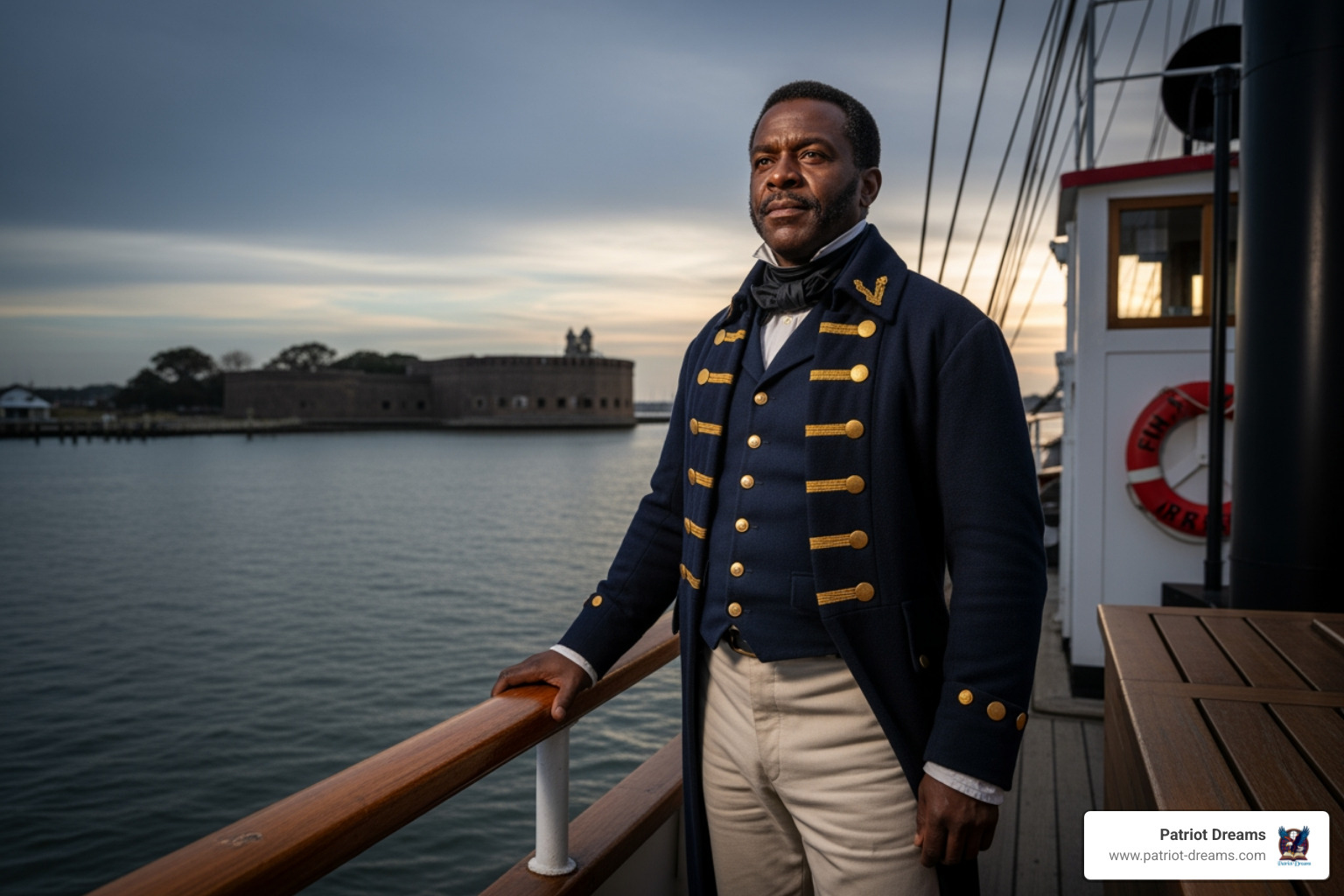
Imagine the quiet waters of Charleston Harbor just before dawn. A young father stands at the wheel of a Confederate warship, wearing a stolen captain's hat. Below deck, his wife Hannah holds their children close. She had told him, "It is a risk, dear, but you and I, and our little ones must be free. I will go, for where you die, I will die."
This is not just a story about escaping slavery. It's a story about a family's love, a community's courage, and one man's brilliant plan that would help change the course of the Civil War. Robert Smalls didn't just steal a ship that night. He stole freedom itself, and in doing so, proved to a divided nation what courage and hope could accomplish.
His journey from the Charleston docks to the halls of Congress reminds us that the American story has always been written by ordinary people doing extraordinary things when it mattered most.
Stealing Freedom: How Robert Smalls Commandeered a Confederate Warship terms you need:
- Behind the Badge: Real Stories of American Heroes in Pop Culture
- Martin Luther King Jr.: The Dream, The Struggle, The Legacy
- The Real Life Behind the Legend: Casey Jones and the Making of an American Railroad Hero
The Man and the Ship: A Life Bound to the Tides
Every great story has a beginning, and for Robert Smalls, his journey began in 1839 in Beaufort, South Carolina. Born into the cruel bonds of slavery, his early life was marked by the harsh realities of the time, yet also by glimpses of extraordinary potential. We learn from historical accounts that his mother, Lydia, played a pivotal role in shaping his character. She reportedly exposed him to the brutal whippings endured by field slaves, not to break his spirit, but to instill a deep-seated defiance against the injustices he faced. This difficult lesson, meant to show him the "harsher realities of slavery," ultimately fueled his desire for freedom and rebellion. It was a tough love, indeed, but one that perhaps prepared him for the monumental tasks ahead.
Who Was Robert Smalls?
Robert Smalls was more than just an enslaved man; he was a keen observer, a quick learner, and a man driven by a profound love for his family. At the tender age of 12, he was sent to Charleston, a busy port city, to work on the docks and in the shipyards. This period, though still under enslavement, became an unexpected apprenticeship. He earned a meager dollar a week, with the rest of his wages going to his master, but what he truly gained was priceless knowledge. He absorbed every detail of maritime life: the intricate workings of ships, the ebb and flow of tides, the complex channels of Charleston Harbor, and the signals used by various vessels. These were skills that would later prove instrumental in his audacious bid for freedom.
In Charleston, he met and married Hannah Jones around 1856. Together, they had two children, Elizabeth and an infant son, Robert Jr. The thought of his family being torn apart by the slave trade—a constant fear for enslaved families—weighed heavily on Smalls. He even attempted to buy Hannah's freedom for $800, a sum he couldn't afford, which only deepened his resolve to find another way. His yearning for freedom, especially for his loved ones, was the powerful current that guided his life. His story, like those of many Historical American Figures, reminds us of the profound human desire for liberty and self-determination.
The CSS Planter: A Vessel of War, A Vessel of Hope
The stage for Robert Smalls' extraordinary act was set aboard the CSS Planter. This was no ordinary boat; it was a Confederate military cargo transport ship, a sidewheel steamer that played a significant role in the Confederacy's operations. The Planter was used for various tasks, including laying mines, transporting troops and supplies, and carrying weapons. It was heavily armed with "200 rounds of ammunition and several weapons, including a 32-pound pivot gun and a 24-pound howitzer." Such a vessel was a vital asset for the Confederate war effort, and its loss would be a considerable blow.
As a trusted wheelman, Robert Smalls held a crucial position on the Planter. His responsibilities gave him an intimate, first-hand knowledge of the ship's capabilities, its routes, and perhaps most critically, the unique coded signals used to steer past the formidable Confederate fortifications guarding Charleston Harbor. This was knowledge that white officers, who "simply did not think that enslaved men would be capable of pulling off a mission as dangerous and difficult as commandeering a Confederate vessel," largely overlooked. Little did they know, this very ship, intended to serve the Confederacy, would become a symbol of hope and ingenuity, a vessel that would carry 16 souls from bondage to liberty. The story of its capture is so compelling that it's been recounted in powerful narratives like the book, "Be Free or Die: The Amazing Story of Robert Smalls’ Escape from Slavery to Union Hero."
Stealing Freedom: How Robert Smalls Commandeered a Confederate Warship
The night of May 12, 1862, unfolded like a scene from a gripping drama, but it was all too real for Robert Smalls and his fellow enslaved crewmen. This was the moment they had been waiting for, the chance to seize their destiny and make a daring bid for freedom.
The Audacious Plan: A Night of Courage and Hope
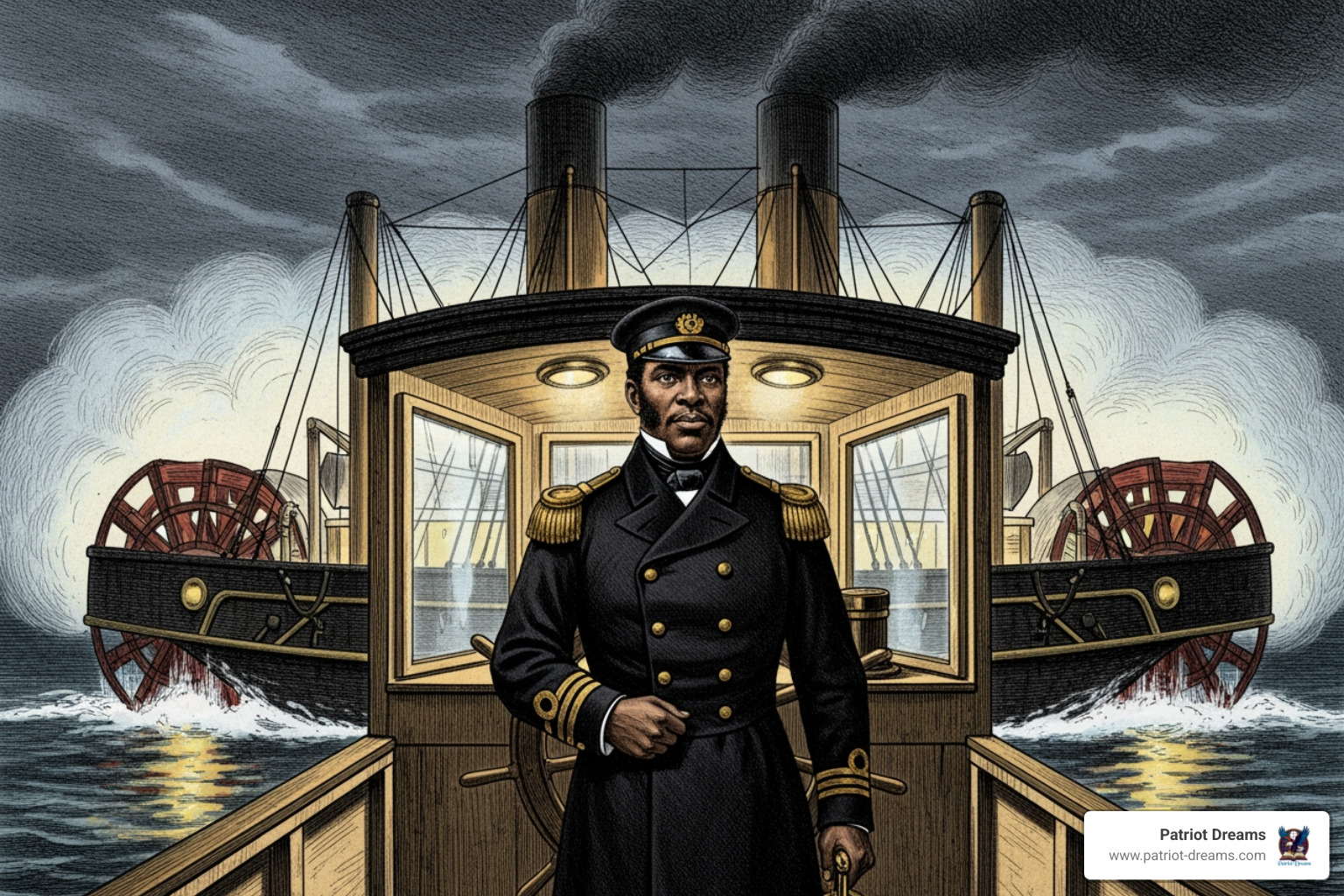
The circumstances that allowed Stealing Freedom: How Robert Smalls Commandeered a Confederate Warship to become a reality were a rare confluence of opportunity and courage. Confederate military orders stipulated that white officers should remain on board their vessels at night, but on this particular evening, Captain Charles Relyea and his two mates decided to spend the night ashore. They left the Planter anchored in Charleston Harbor, trusting the enslaved crew to guard it. This lapse in judgment, born from a deep-seated underestimation of the enslaved men's capabilities and desire for freedom, created the perfect opening.
Robert Smalls, then just 23 years old, understood the gravity of the situation. He confided his audacious plan to the other enslaved crew members. It was a terrifying proposition, carrying the penalty of death if they were caught. Indeed, "it is believed that two of them did not go along with Smalls’ plan for fear of their lives." Yet, the others, fueled by the same desperate hope for freedom, committed to the plan. Smalls himself took on the critical role of impersonating the captain. He donned Captain Relyea's wide-brimmed straw hat and his long coat, using his striking resemblance to the captain and mimicking his walk and mannerisms. This disguise was crucial for passing the Confederate checkpoints.
But this wasn't just a solo mission; it was a family affair, a community's leap of faith. Robert's wife, Hannah, was an integral part of this courage. When he shared his perilous plan with her, her response was one of unwavering support and profound love: "It is a risk, dear, but you and I, and our little ones must be free. I will go, for where you die, I will die." Her words, as recounted by historian Cate Lineberry, encapsulate the incredible bravery and shared determination that powered this escape. It was a pact to seek freedom together, no matter the cost, a powerful testament to the human spirit's yearning for liberty. The other men on board, acting as engineers and deckhands, also played their parts with immense bravery, making this a true collective effort to secure their freedom.
Navigating Treacherous Waters to Freedom
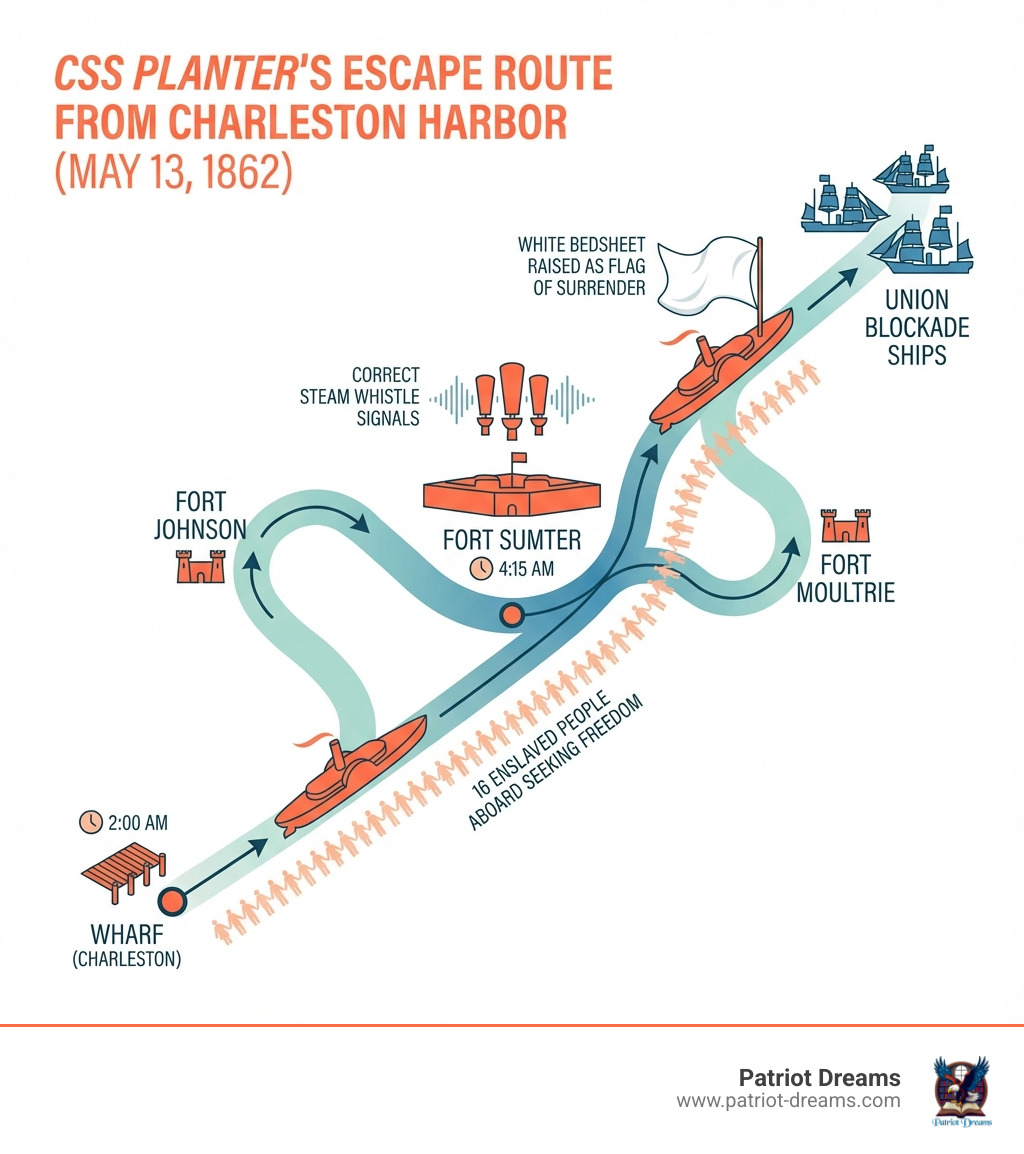
The execution of the plan was a masterpiece of nerve and precision. In the quiet, pre-dawn hours of May 13, 1862, Smalls and his crew slipped the Planter away from its dock. Their first, clandestine stop was at a pre-arranged rendezvous point, the North Atlantic Wharf. Here, under the cloak of darkness, Smalls' family—Hannah, their daughter Elizabeth, and infant son Robert Jr.—along with other enslaved men, women, and children, boarded the ship. In total, 16 souls were now aboard, their lives hanging precariously on the success of Smalls' audacious gamble.
The journey out of Charleston Harbor was fraught with peril. They had to steer past five heavily guarded Confederate forts, including the formidable Fort Sumter and Fort Moultrie, which were constantly on alert for Union attacks. Smalls' intimate knowledge of these waters, gained during his years working on the docks and aboard various vessels, proved invaluable. He knew the channels, the currents, and, most importantly, the specific coded steam whistle signals required to pass each checkpoint.
As they approached Fort Sumter, the tension must have been unbearable. It was around 4:15 a.m. Smalls, still in his captain's disguise, blew the ship's whistle with the correct sequence—two long blasts and one short one. The sentinel at Fort Sumter, believing it was the legitimate Confederate captain, waved them through. This moment, as the Planter glided past the Confederate stronghold, was a testament to Smalls' incredible composure and strategic brilliance. The relief must have been immense, but the danger was not yet over.
Once past the Confederate defenses, the next challenge was to reach the Union blockade without being mistaken for an enemy vessel and fired upon. With Confederate flags still flying, the Planter was a potential target. Quickly, the crew replaced the Confederate and South Carolina flags with an improvised symbol of peace and surrender: a white bedsheet. This simple yet profound act signaled their intentions to the Union ships blockading the harbor, anchored approximately ten miles away.
The Union ship USS Onward soon spotted them. As the Planter drew near, the Union sailors initially prepared for battle, but then noticed the white flag and the absence of any white officers on deck. The sight of the freed individuals, "some dancing, some singing, whistling, jumping," confirmed their intentions. Robert Smalls, standing proudly at the helm, delivered his triumphant and unforgettable greeting to the captain of the Onward: "Good morning, sir! I’ve brought you some of the old United States guns, sir!—that were for Fort Sumter, sir!" It was a moment of profound joy, a brilliant success in the face of unimaginable odds, and a powerful example of American Innovation: History in the pursuit of liberty.
A Hero’s Welcome and a Turning Point for the Nation
The arrival of the CSS Planter, steered by Robert Smalls and carrying 16 newly freed individuals, sent ripples throughout both the Union and the Confederacy. It was a moment that transcended a simple escape; it was a strategic victory and a powerful symbol.
The Union’s New Hero and a Moment of Joy
The immediate reaction from the Union was one of astonishment and celebration. Smalls and his crew were hailed as heroes. The sight of the freed slaves on the deck of the Planter, celebrating their newfound liberty, was deeply moving. As an eyewitness recalled, "When they discovered that we would not fire on them, there was a rush of contrabands out on her deck, some dancing, some singing, whistling, jumping; and others stood looking towards Fort Sumter, and muttering all sorts of maledictions against it." This spontaneous outpouring of joy underscored the profound significance of their daring act.
Beyond the emotional impact, Smalls' actions provided immediate and tangible benefits to the Union war effort. His intimate knowledge of Charleston Harbor's defenses—the placement of Confederate mines, the troop movements, and the layouts of the forts—was invaluable intelligence. Rear Admiral Samuel Francis Du Pont quickly recognized Smalls' intelligence and the strategic importance of the information he provided. This intelligence directly contributed to the Union's capture of Coles Island just a week after Smalls' escape. As a direct reward for their bravery and the military value of the captured ship, Congress passed a private bill awarding Smalls and his crew half the appraised value of the Planter as prize money. Robert Smalls personally received $1,500, a significant sum that would help him build a new life. Smalls' courage served as an inspiration, reminding us of the spirit found in stories of Revolutionary War Heroes who fought for freedom.
The Confederate reaction, predictably, was one of utter embarrassment and fury. They couldn't fathom how enslaved men could have orchestrated such a sophisticated escape. Initially, some suspected white involvement, unwilling to believe that enslaved individuals possessed the intelligence and capability for such an act. A bounty of $4,000 was quickly placed on Robert Smalls' head, a testament to the blow his actions dealt to Confederate morale and their perception of enslaved people.
Changing Minds and Joining the Fight for Freedom
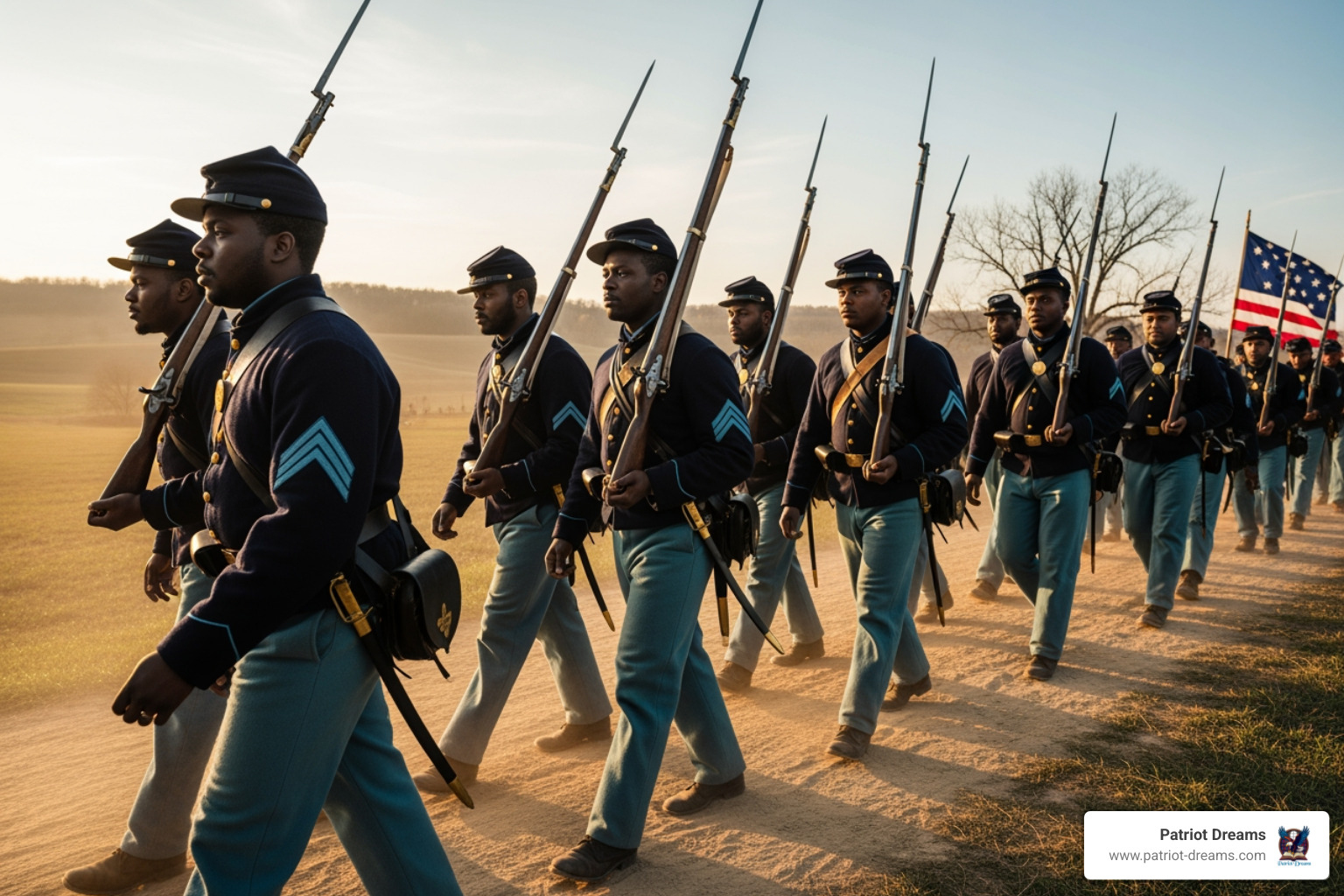
Robert Smalls’ heroism didn't stop with his escape. His actions had a profound impact on the Union war effort and, crucially, on the ongoing debate over arming Black soldiers. A few months after his escape, Smalls traveled to Washington D.C., where he met with President Abraham Lincoln. Alongside figures like Frederick Douglass, Smalls passionately argued for the enlistment of Black men into the Union army, asserting their right and capacity to fight for their own freedom and the preservation of the Union.
This pivotal meeting is widely credited with influencing War Secretary Edwin Stanton's order to enlist 5,000 Black service members. Smalls’ courageous act provided undeniable proof of the bravery, intelligence, and unwavering commitment of Black men to the cause of liberty. His testimony helped dismantle the racist arguments that had previously prevented Black men from serving in uniform. The impact was enormous: by the end of the Civil War, approximately 179,000 Black men served in the Union Army, and 19,000 served in the Navy. Their contributions were vital to the Union victory.
Smalls himself continued to serve with distinction in the Union Navy. He became a skilled pilot, participating in 17 engagements. Remarkably, he returned to pilot the very ship he had commandeered, the Planter, and later commanded the USS Crusader. He rose through the ranks to become the first Black man to be promoted to captain of a U.S. ship. His unwavering commitment to the Union cause, even after securing his own freedom, solidified his status as a true American hero.
From Freedom’s Hero to Statesman: The Enduring Legacy of Robert Smalls
Robert Smalls’ remarkable journey did not end with the Civil War. His transition from an enslaved man to a war hero and then to a respected statesman is a powerful testament to his vision and dedication to a better America.
A Life of Service After the War
After the cannons fell silent, Robert Smalls returned to his hometown of Beaufort, South Carolina, a free man. In a deeply symbolic act of reclaiming his dignity and heritage, he used his prize money from the Planter's capture to buy the very home where his former master, Henry McKee, had lived. This wasn't just a house; it was a powerful statement of reversal and justice.
Smalls immediately immersed himself in the challenging and hopeful era of Reconstruction. He understood that true freedom required political power and representation. He was elected to the South Carolina House of Representatives in 1868, and then to the South Carolina Senate in 1872. His political career culminated in serving five terms in the U.S. House of Representatives, representing South Carolina's Fifth Congressional District from 1875 to 1879 and from 1882 to 1883, and the Seventh Congressional District from 1884 to 1887.
As a congressman, Smalls championed critical issues for his community and for the nation. He was a tireless advocate for public education, believing it was the cornerstone of progress for African Americans. He fought valiantly against the disenfranchisement of Black voters, standing firm against the oppressive Black Codes and later Jim Crow laws that sought to strip away the hard-won rights of African Americans. He also played a key role in helping to found the Republican Party in South Carolina. His dedication to justice was recognized even years later when, in 1897, Congress granted him a pension equal to that of a Navy captain, acknowledging his extraordinary service. Robert Smalls' life exemplifies the enduring spirit of The American Dream: A Cultural Deep Dive, showing how one can rise from the most challenging circumstances to achieve greatness and serve others.
Why the Story of Stealing Freedom Endures
Robert Smalls’ story is more than just a historical anecdote; it is a timeless narrative that continues to inspire us today. It stands as a powerful symbol of courage, ingenuity, and the unyielding human spirit's desire for liberty. His ability to outwit his oppressors and secure freedom for himself and his loved ones challenged the very foundations of white supremacy and paternalistic ideologies prevalent in the South. He proved, beyond a doubt, that enslaved people were not only capable but brilliant strategists and determined fighters for their own liberation.
His legacy is deeply woven into the fabric of American Cultural History. It reminds us that ordinary people, even in the most dire circumstances, can perform extraordinary acts that change the course of history. Though his story, like many Black heroes, was at times overshadowed by the "Lost Cause" narrative, it is now rightfully being reclaimed and celebrated.
Modern honors continue to recognize Smalls' profound impact. In 2007, the U.S. Army commissioned the Major General Robert Smalls, marking the first time the service named a vessel after an African American. More recently, in 2023, the U.S. Navy renamed the USS Chancellorsville to the USS Robert Smalls, ensuring his name graces the seas he so bravely steered. Robert Smalls died on February 23, 1915, having witnessed the abolition of slavery, the emancipation of his people, the right of African American men to vote, and their service in the ranks of the U.S. government. As W.E.B. Du Bois eloquently put it, "The slave went free; stood for a brief moment in the sun; then move..." Smalls' story stands as a guide of hope and unity, inspiring future generations to believe in the power of courage, resilience, and the relentless pursuit of justice for all Americans.
Frequently Asked Questions about Robert Smalls’ Escape
How old was Robert Smalls when he escaped?
Robert Smalls was just 23 years old when he bravely commandeered the Planter and sailed his family and crew to freedom on May 13, 1862. His youth makes his incredible courage and strategic thinking even more remarkable.
What happened to the CSS Planter after it was captured?
The Union Navy took possession of the Planter immediately after its capture. Recognizing its value, they pressed it into service. Robert Smalls himself would later serve as its captain, using the very ship he sailed to freedom to serve the cause of the Union, participating in naval operations during the Civil War.
Did Robert Smalls’ crew receive any reward?
Yes, indeed! As a testament to their extraordinary bravery and the military value of the captured ship, the U.S. Congress awarded Smalls and his crew half the appraised value of the Planter as prize money. This reward was instrumental, helping Smalls, in particular, to purchase his former master’s home and build a new, free life for his family after the war.
Conclusion: The Unwavering Spirit of an American Hero
Robert Smalls’ life is a profound story of turning hardship into hope and oppression into opportunity. His journey from an enslaved man to a national hero and respected statesman reminds us that the American spirit is defined by courage, resilience, and an unshakeable belief in freedom. His legacy is a gentle reminder that every individual's story, no matter how humble its beginning, can contribute to the grand mix of our nation's history. At Patriot Dreams, we believe in the power of these stories to connect us to our shared heritage, to inspire kindness, and to foster a sense of unity and pride in our collective past. By preserving the legacies of heroes like Robert Smalls, we keep the heart of the American story beating for generations to come, encouraging us all to dream big and strive for a more just and compassionate world. Explore more inspiring stories shaping America’s history.

Join the Patriot Dreams Community
Download the app today and start your journey through American history and personal legacy.

Explore Our Latest Insights
Dive into stories that shape our American legacy.