
The US Constitution & Bill of Rights Explained Simply
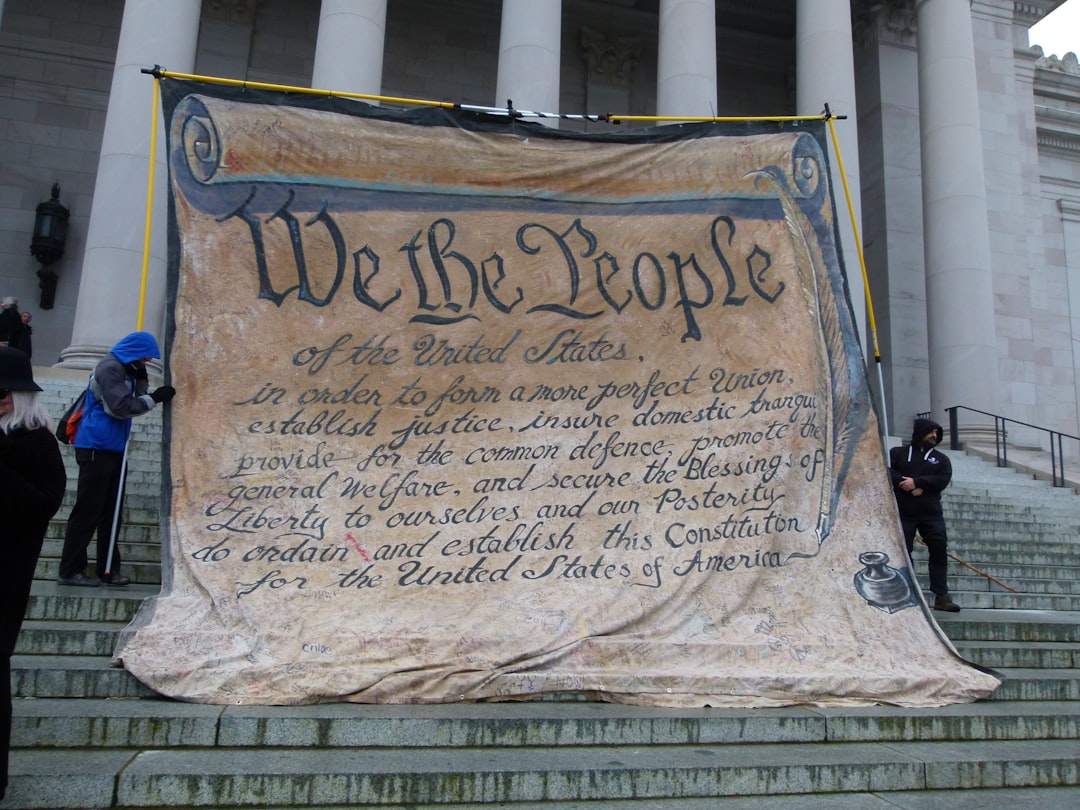

America's Blueprint for Freedom
The US Constitution & Bill of Rights are America's foundational documents. They created our government and protected our freedoms. Here's a simple breakdown:
The US Constitution (1787):
- Creates three branches of government (Legislative, Executive, Judicial)
- Establishes checks and balances to prevent abuse of power
- Sets up the framework for how America is governed
The Bill of Rights (1791):
- First 10 amendments to the Constitution
- Protects individual freedoms like speech, religion, and privacy
- Limits what the government can do to its citizens
Key Relationship:
- The Constitution tells the government what it can do
- The Bill of Rights tells the government what it cannot do
These documents were born from intense debates. The Federalists pushed for a strong central government, while the Anti-Federalists feared tyranny and demanded protections for individual rights. The original Constitution lacked a Bill of Rights, a move historian David O. Stewart called "a political blunder of the first magnitude."
The resulting compromise gave us both documents, creating a government both powerful and restrained. James Madison, initially against a Bill of Rights, became its main author, acknowledging that "a bill of rights is what the people are entitled to against every government on earth."
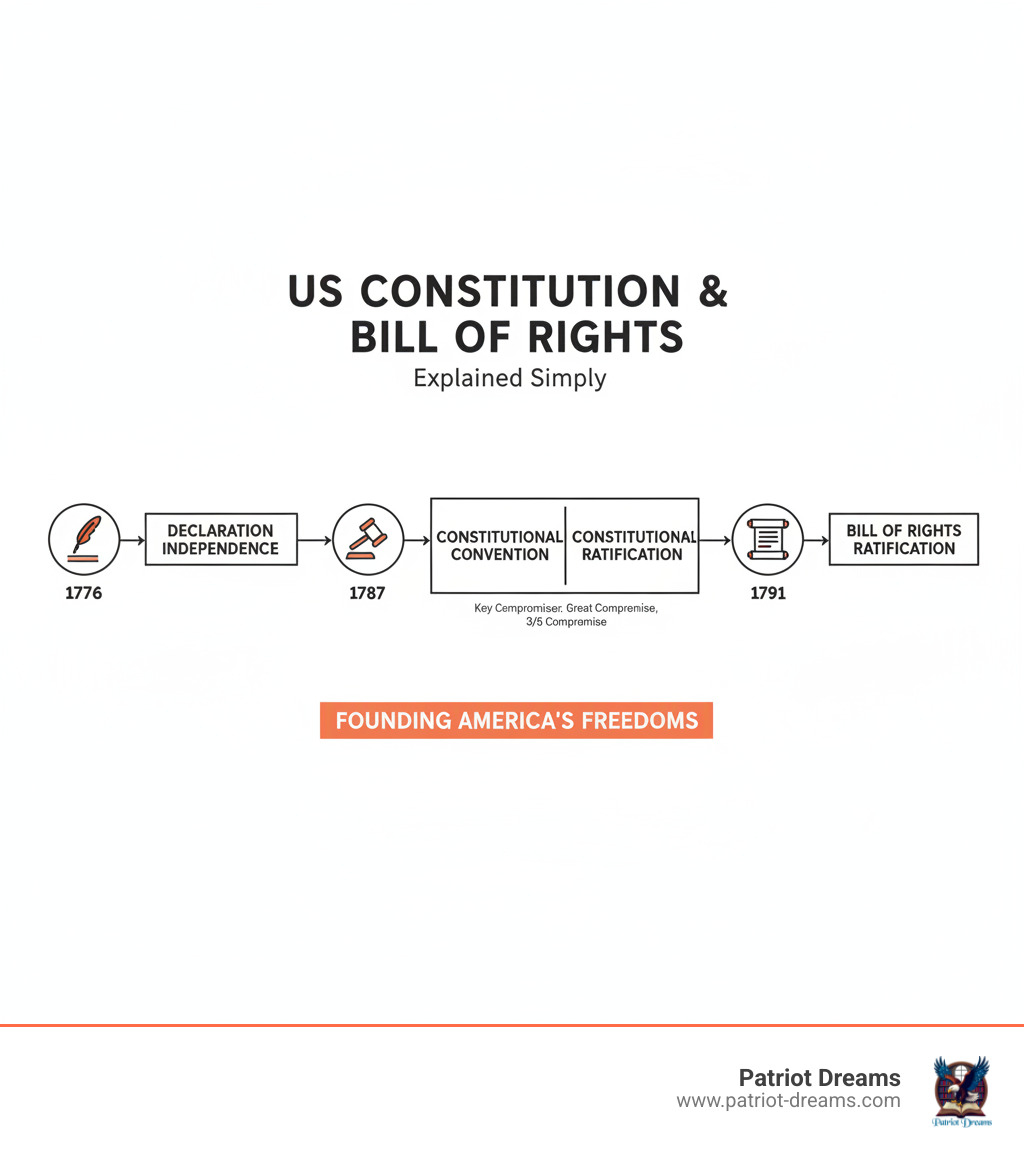
The Story Behind America's Founding Documents
The US Constitution & Bill of Rights were forged through intense debate, argument, and brilliant compromise. It began in 1776 with the Declaration of Independence, where Thomas Jefferson penned the radical idea that all people have "unalienable Rights" and that governments derive their power from the people.
However, America's first government, under the Articles of Confederation, proved too weak. It couldn't collect taxes or maintain order, a failure highlighted by Shays' Rebellion, an armed uprising of indebted farmers. It was clear a change was needed.
The Constitutional Convention of 1787 was convened to fix the Articles, but delegates like James Madison decided to start fresh. Intense debates gave rise to two factions: the Federalists, who wanted a strong central government, and the Anti-Federalists, who feared it would become tyrannical. To argue their case, Federalists wrote The Federalist Papers, but Anti-Federalists still demanded a written guarantee of individual rights.
The Massachusetts Compromise broke the deadlock: states would ratify the Constitution on the condition that a Bill of Rights be added. This classic American compromise satisfied both sides. In 1791, the first ten amendments—our Bill of Rights—were ratified. You can explore more about The Declaration, the Constitution, and the Bill of Rights to see how these documents work together.
The Constitution: A Framework for Government
The Constitution is America's instruction manual for "a government by the people." Having just escaped a king, the Founders were determined to prevent tyranny. Their solution was the separation of powers into three branches.
- The Legislative branch (Congress) makes laws. It consists of the House (representation by population) and the Senate (two seats per state).
- The Executive branch, led by the President, enforces laws. The President is Commander-in-Chief and manages foreign relations.
- The Judicial branch, headed by the Supreme Court, interprets laws and can declare them unconstitutional.
The system's genius lies in checks and balances. Each branch can limit the others. For example, the President can veto laws, but Congress can override the veto. The President appoints judges, but the Senate must approve them. This ensures no single branch becomes too powerful.
The Bill of Rights: A Promise to the People
Despite the Constitution's safeguards, Anti-Federalists remained wary. Their fear of a strong central government, born from experience with British rule, demanded more explicit protections for individual liberties.
The Bill of Rights was the answer. It's a promise to the people that certain freedoms are untouchable, limiting government power at its core. While the Constitution outlines what the government can do, the Bill of Rights states what it cannot do.
James Madison, initially skeptical, came to champion the Bill of Rights after the Massachusetts Compromise made it clear that Americans demanded written guarantees of individual liberties. This addition transformed the Constitution into a complete system that both empowered and constrained the government, securing its place as the foundation of American freedom.
The US Constitution & Bill of Rights Explained Simply: A Breakdown of Your 10 Core Freedoms
Let's explore the first ten amendments. These aren't just historical legal concepts; they are living protections that shape your everyday life.
The First Amendment: The Five Freedoms
The First Amendment packs five essential liberties into one powerful statement, telling the government to keep its hands off our most basic expressions.
- Freedom of religion: The government can't establish a state religion or stop you from practicing your faith (or no faith at all).
- Freedom of speech: Protects your right to speak your mind, even with unpopular opinions. While not absolute, the bar for limiting speech is high.
- Freedom of the press: Ensures journalists and others can report and hold power accountable without government interference.
- Freedom of assembly: You can gather peacefully with others, even if the government dislikes your message.
- Right to petition: You have a direct line to your government to demand change.
For a deeper dive, check out More on the First Amendment.
The Second, Third, and Fourth Amendments: Rights to Security and Privacy
These amendments protect your personal security and privacy from government intrusion.
- The Second Amendment protects the right to bear arms. While often debated, its core purpose relates to the ability of citizens to defend themselves.
- The Third Amendment prevents the government from forcing you to house soldiers (quartering of soldiers), reinforcing the principle that your home is your private space.
- The Fourth Amendment protects you from unreasonable searches and seizures. It generally requires law enforcement to get a warrant based on probable cause, protecting your right to privacy.
The Fifth through Eighth Amendments: Rights of the Accused
These amendments ensure fair treatment for those accused of crimes.
- The Fifth Amendment guarantees due process and protects against double jeopardy and self-incrimination (the right to remain silent).
- The Sixth Amendment ensures a speedy and public trial by an impartial jury and guarantees the right to a lawyer.
- The Seventh Amendment extends the right to a jury trial to certain civil cases.
- The Eighth Amendment protects against excessive bail and cruel and unusual punishment.
The Ninth and Tenth Amendments: The People's and States' Powers
These final amendments clarify the limits of government power.
- The Ninth Amendment states that people have unenumerated rights beyond those listed. It acknowledges that your rights are not limited to what is written down.
- The Tenth Amendment reinforces federalism. It says that any powers not given to the federal government are reserved for the states or the people, maintaining a crucial balance of power.
For a comprehensive look at what each amendment actually says, visit The Bill of Rights: What Does it Say?.
The Evolution of Rights: How They Apply in Modern Life
The US Constitution & Bill of Rights are living documents that have adapted to challenges the Founders never imagined, like digital privacy. Originally, the Bill of Rights only protected citizens from the federal government. Its expansion to cover all levels of government is a key story in American law.

The Fourteenth Amendment and Incorporation
For decades, states could legally infringe on basic freedoms, a reality confirmed in Barron v. Baltimore (1833). Everything changed after the Civil War with the post-Civil War amendments, especially the Fourteenth Amendment (1868).
Its Due Process Clause and Equal Protection Clause became powerful tools. Through a process called "incorporation," the Supreme Court began using the Due Process Clause to apply Bill of Rights protections to state governments. This gradual process, starting with cases like Gitlow v. New York (1925), extended federal protections to cover state actions. Thanks to incorporation, your constitutional rights are now protected from all levels of government.
How The US Constitution & Bill of Rights Explained Simply Balances Freedom and Order
Your constitutional rights are not unlimited. The Founders understood that a balance is needed between individual freedom and public order. For example, freedom of speech doesn't protect incitement to violence, and the Fourth Amendment protection against unreasonable searches has exceptions for public safety.
This balancing act leads to challenging modern debates: digital privacy, religious freedom versus anti-discrimination laws, and free speech versus online harassment. The Supreme Court continuously interprets these boundaries, weighing individual liberties against societal needs to find a balance where freedom can thrive safely.
Landmark Cases in Modern Times
Landmark Supreme Court cases show how these rights apply today.
- Miranda v. Arizona (1966): This Fifth Amendment case established that police must inform you of your rights upon arrest, including the right to remain silent and the right to an attorney.
- Tinker v. Des Moines (1969): This First Amendment case affirmed students' free speech rights in schools, ruling that symbolic protest is permissible as long as it doesn't disrupt the educational environment.
- Gideon v. Wainwright (1963): This landmark Sixth Amendment case guarantees the right to counsel for those who cannot afford a lawyer in serious criminal cases.
- Brown v. Board of Education (1954): This case used the Fourteenth Amendment's Equal Protection Clause to end legal segregation in schools, showing how constitutional principles evolve to fight injustice.
Frequently Asked Questions about the Constitution and Bill of Rights
Here are answers to some common questions about The US Constitution & Bill of Rights.
What is the main difference between the Constitution and the Bill of Rights?
Think of it like a house blueprint versus a security system.
The Constitution is the blueprint. It creates the government's structure—the three branches and their powers. It tells the government what it can do.
The Bill of Rights is the security system. It lists specific protections for citizens, telling the government what it cannot do.
One builds government power; the other limits it to protect individual liberty.
Does the Bill of Rights grant citizens their rights?
No, this is a common misconception. The Founders believed rights like free speech and fair treatment are inherent—you are born with them. The Bill of Rights doesn't grant these rights; it guarantees the government won't take them away.
The Ninth Amendment reinforces this, stating that just because some rights are listed doesn't mean you don't have other, unlisted rights.
Why is the Bill of Rights so important today?
The Bill of Rights is the cornerstone of American liberty. It's why you can express opinions online, practice your faith, and expect privacy from government intrusion. It ensures that if you're accused of a crime, you are treated fairly and have the right to a lawyer.
It provides the legal foundation for challenging government overreach. In our digital age, it helps us steer new questions about privacy and free speech online. Most importantly, it's a constant reminder that the government works for the people, not the other way around.
Conclusion: The Enduring Legacy of America's Charters of Freedom
The US Constitution & Bill of Rights are more than historical artifacts; they are living blueprints that shape our lives. They have proven their enduring relevance by guiding the nation through its greatest challenges.

When you speak your mind, practice your faith, or receive fair treatment in court, you are benefiting from the principles these documents protect. However, these rights don't protect themselves. They require our civic responsibility—to understand how our government works and to participate in preserving our freedoms.
The Founders knew their work wasn't perfect, so they created a process for amendments, allowing the Constitution to adapt. The American ideals they established—liberty, justice, and a government that serves the people—continue to inspire the world.
At Patriot Dreams, we believe knowing these stories helps us understand who we are and who we can become. The Constitution and Bill of Rights are our inheritance and our responsibility.
We invite you to keep exploring the rich mix of American history. There are countless stories of ordinary people doing extraordinary things. Explore more stories from American history and find how the past continues to shape our present.
After all, we're all part of this ongoing American story. The Constitution and Bill of Rights aren't just about what happened centuries ago—they're about what happens next, and that's up to all of us.

Join the Patriot Dreams Community
Download the app today and start your journey through American history and personal legacy.

Explore Our Latest Insights
Dive into stories that shape our American legacy.