The Definitive Guide to Father Kapaun: Medal of Honor Recipient
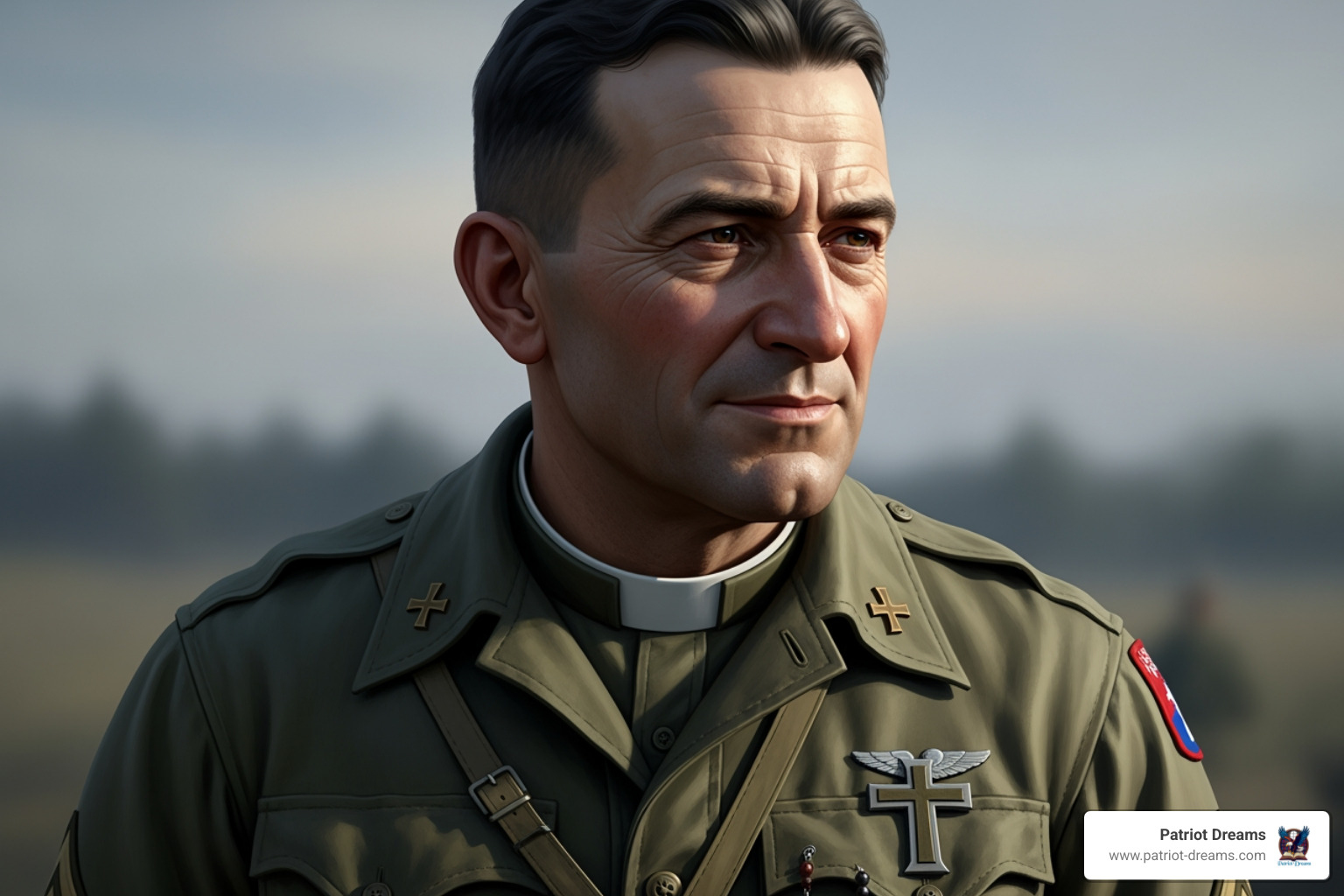
A Shepherd in Combat Boots
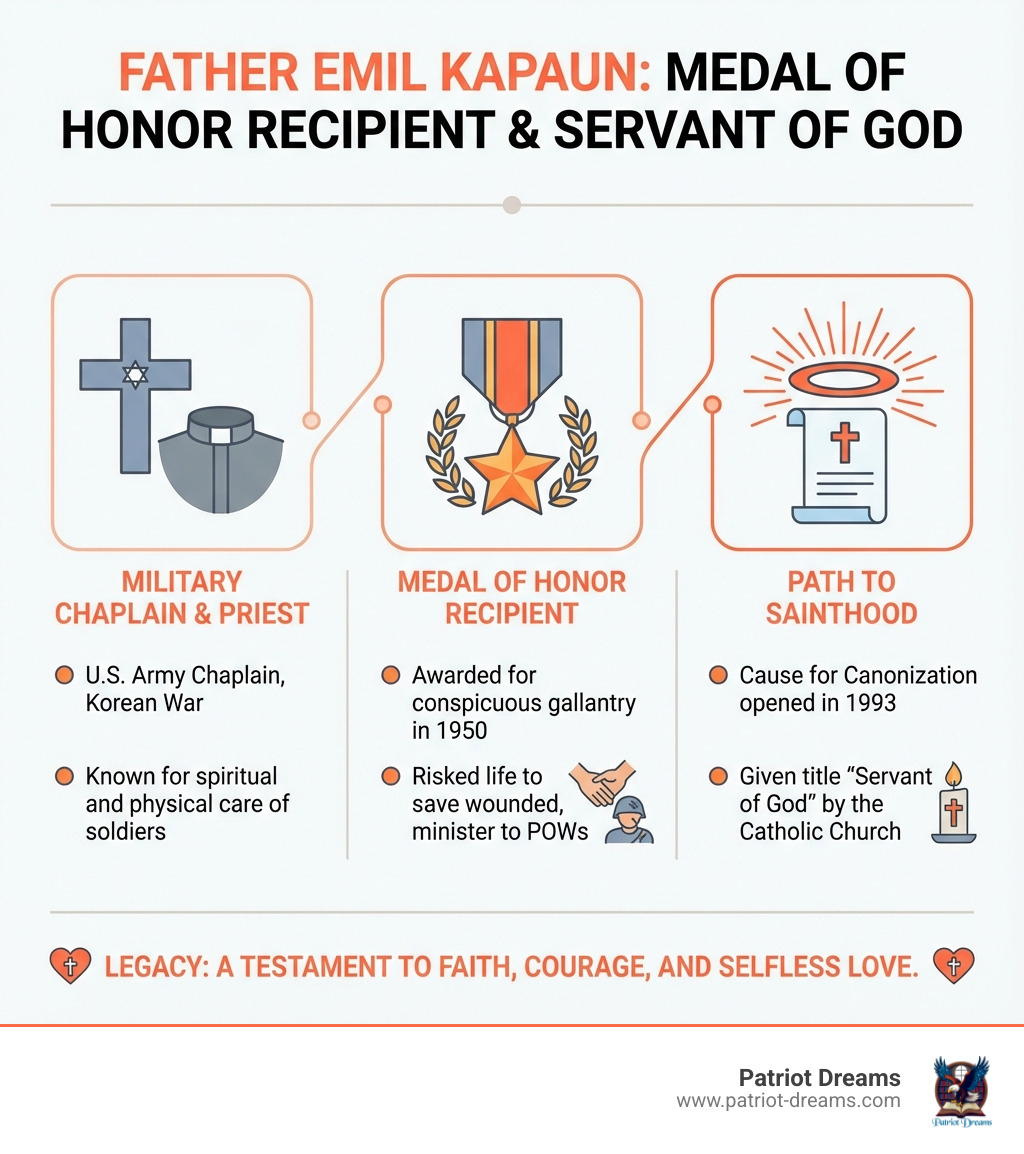
Who Was Father Kapaun? The Medal of Honor Recipient on the Path to Sainthood is a question that opens the door to one of America's most inspiring stories of faith, courage, and selfless service. Father Emil Kapaun was a Catholic priest and U.S. Army chaplain who served during World War II and the Korean War, earning the Medal of Honor posthumously in 2013 for his extraordinary heroism. In 2025, Pope Francis declared him "Venerable," placing him one step closer to sainthood. His fellow soldiers called him "a shepherd in combat boots" for the way he cared for them in battle and captivity.
Quick Facts About Father Kapaun:
- Born: April 20, 1916, in Pilsen, Kansas
- Ordained: June 9, 1940, as a Catholic priest
- Military Service: U.S. Army Chaplain in WWII and Korean War
- Medal of Honor Actions: Battle of Unsan, November 1-2, 1950
- Captured: November 2, 1950, by Chinese forces
- Death: May 23, 1951, in a POW camp at age 35
- Medal of Honor: Awarded posthumously on April 11, 2013
- Remains Found: Identified in May 2021 after 70 years
- Declared Venerable: February 25, 2025, by Pope Francis
Father Kapaun's story is one that brings Americans together. During some of the darkest moments of the Korean War, he walked through enemy fire to rescue wounded soldiers. When captured, he defied his captors to minister to fellow prisoners, sharing his meager rations and leading Easter services in secret. He died forgiving those who imprisoned him.
His life reminds us of the best of America: courage, compassion, and faith in something greater than ourselves. Whether you're drawn to military history, stories of faith, or simply tales of everyday heroism, Father Kapaun's journey from a Kansas farm to the halls of both military honor and potential sainthood offers inspiration for all.
From a Kansas Farm to the Priesthood
Our story begins in the heartland of America, amidst the gentle rhythms of farm life in Pilsen, Kansas. It was here, on April 20, 1916, that Emil Joseph Kapaun was born to Enos and Elizabeth Kapaun, proud descendants of Czech immigrants. Growing up on a farm taught young Emil invaluable lessons about hard work, resilience, and the power of ingenuity – skills that would serve him, and countless others, in ways he could never have imagined. He learned to mend broken machinery and work the land, fostering a practical spirit that would later shine brightly in the grimmest of circumstances.
But beyond the fields and the chores, a different calling stirred in Emil's heart. He felt a deep pull towards spiritual service, a desire to dedicate his life to God and his fellow human beings. This profound vocation led him to the seminary, where he diligently pursued his studies. On June 9, 1940, Emil Kapaun was ordained a Catholic priest for the Diocese of Wichita, Kansas. It was a momentous occasion, marking the beginning of a life committed to pastoral care and spiritual guidance.
His intellectual curiosity and dedication to learning also led him to The Catholic University of America, where he earned a Master of Arts degree in Education. This period of academic pursuit further equipped him with knowledge and understanding, enriching his capacity to serve. His time at the university was a testament to his belief in continuous growth, both spiritually and intellectually. As the Office of Military and Veteran Student Services at The Catholic University of America aptly notes, his journey represented "the best of military traditions and Church life." To learn more about His time at The Catholic University of America and his academic contributions, we can see how deeply rooted his commitment was to both faith and knowledge.
Who Was Father Kapaun? The Medal of Honor Recipient on the Path to Sainthood
Father Kapaun's journey took an unexpected turn with the advent of global conflicts. He answered the call to serve his country, joining the U.S. Army Chaplain Corps. His first military deployment was during World War II, where he served in the distant and challenging China-Burma-India Theater from April 1945 to May 1946. Even then, his dedication to the soldiers was evident, offering spiritual comfort and a steady presence amidst the chaos of war.
After his initial service, Father Kapaun returned home, pursuing his master's degree. Yet, the call to serve those in uniform remained strong. He voluntarily returned to active duty, a decision that speaks volumes about his character and commitment. In July 1950, he was deployed to Korea, joining the 1st Cavalry Division. This marked the beginning of the chapter that would define his legacy, solidifying his place in history as not only a military hero but also a guide of spiritual strength. His willingness to return to the front lines, leaving the comfort of civilian life behind, truly exemplifies the spirit of selfless service we cherish. We invite you to explore More about other American heroes who have shaped our nation's history.
The Battle of Unsan: Answering the Call
In the autumn of 1950, as the Korean War raged, Father Kapaun found himself on the battlefield near Unsan. This was where his extraordinary bravery first came into sharp focus, revealing the "shepherd in combat boots" his fellow soldiers would come to revere. During intense combat operations from November 1-2, 1950, Father Kapaun moved fearlessly amidst relentless enemy fire. His mission was clear: to provide comfort and medical aid to the wounded, regardless of the danger to himself. He raced between foxholes and even ventured into "no-man's land" to drag injured soldiers to safety.
One of the most poignant moments occurred when able-bodied men were ordered to evacuate. Father Kapaun, without hesitation, elected to stay behind with the wounded, knowing full well the immense risk. His Medal of Honor citation details how he "calmly walked through withering enemy fire to provide comfort and medical aid to comrades and rescue wounded." He even convinced an injured Chinese officer to negotiate the safe surrender of American forces, an act of quick thinking and courage that saved many lives. In a moment of sheer heroism, he physically intervened to stop an enemy soldier from executing Sergeant First Class Herbert A. Miller, pushing the weapon aside and saving a life.
His actions during these harrowing days were a testament to his unwavering commitment to his flock. He was captured by Chinese forces on November 2, 1950, but not before performing acts of gallantry that would forever be etched in the memories of those he served. His selfless dedication, even in the face of capture, laid the foundation for his posthumous Medal of Honor. For a deeper understanding of these incredible actions, we can look to the official Details from the Medal of Honor citation.
A Light in the Darkness: Hope in a POW Camp
Capture did not diminish Father Kapaun's spirit; instead, it ignited an even greater fire of compassion and resolve. For seven grueling months, he was a prisoner of war in the notorious Pyoktong camp. The conditions were horrific: extreme cold, starvation, disease, and brutal treatment by their captors. Yet, in this crucible of suffering, Father Kapaun became a guide of hope and a testament to the human spirit's capacity for good.
His selflessness knew no bounds. He consistently put the needs of others before his own, sharing his meager rations and even giving away his own clothes to those who shivered more violently than he. From the practical skills learned on his Kansas farm, he improvised solutions for daily survival, digging latrines, mediating disputes among desperate men, and fashioning vessels from iron sheets to wash clothes and purify drinking water. He was, as one fellow POW remarked, "the best food thief we had," often sneaking out at night to scavenge for food, praying to St. Dismas, the "Good Thief," for success.
Father Kapaun defied his captors' strict rules against religious practice. He secretly led prayer meetings, heard confessions, and offered spiritual guidance. Most famously, he conducted a sunrise Easter service in 1951, a profound act of defiance and faith that brought immense solace to the imprisoned men. He inspired hope, maintained morale, and helped keep the death rate lower than in other camps, simply by caring. Even when he became desperately ill with pneumonia and a blood clot in his leg, he continued to minister, ignoring his own suffering until he could no longer move.
On May 23, 1951, at the young age of 35, Father Kapaun died in the POW camp's makeshift "hospital," denied medical assistance. His final words were an extraordinary act of grace: he forgave his guards and offered comfort to his fellow prisoners, saying, "Don't worry about me. I'm going where I've always wanted to go, and when I get there, I'll say a prayer for all of you." His unwavering faith and boundless love, even in the face of death, left an indelible mark on every soul he touched.
An Enduring Legacy of Heroism and Holiness
Father Kapaun's story, though tragically cut short, did not end with his death in the POW camp. His heroism and holiness resonated deeply with those he served, ensuring his legacy would endure. For decades, his fellow POWs championed his cause, relentlessly sharing their testimonies and keeping his memory alive. They were the keepers of his flame, ensuring that his extraordinary acts of courage and compassion would not be forgotten.
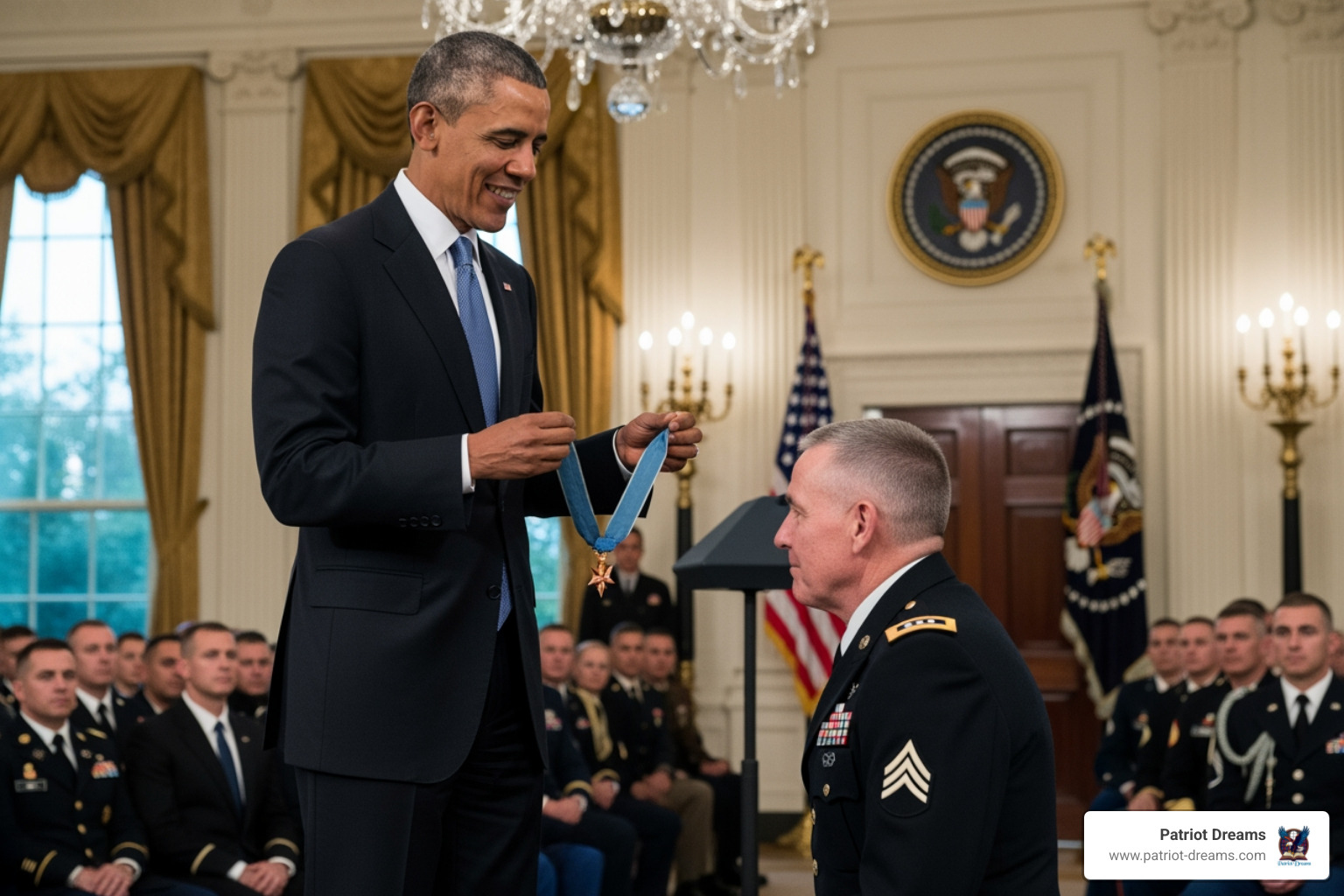
This tireless advocacy eventually led to the highest military honor. On April 11, 2013, more than six decades after his death, Father Kapaun was posthumously awarded the Medal of Honor. It was a powerful moment, with President Barack Obama presenting the medal to Father Kapaun's nephew, Ray Kapaun, at a White House ceremony. This recognition was a profound validation of the stories told by the men whose lives he had touched and saved.
A remarkable chapter in his story unfolded in May 2021, when, after 70 years, Father Kapaun's remains were positively identified. He had been buried as an "unknown" in the National Memorial Cemetery of the Pacific in Hawaii since 1956. This finding, part of the Defense POW/MIA Accounting Agency's diligent efforts, brought immense relief and a sense of closure to his family and all who admired him. In September 2021, Father Kapaun finally returned home to Kansas. His remains were reinterred with full military honors at the Cathedral of the Immaculate Conception in Wichita, a homecoming that was both solemn and celebratory. This emotional Return home to Kansas allowed countless people to pay their respects. Each year, thousands continue to honor his memory with a 60-mile pilgrimage from Wichita to his hometown, a living tribute to his enduring spirit.
Who Was Father Kapaun? The Medal of Honor Recipient on the Path to Sainthood
Beyond military accolades, Father Kapaun's selfless life has also set him on a spiritual path towards sainthood within the Catholic Church. This journey began in earnest in 1993 when Pope John Paul II declared him a "Servant of God," the first formal step in the rigorous canonization process. It was a recognition that his life demonstrated exceptional virtue worthy of investigation.
The most recent significant step occurred on February 25, 2025, when Pope Francis officially declared Father Kapaun "Venerable." This declaration signifies that the Church has recognized his heroic virtues and, in his case, his "offering of life"—a specific criterion for sainthood established by Pope Francis in 2017. This criterion acknowledges individuals who freely offered their lives for others, leading to their death, motivated by profound charity and an imitation of Christ. Father Kapaun's actions in the POW camp, where he sacrificed his health and well-being for his fellow prisoners, perfectly embody this spiritual ideal.
The path to sainthood involves several stages. After being declared Venerable, the next step is beatification, which typically requires a verified miracle attributed to his intercession. Should a miracle be confirmed, he would be declared "Blessed." A second verified miracle would then pave the way for his canonization, making him a "Saint." It's a profound process, and should it come to pass, Father Kapaun would potentially become the first saint to also be a Medal of Honor recipient, a truly unique distinction. The Diocese of Wichita has been diligently leading his cause for sainthood, collecting testimonies and evidence of his virtuous life. To learn more about Pope Francis's 2025 declaration and the significance of this step, we see the deep spiritual recognition of his life. His story reminds us that heroism comes in many forms, and faith can be the greatest strength. We are always inspired by such figures; you can find More on inspiring historical figures who have left their mark on our American story.
Frequently Asked Questions about Father Kapaun
We often hear questions about Father Kapaun's remarkable life and journey. Here, we aim to answer some of the most common inquiries, shedding more light on this extraordinary American hero.
Why was Father Kapaun awarded the Medal of Honor?
Father Kapaun was posthumously awarded the Medal of Honor for his "conspicuous gallantry and intrepidity at the risk of his life above and beyond the call of duty." His citation highlights his actions during combat operations at Unsan, Korea, from November 1-2, 1950. During this intense period, he repeatedly moved under enemy fire to rescue wounded soldiers, administer last rites, and provide comfort. When his unit was overrun, he voluntarily remained with the wounded, refusing an opportunity to escape, placing himself in harm's way to continue his ministry and care.
As a prisoner of war, his selflessness continued. He risked his life daily to care for the sick and wounded, scrounge for food, and lead prayers, inspiring hope and courage in his fellow captives. His Medal of Honor recognized not only his battlefield bravery but also his enduring spirit and compassionate leadership in the direst of circumstances.
Here is a list of his key military awards:
- Medal of Honor
- Distinguished Service Cross (later upgraded to Medal of Honor)
- Legion of Merit
- Bronze Star Medal with "V" Device
- Purple Heart
- Prisoner of War Medal
- Taegeuk Order of Military Merit (Republic of Korea)
What does it mean that Father Kapaun is 'Venerable'?
Being declared "Venerable" is a significant step in the Catholic Church's process towards sainthood. It means that the Pope has officially recognized that the individual lived a life of "heroic virtue" or, in Father Kapaun's case, made an "offering of life." This declaration signifies that the Church has thoroughly investigated his life and found that he consistently practiced virtues like faith, hope, charity, prudence, justice, fortitude, and temperance to an extraordinary degree.
The decree from Pope Francis on February 25, 2025, acknowledges his profound love and sacrifice for others. It precedes two further stages: "Blessed" (beatification), which typically requires a verified miracle attributed to the individual's intercession, and "Saint" (canonization), which requires a second verified miracle. It's a recognition that his life is an inspiring example for all people of faith.
How were Father Kapaun's remains found?
For 70 years after his death in the Pyoktong POW camp, Father Kapaun's remains lay buried under an "Unknown" marker in the National Memorial Cemetery of the Pacific in Hawaii. The Defense POW/MIA Accounting Agency (DPAA) has a vital mission to account for missing U.S. personnel, and in 2019, as part of their Korean War Disinterment Project, they disinterred 867 sets of "unknown" remains from that cemetery.
The identification process is meticulous, involving advanced forensic science, including DNA analysis and dental records. A crucial piece of the puzzle came earlier, in 2003, when a fellow prisoner of war, Robert McGreevy, saw a picture of Father Kapaun in a Knights of Columbus magazine at a Veterans Affairs clinic in Florida. This led to further investigation and eventually, the scientific confirmation. In May 2021, the DPAA announced the positive identification of Father Kapaun's remains, bringing a long-awaited homecoming for this American hero. It was a moment that underscored our nation's unwavering commitment to never leave a fallen comrade unaccounted for.
A Story of Unwavering Faith and Service
The story of Father Emil Kapaun is more than just a historical account; it's a timeless narrative that speaks to the very best of the human spirit. His journey from a Kansas farm to the battlefields of Korea, and then into the harrowing confines of a POW camp, is a profound testament to unwavering faith, boundless courage, and selfless service. He embodied kindness, demonstrated incredible resilience in the face of unimaginable hardship, and fostered a sense of community among those who had lost almost everything.
Father Kapaun's life is a unifying American story, transcending boundaries and inspiring us all. It reminds us that true heroism often lies not in power or conquest, but in humble acts of compassion, in lifting others up, and in standing firm in one's convictions. At Patriot Dreams, we believe that stories like Father Kapaun's are the heart of our nation's heritage. They are the gentle, kind, and thoughtful narratives that make us feel connected, hopeful, and proud. His legacy encourages us to look for the good in every situation and to strive to be "shepherds" in our own communities, caring for those around us.
We are so grateful for the opportunity to share stories that inspire and uplift, reminding us of the enduring values that make America so special. We invite you to Explore more stories of American heritage and find other incredible figures who have shaped our shared history.

Join the Patriot Dreams Community
Download the app today and start your journey through American history and personal legacy.

Explore Our Latest Insights
Dive into stories that shape our American legacy.