How Women and Immigrants Shaped the American Story

The Long March to the Ballot: A Heartfelt Look at Women's Suffrage History
Women's suffrage history is the story of ordinary people doing extraordinary things — generation after generation — until the door to democracy finally opened for everyone.
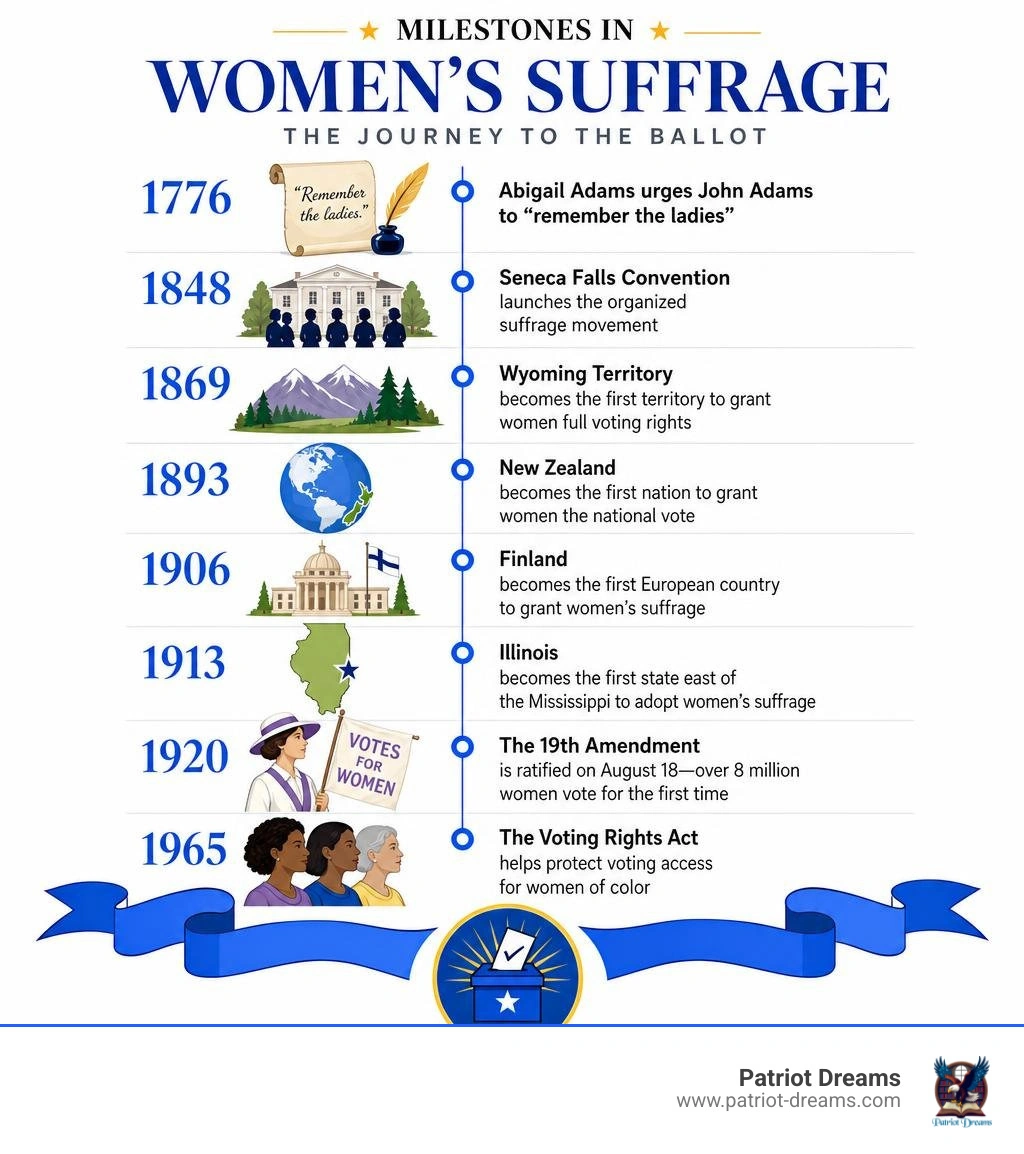
Here is a quick overview of the key milestones:
| Year | Milestone |
|---|---|
| 1776 | Abigail Adams urges John Adams to "remember the ladies" |
| 1848 | Seneca Falls Convention launches the organized suffrage movement |
| 1869 | Wyoming becomes the first territory to grant women full voting rights |
| 1893 | New Zealand becomes the first nation to grant women the national vote |
| 1906 | Finland becomes the first European country to grant women's suffrage |
| 1913 | Illinois becomes the first state east of the Mississippi to adopt women's suffrage |
| 1920 | The 19th Amendment is ratified on August 18 — over 8 million women vote for the first time |
| 1965 | The Voting Rights Act helps protect voting access for women of color |
It took nearly 100 years of marching, petitioning, debating, and persevering for American women to win the right to vote. That is not a footnote in history. That is one of the greatest acts of quiet, determined courage this country has ever seen.
And it was not a single movement. It was a patchwork of voices — mothers and daughters, abolitionists and factory workers, women from the East Coast and the Western frontier — each adding their thread to the same great tapestry.
This article walks you through that journey: the sparks, the setbacks, the splits, and ultimately, the triumph.
Explore more about Women's suffrage history:
1. The Early Hearth of Freedom: Seneca Falls and the Spark of Equality
Long before the organized crusade for the vote began, the desire for equal representation was quietly shared around kitchen tables and in handwritten letters. We often think of the suffrage movement as starting in the mid-19th century, but the longing for a voice in our nation’s future is as old as the country itself.
In the spring of 1776, as the Continental Congress drafted the founding principles of a new nation, Abigail Adams wrote to her husband John Adams, one of our prominent Founding Fathers. She gently but firmly urged him to "remember the ladies." She warned him that women would not hold themselves bound by laws in which they had no voice or representation. Though her husband and the other Declaration Independence Signers did not heed her call, Abigail’s words remained a guiding light for generations of women to come.
These early advocates were true Revolutionary War Heroes in their own right, fighting a quiet battle for the soul of American democracy. They believed that a home built on the foundation of liberty must have room for everyone at the hearth.
Early Milestones in Women's Suffrage History
If we look even further back into our colonial past, we find remarkable individuals who challenged the boundaries of their time. In 1648, more than a century before the American Revolution, a determined woman named Margaret Brent stood before the Maryland Assembly. As the executor of Governor Leonard Calvert’s estate, she formally demanded not just one, but two votes in the assembly—one for herself and one to represent the estate. Though her request was denied, she set a brave precedent of female civic action.
There were also moments of early progress that were later taken away. When the Revolutionary War ended, New Jersey’s 1776 constitution granted voting rights to all free, property-owning inhabitants, regardless of gender or race. For three decades, property-owning women in New Jersey regularly cast ballots in local and national elections.
However, in 1807, the state legislature passed a law restricting the franchise to white, tax-paying, adult males. This legal setback was part of a broader shift toward "coverture"—a legal doctrine under which a married woman’s legal personhood was suspended and absorbed by her husband. Coverture meant women could not own property, sign contracts, or control their own earnings, making it incredibly difficult to organize or fund a political movement. To learn more about how these early legal structures shaped the nation, you can explore Women's suffrage in the United States .
The Declaration of Sentiments and the Power of Shared Voices
The formal launch of the organized movement occurred in July 1848 in the quiet, canal-side town of Seneca Falls, New York. Organized by Lucretia Mott and Elizabeth Cady Stanton, the Seneca Falls Convention brought together about 300 people, including reformers, abolitionists, and local citizens.
Stanton drafted the convention's foundational document, the Declaration of Sentiments, intentionally modeling it after the Declaration of Independence. She wrote:
"We hold these truths to be self-evident: that all men and women are created equal."
Stanton recalled that they "were but a handful" during those early days, and demanding the "elective franchise" was considered their most radical proposal. Even Lucretia Mott initially worried that asking for the vote would make the movement look ridiculous to the public.
The resolution only passed because Frederick Douglass, the legendary abolitionist and statesman, stood up and spoke passionately in its support. Douglass argued that the world would never be just until women were active participants in making the laws. His voice helped forge a deep, early bond between the anti-slavery movement and the struggle for women's rights, establishing a shared vision of moral equality and civic sisterhood.
2. A House Divided and Rebuilt: The Civil War, Reconstruction, and the Great Split
During the American Civil War, women's rights advocates paused their campaign for the ballot to support the Union and work toward the abolition of slavery. Women served as nurses, organized relief societies, and collected nearly 400,000 signatures for the Women's Loyal National League petition to abolish slavery—the largest petition drive in American history up to that point.
When the war ended, reformers hoped that the reconstruction of the nation would bring universal suffrage for all adult citizens. However, this hope soon ran into the complex realities of constitutional politics. Many of the same women who fought for abolition found themselves at a painful crossroads when the 14th and 15th Amendments were drafted.
These legal changes are beautifully documented in Woman Suffrage Centennial | The Senate and Women's Fight for the Vote , which traces the deep legislative debates that occurred within the halls of Congress.
The Reconstruction Amendments and the Crossroads of Reform
The drafting of the 14th Amendment introduced a major constitutional setback for women. For the first time, the word "male" was explicitly written into the U.S. Constitution to define who counted as a citizen for voting representation. This meant that while the amendment guaranteed equal protection under the law, it legally reinforced gender discrimination at the ballot box.
When the 15th Amendment was proposed to protect the voting rights of newly emancipated African American men, it did not include any protections against discrimination based on sex. Prominent abolitionist allies like Frederick Douglass and William Lloyd Garrison felt that securing the vote for Black men was an urgent matter of life and death in the post-war South, calling it "the negro's hour."
This period also featured powerful appeals for unity and equality, such as those highlighted in the famous Sojourner Truth Speech, where she reminded the nation of the intersecting struggles of Black women who deserved both freedom and political representation.
Two Paths to the Same Dream: NWSA vs. AWSA
The disagreement over the 15th Amendment caused a deep and painful split within the American Equal Rights Association (AERA) in 1869, leading to the creation of two separate national suffrage organizations.
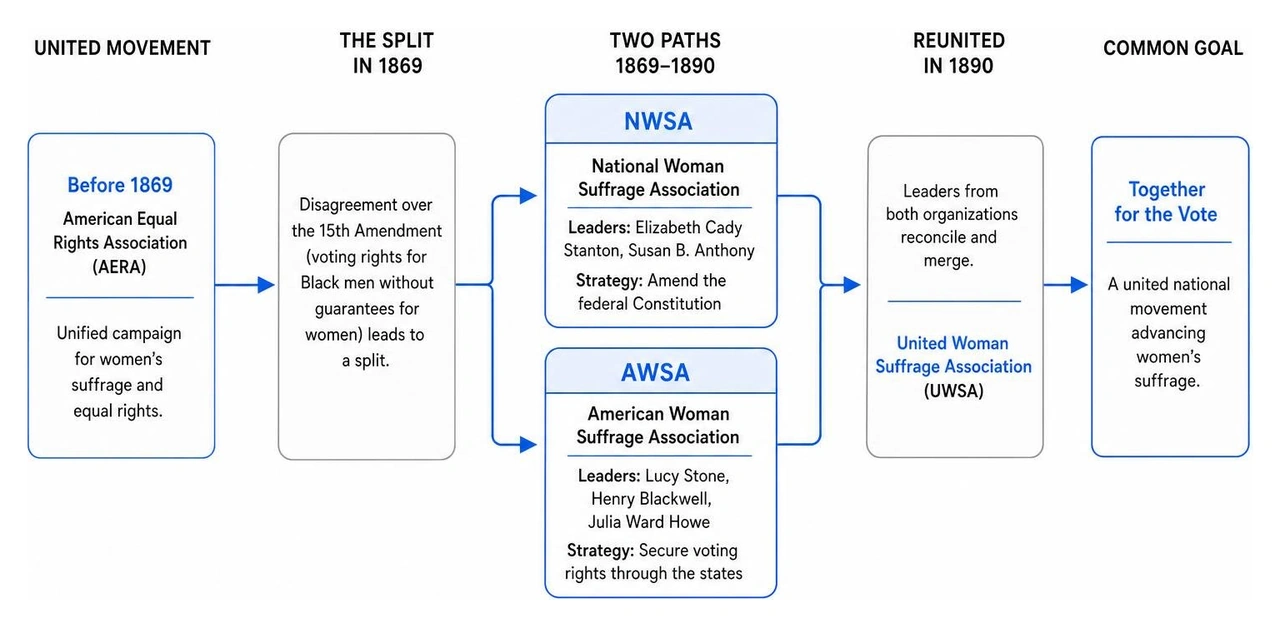
The two organizations differed significantly in their leadership, strategy, and vision:
| Feature | National Woman Suffrage Association (NWSA) | American Woman Suffrage Association (AWSA) |
|---|---|---|
| Founders | Elizabeth Cady Stanton, Susan B. Anthony | Lucy Stone, Henry Blackwell, Julia Ward Howe |
| Primary Goal | Federal constitutional amendment for women's suffrage | State-by-state enfranchisement campaigns |
| Scope of Issues | Broad social reforms (divorce laws, property rights, labor reform) | Single-focus campaign (securing the vote) |
| Stance on 15th Amendment | Opposed because it excluded women | Supported as a necessary step forward for civil rights |
Susan B. Anthony and Elizabeth Cady Stanton led the NWSA from New York, focusing on a federal amendment. In 1872, Anthony tested the legal limits of the 14th Amendment by registering and voting in the presidential election in Rochester, New York. She was arrested, tried, and fined $100—a fine she proudly refused to pay.
Meanwhile, Lucy Stone and her allies in the AWSA focused on building local support, believing that winning the vote state-by-state would eventually force the federal government to act. These two paths, though divided for over twenty years, both helped lay the groundwork for the ultimate success of the movement.
To read about other pioneering women who helped shape our country, you can check out Women In Revolution.
3. The Heart of the Home in Public Spaces: How the Movement's Message Evolved
As the United States moved into the late 19th and early 20th centuries, the rapid growth of cities and industries changed the daily lives of millions of families. The suffrage movement began to shift its messaging to reflect these changes.
Instead of arguing solely on the basis of abstract "natural rights," suffragists increasingly argued that women needed the vote to protect their homes, children, and communities.
From Natural Rights to the Maternal Commonwealth
This shift in strategy was closely tied to the rise of "maternalism"—the idea that women possessed a unique moral, nurturing, and domestic nature. Suffragists argued that instead of pulling women away from their traditional roles, the vote would allow them to bring their domestic virtues into the public sphere. This concept was often called "civic housekeeping."
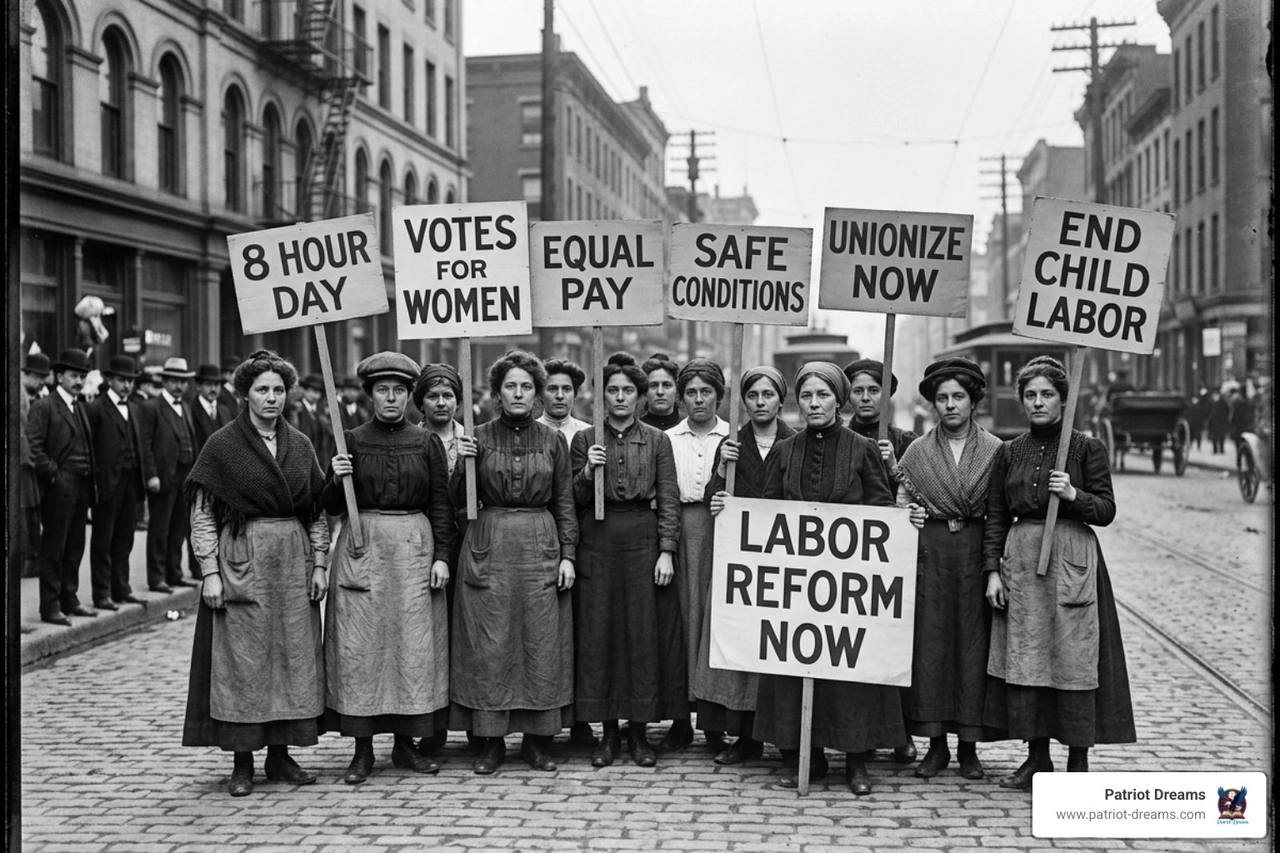
Women argued that they could not keep their homes clean, their food safe, or their children healthy if they had no control over the laws governing sanitation, education, and child labor. This argument resonated deeply with middle-class families and aligned the suffrage movement with other popular social reform efforts of the Progressive Era, such as the temperance movement and the creation of women's labor unions.
By framing the vote as a tool to protect the family, the movement gained widespread mainstream support and made the idea of female voting feel less threatening to traditional social structures.
The Growing Strength of Working Women
At the same time, the economic reality of American households was shifting rapidly. Between 1880 and 1910, the number of employed women in the United States tripled, growing from 2.6 million to 7.8 million. At the turn of the century, 60 percent of these working women were employed as domestic servants, while millions of others worked in textile mills, factories, and retail shops.
For these women, the vote was not just a symbol of equality; it was a practical tool to fight for safer working conditions, fair wages, and reasonable hours. The tragic Triangle Shirtwaist Factory fire of 1911 in New York City, which claimed the lives of 146 young garment workers, highlighted the urgent need for political representation.
Working-class women joined forces with wealthy reformers, bringing a new energy, determination, and economic focus to the suffrage campaign.
4. Courage in Action: The Winning Plan and the Final Push for the Vote
In 1890, the two rival suffrage organizations merged to form the National American Woman Suffrage Association (NAWSA). This merger marked the beginning of a coordinated national campaign.
As we look back from our perspective in July 2026, we can appreciate how this era produced some of the most Famous Figures In American History, whose stories of resilience continue to inspire us today.
Carrie Chapman Catt’s Visionary Strategy
In 1915, Carrie Chapman Catt took leadership of NAWSA and introduced her famous "Winning Plan." This was a highly disciplined, multi-tiered political campaign that combined lobbying in Washington, D.C., with grassroots campaigns in individual states.
Catt’s strategy was to secure suffrage victories in key states, particularly in the East and Midwest, to build unstoppable political momentum. She recognized that as more states enfranchised women, members of Congress from those states would be forced to support a federal amendment to satisfy their new female constituents.
Under her leadership, NAWSA grew to over two million members, becoming a highly sophisticated political machine that coordinated petition drives, held parades, and lobbied politicians at every level of government.
Silent Sentinels and the Impact of World War I
While NAWSA pursued a diplomatic, lobbying-focused approach, a younger generation of activists led by Alice Paul and Lucy Burns felt that more direct action was needed. They formed the National Woman's Party (NWP) and introduced more confrontational tactics inspired by the British suffrage movement.
In January 1917, the NWP organized the "Silent Sentinels"—the first group of protestors to picket the White House. For months, through rain and snow, these women stood silently at the gates, holding banners that asked:
"Mr. President, how long must women wait for liberty?"
When the United States entered World War I in April 1917, NAWSA chose to support the war effort, arguing that women's service on the home front and in factories proved their patriotism and deserved enfranchisement.
However, the Silent Sentinels continued their protests, arguing that it was hypocritical for President Woodrow Wilson to fight for democracy abroad while denying it to women at home.
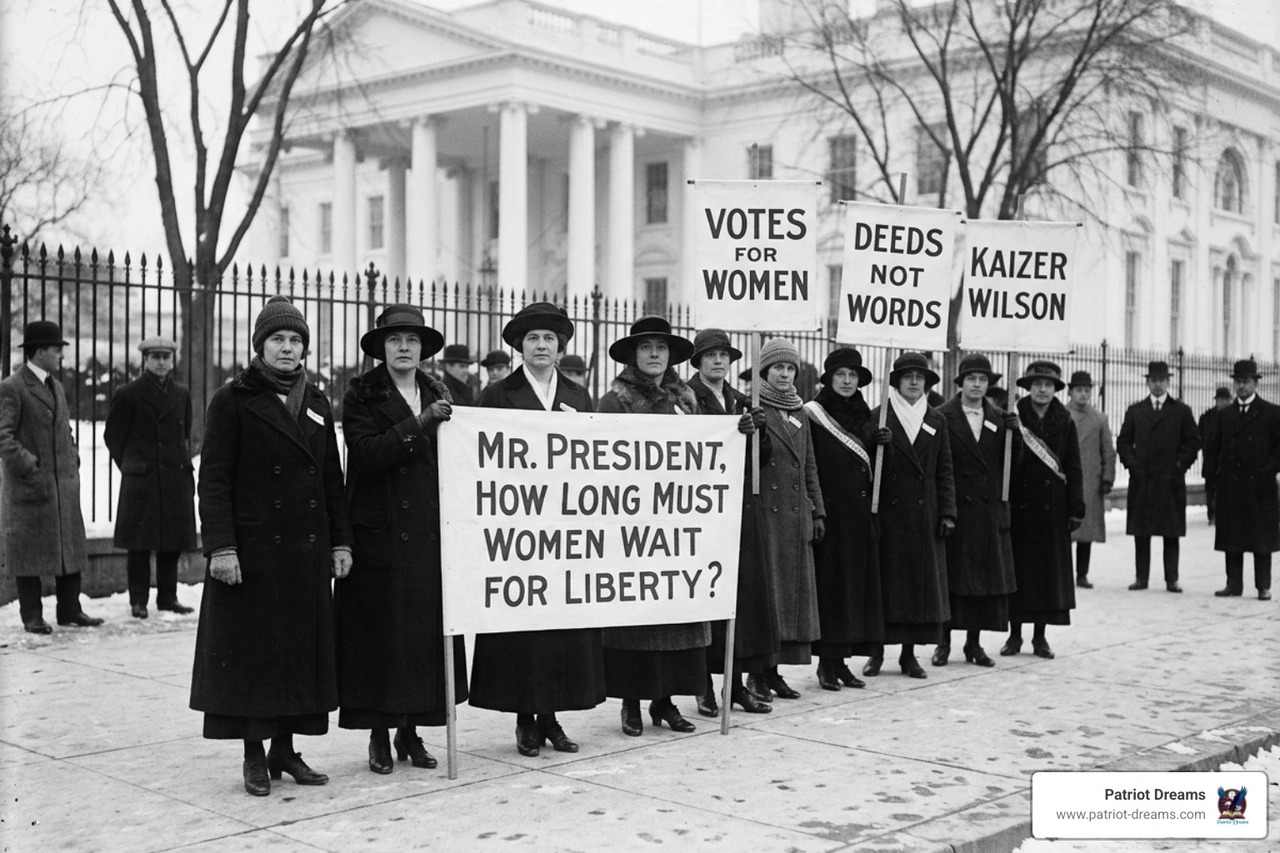
The picketers faced growing hostility. Many were arrested on charges of "obstructing traffic" and sent to workhouses, where they faced harsh conditions. In protest, Alice Paul and others went on hunger strikes, leading to forced feedings that shocked the public.
The courage of these women, combined with the patriotic service of millions of wartime workers, shifted public opinion and finally pushed President Wilson to support the federal suffrage amendment as a vital war measure.
5. The Inspiring Chapters of Women's Suffrage History
The final battle for the 19th Amendment came down to a dramatic vote in the Tennessee legislature in August 1920. Tennessee was the 36th state needed for ratification, and the vote was deadlocked.
The impasse was broken by a young representative named Harry Burn. He had planned to vote against the amendment, but he received a letter from his mother, Phoebe Ensminger Burn, urging him to "be a good boy" and vote for suffrage. Harry changed his vote, and on August 18, 1920, the 19th Amendment was officially ratified.
On November 2, 1920, more than 8 million women across the United States voted in elections for the first time, realizing a dream that had been nurtured for nearly a century.
Global Milestones and the Legacy of Women's Suffrage History
While the United States was celebrating this historic achievement, women around the world were fighting similar battles.
To understand the global context of this movement, we can look at several key milestones:
- New Zealand (1893): The self-governing British colony of New Zealand became the first nation to grant women the right to vote in national elections.
- Finland (1906): The Grand Duchy of Finland became the first place in Europe to introduce women's suffrage, and the first in the world to implement racially-equal suffrage and allow women to run for parliament.
- Armenia (1919): In their first parliamentary elections, three women deputies were elected to the 80-seat legislature.
- France (1944): French women were granted suffrage in July 1944. For about a decade prior, France had been the only Western country that did not at least allow women to vote in municipal elections.
These global achievements showed that the desire for democratic participation was a universal human aspiration, transcending borders and cultures. You can explore these international connections further through Women's suffrage and Woman Suffrage | Encyclopedia.com .
The Triumph and Hurdles of the 19th Amendment
While the ratification of the 19th Amendment was a monumental victory, it is important to remember that the door of democracy did not open equally for everyone in 1920.
For millions of women of color, the fight for the ballot was far from over. In the Jim Crow South, African American women faced the same discriminatory voter suppression tactics as Black men, including poll taxes, literacy tests, and physical intimidation.
Pioneering activists like Ida B Wells Journalist and Mary Church Terrell fought tirelessly to protect the rights of Black women, reminding the nation that the promise of the 19th Amendment remained unfulfilled for many.
Native American women were also excluded, as many were not recognized as U.S. citizens until the Indian Citizenship Act of 1924, and some states continued to deny them voting rights for decades. It was not until the passage of the Voting Rights Act of 1965 that the federal government took decisive action to protect voting access for all citizens, regardless of race.
Additionally, in 1923, the National Woman's Party proposed the Equal Rights Amendment to prohibit all discrimination based on sex. This amendment has never been ratified, showing that the journey toward complete equality is an ongoing effort.
For those researching these historical records, valuable resources can be found at the History of U.S. Woman's Suffrage , Women's Suffrage: U.S. Movement, Leaders & 19th ... , and Women's Suffrage in the U.S. Special Collections Resources .
Later generations of women, such as those inspired by the Eleanor Roosevelt Achievements, continued to build on this foundation, working to ensure that every voice in our national family is heard and valued.
Frequently Asked Questions About Women's Suffrage
To help bring clarity to this vital chapter of our history, here are answers to some of the most common questions about the movement.
Why did the suffrage movement split after the Civil War?
The movement split primarily over disagreements regarding the 14th and 15th Amendments. Some leaders, like Susan B. Anthony and Elizabeth Cady Stanton, refused to support the amendments because they excluded women, leading them to form the National Woman Suffrage Association (NWSA) to focus on a federal amendment.
Other reformers, like Lucy Stone and Julia Ward Howe, supported the amendments as a necessary step forward for civil rights and formed the American Woman Suffrage Association (AWSA) to campaign for women's suffrage on a state-by-state basis.
Which state was the first to grant women the right to vote?
The Wyoming Territory was the first to extend complete voting rights to women, doing so in 1869. When Wyoming was admitted as a state in 1890, it insisted on keeping women's suffrage, making it the first state in the nation where women could vote.
Almost 25 years passed before other states followed, with Colorado adopting women's suffrage in 1893, followed by Utah and Idaho in 1896.
How did World War I affect the push for women's suffrage?
World War I helped shift public and political opinion in favor of suffrage. As women took on essential roles as factory workers, nurses, and volunteers on the home front, they demonstrated their patriotism and civic responsibility.
Suffragists argued that denying women the vote was inconsistent with President Wilson’s goal of defending democracy abroad, which eventually led to federal support for the 19th Amendment.
Conclusion
The history of women's suffrage is a beautiful reminder of the power of persistence, community, and shared dreams. It shows us that progress is rarely a straight line; rather, it is a journey made of quiet acts of courage, family stories, and a shared commitment to building a more welcoming home for everyone.
At Patriot Dreams, we believe that history is not just about dates and documents — it is about the living memories and personal legacies of the people who came before us. Our interactive map and unique listening experiences are designed to bring these stories of resilience, family, and community to life, helping you connect with your own family's heritage and preserve your stories for the next generation.
We invite you to explore the voices, trials, and triumphs of the people who shaped our country. Experience history in a warm, personal way by visiting https://www.patriot-dreams.com/app and start preserving your family's legacy today.
Join the Patriot Dreams Community
Download the app today and start your journey through American history and personal legacy.

Explore Our Latest Insights
Dive into stories that shape our American legacy.