Unsung Heroes of Ground Zero and Their Miraculous Rescue Stories
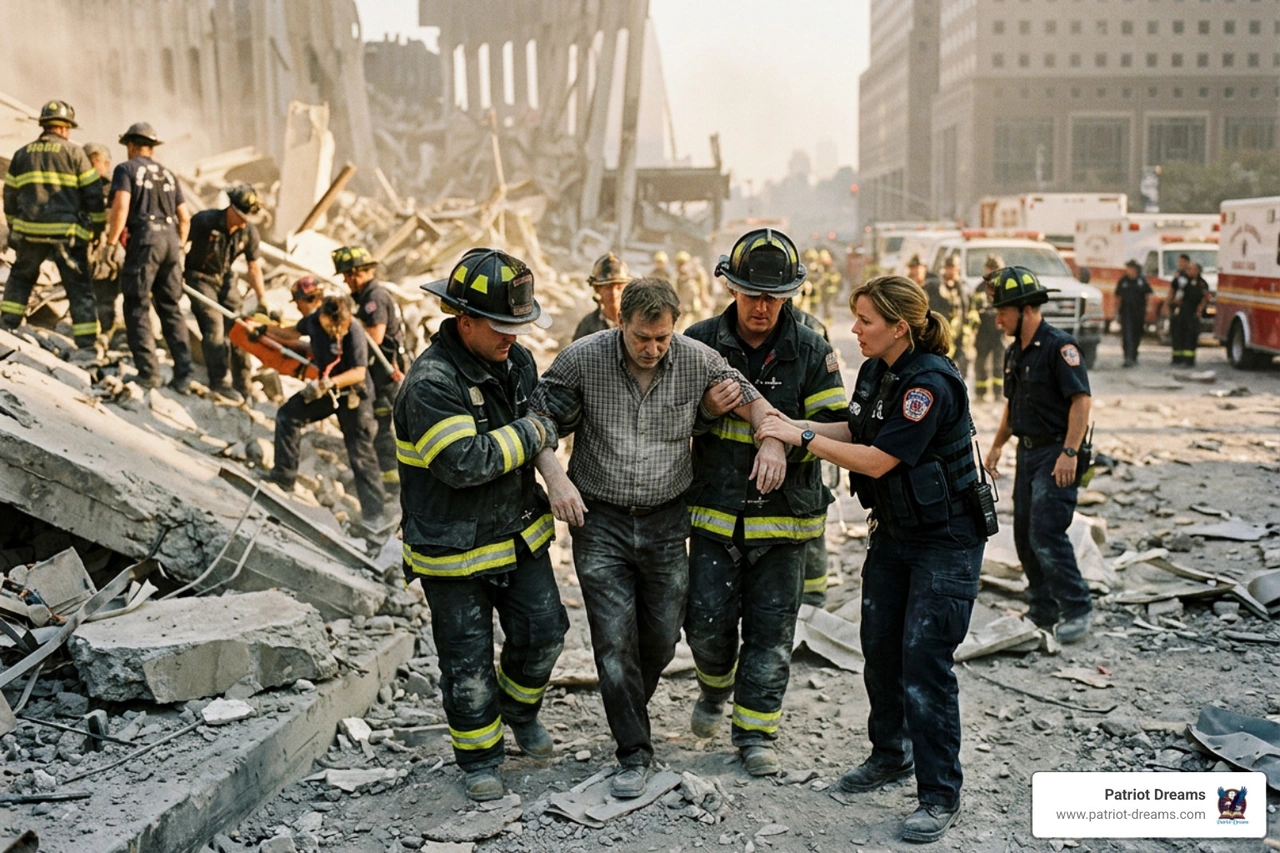

The Stories That Remind Us What Americans Do in the Dark
Some of the most powerful 9/11 hero rescue tales ever recorded aren't about governments or generals. They're about ordinary people — firefighters, office workers, boat captains, and even dogs — who chose to run toward the danger.
Here is a quick look at the key rescue stories from that day:
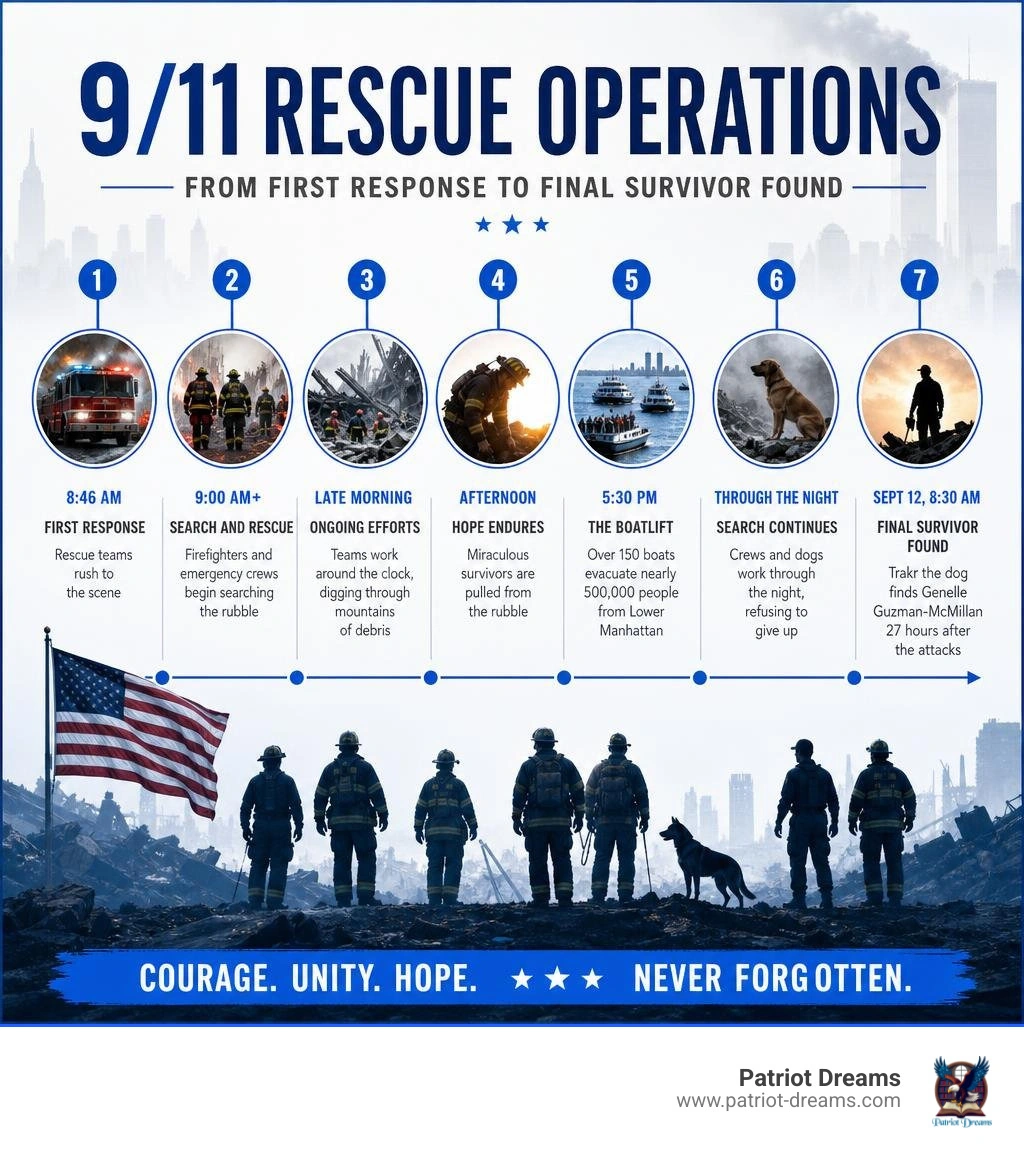
- Trakr the dog found the last living survivor, Genelle Guzman-McMillan, buried 30 feet deep after 27 hours in the rubble
- Rick Rescorla led nearly 2,700 coworkers to safety, singing to keep them calm on the way down
- Josephine Harris — a bookkeeper — accidentally saved 14 lives by slowing a group of firefighters just enough to survive the collapse
- Ladder Co. 6 firefighters sheltered in Stairwell B of the North Tower and lived when the building fell around them
- Over 150 boats answered a Coast Guard call and evacuated nearly 500,000 people from Lower Manhattan in under nine hours
- More than 300 dogs worked 12-hour shifts for weeks at Ground Zero, searching rubble for signs of life
- Flight 93 passengers fought back against hijackers, preventing the plane from reaching its target in Washington, D.C.
These aren't just history. They're reminders of something beautiful — that in the worst moments, people still reach out a hand.
The stories below go deeper into each of these rescues. Some will make you catch your breath. All of them will leave you proud of what ordinary Americans are capable of.
9/11 hero rescue tales terms simplified:
Four-Legged Angels: The Canine 9/11 Hero Rescue Tales
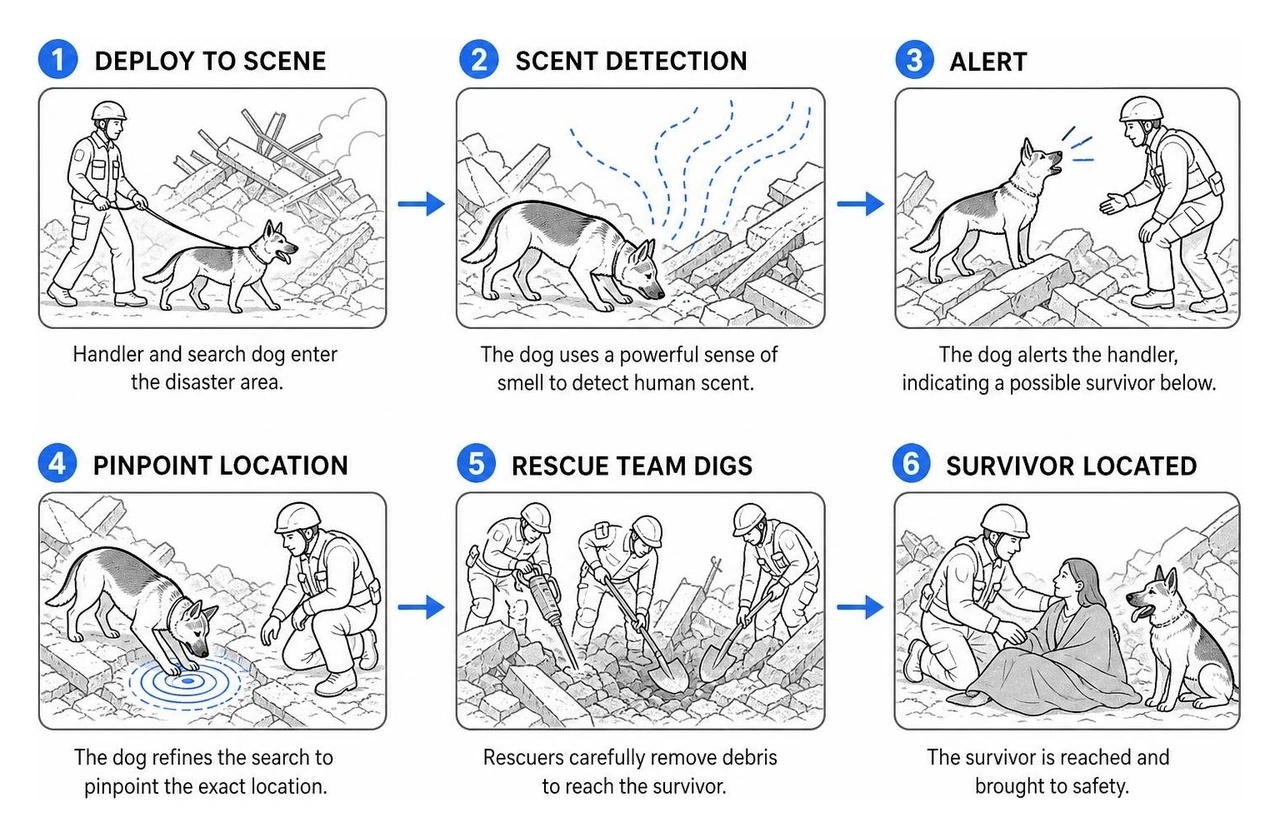
When the dust settled over Lower Manhattan, the landscape was unlike anything our brave first responders had ever seen. Amidst the tangled steel and smoldering concrete, some of the most extraordinary help came on four paws. More than 300 dogs took part in the search, rescue, and recovery efforts at Ground Zero, working tirelessly alongside their human handlers to find signs of life.
These weren't just highly trained search dogs; they were symbols of pure, unconditional comfort in a dark hour. FEMA-certified search-and-rescue (SAR) dogs are trained to detect the scent of living humans deep beneath debris. However, the physical and emotional challenges they faced at Ground Zero were immense. The debris was hot, sharp, and constantly shifting. Dogs worked grueling 12-hour shifts, navigating smoking ruins that burned their paw pads and irritated their eyes and noses.
To keep these canine heroes safe, veterinary stations were set up right on the edge of the site. Dedicated veterinarians washed the dogs' eyes, cleaned out their noses, and carefully bandaged their cut paws.
But there was another, softer challenge that the handlers had to manage: the dogs' emotional state. Because these animals are trained to find living people, finding only deceased victims took a heavy toll on their spirits. When a search dog goes days without a "find," they can become visibly depressed, losing their motivation to search. To lift their spirits, handlers and rescue workers would stage "mock finds"—hiding in the rubble so the dogs could successfully "rescue" someone and receive the praise, treats, and play they needed to keep going.
Among these incredible animals were dogs like Riley, a golden retriever who became famous for his tireless search efforts, and Apollo, a German shepherd who arrived at the South Tower just 15 minutes after its collapse. There was also Sage, who located the remains of the Flight 77 pilot at the Pentagon, and Jake, a black labrador who searched Ground Zero for 17 days and later went on to help during Hurricane Katrina. These four-legged heroes brought a gentle sense of hope to everyone who crossed their paths, as detailed in the archives of the Four-Legged 9/11 Heroes.
How Trakr and Other Dogs Led the 9/11 Hero Rescue Tales
Of all the miraculous canine accounts, the story of Trakr, a retired Canadian police German shepherd, and his handler James Symington, remains one of the most iconic 9/11 hero rescue tales. Hearing about the attacks, Symington and Trakr drove all the way from Canada to New York to offer their help.
On September 12, after searching through the night, Trakr caught a faint scent drifting up from a deep crevice in the wreckage of the North Tower. He alerted Symington, signaling that someone was alive down there.
Buried 30 feet deep under a massive pile of steel and concrete was Genelle Guzman-McMillan. She had been on the 64th floor of the North Tower when it collapsed. The descent had been terrifying, and she was pinned in complete darkness, unable to move her legs, with her head wedged between two concrete pillars. For 27 hours, she prayed in the dark, wondering if anyone would ever find her.
Trakr's keen nose located her exact position. Handlers and firefighters immediately went to work, digging through the dangerous ruins to pull her to safety. Genelle was the last living person rescued from Ground Zero, a miracle that occurred 27 hours after the collapse. Trakr worked so hard during the rescue that he eventually collapsed from smoke inhalation and burns, but his bravery saved a life. The story of her survival is beautifully preserved in the article Buried for 27 hours: The miraculous rescue of Genelle Guzman after 9/11 attack.
Everyday Citizens and First Responders Who Answered the Call
While first responders flooded the scene from across the nation, ordinary citizens inside the towers became heroes in their own right. They didn't wait for instructions; they simply saw their neighbors in need and acted.
One of the most famous figures of that day was Welles Crowther, a 24-year-old equity trader who had also served as a volunteer firefighter. When the plane hit the South Tower, Welles didn't run to save only himself. Armed with a simple red bandana tied around his nose and mouth to keep out the smoke, he repeatedly went back up into the burning, choked stairwells. He carried an injured woman down on his back, led groups of confused survivors to the only open exit, and then went back up to find more. Welles saved up to 18 lives before the tower fell, leaving behind a legacy of selflessness that defined the spirit of the day.
Another legendary figure was Rick Rescorla, a Vietnam veteran and the head of security for Morgan Stanley in the South Tower. Having lived through the 1993 World Trade Center bombing, Rick knew that safety required practice. He had spent years conducting regular, mandatory evacuation drills for the company’s employees, even when people grumbled about the disruption. When the first plane hit the North Tower on 9/11, Rick ignored instructions to keep employees at their desks. He grabbed a bullhorn and ordered an immediate evacuation. As he directed nearly 2,700 Morgan Stanley employees down the stairs, he sang traditional Welsh and military songs to keep them calm. Thanks to Rick's foresight and leadership, only 13 Morgan Stanley employees lost their lives that day. Rick himself went back up to search for stragglers and was last seen heading up the stairs before the tower collapsed.
We also remember Moira Smith, the only female NYPD officer to die on 9/11. She was seen calmly and systematically guiding injured, shocked people out of the North Tower, standing as a beacon of composure in the middle of chaos.
There was Benjamin Clark, a chef and former Marine who worked on the 96th floor. After ensuring everyone in his department had evacuated safely, he stopped on the 78th floor to help a woman in a wheelchair, losing his life so that others might have a chance.
And William Rodriguez, a maintenance worker with a master key to the buildings, who courageously stayed behind to unlock emergency exit doors, helping firefighters ascend and saving dozens of trapped workers. Their sacrifices are honored in the tribute to 13 courageous lives: 9/11 heroes remembered.
The Miracle of Stairwell B and Flight 93
Among the many survival stories of 9/11, the story of Stairwell B in the North Tower is one of the most astonishing. When the building began its final collapse, a small group of 14 people—including 12 firefighters from units like Ladder Co. 6, a Port Authority police officer, and a civilian bookkeeper named Josephine Harris—found themselves trapped inside a section of Stairwell B.
Josephine, who had walked down from the 73rd floor, was exhausted and could no longer walk. The firefighters of Ladder Co. 6 refused to leave her behind, taking turns carrying and assisting her down. This act of kindness, which slowed their descent, turned out to be their saving grace.
Because they were slowed down by helping Josephine, they were still in a reinforced, central section of the stairwell between the 22nd and 1st floors when the tower collapsed around them. The massive building fell like a "peeling banana," leaving only a small, vertical section of Stairwell B standing amidst the wreckage. They survived the collapse and were eventually rescued from the ruins. The firefighters later called Josephine their "guardian angel," believing that by slowing them down, she had saved all of their lives. You can read more about this incredible story of mutual rescue in 14 individuals survived the collapse of the north tower by taking shelter in Stairwell B.
Meanwhile, miles away in the skies over Pennsylvania, another group of everyday heroes was making a stand. On Flight 93, passengers and crew members learned through phone calls to loved ones that their plane was part of a coordinated attack. Realizing their aircraft was being steered toward a major landmark in Washington, D.C., they decided to act. Led by passengers like Todd Beamer, who was heard saying, "Are you ready? OK, let's roll," they used whatever they had—boiling water, cutlery, and a heavy food cart—to storm the cockpit. Their brave charge forced the hijackers to crash the plane into an empty field in Shanksville, Pennsylvania, sacrificing their own lives to save countless others on the ground.
The Great Boatlift: The Largest Water Rescue in U.S. History
On the morning of September 11, hundreds of thousands of people fled the collapsing towers, only to find themselves trapped at the southern tip of Manhattan. With the subways shut down, the bridges closed, and a thick cloud of dust rolling through the streets, there was nowhere left to run. They were backed up against the seawalls of the Hudson and East Rivers.
That is when the U.S. Coast Guard issued a historic call to all nearby vessels: All available boats, this is the United States Coast Guard. If you can assist in the evacuation of Lower Manhattan, report to Governor's Island.
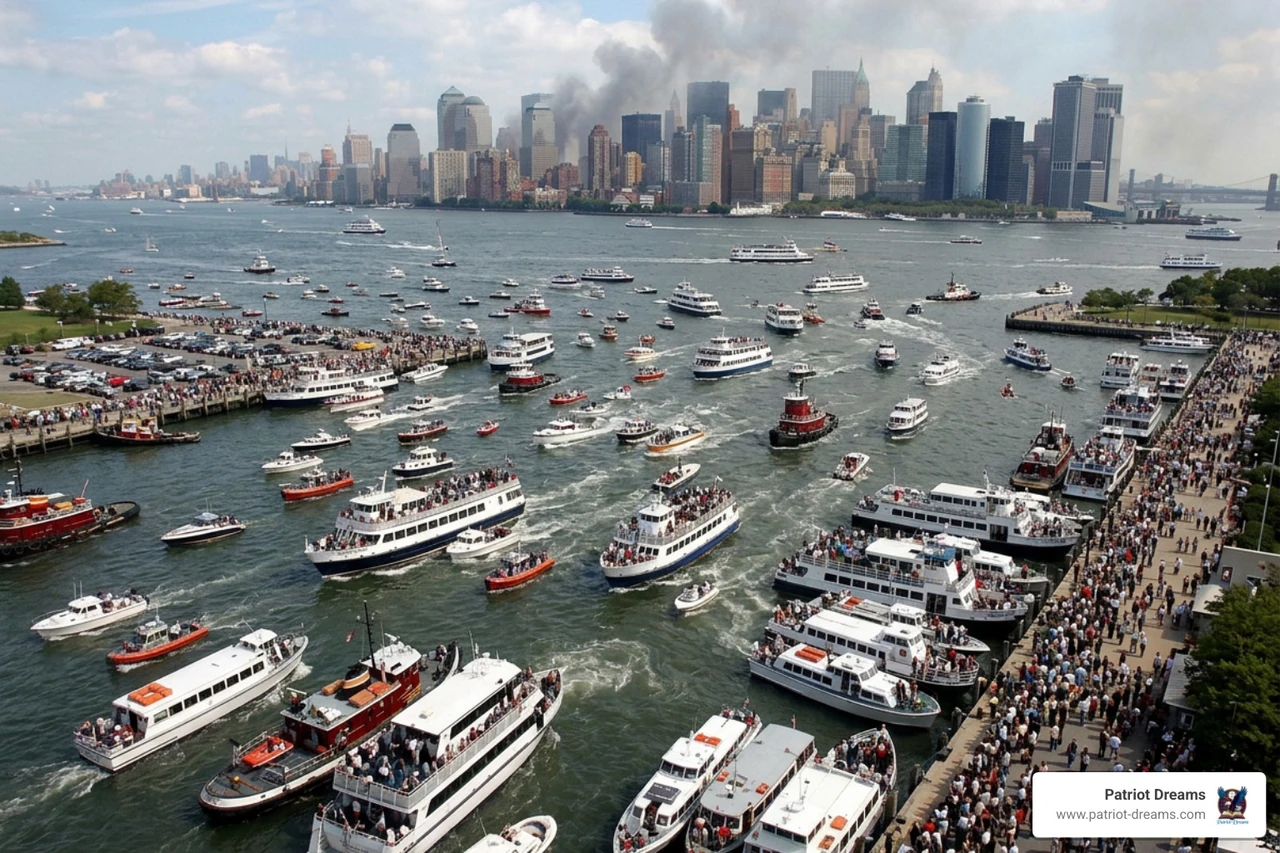
What followed was the largest water evacuation in human history, surpassing even the historic rescue at Dunkirk during World War II. Hundreds of vessels—civilian ferries, tugboats, private yachts, fishing boats, and party cruises—turned toward the smoke. They pulled up to the seawalls, lowered their gates, and began loading shocked, dust-covered people onto their decks.
For nearly nine hours, these boat captains and crews worked without stopping, carrying almost 500,000 people to safety in New Jersey, Staten Island, and Brooklyn. It was a beautiful display of the American maritime spirit, proving that when our neighbors are in trouble, we show up.
| Feature | The 9/11 Boatlift (2001) | Dunkirk Evacuation (1940) |
|---|---|---|
| Location | Lower Manhattan, New York, USA | Dunkirk, France |
| Total People Evacuated | Approximately 500,000 | Approximately 338,000 |
| Timeframe | Under 9 hours | 9 days |
| Vessels Involved | ~150+ civilian and commercial boats | ~850 military and civilian "Little Ships" |
| Primary Goal | Evacuating trapped civilians | Rescuing trapped Allied soldiers |
Healing and Remembering: The Legacy of Our Heroes
The events of 9/11 left a deep impression on everyone involved, and the years that followed brought both physical and emotional challenges. Many of the human first responders and volunteers who spent weeks working in the toxic dust of Ground Zero went on to face serious, long-term health issues, including respiratory diseases and cancers.
The canine heroes were not immune to these challenges either. Many of the search dogs suffered from cuts, respiratory issues, and later in life, illnesses linked to the toxic environment of the pile. Yet, their legacy lived on. The last known surviving search dog of 9/11, a beautiful golden retriever named Bretagne, was laid to rest with full military honors in June 2016 at the age of 16. Her passing marked the end of an era, but the memory of her gentle presence continues to inspire new generations of search-and-rescue teams.
For the survivors, healing has been a long journey of faith, gratitude, and remembrance. Genelle Guzman-McMillan, who spent three months in Bellevue Hospital and underwent multiple surgeries to save her leg, has dedicated her life to sharing her story of hope. During her 27 hours under the rubble, she felt a hand clasp hers and heard a comforting voice from a man who called himself "Paul." Though she never found the human rescuer named Paul, she remains convinced he was an angel sent to keep her alive. Her full story of recovery and faith is recorded in 9/11: The Last Person Pulled Out Alive from World Trade Center Rubble: 'I Was Given a New Life'.
Preserving the Voices of These 9/11 Hero Rescue Tales
To ensure that these stories of courage and kindness are never lost, organizations like StoryCorps and the 9/11 Memorial & Museum have worked to record the personal memories of survivors, families, and rescue workers. These oral histories capture the quiet, human moments of the day—the phone calls home, the shared prayers in dark stairwells, and the gentle comfort of therapy dogs.
We remember people like Father Mychal Judge, the beloved FDNY chaplain who was the first certified fatality of the attacks, having died while offering spiritual support and comfort in the lobby of the North Tower. His warmth and devotion to his fellow firefighters remain a guiding light for the community, as shared in Remembering Our Heroes - The 20th Anniversary Of 9/11. By listening to these voices, we keep the spirit of unity and love alive, reminding ourselves of who we are when we stand together.
Frequently Asked Questions about 9/11 Rescue Efforts
Who was the last person pulled alive from the World Trade Center rubble?
The last survivor pulled alive from the wreckage of the Twin Towers was Genelle Guzman-McMillan. She was rescued 27 hours after the collapse of the North Tower, having been located by the search-and-rescue dog Trakr and his handler, James Symington.
How many dogs participated in the Ground Zero rescue operations?
More than 300 search-and-rescue, therapy, and recovery dogs participated in the efforts at Ground Zero. They worked 12-hour shifts for several weeks, providing vital search capabilities and emotional comfort to firefighters and rescue workers.
What was the 9/11 boatlift?
The 9/11 boatlift was a massive, spontaneous maritime evacuation of Lower Manhattan. Following a call from the U.S. Coast Guard, over 150 civilian and commercial vessels came together to transport nearly 500,000 stranded people to safety in less than nine hours.
Conclusion
The stories of 9/11 remind us that even in our darkest moments, the light of human kindness, courage, and love cannot be put out. From the brave firefighters of Ladder Co. 6 to the civilian boat captains of the harbor, and the tireless search dogs on the pile, these heroes showed us the very best of the American spirit.
At Patriot Dreams, we believe that preserving these stories of everyday heroism is a vital part of keeping our heritage alive. Through our interactive map and audio storytelling platform, we bring the history, heritage, and personal legacies of our nation to life, helping families stay connected to the values of resilience, unity, and hope that define us.
We invite you to explore more of our shared history and discover the stories that shape our nation by visiting America: 250 Years in the Making. Let us carry the lessons of these heroes with us, remembering that a simple hand held out in the dark can change a life forever.

Join the Patriot Dreams Community
Download the app today and start your journey through American history and personal legacy.

Explore Our Latest Insights
Dive into stories that shape our American legacy.