Echoes of the Past: Capturing and Preserving Family Stories


Why Our Family Stories Are a Timeless Treasure
Preserving family stories is essential for understanding who we are, strengthening family bonds, and passing down values to future generations. The process involves interviewing loved ones, digitizing photos and documents, recording memories through audio or video, and creating keepsakes like scrapbooks or written memoirs.
Quick ways to start preserving family stories:
- Gather what you have - Collect old photos, letters, recipes, and heirlooms
- Record conversations - Use your phone to capture stories from older relatives
- Ask open-ended questions - "What was your childhood like?" works better than "Did you enjoy school?"
- Digitize precious items - Take photos of photos, scan documents, backup everything
- Create something tangible - Make a photo album, write stories down, or compile a family cookbook
Every family has stories worth telling. Stories of courage and kindness. Stories of ordinary days that somehow become extraordinary when we look back on them. Stories that help us understand where we come from and who we might become.
Only 30% of Americans have a family tree that goes back four generations. Even fewer have recorded the voices, the laughter, or the wisdom of their grandparents and great-grandparents. When those voices fall silent, something irreplaceable is lost.
But it doesn't have to be that way.
James Baldwin once wrote that we need to know our history because it helps us know who we are. When we preserve our family stories, we're not just saving facts and dates. We're capturing the essence of the people we love. We're creating a bridge between past and future, between the struggles our ancestors faced and the dreams our children will chase.
Think about the stories you heard growing up. Maybe it was Grandma's tale of coming to America with nothing but hope. Maybe it was Dad's memory of his first job, or Mom's recipe that tastes like home. These stories shaped you, even if you didn't realize it at the time.
The beautiful truth is this: preserving family stories doesn't require fancy equipment or expert skills. It just requires caring enough to start. A simple conversation over tea. A phone recording of Grandpa's laugh. A handwritten note about why that old watch matters.
In the pages ahead, we'll walk you gently through the process of capturing and preserving your family's legacy. You'll learn how to ask the right questions, choose the best methods for your family, and overcome common challenges with patience and grace.
Your family's story is part of the great American story. It deserves to be told, remembered, and treasured.
Preserving family stories terms to learn:
- "We Stick Together": The Unforgettable Sacrifice of the Sullivan Brothers
- Why the American Dream Still Resonates: A Cultural Deep-Dive
- Patriot Dreams and America 250: Empowering the Next Generation of Leaders for the Nation’s Semiquincentennial
Getting Started: Your First Steps in Preserving Family Stories
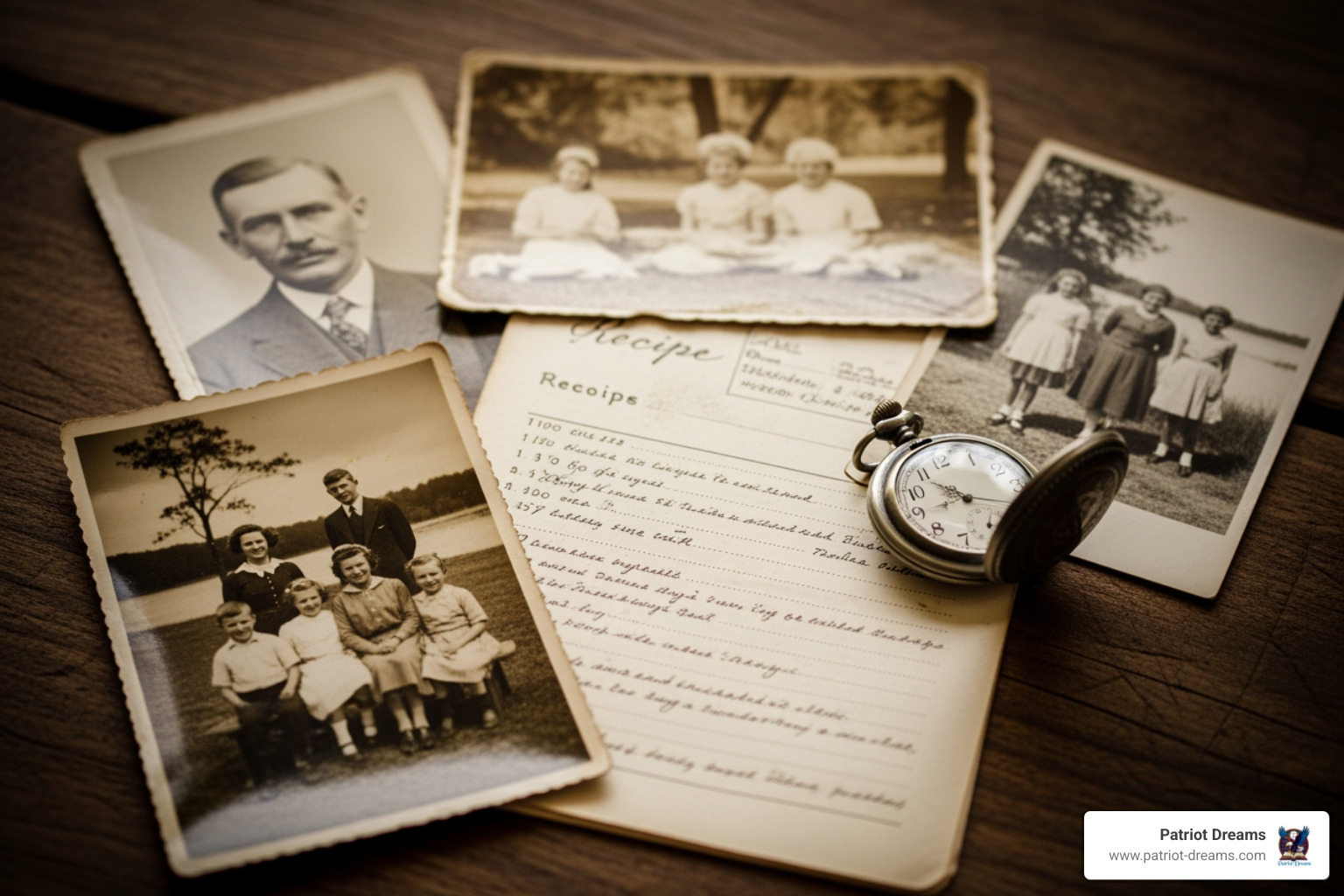
The thought of preserving an entire family's history can feel a bit like trying to climb a mountain. Where do you even begin? We understand that feeling, but we're here to tell you it's much simpler than it seems. The journey of a thousand miles, after all, begins with a single step. And when it comes to preserving family stories, that first step can be delightfully small and heartfelt.
We believe that family history preservation is a meaningful act, a gift we give to ourselves and to generations yet to come. It’s about building understanding and connection. Many of us hope to sit down "one day" to capture these moments, but the hustle and bustle of daily life often gets in the way. Don't let it! Let's start with what's already around you.
Begin with What You Have: Photos, Heirlooms, and Recipes
Sometimes, the best place to start uncovering your family's narrative isn't with an interview, but with the tangible treasures already nestled in your home. These are your prompts, your story-holders, just waiting for you to ask them to share their secrets.
- Photos as Windows to the Past: Old photographs are often the easiest entry point. They trigger memories and stories that might otherwise remain dormant. We encourage you to gather your old family albums. As one expert suggests, even simply taking pictures of your old photos with your phone can be a great way to digitize them and make them accessible. Then, add detailed captions, leaving space for new information as you uncover it. You might be surprised to learn that only 13% of Americans say they have a great-grandmother still alive, making those old photos even more precious as a link to the past.
- Heirlooms as Physical History: Do you have a piece of jewelry, a piece of furniture, or a special object that has been passed down? These heirlooms are physical pieces of your family's journey. 60% of Americans say that they have a family heirloom that has been passed down for at least three generations. Take a moment to catalogue these items, writing down their history and significance. Sometimes, the most beautiful way to preserve an heirloom is to use it, to create new memories and experiences with it, rather than keeping it tucked away. For tips on becoming your family's archivist, consider exploring resources like How to be the archivist of your own family.
- Recipes as Cultural Traditions: Food is often central to family life and tradition, and family recipes are much more than just ingredients and instructions. They are often tied to rituals, childhood memories, and specific family members. Find a popular family cookbook, or ask relatives for their written recipes. Not only should you record the recipes themselves, but also the handwriting, the notes in the margins, and the stories about who made them, why they were favorites, or the special occasions they graced. This helps preserve the love and connection associated with them.
Set a Simple, Heartfelt Goal
The key to starting is not to get overwhelmed. Instead of aiming to document everything, let's set a simple, heartfelt goal.
- Focus on one relative: Perhaps a grandparent, an aunt, or an uncle whose stories you've always wanted to hear more of.
- Aim to capture one specific story: Maybe it's their childhood memory of a significant event, their first job, or a beloved family tradition.
- Document a single family tradition: How did your family celebrate a particular holiday? What was the story behind it?
The goal here is connection, not perfection. This process should be joyful, not a chore. We often find that once you begin, the stories start to flow, and the process becomes its own reward.
The Art of Listening: A Guide to Interviewing Your Loved Ones

At the heart of preserving family stories lies the beautiful act of listening. It's about building rapport, creating a safe space where memories can be shared freely, and offering the gift of your focused attention. As one expert from the Library of Congress's Veterans History Project wisely noted, "People have entire worlds contained within their lives. Listening, engaging, and really trying to understand someone's perspective and what they've been through is an exquisite experience."
Oral history, as a method, is fundamentally about relationships. It’s about more than just collecting facts; it’s about understanding the nuances of a life lived. This section will guide you through the art of interviewing, ensuring you approach these precious conversations with warmth and respect.
Preparing for a Warm Conversation
Preparation doesn't mean rigidity; it means creating an environment where stories can flourish.
- Choose a Quiet Location: A comfortable, familiar, and quiet setting is ideal. This minimizes distractions and helps your loved one feel relaxed and open.
- Test Your Equipment: Whether you're using a digital recorder, a mobile phone, or a video camera, always test it beforehand. As NPR archivist Nicolette Khan suggests, "You could get really hung up on creating a perfect recording or preserving it in the perfect way, but as long as it's something that you can save, keep and share, whatever tools you have are the best to use." Simplicity is key! Have extra batteries or ensure devices are fully charged.
- Prepare Open-Ended Questions: Avoid "yes/no" questions. Instead, craft questions that encourage detailed responses and reflection. For example, instead of "Did you like school?", try "What was a typical day at school like for you, and what did you enjoy most or least about it?" The Smithsonian Center for Folklife and Cultural Heritage offers a long list of possible questions to get you started.
- Share Topics Beforehand: To help jog memories, provide your family member with a rundown of topics, people, or places that might be mentioned. This gives them time to reflect and recall stories they wish to share.
- Set a Comfortable Tone: Start with casual conversation to put everyone at ease. Remind your loved one how much their stories mean to you. Discuss how you plan to use and share the recordings, ensuring they are comfortable with the process. The Smithsonian also offers the following advice for getting started with oral histories.
The goal is to get your family member to tell their story in their own words. For more detailed guidance, the Capturing Your Family’s Oral History resource offers excellent insights.
Walking Gently Through Difficult Memories
Family histories, like life itself, are not always simple or easy. Sometimes, difficult or sensitive stories emerge. Approaching these with care is paramount.
- Respect and Consent: Always lead with respect. Understand that your family member may have experienced trauma or pain that they are not ready to share, or perhaps never wish to share. Do not force the story. Make it clear that they are in control of what they reveal.
- Acknowledge and Validate: If a difficult memory is shared, acknowledge the emotional weight. Listen without judgment and validate their feelings. The process of recording can sometimes be a healing one, offering a chance for deeper understanding and connection.
- The Beauty of Inconsistencies: Sometimes, different family members remember events differently, or details conflict. This isn't a problem; it's the beauty of human memory. These inconsistencies can contribute to an "emotional history," revealing different perspectives and feelings about the past. It's okay to accept that stories can be fragmented or have varying accounts.
- Knowing When to Pause: If a conversation becomes too painful, or if your loved one seems uncomfortable, gently suggest a break or a shift to a lighter topic. It's perfectly fine to let some stories rest, perhaps to be revisited another day, or not at all. The priority is the well-being of your family member.
As Dina Gachman, author of So Sorry for Your Loss, emphasizes, getting a record of your family's history is a gift. But it's a gift best given with empathy and patience. We're not just collecting facts; we're honoring lives.
Choosing Your Canvas: Methods for Capturing Your Family's Legacy
Once you've begun to gather your materials and conduct interviews, you'll want to decide how best to preserve these precious stories. Fortunately, we live in an age where technology offers us a wonderful array of choices, allowing us to make these stories accessible and enduring. There are many different methods available, and the best approach often involves leveraging technology to suit your family's needs and preferences. At Patriot Dreams, we believe in making history come alive, and that includes your family's unique narrative.
Our goal is to help you find the "canvas" that best suits your family's stories, ensuring they resonate for years to come. Whether you're looking for Record Family Stories or general Family History Preservation, we have insights for you.
The Power of Voice: Preserving Family Stories with Audio
One of the most intimate and powerful ways to preserve a story is through audio. The sound of a loved one's voice—their tone, their laughter, the way they phrase things—is irreplaceable.
- Audio Recording: Modern smartphones and tablets are excellent tools for capturing audio. There are many free recording apps available, making this method incredibly accessible. Remember Nicolette Khan's advice about simplicity being key; you don't need professional equipment to make a meaningful recording. Digital voice recorders are also a great option for clearer sound quality.
- Benefits: Audio recordings capture not just the words, but the emotion and personality behind them. This can create a profound connection for future generations who get to "hear" their ancestors. It's often less intimidating for storytellers than video, leading to more relaxed and authentic conversations.
- Patriot Dreams Resources: We understand the power of audio storytelling. Our platform focuses on bringing historical narratives to life through sound, and the same principles apply to your family's tales. We encourage you to contact us Patriot Dreams to help you share your own legacy story.
Visual Legacies: Video, Photos, and Scrapbooks
While audio captures the voice, visual methods bring stories to life with faces, places, and objects.
- Video Interviews: If your family member is comfortable, video recordings can capture facial expressions, gestures, and the environment, adding another rich layer to the story. A well-made video can create a beautiful, lasting legacy for your family to cherish.
- Digitizing Old Photos: We've touched on this, but it bears repeating. Digitizing old photos is crucial for preservation and sharing. Once digital, they can be easily shared with family members, used in presentations, or printed in new albums. Online archives and public records can also help you track down old documents to add visual context to your stories.
- Creating Themed Scrapbooks or Digital Albums: Organize your photos, letters, and other memorabilia into physical scrapbooks or digital albums. These can be themed around events (weddings, holidays), individuals, or specific periods. Adding captions and short narratives transforms a collection of images into a compelling story.
- Storytelling with Images: Use your visual assets to create narratives. A sequence of photos can tell a story, or a single powerful image can serve as a jumping-off point for a deeper dive into a memory. Our Patriot Dreams tips for organizing and sharing visual memories often emphasize the narrative power of carefully curated images.
The Written Word: Creating a Family Memoir
The written word offers a unique permanence and depth, allowing for detailed reflection and narrative structure.
- Journaling and Memoirs: Encourage family members to write down their memories, thoughts, and reflections. This can be a personal journal, or a more structured memoir. The act of writing can be therapeutic and allows for a comprehensive account of a life.
- Family Newsletters or Blogs: For a more collaborative and ongoing project, consider creating a family newsletter or a private blog where different family members can contribute stories, photos, and updates.
- Creating a Keepsake Book: For a more structured approach, consider creating a keepsake book. You can do this by compiling answers to a list of questions sent out weekly or monthly. This method turns small, consistent efforts into a beautiful, tangible book. It's a thoughtful way to help future generations connect with who a person truly is, beyond just a name. Many families have found this to be a trusted method for compiling their stories into a lasting treasure.
- The Permanence of Writing: A written memoir or archive offers a lasting record that can be easily shared and revisited. It allows for the integration of various elements—stories, photos, recipes—into a cohesive narrative.
Overcoming Common Problems on Your Journey
Starting on the journey of preserving family stories is a truly rewarding endeavor, but like any meaningful quest, it can present its own set of challenges. It's okay to pause, to feel a little overwhelmed, or to encounter a few bumps along the way. This is a journey, not a race. We can draw inspiration from American Pioneer Stories, where resilience and perseverance were key. The most important thing is to find joy in the process and remember that every step forward is a victory.
Encouraging a Reluctant Storyteller
One of the most common challenges we hear about is encountering a family member who is reluctant to share their stories. Perhaps they feel their life isn't interesting enough, or they're hesitant to revisit painful memories.
- Patience is a Virtue: Don't push too hard. Sometimes, it takes time for someone to feel comfortable opening up. As one author noted, her grandmother was initially reluctant to share stories, but patience eventually won out.
- Start with Simple, Positive Questions: Begin with lighthearted questions about happy memories, childhood games, or favorite foods. Build trust and comfort before delving into deeper topics.
- Share Your 'Why': Explain why their stories are important to you. Tell them it's not just for historical record, but for understanding who they are and for sharing their wisdom with future generations. Sometimes, knowing the stories will be a gift to others, especially children and grandchildren, can be a powerful motivator.
- Lead by Example: Share some of your own memories or reflections first. This can create a reciprocal environment where they feel more at ease.
- Express Love and Curiosity: Often, simply expressing genuine love and curiosity about their life can be enough to open the door to conversation.
Making Sense of It All
As you gather stories, photos, and documents, you might find yourself with a wonderful but somewhat chaotic collection. Organizing and making sense of it all can feel daunting.
- Organizing Digital Files: Create a clear, consistent filing system for all your digitized photos, audio recordings, and written notes. Use descriptive names for files (e.g., "Grandpa John - Childhood Stories - 1940s.mp3," "Aunt Mary's Wedding - 1972.jpg").
- Accept Inconsistencies as 'Emotional History': As we discussed, family stories can have different versions. Instead of trying to find one "true" account, accept these inconsistencies as part of your family's unique "emotional history." They reveal different perspectives and feelings, which are just as valuable as factual accuracy.
- Focus on the Feeling Behind the Facts: Sometimes the most important part of a story isn't the exact date or name, but the emotion it conveys—the resilience, the joy, the struggle. Focus on capturing these feelings.
- Transcribing Recordings: If you have audio or video recordings, consider transcribing them. This makes them searchable and easier to share. There are many services and software options available to help with transcription.
- Leverage Genealogical Resources: For deeper dives into records and documents, non-profit genealogical websites and public library archives can be invaluable. Many offer vast, free collections of digitized historical books and records, helping you fill in gaps and verify details. These resources can expand your access to millions of historical records, enriching your family's story.
At Patriot Dreams, we understand the importance of keeping your family stories safe and meaningful. We believe in finding strength through story, and part of that strength comes from the care and organization you put into your family's archive.
Conclusion: Your Family's Story, A Legacy of Love
As we reach the end of our guide, we hope you feel inspired and equipped to begin or continue your journey of preserving family stories. This endeavor is so much more than a hobby; it's a profound act of love, connection, and legacy.
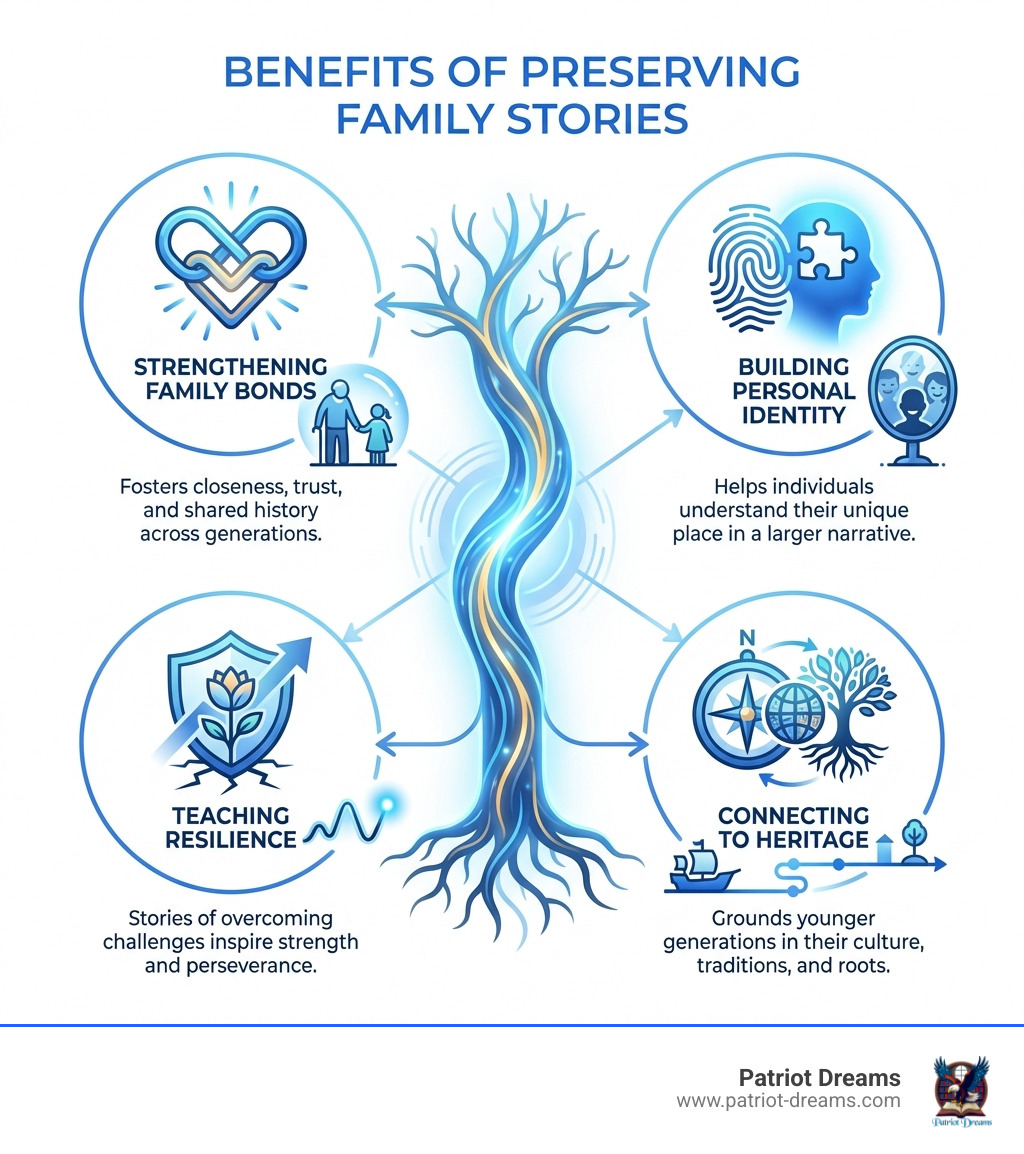
Why is this so important for future generations? Because our stories are the threads that weave the mix of who we are. They strengthen family bonds, helping us understand that we are part of something larger than ourselves. They contribute to an individual's sense of identity and belonging, giving us roots and wings. When we know the resilience and triumphs of those who came before us, it teaches us how to face our own challenges. As one article insight put it, "It's wonderful to know my children and future generations will get a feel for who I am rather than just being a name."
The benefits of creating a family history archive or memoir are immeasurable. It's a gift that keeps on giving, offering comfort, wisdom, and a tangible link across time. Imagine your great-grandchildren, years from now, listening to your voice or reading your words, understanding your joys and struggles. This is the power of your legacy.
We are all part of a larger story, the grand narrative of our nation. Just as we celebrate the stories of Founding Fathers and Historical American Figures, your family's story adds a unique and vital chapter to the American experience. Every family's journey, with its unique challenges and victories, contributes to the rich fabric of our shared heritage.
At Patriot Dreams, we are passionate about bringing American history, heritage, and personal stories to life. We believe that every story matters, especially yours. Your family's journey is a testament to the enduring spirit of our country, filled with lessons of kindness, perseverance, unity, and everyday heroism.
We invite you to find and preserve your own family's place in the great American story. Find how our Educational Audio App and Patriotic Stories App can inspire you to connect with your roots and share your legacy.
Start today. Your family's story is a timeless treasure, waiting to be shared.
Find and preserve your own family's place in the great American story with our App for Patriotic Families.

Join the Patriot Dreams Community
Download the app today and start your journey through American history and personal legacy.

Explore Our Latest Insights
Dive into stories that shape our American legacy.