A Comprehensive Guide to the Battle of the Bulge

What Was the Battle of the Bulge?
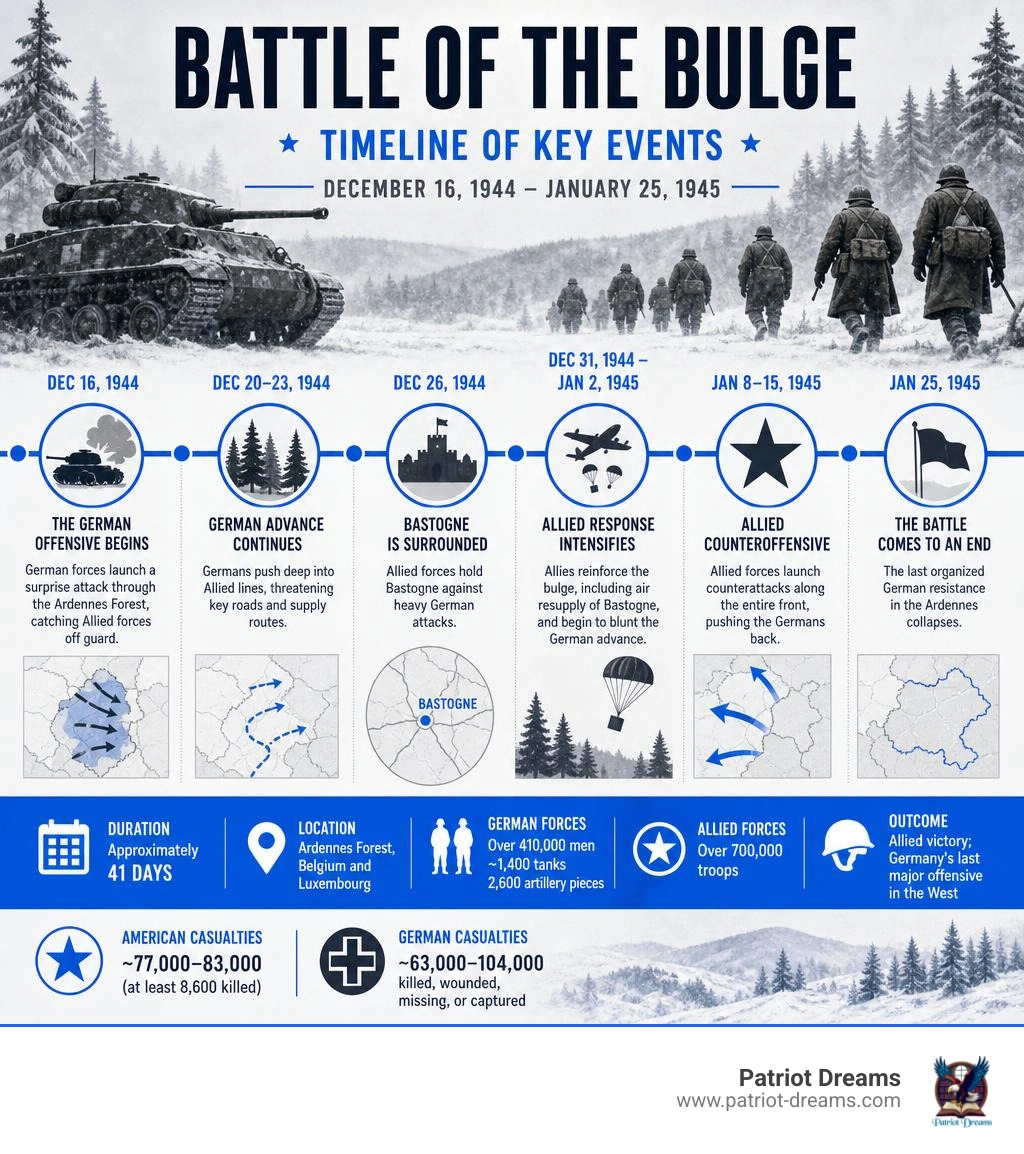
The Battle of the Bulge was the largest and bloodiest single battle ever fought by the United States Army — a desperate, surprise German offensive launched on December 16, 1944, through the frozen forests of the Ardennes in Belgium and Luxembourg.
Here are the key facts at a glance:
| Detail | Facts |
|---|---|
| Dates | December 16, 1944 – January 25, 1945 |
| Duration | Approximately 41 days |
| Location | Ardennes Forest, Belgium and Luxembourg |
| German forces | Over 410,000 men, ~1,400 tanks, 2,600 artillery pieces |
| Allied forces | Over 700,000 troops |
| American casualties | ~77,000–83,000 (at least 8,600 killed) |
| German casualties | ~63,000–104,000 killed, wounded, missing, or captured |
| Outcome | Allied victory; Germany's last major offensive in the West |
In late 1944, most people — soldiers and civilians alike — believed the war in Europe was nearly over. Allied forces had swept across France and were pushing toward Germany. Hope was in the air.
Then, in the dark early hours of a December morning, everything changed.
Adolf Hitler launched a massive, secret counteroffensive through the dense Ardennes Forest — a place the Allies believed was too rugged and remote for a major attack. More than 200,000 German troops struck along an 85-mile front, catching Allied forces almost completely off guard.
The attack drove a deep "bulge" into the Allied front lines — and the battle that followed would test the courage, grit, and heart of ordinary American soldiers in ways that still move us today, more than 80 years later.
Winston Churchill later called it "undoubtedly the greatest American battle of the war."
This guide walks you through everything — the German plan, the Allied response, the heroes of Bastogne, the brutal winter conditions, and the lasting legacy of those 41 extraordinary days.
Battle of the Bulge basics:
- General Jonathan Wainwright: The Hero of Bataan’s Defiance
- The Courage of Mitchell Red Cloud Jr.: A Native American Hero of the Korean War
- The Four Chaplains, George Fox, Alexander Goode, Clark Poling, John Washington
The Ardennes Offensive: Hitler's Last Gamble
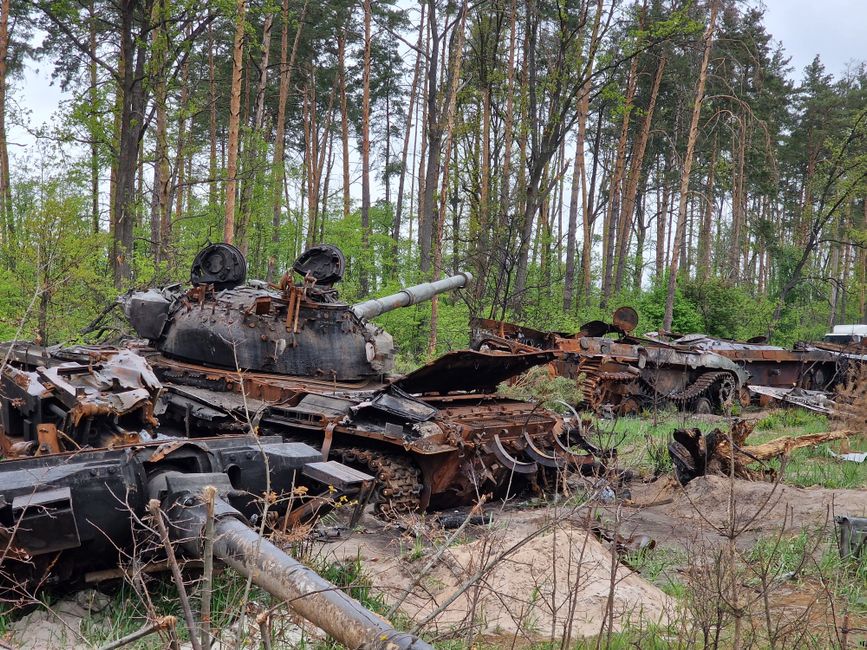
By the winter of 1944, the German war machine was retreating on both the Eastern and Western fronts. Allied forces were knocking on the very doors of Germany. Yet, rather than prepare a purely defensive strategy, Adolf Hitler decided to play one final, high-stakes card. He believed that a sudden, devastating blow could shatter the Allied coalition, forcing Great Britain and the United States to negotiate a separate peace.
The result of this desperate gamble was Operation Wacht am Rhein ("Watch on the Rhine")—a title deliberately chosen to sound like a defensive operation to keep Allied intelligence in the dark. The target was the Ardennes, a heavily forested, mountainous region spanning eastern Belgium, Luxembourg, and parts of France. The Germans aimed to strike hard across a 75-mile front, punch through the thin Allied lines, and race toward their ultimate prize.
To explore the strategic context of this massive clash, you can read more from Battle of the Bulge | The National WWII Museum | New Orleans .
Objectives of the German Offensive
The primary objective of the offensive was both simple and incredibly ambitious: capture the vital Belgian port of Antwerp. By seizing Antwerp, the Germans hoped to cut off the main supply line for the Allied armies in the north.
Furthermore, this drive would split the Allied forces in two, separating the British armies under Field Marshal Bernard Montgomery from the American armies under General Dwight D. Eisenhower. Hitler believed that if he could isolate and destroy these forces, the Western Allies would lose their will to fight, allowing Germany to focus all its remaining strength on the advancing Soviet Union in the East.
However, the plan was plagued by severe logistical weaknesses. The German army faced critical fuel shortages. They simply did not have enough gasoline to power their massive Tiger and Panther tanks all the way to Antwerp. The success of the entire offensive relied on capturing American fuel depots along the way.
To avoid detection by Allied scouts before the attack, German forces took extreme precautions. They moved only at night and even banned wood fires, requiring soldiers to use charcoal instead so that no telltale smoke would give away their positions in the dense woods.
The Element of Surprise in the Battle of the Bulge
On the morning of December 16, 1944, the Germans achieved near-total tactical surprise. This was due to a perfect storm of Allied overconfidence, faulty intelligence, poor aerial reconnaissance, and terrible winter weather.
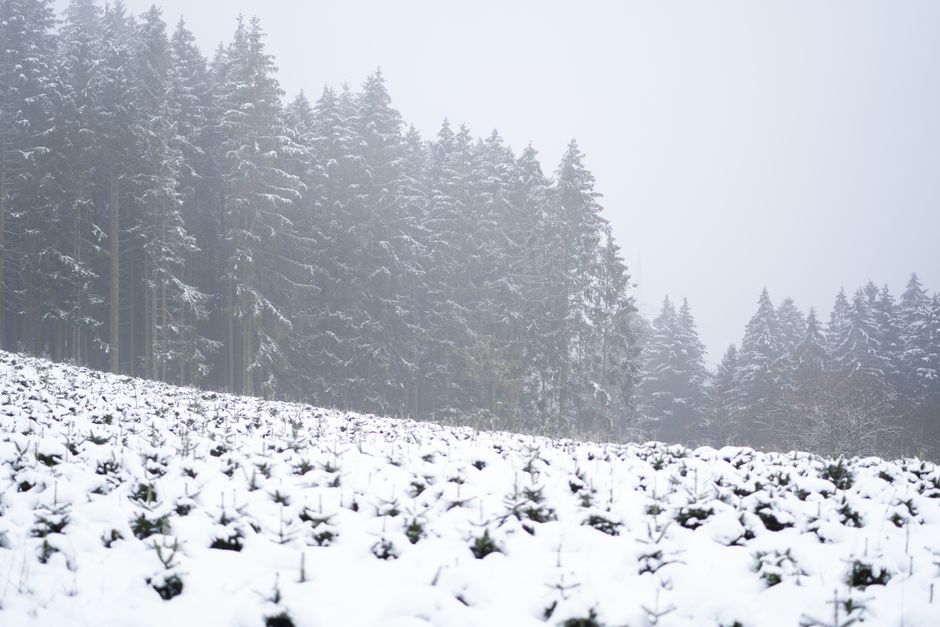
For weeks, heavy fog, thick low clouds, and driving snow hung over the Ardennes. This bad weather grounded the Allied air forces, stripping them of their greatest advantage: tactical air support. Allied commanders had also grown complacent, believing the Ardennes was a "quiet sector" where tired divisions could rest and new, inexperienced units could get used to life near the front lines.
Intelligence officers dismissed reports of German troop build-ups near the border. In some cases, reports of heavy vehicular movement were brushed aside as nothing more than German phonograph recordings played to confuse them.
When the massive artillery barrage began at 5:30 AM on December 16, the thin line of American defenders suddenly found themselves outnumbered ten to one in some areas. You can read a detailed breakdown of these initial movements on Battle of the Bulge - Wikipedia .
Turning the Tide in the Battle of the Bulge
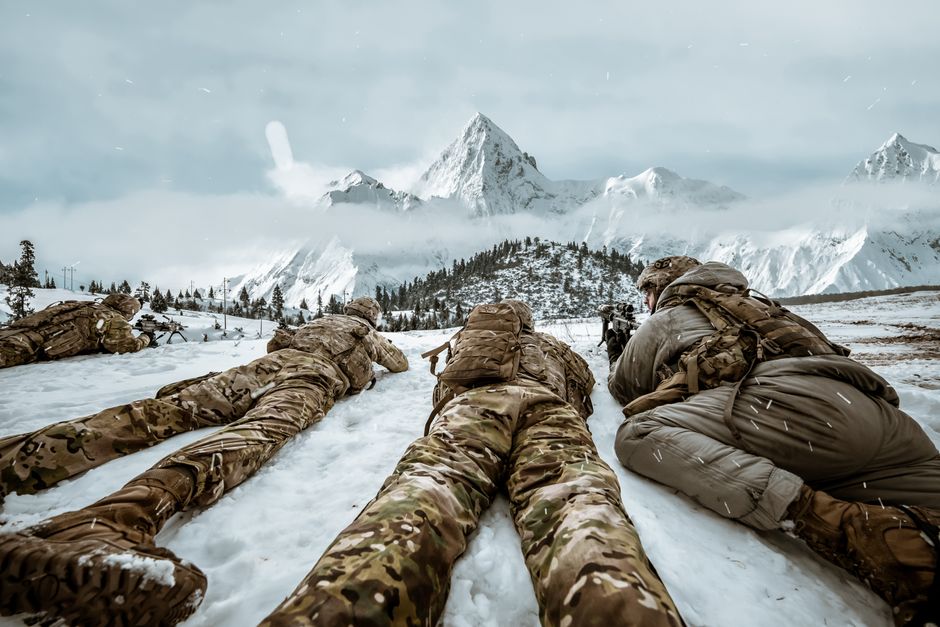
As news of the massive German breakthrough reached Allied Headquarters, the initial confusion quickly turned into a coordinated, determined response. General Dwight D. Eisenhower, the Supreme Allied Commander, recognized the gravity of the threat but also saw an opportunity. If the Germans pushed deep into Allied lines, they would create a vulnerable salient—a "bulge"—that could be pinched off and destroyed.
Eisenhower immediately ordered reinforcements to the area, including the elite 82nd and 101st Airborne Divisions, which were resting in France. He also called on General George S. Patton Jr. to perform one of the most remarkable tactical maneuvers of the war: turning his entire Third Army 90 degrees north in the middle of winter to strike the southern flank of the German advance.
To learn more about how the leadership of Eisenhower, Patton, and Montgomery helped coordinate this massive defense, visit Battle of the Bulge | The United States Army .
Heroic Stands at Bastogne, St. Vith, and Elsenborn Ridge
While high-level commanders moved divisions on maps, the battle was ultimately decided by the stubborn, isolated resistance of small groups of American soldiers. At key crossroads, villages, and ridges, ordinary men refused to give way, delaying the German advance and throwing Hitler's strict timetable into complete chaos.
At Elsenborn Ridge in the north, American troops held their ground against the elite SS Panzer divisions. Their tenacious defense blocked the main roads, preventing the Germans from expanding the northern shoulder of the breakthrough and protecting vital Allied supply dumps.
In the center of the front, at the vital road junction of St. Vith, the men of the VIII Corps fought a brilliant delaying action. Though eventually forced to withdraw, their resistance bought precious time for the Allies to secure another crucial crossroads town: Bastogne.
At Bastogne, the 101st Airborne Division, along with elements of the 10th Armored Division and other units, found themselves completely surrounded by a much larger German force. The weather was freezing, supplies of food and ammunition were running dangerously low, and the medical tents were overwhelmed.
On December 22, the German commander sent a formal demand for surrender, warning that the town would otherwise be annihilated. The acting commander of the 101st, Brigadier General Anthony McAuliffe, gave a legendary, one-word response that perfectly captured the spirit of his men:
"NUTS!"
This defiant reply boosted the morale of the defenders and became an enduring symbol of American resolve.
Among the heroes of Bastogne and the surrounding areas were segregated African American units, such as the 333rd Field Artillery Battalion and the 761st Tank Battalion (known as the "Black Panthers"). Despite facing systemic discrimination back home, these brave men fought with extraordinary courage, sacrificing themselves to defend the front lines and support their fellow soldiers in the freezing snow.
The Allied Counterattack and Clearing the Bulge
By late December, the tide began to turn. On December 26, the lead elements of General Patton's Third Army broke through the German encirclement, relieving the exhausted but triumphant defenders of Bastogne.
At the same time, the freezing winter weather finally cleared. The sun broke through the clouds, and the Allied air forces took to the skies. Thousands of fighter-bombers hammered German supply columns, tanks, and bridges, cutting off the fuel and ammunition the offensive so desperately needed.
Over the next month, American and British forces launched a coordinated counteroffensive to squeeze the "bulge" from both the north and the south. Fighting in waist-deep snow and sub-zero temperatures, they systematically cleared the forests and villages. By January 25, 1945, the lines were restored to where they had stood before the offensive began. Hitler's final gamble had utterly failed.
The Human Cost and Legacy of the Ardennes
The Battle of the Bulge was a triumph of human courage, but it came at a staggering cost. For 41 days, men fought not only a determined enemy but also a brutal winter environment. The physical and emotional scars of those weeks in the snow would stay with the survivors for the rest of their lives.
To explore the deeper historical impact of this battle, you can read the comprehensive overview on Battle of the Bulge .
Casualties and the Road to Victory
The Battle of the Bulge is recorded as the largest and bloodiest single battle ever fought by the United States military. Out of the 700,000 Allied troops who participated, the vast majority were Americans. The human cost was immense, with tens of thousands of families forever changed by the news that came home from the Ardennes.
| Force Statistics | Allied Forces | German Forces |
|---|---|---|
| Total Troops Committed | ~700,000+ | ~410,000+ |
| Tanks & Armored Vehicles | ~800 lost | ~600-800 lost |
| Total Casualties | ~77,000 to 83,000 | ~63,000 to 104,000 |
| Killed in Action | At least 8,600 (some estimates over 16,000) | ~12,000 to 20,000 |
Beyond the combat casualties, the battle was marked by moments of tragedy, such as the Malmedy massacre, where 84 unarmed American prisoners of war were murdered by their SS captors in a snowy field.
Yet, this costly victory broke the back of the German army. Hitler had spent his last remaining reserves of men, tanks, and fuel in the Ardennes. The German army would never recover from these losses, clearing the path for the final Allied advance into Germany and the end of the war in Europe just a few months later.
Everyday Heroism in the Battle of the Bulge
While history books often focus on the movements of armies, we believe the true heart of the story lies in the quiet, everyday moments of kindness, resilience, and unity.
We remember the three young American scouts in Luxembourg who, lacking winter uniforms, wrapped themselves in white bedsheets donated by local families to camouflage themselves in the snow. We remember the Belgian civilians who risked their lives to hide wounded American soldiers in their cellars, sharing their meager winter food supplies.
We also cherish stories like that of Richard Brookins, an American soldier who brought joy to the war-torn town of Wiltz, Luxembourg. Dressed in makeshift robes, he acted as the "American St. Nick," giving the local children their first real Christmas celebration in years. Decades later, the people of Wiltz still honor his memory, a beautiful testament to the enduring friendship born in the darkest days of winter.
At Patriot Dreams, we believe these personal stories are the threads that bind our national family together. Preserving these legacies of courage and kindness is at the very core of what we do.
Frequently Asked Questions
Why is it called the "Bulge"?
The battle got its name from the way the front lines looked on Allied military maps. When the German forces launched their surprise attack, they pushed deep into the Allied lines but did not completely break through. This created a large, nose-like protrusion—or "bulge"—that extended about 50 miles deep into Belgium and Luxembourg.
How did the winter weather affect the fighting?
The weather was one of the most challenging factors of the battle. Temperatures dropped to near zero, and heavy snowstorms limited visibility to just a few yards. Soldiers suffered terribly from frostbite and trench foot, and many wounded men froze to death before medics could reach them. The thick fog also kept Allied planes on the ground during the first week of the battle, allowing the Germans to advance without fear of air attacks.
What was the significance of the "Nuts!" response?
When Brigadier General Anthony McAuliffe gave his famous "Nuts!" reply to the German surrender demand at Bastogne, it was more than just a witty remark. It sent a powerful message of defiance and hope to his surrounded troops, signaling that they had no intention of giving up. The story quickly spread, becoming a symbol of the unbreakable spirit of the American soldier.
Conclusion
Today, the Ardennes Forest is once again peaceful. The quiet woods, once filled with the roar of artillery and the cries of battle, are now home to beautiful memorials, towering trees, and green fields. But the legacy of what happened there during that cold winter of 1944 lives on.
The Battle of the Bulge was a moment when ordinary people—farmers, students, factory workers, and teachers from every corner of America—stood together against tyranny. They looked after one another, shared their warmth in the freezing cold, and showed us the true meaning of courage and community.
Here at Patriot Dreams, we are dedicated to keeping these stories alive. Through our interactive maps and heartfelt audio journeys, we help families discover, preserve, and share the legacies of the everyday heroes who shaped our world. We invite you to join us in honoring their memory and keeping their spirit close to our hearts.

Join the Patriot Dreams Community
Download the app today and start your journey through American history and personal legacy.

Explore Our Latest Insights
Dive into stories that shape our American legacy.