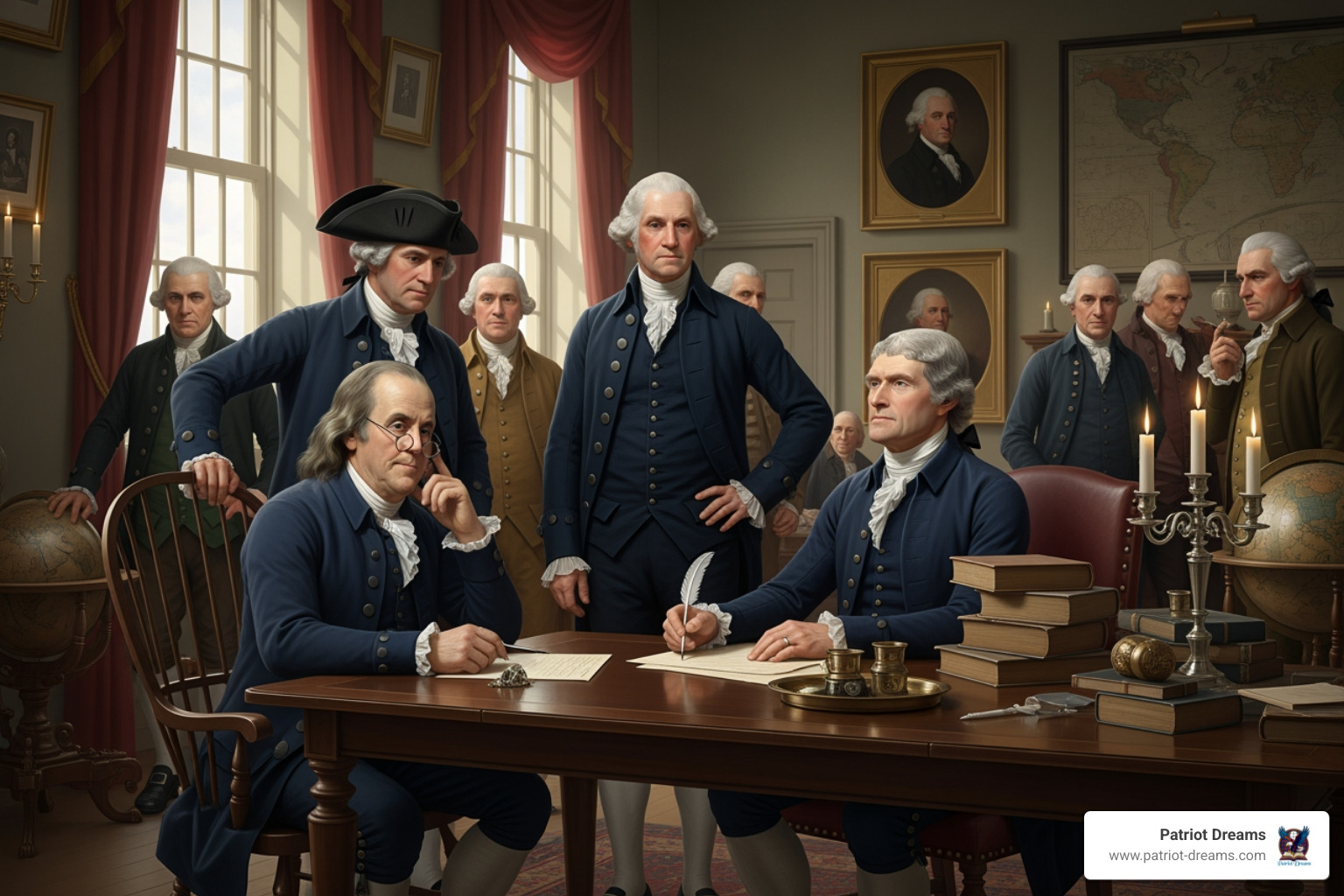
Unpacking Franklin's Genius: The Top Inventions That Shaped America
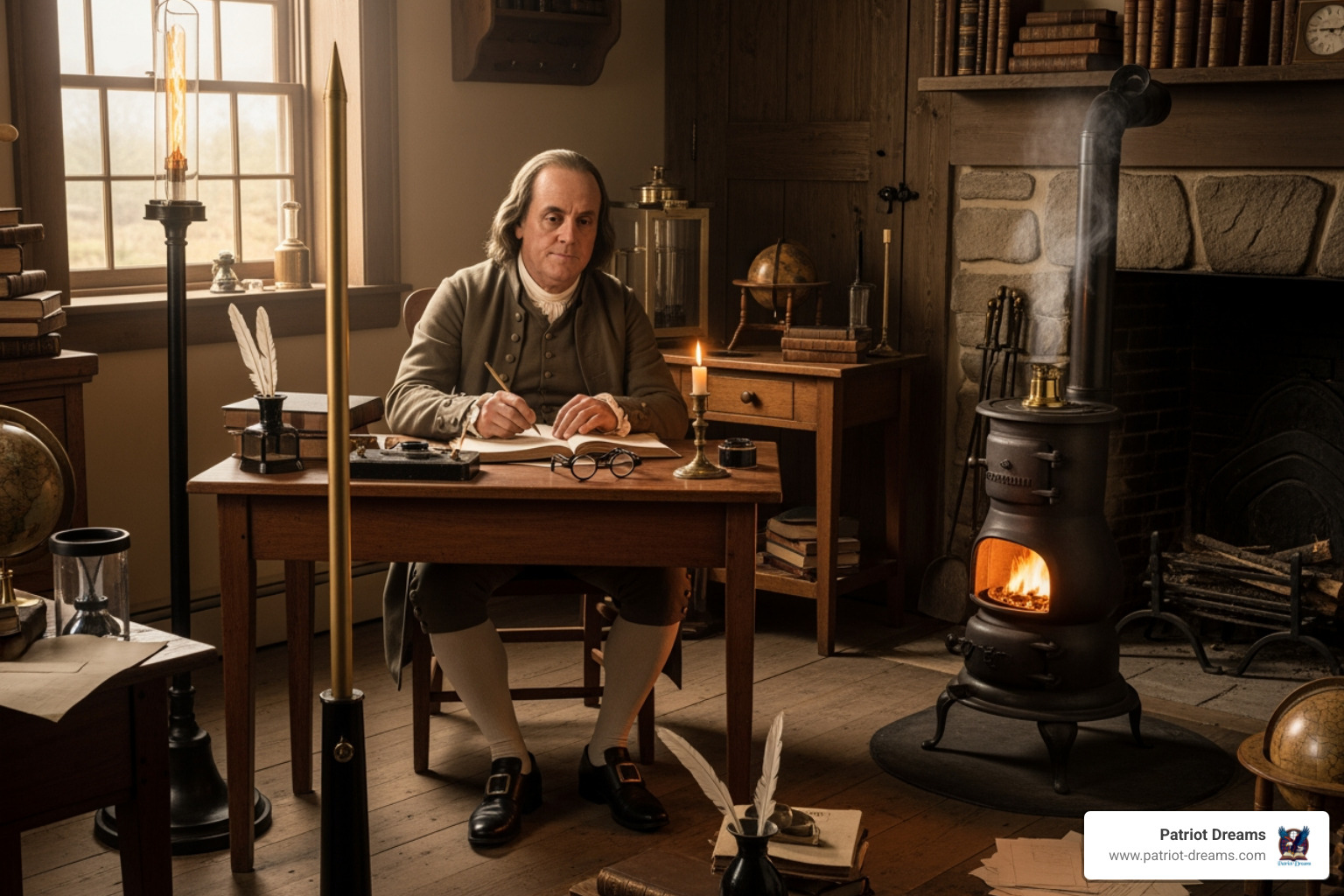

The Ingenious Mind of Benjamin Franklin
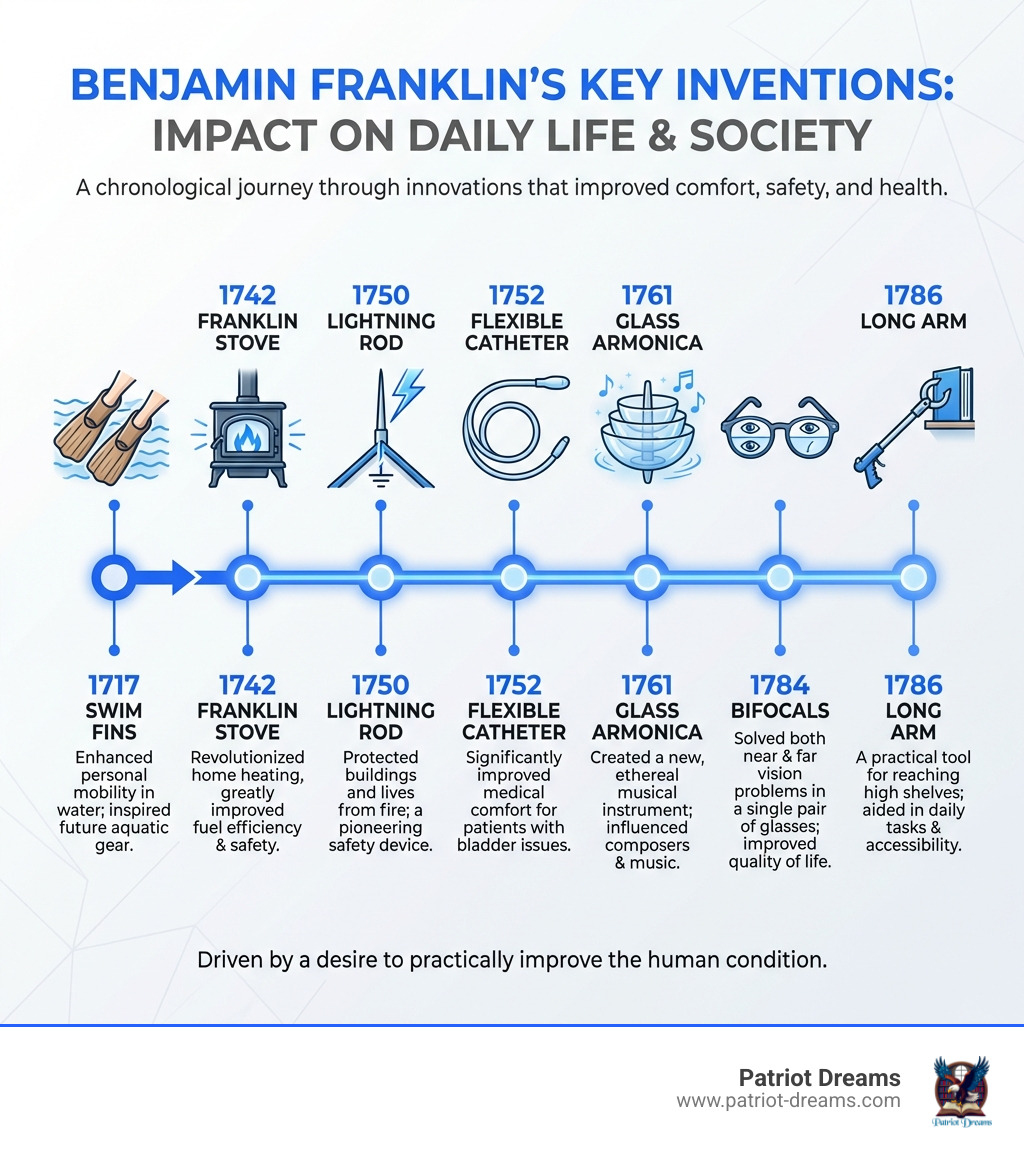
For quick reference, here are some of Benjamin Franklin's most significant inventions:
- Lightning Rod
- Bifocals
- Franklin Stove
- Glass Armonica
- Flexible Catheter
- Swim Fins
- Long Arm
When we think of the great American story, few figures shine as brightly as Benjamin Franklin. He was more than just a Founding Father; he was a printer, a scientist, a diplomat, and a true American original with an insatiable curiosity. His remarkable journey is highlighted by his numerous contributions, including the Benjamin Franklin inventions that continue to inspire us today. Franklin always looked for ways to make life a little better for everyone around him. He believed in giving his findies freely, seeing them as gifts to help his community and, indeed, the world.
He wasn't just inventing for himself; he was inventing for us. Each of his creations, from keeping our homes warm to helping us see clearly, shows a kind heart and a brilliant mind dedicated to practical solutions. Join us as we unpack the genius behind these wonderful innovations, reminding us that with a little curiosity and a lot of care, we can all make a difference.
Benjamin Franklin inventions vocabulary:
- Patrick Henry speech
- Folklore Files: Forgotten American Legends and What They Reveal About Us
- The Industrial Ages in Hollywood: How Movies Portray America’s Manufacturing Boom
A Mind for the People: Franklin's Philosophy of Innovation
Benjamin Franklin, a name synonymous with American ingenuity, wasn't just a tinkerer; he was a visionary with a profound belief in the power of shared knowledge. His motivation for inventing wasn't personal gain or fame, but a genuine desire to improve the lives of others. We see this caring spirit reflected in his unique philosophy on patents. Franklin famously never patented a single one of his inventions, holding the conviction that they should be shared freely and generously. He believed that since we all benefit from the inventions of others, we should be equally eager to share our own contributions with the world. This altruistic approach ensured that his innovations could be adopted widely, benefiting countless individuals and communities without the barrier of cost or intellectual property rights.

This philosophy wasn't born in a vacuum; it was deeply rooted in his background and experiences. As a printer, Franklin understood the power of disseminating information and ideas. He was a civic leader, constantly looking for ways to uplift his community, whether by founding America's first circulating library (The Library Company of Philadelphia, 1731) or organizing the Union Fire Company (1736), the nation's first volunteer fire department. His "printer's mindset" taught him the value of practical solutions and the importance of making knowledge accessible. This blend of scientific curiosity, civic responsibility, and a generous spirit shaped his approach to every challenge he encountered. His character traits, as much as his intellect, drove his inventive spirit, making him a truly unique historical American figure. To learn more about the kind of man Benjamin Franklin was, we can explore More about Franklin's character.
Franklin's inventions, therefore, were not just mechanical marvels; they were acts of public service. From the very start of his scientific inquiries, which began in earnest around 1746 after he retired from his lucrative printing business at the young age of 42, his goal was to apply scientific principles to solve everyday problems. He observed the world around him with a keen eye, always asking, "How can we make this better for everyone?" This simple, yet powerful, question led him to some of the most impactful Benjamin Franklin inventions. His commitment to the common good is a heartwarming testament to what can be achieved when genius is coupled with generosity.
Using the Heavens: The Lightning Rod
One of the most life-saving and iconic Benjamin Franklin inventions is undoubtedly the lightning rod. In the 18th century, lightning strikes were a terrifying and destructive force, frequently causing fires and severe damage to homes, barns, and churches. There was little understanding of its nature, and even less in the way of protection. Franklin, with his insatiable curiosity about the natural world, saw this as a problem to be solved.
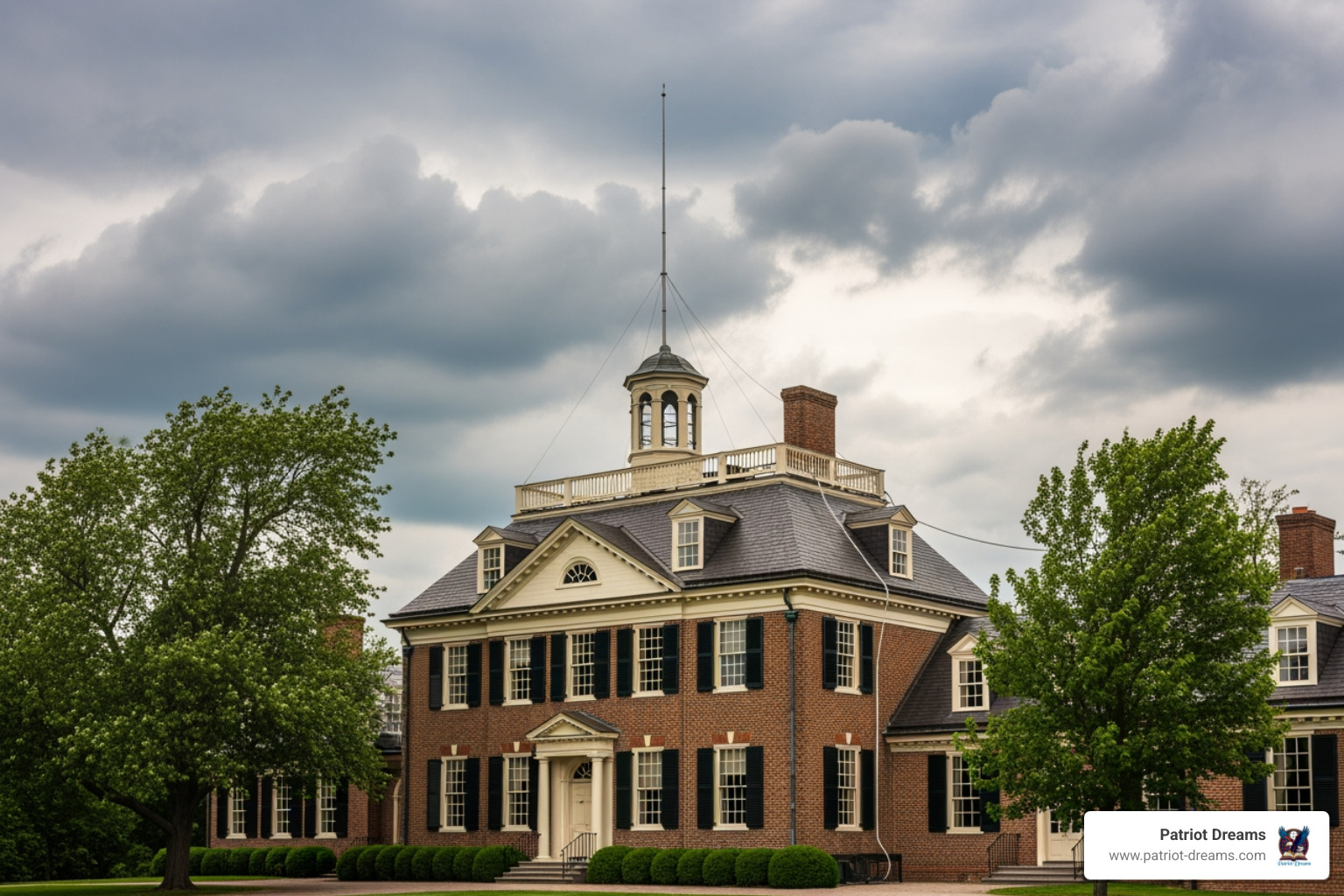
His fascination with electricity deepened after an accidental shock in 1746, which, while startling, propelled him into groundbreaking experiments. He theorized that lightning was a form of electrical discharge, and if so, it could be controlled. The scientific principle he explored was that of conduction: a sharp iron rod, he believed, could draw electrical "fire" from clouds, safely channeling it away from structures and into the ground.
The Spark of an Idea: How Electrical Experiments Led to Key Benjamin Franklin Inventions
Franklin's journey to the lightning rod began with extensive electrical experiments. He was the first to use terms like "positive" and "negative" to describe electrical charges in 1747, and he finded the principle of conservation of charge. His work established that electricity was a single fluid, not two, and that objects could have an excess (positive) or deficiency (negative) of this fluid.
The most famous, though perhaps most dangerous, demonstration of his theory was the kite and key experiment, conducted in June 1752. While he didn't "find" electricity with it, as some myths suggest, he proved that lightning was indeed electrical. By flying a kite during a thunderstorm, with a metal key attached to the kite string, he was able to draw atmospheric charge into a Leyden jar (an early capacitor). This daring experiment confirmed his hypothesis, laying the groundwork for his practical invention. You can read The story of the kite experiment for a deeper dive into this pivotal moment.
The societal impact of the lightning rod was immediate and profound. Its widespread adoption offered unprecedented protection, significantly reducing fires and saving lives and property across the Colonies. Even King George III, despite his political differences with Franklin, had lightning rods installed on Buckingham Palace, a testament to the invention's undeniable effectiveness. This simple yet brilliant device, born from scientific inquiry and a desire for public safety, remains a lasting legacy of Franklin's genius and a testament to american innovation history.
A Clearer View: The Invention of Bifocals
As we age, many of us experience a common challenge: presbyopia, the natural stiffening of the eye's lens that makes it difficult to focus on close objects. Benjamin Franklin, ever the practical problem-solver, faced this very issue as his eyesight began to decline. He found himself constantly switching between two pairs of glasses—one for reading and one for distance vision—a cumbersome inconvenience that surely sparked his inventive mind.
The Story Behind One of the Most Personal Benjamin Franklin Inventions: Bifocals
The year was 1784, and Franklin was spending considerable time in France, serving as a diplomat. Imagine the scene: a busy dinner party, Franklin trying to follow a conversation across the table, then fumbling for his reading glasses to glance at a menu or a document. This personal frustration, a relatable problem for many then and now, led him to a beautifully simple solution. He took his two pairs of glasses, cut each lens in half, and then combined them into a single frame. The upper half of each lens was for distance, and the lower half for reading. He called them "double spectacles."
This ingenious design allowed him to adjust his vision simply by moving his eyes up or down, rather than constantly swapping glasses. It was a clear improvement to daily life, offering convenience and efficiency. His bifocals quickly gained traction, and the concept endures today as a fundamental design in modern eyewear, a lasting testament to one of the most practical and personal Benjamin Franklin inventions. It reminds us that sometimes, the greatest innovations arise from solving our own everyday inconveniences with a thoughtful, caring approach.
More Than Just a Spark: A List of Benjamin Franklin Inventions
Beyond the iconic lightning rod and the universally useful bifocals, Franklin's inventive spirit touched many aspects of colonial life. His mind was a hive of activity, constantly observing, questioning, and improving. Let's dig into more of his remarkable creations.
The Franklin Stove
Invented in 1742, the Franklin Stove was a answer to a pervasive problem: the inefficiency of traditional colonial fireplaces. Open fireplaces, while providing warmth, were notoriously wasteful of wood and often filled homes with smoke. Franklin, ever the pragmatist, designed a cast-iron stove, originally called the "Pennsylvania Fire-Place," that stood in the middle of a room rather than being built into a wall.
This innovative design included a baffle system that forced smoke and hot air to travel a longer path before exiting the chimney. This meant more heat was extracted from the fire and radiated into the room, and less smoke escaped into the living space. The iron walls of the stove also absorbed and radiated heat long after the fire died down. The Franklin Stove significantly improved fuel efficiency, making it a more economical and comfortable way to heat homes, greatly enhancing home comfort and safety for countless American families. We can see how his desire to improve the lives of his fellow citizens shone through in this thoughtful design.
The Flexible Catheter
Not all of Franklin's inventions were about grand scientific principles; some were born from a deep sense of compassion. In 1752, Franklin's elder brother, John, suffered from painful bladder stones. The medical catheters of the time were rigid metal tubes, causing immense discomfort during use. Witnessing his brother's suffering, Franklin's caring nature spurred him to action.
He devised a flexible catheter made of hinged segments of tubes, which could be stiffened with an internal wire for insertion and then made flexible once in place. This was a significant improvement in medical device technology, offering a far less painful and more humane solution for a common and agonizing condition. This compassionate innovation highlights Franklin's commitment to easing human suffering, even in the most intimate and challenging circumstances.
The Glass Armonica
One of the most poetic and personally satisfying of all Benjamin Franklin inventions was the glass armonica, designed in 1761. Franklin was inspired by seeing musicians play music by rubbing their wet fingers around the rims of water-filled wine glasses. Enchanted by the ethereal tones, he sought to create a more sophisticated and practical instrument.
His armonica consisted of a series of glass bowls, graduated in size to produce different notes, mounted horizontally on a spindle. The spindle was then turned by a foot pedal, allowing the musician to play multiple notes simultaneously by touching the spinning, wet glass rims with their fingers. The resulting sound was hauntingly beautiful and captivated audiences across Europe. Renowned composers like Mozart and Beethoven even wrote music for it. Franklin himself stated that of all his inventions, the glass armonica gave him the greatest personal satisfaction. It showcased his artistic and creative side, proving that his genius extended beyond pure utility to the field of beauty and emotional expression.
Swim Fins and the Long Arm
Franklin's inventive spirit was evident from a very young age. We learn that Franklin invented swim fins in 1717, when he was just 11 years old! As a lifelong swimmer and an avid advocate for the sport, he designed oval paddles, about 10 inches long and 6 inches wide, to be held in the palms of the hands. These early swim fins helped him move faster through the water, a simple yet effective improvement to his beloved pastime. It's a charming glimpse into the early spark of genius that would define his life, showing us that curiosity and innovation can begin at any age.
Later in life, as Franklin aged and accumulated an impressive personal library, he faced a new, albeit less dramatic, challenge: reaching books on high shelves. This led to another practical Benjamin Franklin invention, the "Long Arm," in 1786. This was essentially a wooden pole with a grasping mechanism at the end, allowing him to extend his reach and retrieve books without needing a ladder. It's a simple tool, born from a personal need, that embodies his lifelong ingenuity and dedication to making life a little easier, even in the quiet moments of reading and reflection.
Frequently Asked Questions about Benjamin Franklin's Work
We often receive questions about the fascinating life and work of Benjamin Franklin. Let's explore some of the most common inquiries, shedding light on the details of his incredible contributions.
Why didn't Benjamin Franklin patent his inventions?
This is one of the most admired aspects of Franklin's character and a cornerstone of his philosophy. Benjamin Franklin never patented any of his inventions because he firmly believed that ideas and innovations should be shared freely for the benefit of all humanity. He famously stated, "as we enjoy great advantages from the inventions of others, we should be glad of an opportunity to serve others by any invention of ours; and this we should do freely and generously."
This principle was not just a lofty ideal; it was a practical commitment. By not patenting his designs, such as the Franklin Stove or the lightning rod, he ensured that they could be manufactured and adopted widely without legal or financial restrictions. This decision accelerated the positive impact of his inventions on society, truly making them a gift to humanity. It's a powerful reminder of his generous spirit and his dedication to the common good, a truly inspiring aspect of his legacy.
What was Benjamin Franklin's first invention?
While his electrical experiments and later inventions often grab the spotlight, Benjamin Franklin's first recorded invention dates back to his boyhood. At the tender age of 11, in 1717, Franklin invented swim fins! This early sign of genius highlights his innate curiosity and practical approach to improving even his favorite hobbies. As an avid swimmer throughout his life, it's clear his passion for the water sparked this early innovation. It reminds us that brilliance can emerge in childhood, often from simple desires to improve our experiences.
Did Benjamin Franklin invent Daylight Saving Time?
This is a common and amusing misconception! While Benjamin Franklin is often credited with inventing Daylight Saving Time, the truth is a bit more nuanced—and quite humorous. Franklin did not invent Daylight Saving Time as we know it today. Instead, in 1784, while living in Paris, he wrote a satirical essay titled "An Economical Project for Diminishing the Cost of Light," published anonymously. In this essay, he jokingly suggested that Parisians could save money on candles by waking up earlier to take advantage of natural daylight during the summer months.
His proposal included firing cannons at sunrise to ensure everyone woke up, and imposing a tax on window shutters to encourage early rising. It was a witty observation on societal habits and resourcefulness, not a formal proposal for a time change. So, while he certainly had a keen eye for efficiency and saving resources, we can definitively say that Daylight Saving Time is not one of the actual Benjamin Franklin inventions. You can explore The truth about Franklin and DST for more details on this delightful historical anecdote.
Conclusion: The Enduring Legacy of a Generous Genius
As we reflect on the remarkable array of Benjamin Franklin inventions, we're struck not just by the sheer number of his contributions, but by the profound character that underpinned them all. From the life-saving lightning rod to the vision-correcting bifocals, the warmth-providing Franklin Stove, the compassionate flexible catheter, the melodious glass armonica, the playful swim fins, and the practical Long Arm, each invention tells a story of a mind dedicated to improvement and service.
Franklin's curiosity was boundless, his practicality best, and his spirit of community was a guiding light. He wasn't inventing for personal fame or fortune, but to genuinely make the world a better, safer, and more comfortable place for everyone. His philosophy of sharing knowledge freely, without the constraints of patents, stands as a powerful testament to his generosity and foresight. It's a heartwarming example of what true American ingenuity, coupled with a caring heart, can achieve.
His legacy continues to inspire us at Patriot Dreams, reminding us that the greatest contributions often come from those who seek to uplift others. His life, filled with findy and benevolence, encourages us to accept our own curiosity, to tackle everyday problems with creative solutions, and to always consider how our actions can benefit our communities. Benjamin Franklin wasn't just a historical figure; he was an embodiment of the hopeful, inventive, and generous spirit that continues to shape our nation. We hope his story leaves you feeling inspired and connected to the incredible mix of American history.
To find more inspiring American stories and explore the rich heritage of our nation, we invite you to visit our platform. There, you can dig into the lives of other remarkable figures and uncover the tales that have shaped who we are today. Discover more inspiring American stories on our platform.

Join the Patriot Dreams Community
Download the app today and start your journey through American history and personal legacy.

Explore Our Latest Insights
Dive into stories that shape our American legacy.