Everything You Need to Know About Lewis and Clark Expedition
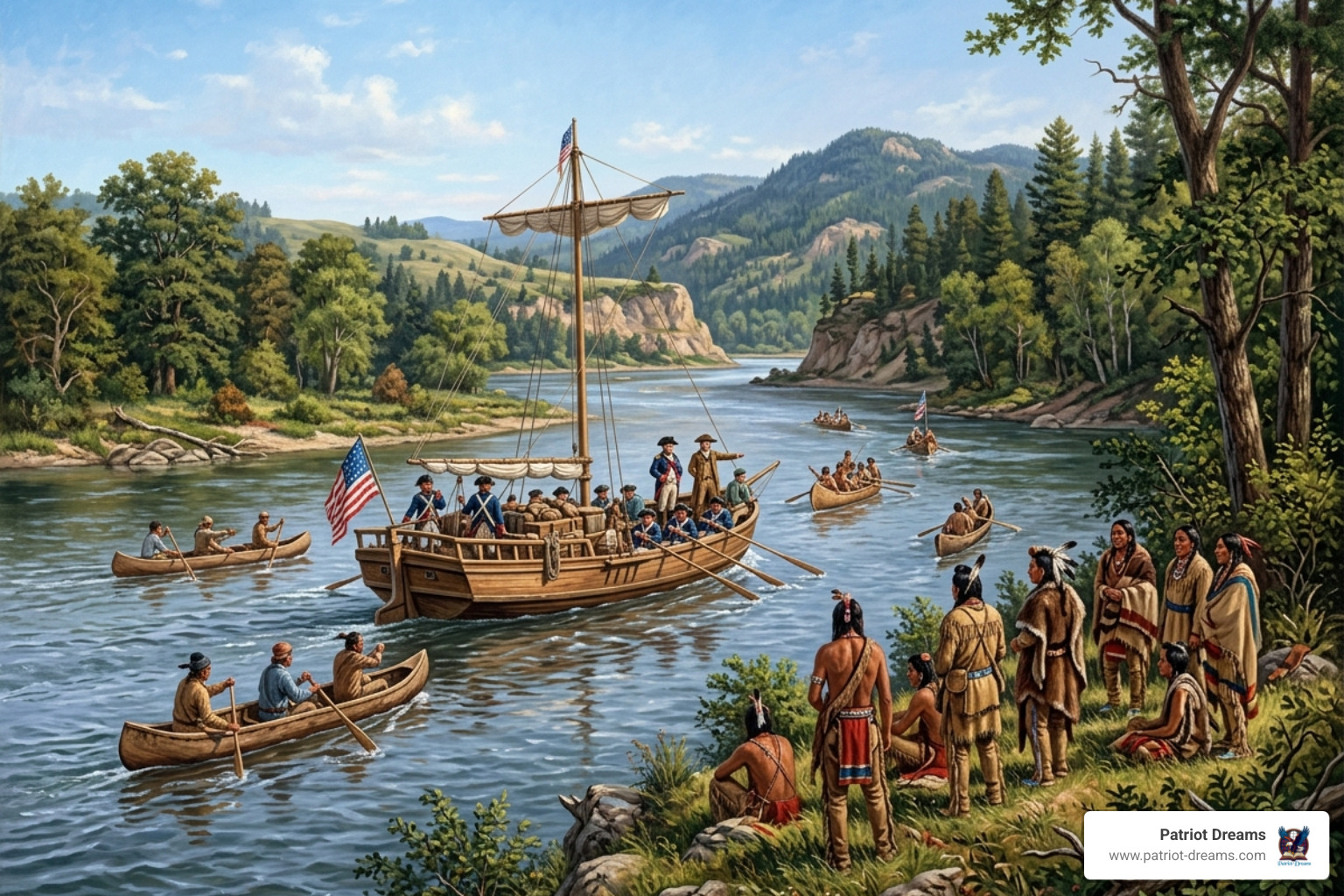

The Lewis and Clark Expedition: America's Greatest Adventure Story
The Lewis and Clark expedition was a U.S. military exploration led by Meriwether Lewis and William Clark from 1804 to 1806, commissioned by President Thomas Jefferson to explore the newly acquired Louisiana Territory and find a route to the Pacific Ocean.
Quick Facts:
- Who: Captains Meriwether Lewis and William Clark, leading about 45 members of the Corps of Discovery
- When: May 14, 1804 – September 23, 1806 (862 days)
- Where: From Camp Wood near St. Louis, Missouri, to the Pacific Coast and back
- Distance: Over 8,000 miles traveled
- Purpose: Explore the Louisiana Purchase, map the land, document wildlife, and establish relations with Native American tribes
- Cost: $2,500 initially approved by Congress; roughly $40,000 total
Imagine stepping out your front door one morning and not coming home for two and a half years — traveling through wilderness that no American had ever mapped, meeting people whose languages you didn't speak, and facing mountains that seemed to touch the sky.
That's exactly what a brave group of Americans did starting in the spring of 1804.
It began with a dream. President Thomas Jefferson had long gazed westward, wondering what lay beyond the known edges of the young nation. After the Louisiana Purchase doubled the size of the United States in 1803 — adding 828,000 square miles of land for just about three cents per acre — Jefferson saw his chance. He asked his trusted personal secretary, Meriwether Lewis, to lead an expedition into that vast, unknown world.
What followed became one of the greatest adventure stories in American history — a journey of courage, friendship, curiosity, and wonder that still inspires us today.
A President’s Dream: The Purpose of the Lewis and Clark Expedition
Long before he held the highest office in the land, Thomas Jefferson was a man of deep curiosity. He spent years at his home, Monticello, dreaming of what lay toward the setting sun. We often think of the Lewis and Clark expedition as a simple scouting trip, but for Jefferson, it was a grand scientific and diplomatic mission.
In 1803, the United States finalized the Louisiana Purchase with France. For $15 million — a price that works out to a mere three cents per acre — the young nation acquired 828,000 square miles of territory. This wasn't just a real estate deal; it was a transformation of the American identity. Suddenly, the U.S. stretched from the Mississippi River to the Rocky Mountains.
Jefferson’s primary goal was to find the "Northwest Passage" —a legendary water route that would connect the Missouri River to the Pacific Ocean, opening up a direct path for the fur trade and commerce. Beyond trade, he gave Lewis specific instructions to study everything: the soil, the weather, the minerals, the plants, and the diverse Native American nations they would encounter.
Jefferson initially requested only $2,500 from Congress for this "confidential" mission. While the final cost would eventually reach about $40,000, the wealth of knowledge brought back was priceless. You can learn more about these early plans at Monticello | Origins of the Lewis and Clark Expedition.
The Corps of Discovery: A Story of Friendship and Bravery
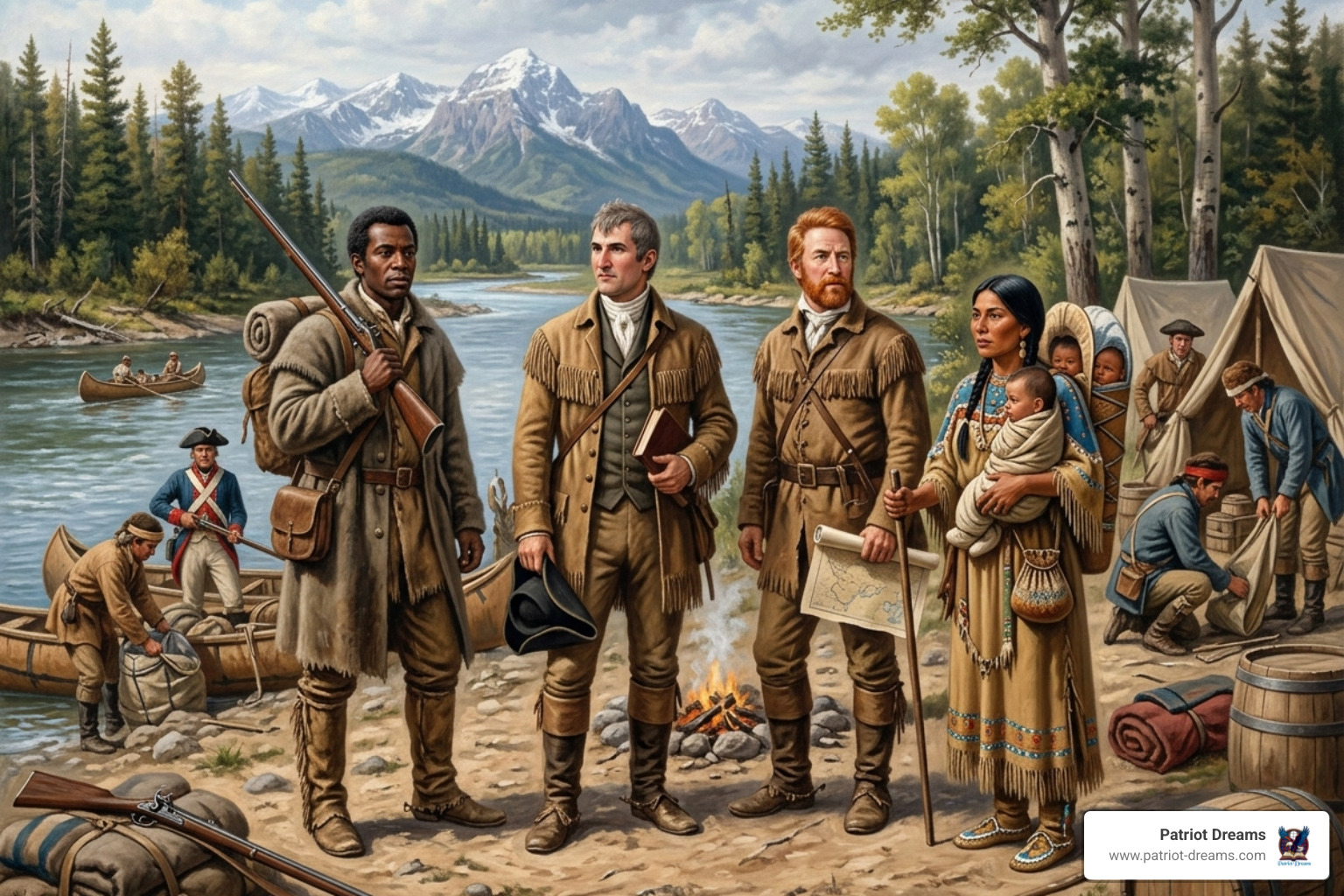
The group that set out on this journey wasn't just a military unit; it was a small community. Officially called the Corps of Discovery, the party numbered 45 at the start. This diverse group included 27 young unmarried soldiers, a French-Indian interpreter, and some very special individuals who became legends in their own right.
Among them was York, William Clark’s enslaved African American servant. York was a vital member of the team, often fascinating the Native American tribes who had never seen a person of African descent. He worked alongside the soldiers, hunting and scouting, and was even given a vote in team decisions — a rare moment of equality in that era.
Then there was Seaman, Meriwether Lewis’s faithful Newfoundland dog. Purchased for $20, Seaman was more than a pet; he was a guardian who protected the camp from bears and helped hunt for food.
And, of course, there was Sacagawea. A Shoshone woman who joined the expedition with her husband, Toussaint Charbonneau, she traveled thousands of miles with her newborn son, Jean Baptiste, strapped to her back. Her presence was a "white flag of peace," as Native tribes knew that a war party would never travel with a woman and an infant. We invite you to read more about her incredible journey in the-true-story-of-sacagawea-guide-interpreter-and-american-icon.
Who were the leaders of the Lewis and Clark expedition?
At the heart of the journey were two men whose friendship is one of the most touching in our history. Meriwether Lewis was the intellectual, a literate frontiersman who Jefferson personally trained in botany, astronomy, and medicine. William Clark was the expert draftsman and mapmaker, a man of steady nerves and superior frontier skills.
While the U.S. Army only officially recognized Lewis as the commanding captain and Clark as a lieutenant, Lewis refused to let that stand. He treated Clark as a full co-captain, and the men of the Corps never knew the difference in their official ranks. This spirit of mutual respect and shared leadership is a hallmark of what we call explorers-trailblazers.
From St. Louis to the Pacific: Mapping a New Frontier
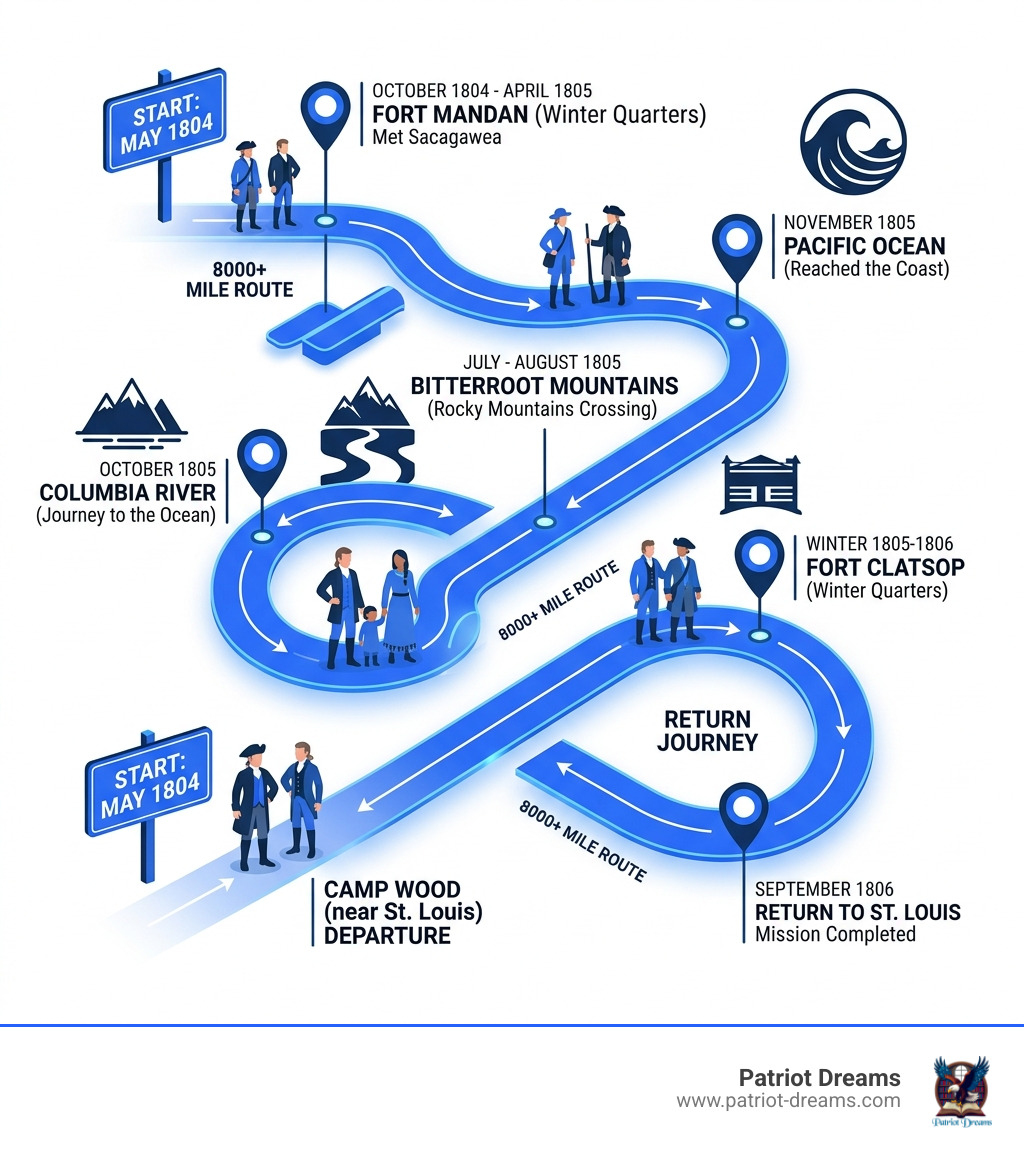
The journey officially began on May 14, 1804, as the Corps departed from Camp Wood near St. Louis. They spent the first summer battling the powerful Missouri River, averaging about 15 miles a day against the current.
Their route was a winding path through the heart of the continent. They spent their first winter at Fort Mandan (in present-day North Dakota), where they met Sacagawea. The following spring, they pushed further west, facing the daunting Great Falls of the Missouri — which required an 18-mile portage — and finally the snow-capped Rocky Mountains.
Reaching the Pacific Ocean in November 1805 was a moment of pure triumph. They built Fort Clatsop near the mouth of the Columbia River to survive the rainy winter. During those cold months, they stayed busy: they hunted 131 elk and 20 deer and even made 358 pairs of moccasins to prepare for the long walk home.
MilestoneDateSignificanceDeparture from St. LouisMay 14, 1804The official start of the 8,000-mile journey.Death of Sgt. Charles FloydAugust 20, 1804The only fatality of the entire expedition.Arrival at Fort MandanWinter 1804-05Met Sacagawea and prepared for the mountains.Reaching the Pacific OceanNovember 1805Proved an overland route to the ocean was possible.Return to St. LouisSeptember 23, 1806The triumphant return that sparked westward expansion.
For a deeper dive into the specific dates and facts of the route, you can explore the Lewis and Clark Expedition | Summary, History, Members, Facts, & Map | Britannica.
Nature’s Wonders and the Challenges of the Trail
The Lewis and Clark expedition was not without its trials. The Corps faced swarms of mosquitoes, treacherous river rapids, and the constant threat of grizzly bears. Lewis once remarked that he would "rather fight two Indians than one bear" after several close calls with the massive "white bears" of the plains.
The most grueling challenge was crossing the Bitterroot Mountains along the Lolo Trail. They were cold, hungry, and exhausted, fearing their feet would freeze in the mountain snow. Yet, through perseverance and the help of the Nez Perce people, they made it through.
Tragically, the expedition did lose one member. Sergeant Charles Floyd passed away on August 20, 1804, near what is now Sioux City, Iowa. It is believed he suffered from a ruptured appendix—a condition that even the best doctors of the time could not have cured. He remains the only member of the Corps of Discovery to die during the journey, a testament to the leadership and care Lewis and Clark provided.
What scientific discoveries were made during the Lewis and Clark expedition?
While the adventure makes for a great story, the scientific contributions were staggering. Lewis and Clark documented 178 plants and 122 animals that were previously unknown to European-American science.
They were the first to describe the "barking squirrels" we now call prairie dogs. They sent a live one back to President Jefferson, along with magpies and a sharp-tailed grouse! They also identified the Bitterroot plant (the state flower of Montana), Douglas fir, and Ponderosa pine. These discoveries are a vital part of our american-pioneer-stories.
The Lasting Legacy of the Lewis and Clark expedition
When the Corps of Discovery returned to St. Louis on September 23, 1806, they were greeted as heroes. They had been gone so long that many people assumed they were dead. Instead, they returned with maps that changed the world and stories that fueled the American imagination for generations.
The expedition contacted over 70 Native American tribes, establishing diplomatic relations and distributing "Peace Medals" as symbols of friendship. While the years that followed would bring many challenges to those relationships, the journals of Lewis and Clark reflect a time of mutual curiosity and shared survival.
Their journey proved that while a continuous "Northwest Passage" by water didn't exist, a path to the Pacific did. This paved the way for the oregon-trail-stories that would define the next century of American history.
Frequently Asked Questions about the Journey
Who was the only member to die during the expedition?
Sergeant Charles Floyd was the only member to perish. He died on August 20, 1804, likely from a ruptured appendix. The captains buried him with full military honors on a bluff overlooking the Missouri River in Sioux City, Iowa.
What role did Sacagawea play in the journey's success?
Sacagawea was indispensable. As an interpreter, she helped the expedition communicate with the Shoshone to trade for the horses they needed to cross the mountains. Her knowledge of the land helped them find edible plants when food was scarce, and her presence signaled to every tribe they met that the Corps came in peace.
How much did the entire expedition cost the taxpayers?
While Jefferson initially asked for $2,500, the final tally was approximately $40,000. When you consider that they mapped a territory that cost only 3 cents per acre in the Louisiana Purchase, the expedition was one of the best investments our government ever made.
Conclusion
At Patriot Dreams, we believe that every map tells a story and every journey leaves a legacy. The Lewis and Clark expedition is more than just a chapter in a history book; it is a story of what happens when people of different backgrounds come together with a common purpose. It's about the kindness of strangers like the Nez Perce, the bravery of a young mother like Sacagawea, and the unbreakable bond between two friends named Meriwether and William.
We hope this story inspires you to look at your own family’s journey with the same sense of wonder. Our heritage is built on the footsteps of those who went before us, carving trails through the unknown so that we might have a place to call home.
If you’re ready to discover more about the people and places that shaped our nation, join us as we celebrate America 250 Years in the Making. There are so many stories waiting to be told — and yours is one of them.

Join the Patriot Dreams Community
Download the app today and start your journey through American history and personal legacy.

Explore Our Latest Insights
Dive into stories that shape our American legacy.