Heartbreaking Stories from the Cherokee Trail of Tears


The Human Stories Behind the Cherokee Trail of Tears
Cherokee Trail of Tears stories are some of the most heartbreaking — and most important — chapters in all of American history.
Here is a quick overview of what these stories tell us:
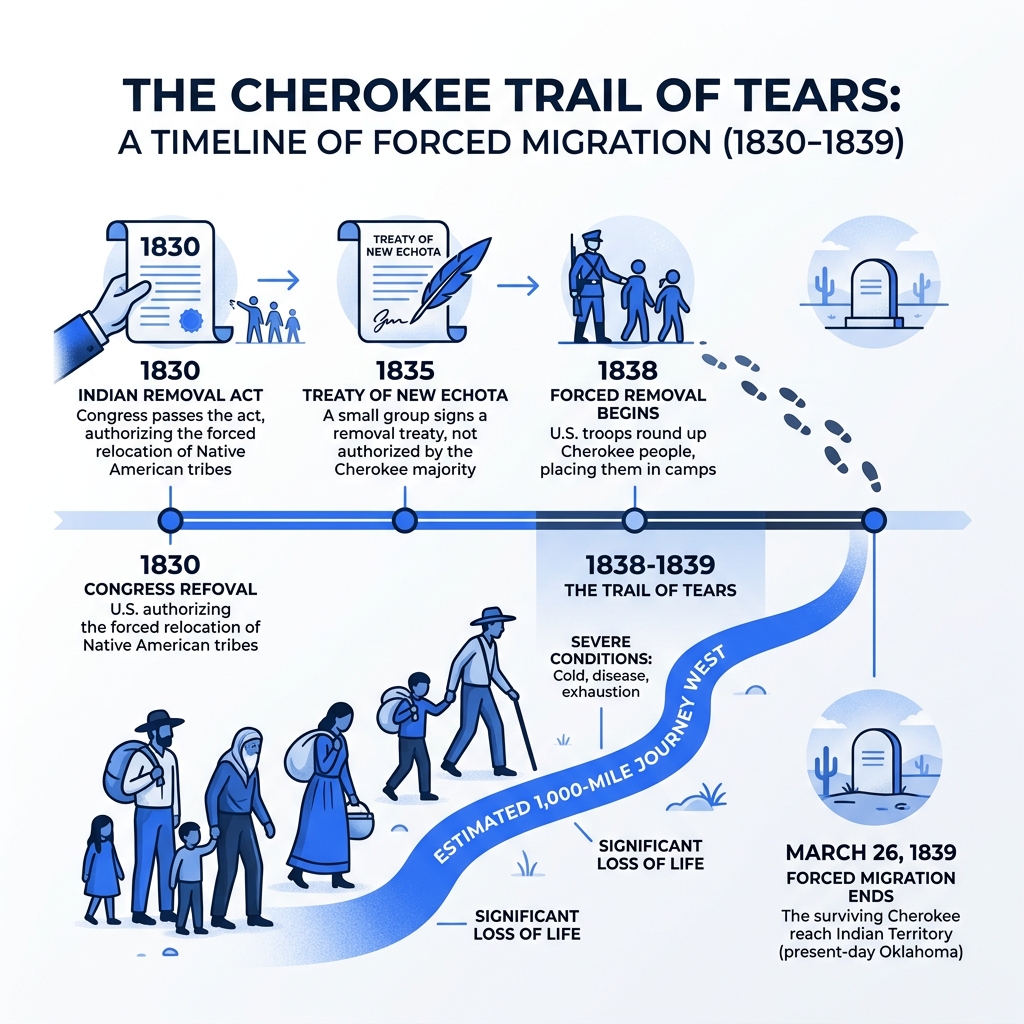
- What happened: Between 1838 and 1839, the U.S. government forced nearly 16,000 Cherokee people to leave their ancestral homelands in the Southeast and march roughly 1,000 miles to Indian Territory (present-day Oklahoma).
- Who was affected: The Cherokee, along with the Choctaw, Creek, Chickasaw, and Seminole nations — often called the Five Civilized Tribes.
- The human cost: Approximately 4,000 Cherokee people died from cold, disease, and exhaustion along the way.
- The voices: Survivors like Rebecca Neugin and eyewitnesses like Private John G. Burnett left behind powerful personal accounts of what they saw and endured.
- The legacy: The Cherokee Nation survived, rebuilt, and continues to honor those who were lost through traditions, ceremonies, and programs like Remember the Removal.
These are not just history book facts. They are family stories — stories of grandmothers carrying toddlers, of soldiers showing small kindnesses in the cold, of a people who refused to let their culture disappear.
As Private John G. Burnett, a U.S. soldier who witnessed the march firsthand, later wrote on his 80th birthday: the long and painful journey westward ended on March 26, 1839, leaving behind four thousand silent graves stretching from the foothills of the Smoky Mountains all the way to Indian Territory.
This guide walks through those stories with care and respect — for the families who lived them, and for all of us who can learn from them.
Understanding the Journey: The Origins of the Removal
To understand the Cherokee Trail of Tears stories, we have to look back at the years leading up to the march. The Cherokee people lived in beautiful, lush homelands across Georgia, Tennessee, Alabama, and North Carolina. They weren't "nomads"; they were a sophisticated nation with their own written language (the Sequoyah syllabary), a constitution, schools, and successful farms.
However, a few things changed the course of history. First, the discovery of a gold nugget in Georgia in 1828 triggered a "gold rush" that brought thousands of settlers onto Cherokee land. Second, President Andrew Jackson pushed for the Indian Removal Act of 1830. This law gave the federal government the power to trade land in the East for land in the West (what is now Oklahoma).
While some tribes, like the Choctaw, began moving as early as 1831, the Cherokee Nation fought back—not with weapons, but with the law. Led by Chief John Ross, they took their case all the way to the Supreme Court and won! But the government, under Jackson and later Martin Van Buren, ignored the ruling.
The turning point was the Treaty of New Echota in 1835. This treaty was signed by a small group of Cherokee men who did not represent the whole nation. Even though over 14,000 Cherokee people signed a petition saying they did not agree to it, the U.S. Senate ratified the treaty anyway. This set the stage for the forced removal that would begin in 1838.
During this time, many kind-hearted people spoke out against the injustice. Missionaries like Elizur Butler and even the famous frontiersman Davy Crockett risked their reputations to defend the Cherokee. If you're interested in other tales from this era of growth and struggle, you might enjoy reading more about American pioneer stories to see the different perspectives of those living on the frontier.
Voices of Resilience: Personal Cherokee Trail of Tears stories
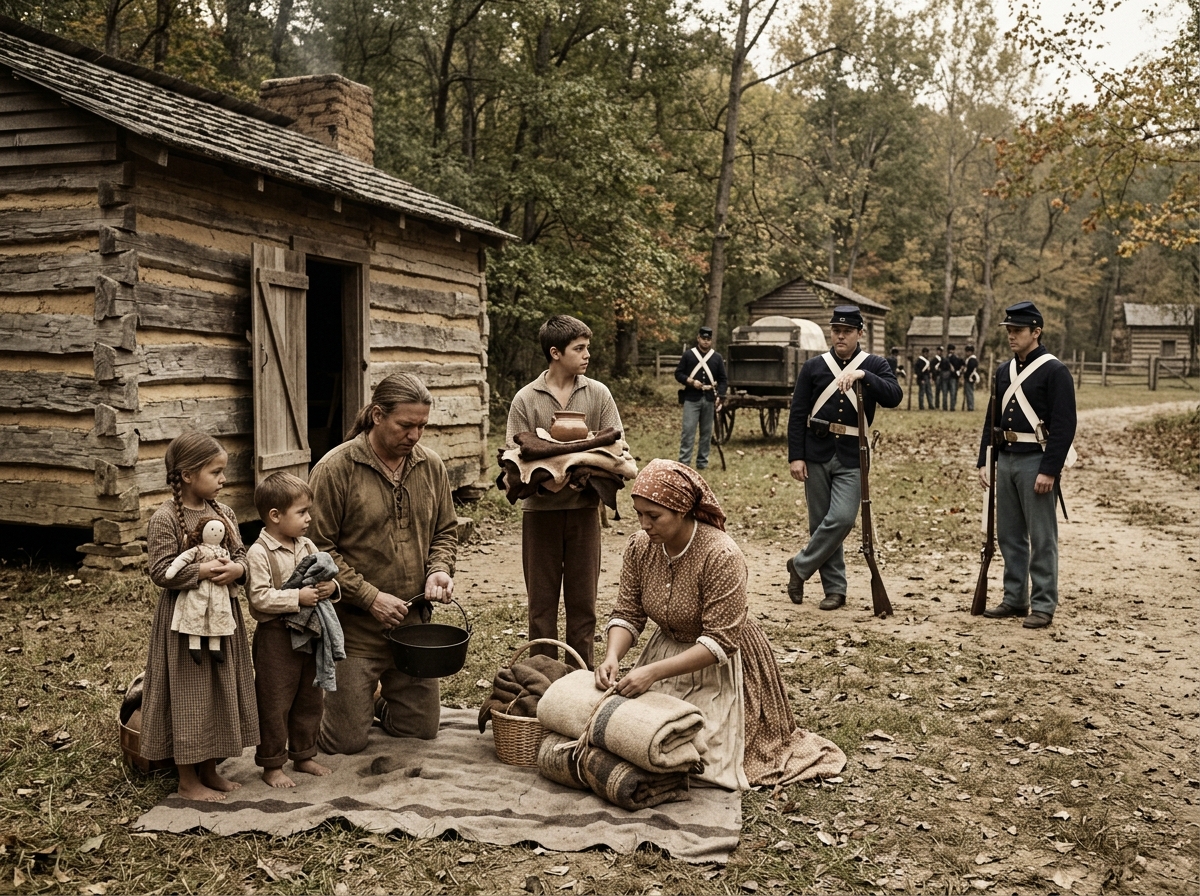
History is often told through dates and maps, but at Patriot Dreams, we believe the heart of history lives in the personal experiences of families. When the soldiers arrived to round up the Cherokee, they often didn't give families time to pack. People were driven from their dinner tables or their fields at bayonet point.
Yet, even in these dark moments, we see incredible resilience. Families stayed together, clans looked out for one another, and elders passed down the "Gadugi" spirit—a Cherokee word for working together for the community.
The Childhood Memories of Rebecca Neugin and Cherokee Trail of Tears stories
One of the most touching Cherokee Trail of Tears stories comes from Rebecca Neugin. She was only about three or four years old when the soldiers came to her home in Georgia.
Rebecca later recalled how her mother managed to sneak back into their house to grab a few essential items—bedding and cooking utensils—while the soldiers were distracted. Imagine a little girl watching her world change in an instant. Her family was taken to a stockade (a temporary prison camp) before starting the long walk.
Rebecca’s family traveled in a detachment led by Mose Daniel. She remembered her father hunting for deer and turkey along the way to help feed them, as the government rations were often just salt pork and corn. Despite the fear and the cold, Rebecca survived and lived to be nearly 100 years old in Oklahoma. Her story reminds us that even the smallest children carried the weight of this journey, and their survival is why the Cherokee Nation is so strong today. You can find similar stories of courage among explorers and trailblazers who navigated the unknown.
A Soldier’s Compassion: The Account of Private John G. Burnett
Not every soldier wanted to be there. Private John G. Burnett was a young man who had grown up hunting with the Cherokee and spoke their language. On his 80th birthday, he wrote a letter to his children because he couldn't keep the memories inside anymore. He called the removal "the most brutal order in the history of American warfare."
Burnett shared stories of small acts of kindness that shine like little lights in the darkness. He spoke of how he used his own overcoat to wrap a sick child during a freezing night on guard duty. He also wrote about Quatie Ross, the wife of Chief John Ross. During a bitter winter storm, she gave her only blanket to a sick child who was crying from the cold. Tragically, Quatie Ross caught pneumonia and died soon after.
Burnett’s account is a reminder that even in systems of great injustice, individuals can choose to be kind. His moral courage to speak the truth decades later helps us ensure these stories are never forgotten.
Hardships and Heroes Along the Way
The journey was roughly 1,000 miles, and it took months to complete. Most Cherokee people walked the entire way. There were two main paths: the Water Route and the Land Route. Neither was easy.
At places like Mantle Rock in Kentucky, thousands of Cherokee were stranded for weeks because the Ohio River was frozen over, and the ferries couldn't cross. They had to sleep in the snow with only thin blankets. Disease, like whooping cough and dysentery, spread quickly through the camps.
One of the greatest heroes of this time was Chief Junaluska. Years earlier, he had actually saved Andrew Jackson’s life during the Battle of Horseshoe Bend. When the removal began, he went to Washington to plead with Jackson for mercy. Jackson coldly turned him away. Junaluska later said that if he had known how Jackson would treat his people, he would have let history take a different course that day.
| Feature | Water Route | Land Route |
|---|---|---|
| Method | Steamboats and flatboats | Wagons and walking |
| Primary Danger | Disease (Cholera) and drowning | Exposure (Cold) and starvation |
| Duration | Often faster, but cramped | Slower, months-long trek |
| Legacy | High mortality in summer | High mortality in winter |
Significant Sites and the Path to Oklahoma
Today, the Trail of Tears is a National Historic Trail that stretches across nine states. These sites are not just landmarks; they are sacred ground.
- New Echota (Georgia): The former capital of the Cherokee Nation where the controversial treaty was signed.
- Rattlesnake Springs (Tennessee): The site where the Cherokee held their last council in the East. Here, they made a beautiful and brave resolution: they would maintain their laws and their identity, no matter where they were moved.
- Fort Cass (Tennessee): One of the largest emigration depots where families were held before the march.
- Mantle Rock (Kentucky): A natural sandstone arch that provided some shelter for those waiting to cross the frozen river.
- Tahlequah (Oklahoma): The new capital established by the Cherokee after they arrived. It remains the heart of the Cherokee Nation today.
If you ever visit Oklahoma, the Cherokee Heritage Center is a wonderful place to learn more. It features a recreated village that shows how the Cherokee lived before and after the removal, proving that their story didn't end in 1839—it was just a new beginning.
Legacy of the Cherokee Nation and Modern Remembrance
The Cherokee Trail of Tears stories are ultimately stories of "Gadugi"—coming together. When the Cherokee arrived in Indian Territory, they didn't give up. They built a new capital, started a new newspaper, and established a school system that was often better than those in the surrounding states.
Today, the Cherokee Nation is a thriving sovereign government with over 400,000 citizens. They provide healthcare, education, and jobs, contributing billions to the economy. They have turned a story of loss into a story of incredible success.
Preserving Cherokee Trail of Tears stories for Future Generations
Every year, a group of young Cherokee citizens participates in the "Remember the Removal" bike ride. They cycle the 1,000-mile route their ancestors walked. It’s a way to connect with their family genealogy and ensure the names of those who suffered are still spoken.
We believe that by sharing these stories, we honor the resilience of the human spirit. History isn't just about what happened "back then"; it's about how we carry those lessons into the future. Much like visiting Civil War battlefields, walking these paths helps us understand the price of our shared history and the value of our community bonds.
Frequently Asked Questions about the Trail of Tears
What was the primary cause of the Trail of Tears?
The primary cause was the Indian Removal Act of 1830. This was driven by the desire of white settlers for tribal lands, especially after gold was discovered in Georgia in 1828. The U.S. government wanted to clear the Southeast for expansion and used the Act to force tribes westward.
How many Cherokee people died during the removal?
It is estimated that nearly 4,000 Cherokee people died. This was roughly one-fifth of the entire population at the time. Deaths occurred in the stockade camps before the march began, during the 1,000-mile journey, and shortly after arriving in Indian Territory due to the harsh conditions and lack of supplies.
Who were the main figures who opposed the removal?
Chief John Ross was the most prominent leader of the resistance, spending years in Washington fighting for his people's rights. He was joined by non-Native figures like Davy Crockett, who famously voted against the Indian Removal Act, and Christian missionaries like Elizur Butler and Samuel Worcester, who were even imprisoned for their support of the Cherokee.
Conclusion
The Cherokee Trail of Tears stories are a vital part of the American tapestry. They remind us that our history is filled with moments of both great sorrow and great strength. At Patriot Dreams, we are honored to help keep these memories alive, connecting the past to the present through the power of storytelling.
By remembering the kindness of a soldier, the bravery of a mother, and the resilience of a nation, we heal the wounds of the past and build a more thoughtful future. We invite you to discover our journey through 250 years of American history and find the stories that connect your family to the heart of this great land. Together, we can ensure that the "silent graves" of the trail are silent no more, but instead speak to us of courage, unity, and hope.

Join the Patriot Dreams Community
Download the app today and start your journey through American history and personal legacy.

Explore Our Latest Insights
Dive into stories that shape our American legacy.