9 Little Known Facts About Declaration Signers

Meet the 56 Declaration Signers
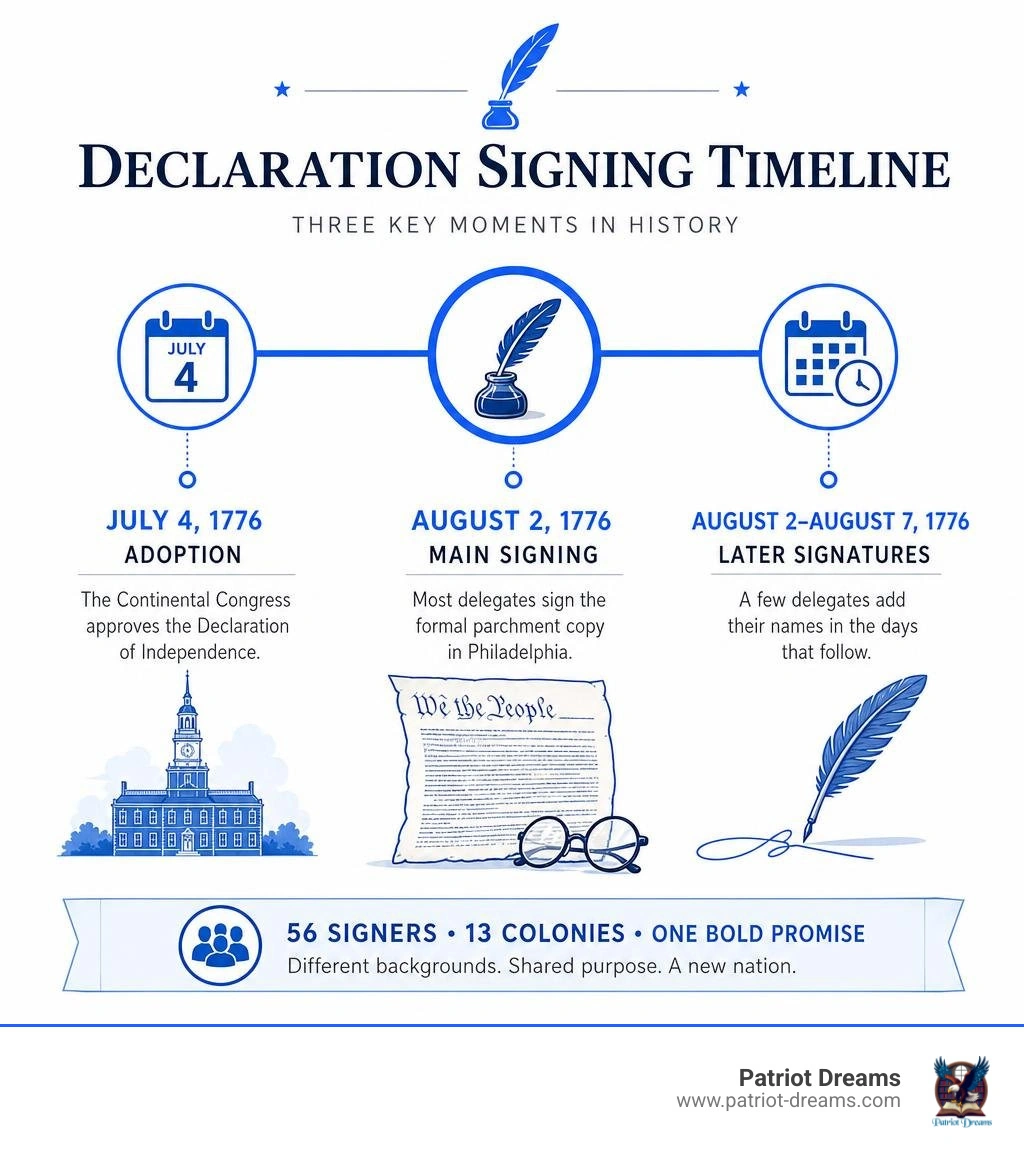
Declaration Signers were the 56 delegates from the 13 colonies who placed their names on the Declaration of Independence. Congress approved its text on July 4, 1776, but most delegates signed the formal parchment copy on August 2, with a few adding their names later.
| Quick fact | Answer |
|---|---|
| Total signers | 56 |
| Colonies represented | 13 |
| Oldest signer | Benjamin Franklin, age 70 |
| Youngest signer | Edward Rutledge, age 26 |
| Most famous signature | John Hancock's, nearly 5 inches long |
These were not simply famous names on an old page. They were lawyers, merchants, doctors, farmers, and community leaders who came from different places and generations, then made a shared promise at a moment of enormous uncertainty.
Their stories include late-night rides, unusual signatures, close calls, and surprising connections that reach far beyond the familiar names of Hancock, Adams, Jefferson, and Franklin. Each one helps make the Declaration feel less like a distant artifact and more like a human story.
We are Kyle & Emily, and we are glad to explore these small but remarkable pieces of American history with you.
9 Surprising Facts About Famous Declaration Signers
When we look back at the birth of the United States, it is easy to picture a single, flawless moment frozen in time. Paintings often show dozens of dignified men sitting quietly together in Philadelphia's Independence Hall, stepping forward one by one on a hot summer afternoon to put pen to parchment.
The real story, however, is full of quiet courage, unexpected twists, and deeply personal human details. The 56 Declaration Signers were real people stepping into the unknown. Below are nine surprising facts that bring their journey into warmer, clearer focus.
1. Most Delegates Did Not Sign on July 4, 1776
One of the most gentle surprises in American history is that July 4 was not the day everyone gathered with a quill in hand. On July 4, 1776, the Second Continental Congress officially approved the written text of the Declaration of Independence. But the famous parchment document we admire today in Washington, D.C., did not even exist yet.
On July 19, Congress ordered the document to be official written on high-quality parchment in a clear, formal script—a process known as "engrossing." A talented clerk named Timothy Matlack was entrusted with this task.
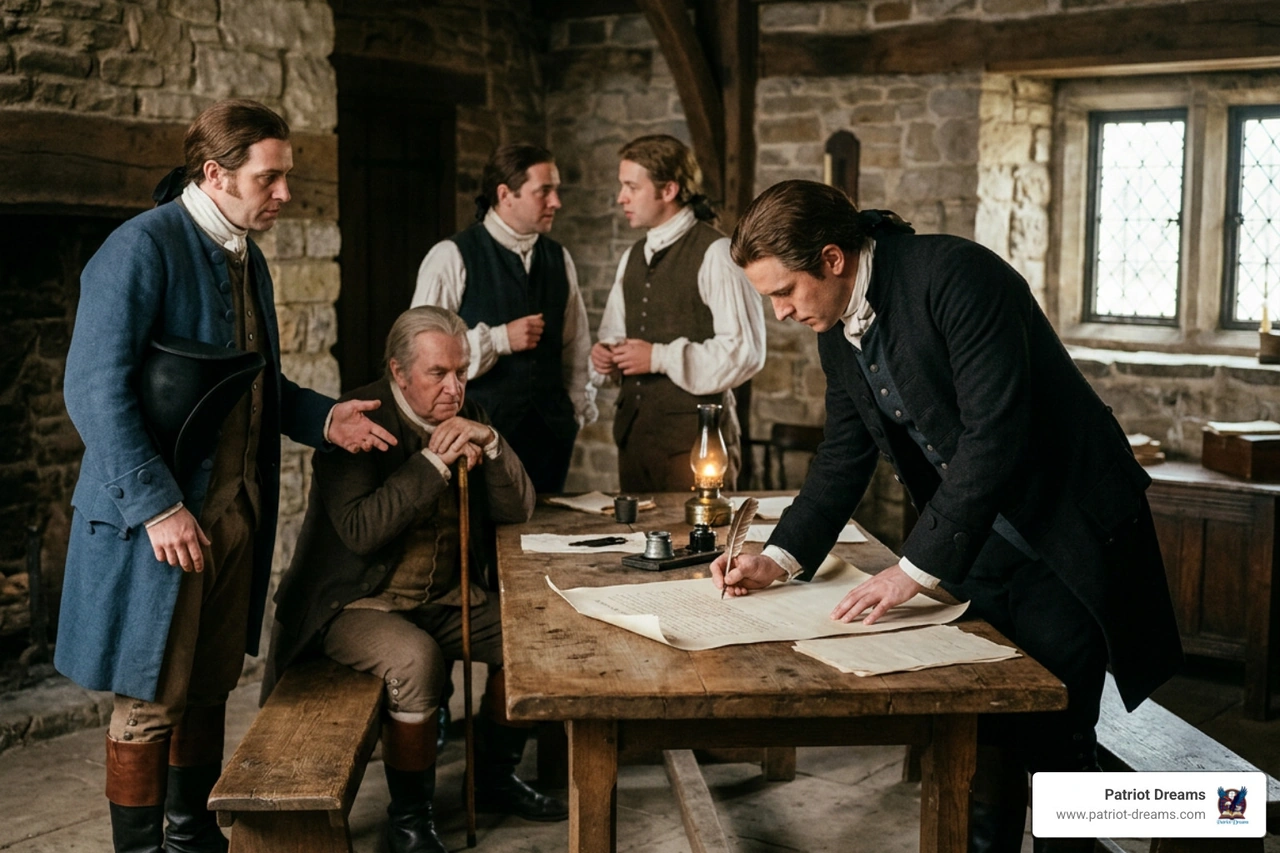
It was not until August 2, 1776, that the delegates gathered to add their signatures to Matlack’s beautifully written parchment. Even then, not everyone was present. Some delegates were away serving in local militias, while others had not yet been elected to Congress. Latecomers continued to add their names throughout the autumn, with New Hampshire delegate Matthew Thornton squeezing his signature onto the bottom right corner as late as November 1776.
To learn more about the official records and parchment history, you can explore the Signers of the Declaration of Independence | National Archives.
2. A Wide Age Gap Separated the Oldest and Youngest Declaration Signers
When we imagine the founders, we often picture graying elders sitting around a council table. Yet the delegates represented every stage of adult life, creating a rich blend of youthful enthusiasm and seasoned wisdom.
The average age of the Declaration Signers in the summer of 1776 was just 44 and a half years old.
- The Oldest Signer: Benjamin Franklin of Pennsylvania was the elder statesman of the group at 70 years old. Known affectionately as the "Sage of Philadelphia," his long experience as a printer, inventor, and diplomat brought steady reassurance to the younger men in the room.
- The Youngest Signers: Edward Rutledge and Thomas Lynch Jr., both representing South Carolina, were only 26 years old when independence was declared. They were young men in their twenties stepping up to build a country they would grow old alongside.
This generational dialogue allowed fresh vision and long experience to sit at the same table, working toward a shared purpose.
3. Eight Foreign-Born Immigrants Were Among the Declaration Signers
The spirit of the American Revolution drew people from across the globe who sought opportunity and self-governance. Out of the 56 signers, eight were foreign-born immigrants who made America their home:
- Ireland (3): James Smith, George Taylor, and Matthew Thornton
- England (2): Robert Morris and Button Gwinnett
- Scotland (2): James Wilson and John Witherspoon
- Wales (1): Francis Lewis
Men like James Wilson of Scotland went on to become key legal thinkers of the era, while Button Gwinnett of England played a vital role in Georgia’s early state government. Their presence reminds us that America’s founding was built by people from many paths who shared a unified dream of freedom.
4. John Hancock’s Signature Was an Act of Bold Defiance
As President of the Continental Congress, John Hancock was the first to sign the engrossed parchment on August 2, 1776. Positioned prominently in the center of the document, his signature stretches nearly five inches long in flowing, elegant script.
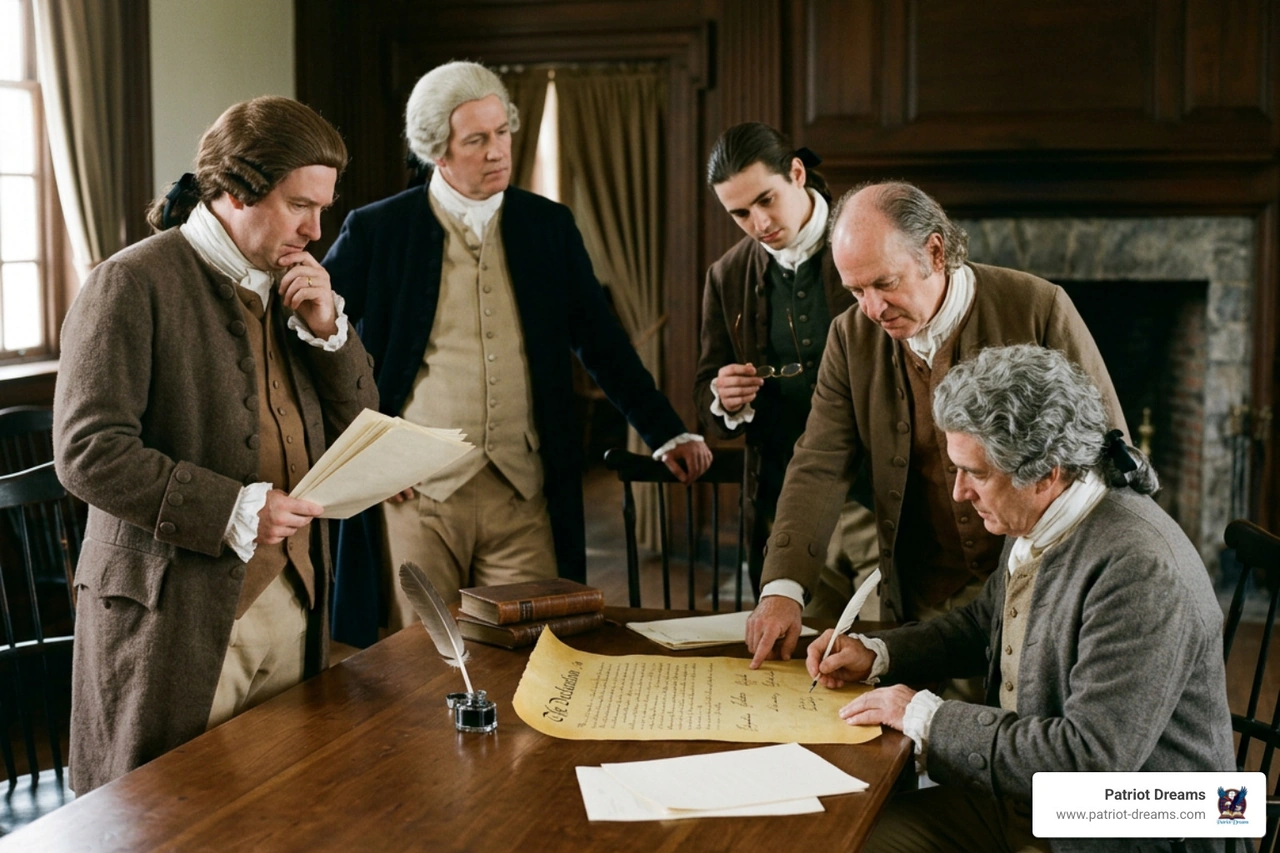
Legend says Hancock wrote so boldly so that King George III could read it without his spectacles. While that story may have grown over time, the boldness of his signature was undeniable. Because Congress was committing an act that British law viewed as treason, signing first and signing large took immense personal courage. Today, "John Hancock" remains a warm American idiom meaning a personal signature, honoring his fearless stance.
5. Several Signers Faced Captivity and Devastating War Losses
Putting one's name on the Declaration was not a symbolic gesture; it carried real risk to life, home, and family. Under British law, signing the document was considered an act of treason punishable by death.
Many signers bore severe personal burdens during the war:
- Richard Stockton of New Jersey was captured by loyalist forces in late 1776. He was imprisoned, mistreated, and returned home to find his estate looted and his health severely broken.
- Thomas Nelson Jr. of Virginia served as a military commander during the Siege of Yorktown. When he realized British officers were using his own stately brick home as a headquarters, Nelson instructed Continental artillery units to open fire on his residence to dislodge the enemy.
- Abraham Clark of New Jersey refused to back down even when two of his sons were captured by the British and held aboard harsh prison ships.
These quiet stories of sacrifice highlight the profound conviction behind their public pledge of "our Lives, our Fortunes and our sacred Honor."
6. Button Gwinnett’s Autograph Is One of the Rarest in History
Among all 56 signers, the signature of Button Gwinnett of Georgia is by far the rarest and most valuable to collectors today.
Gwinnett was an English-born merchant and planter who moved to Georgia and quickly became active in colonial politics. Less than ten months after signing the Declaration, Gwinnett was killed in a duel in May 1777 following a political dispute with Brigadier General Lachlan McIntosh.
Because Gwinnett died so shortly after signing, very few documents bearing his signature survive. Today, a clear autograph from Button Gwinnett can fetch hundreds of thousands of dollars at historical auctions.
7. Only Six Men Signed Both the Declaration and the U.S. Constitution
We often think of the founding generation as a single group that wrote all of America's initial documents together. However, eleven years separated the Declaration of Independence in 1776 and the United States Constitution in 1787. Out of all 56 Declaration Signers, only six went on to sign the U.S. Constitution as well.
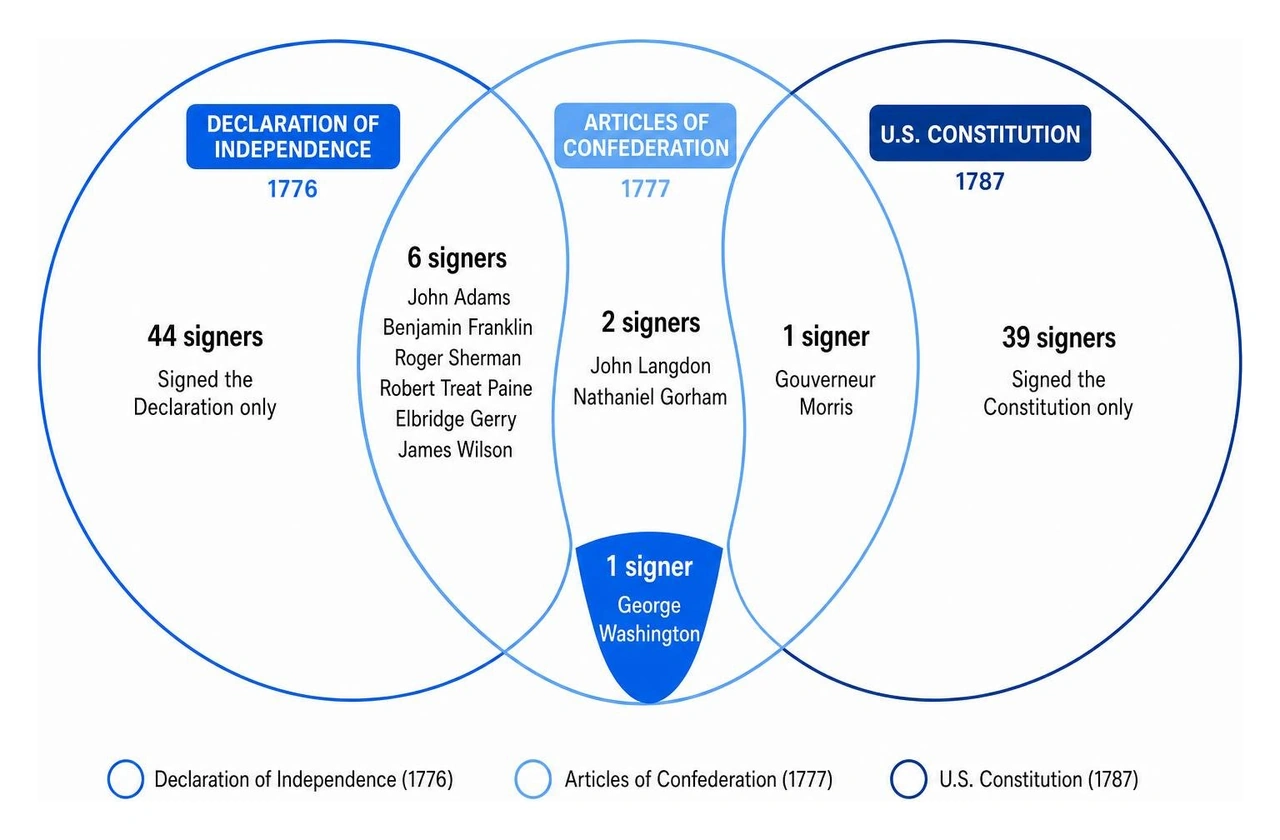
Here is a quick look at how these foundational documents connected key figures:
| Founding Leader | Declaration (1776) | Articles of Confederation (1777) | U.S. Constitution (1787) |
|---|---|---|---|
| Benjamin Franklin | Yes | No | Yes |
| Roger Sherman | Yes | Yes | Yes |
| Robert Morris | Yes | Yes | Yes |
| James Wilson | Yes | No | Yes |
| George Clymer | Yes | No | Yes |
| George Read | Yes | No | Yes |
Connecticut’s Roger Sherman holds a unique place in history as the only person to sign all four major federal documents of the early United States: the Continental Association (1774), the Declaration of Independence (1776), the Articles of Confederation (1777), and the Constitution (1787).
8. Names Were Kept Secret for Months to Avoid Execution
When the Declaration of Independence was first printed on the evening of July 4, 1776—by printer John Dunlap in Philadelphia—only two names appeared at the bottom: John Hancock (President) and Charles Thomson (Secretary).
For six months, the names of the remaining delegates were kept strictly secret from the general public. Revealing their identities right away would have handed British soldiers a ready-made list of leaders to arrest for treason.
It was not until January 1777, following vital American victories at Trenton and Princeton, that Congress felt secure enough to publish an official copy listing every signer. This famous document, printed in Baltimore by pioneering female printer Mary Katherine Goddard, brought the courage of all 56 men into full public view.
9. Adams and Jefferson Died on the Exact Same 50th Anniversary
Perhaps the most astonishing coincidence in American history involves John Adams and Thomas Jefferson. Although the two men were close friends while drafting the Declaration in 1776, they later became political rivals before reconciling in their senior years through warm, reflective letters.
On July 4, 1826—exactly 50 years to the day after the Declaration was adopted—both men passed away within hours of each other.
Adams, aged 90, breathed his last in Massachusetts, famously uttering as his final words, "Thomas Jefferson survives." He did not know that Jefferson, aged 83, had passed away just a few hours earlier at Monticello in Virginia.
Their quiet passing on the nation’s Golden Jubilee added a poetic close to the era. The last surviving signer of the Declaration, Charles Carroll of Carrollton, lived on until November 14, 1832, passing away peacefully at the age of 95.
Demographic and Background Breakdown of the Signers
To truly appreciate the Declaration Signers, it helps to look at who they were in their daily lives. They represented a broad cross-section of colonial society, bringing different talents and viewpoints to Philadelphia.
- Professions: 23 signers were lawyers, making law the most common background. 12 were merchants engaged in Atlantic trade, 12 were plantation owners or farmers, and several were physicians, scientists, printers, or ministers.
- Education: Their schooling ranged widely. 8 signers attended Harvard, 4 attended Yale, 4 attended the College of William & Mary, while 5 signers were completely self-educated.
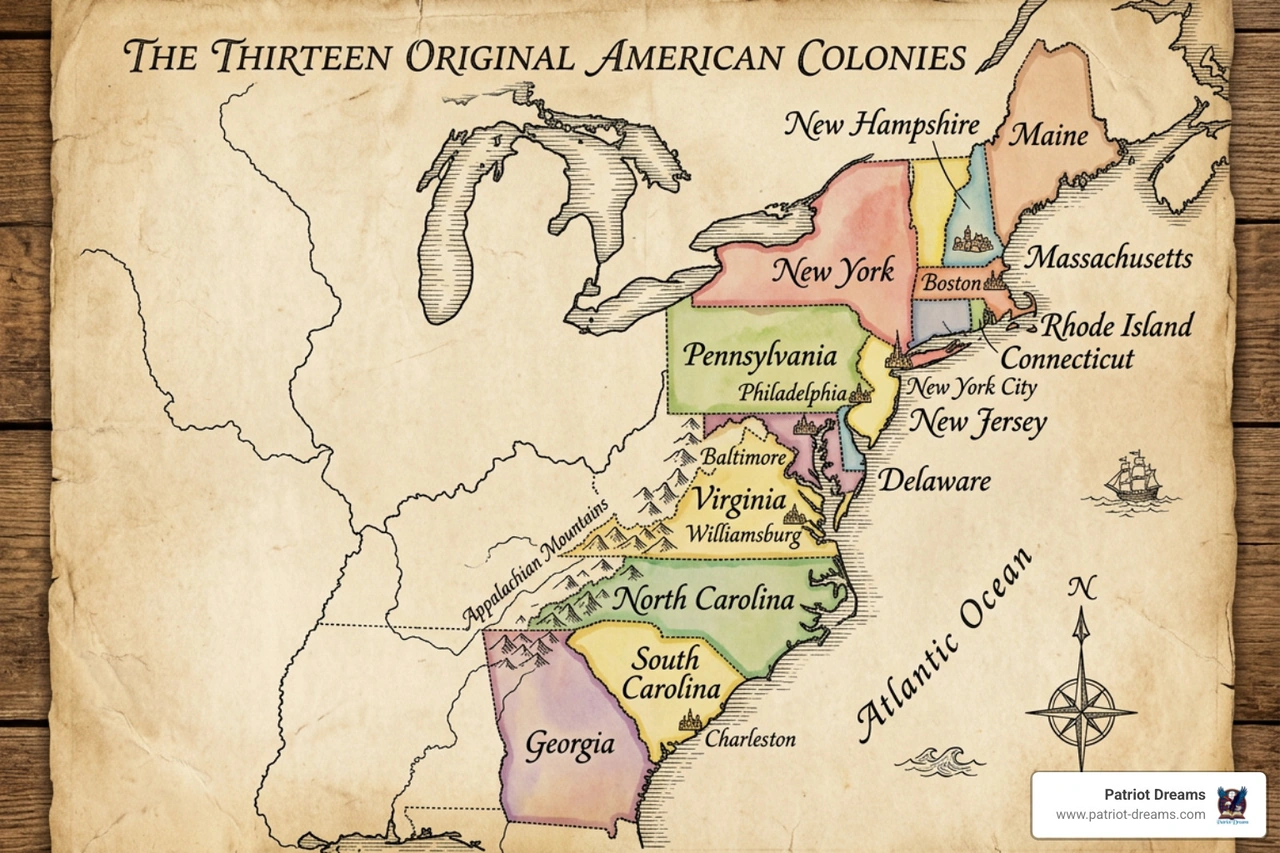
- Geographic Balance: The delegates came from all 13 colonies, ranging from Pennsylvania with 9 signers to Rhode Island with 2.
To dig deeper into the backgrounds and stories of each delegate, visit the comprehensive guide from the Who Were the Signers of the Declaration of Independence? | American Battlefield Trust.
Legacy and Preservation of Colonial History
The legacy of the Declaration Signers lives on not just in history textbooks, but in the places we visit and the stories we share around our dinner tables. The physical parchment they touched is carefully preserved under protective atmosphere at the National Archives Museum in Washington, D.C., allowing future generations to stand in front of their signatures.
Beyond physical archives, exploring their personal journals, family letters, and home sites gives us a window into their everyday humanity. When we listen to their stories—not just as political figures, but as parents, neighbors, and dreamers—we feel a deeper warmth and connection to the foundation of our country.
Frequently Asked Questions About Declaration Signers
Who was the youngest and oldest signer of the Declaration of Independence?
The oldest signer was Benjamin Franklin of Pennsylvania, who was 70 years old in 1776. The youngest signers were Edward Rutledge and Thomas Lynch Jr., both of South Carolina, who were just 26 years old when the Declaration was adopted.
Who was the last surviving signer of the Declaration of Independence?
Charles Carroll of Carrollton, Maryland, was the last surviving signer. He died on November 14, 1832, at the remarkable age of 95, surviving 56 years after placing his name on the document.
How many delegates signed both the Declaration and the Constitution?
Only six men signed both the Declaration of Independence (1776) and the U.S. Constitution (1787): Benjamin Franklin, George Clymer, James Wilson, George Read, Roger Sherman, and Robert Morris.
Conclusion
The 56 Declaration Signers were everyday people who chose hope over fear. By stepping forward in a time of uncertainty, they laid a foundation built on perseverance, unity, and shared dreams. Their choices remind us that great historical moments are shaped by ordinary individuals listening to their hearts and working together for something larger than themselves.
At Patriot Dreams, we love bringing these heartfelt stories of American history and heritage to life. Through interactive audio storytelling and legacy preservation, we make it easy to listen, explore, and share the powerful moments that connect our past to our families today.
If you would like to explore more inspiring stories from our founding era, we warmly invite you to Discover Stories of the Declaration Signers and preserve these beautiful memories with the people you love.
Join the Patriot Dreams Community
Download the app today and start your journey through American history and personal legacy.

Explore Our Latest Insights
Dive into stories that shape our American legacy.