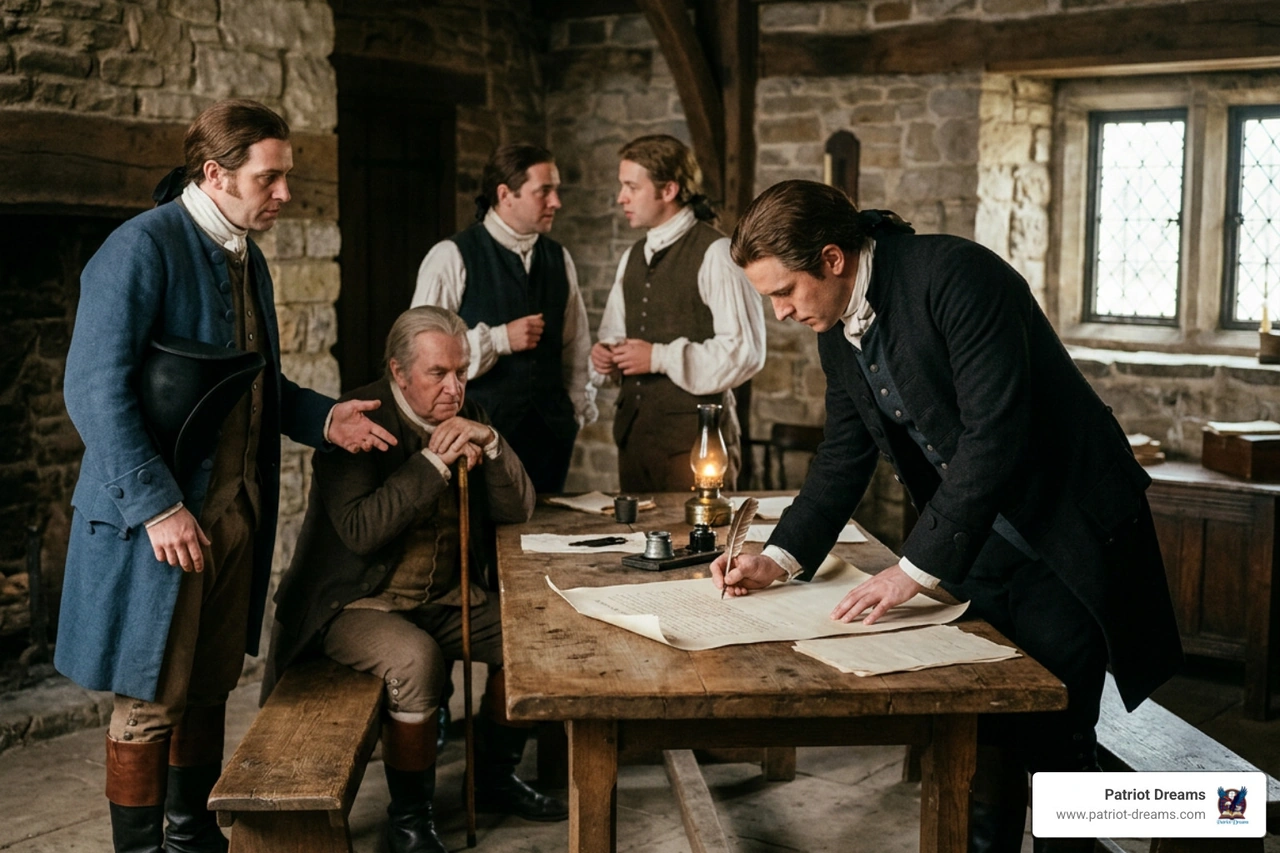
Carnegie's Steel: How One Man Built America's Industrial Backbone
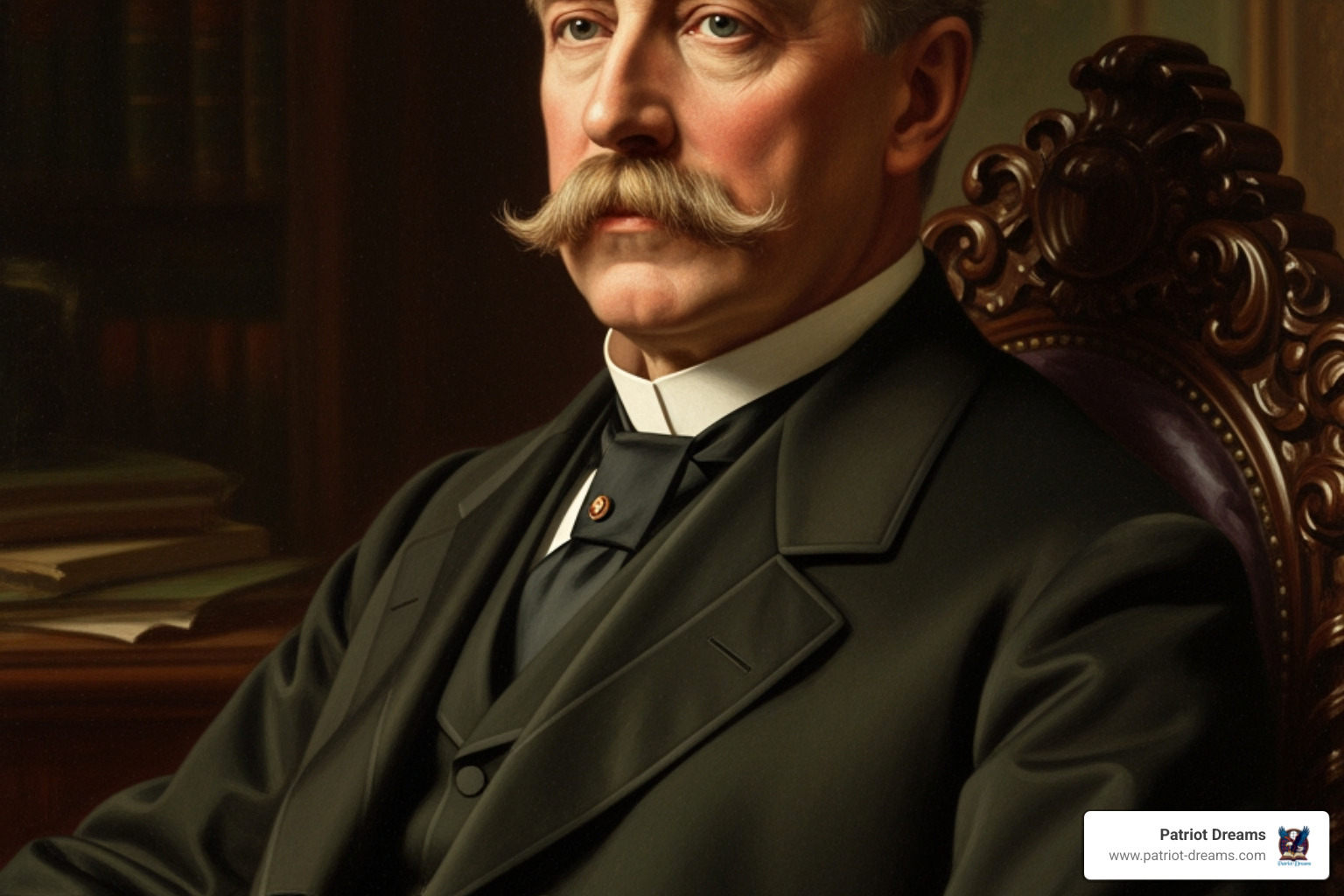

From Dunfermline to Pittsburgh: The Steel Story That Built a Nation
Andrew Carnegie steel transformed America. From 1875 to 1901, a Scottish immigrant named Andrew Carnegie built the largest and most profitable steel company in the world, producing the rails, bridges, and beams that constructed modern America.
Quick Facts About Andrew Carnegie Steel:
- 1875 - Carnegie opened his first steel mill, the J. Edgar Thomson Steel Works in Braddock, Pennsylvania
- 1889 - Carnegie Steel Company was formally launched with an integrated network of mines, mills, and transport
- 1890s - Carnegie Steel became the largest and most profitable steel company in the world
- 1901 - Carnegie sold his steel empire to J.P. Morgan for $480 million, forming U.S. Steel
- Key Innovation - Adopted the Bessemer process for mass steel production
- Business Strategy - Vertical integration: owned everything from coal mines to river barges
- Legacy - Built America's railroads, bridges, and skyscrapers while funding over 2,500 public libraries
There's something beautifully American about Andrew Carnegie's story. A young boy arrived in Pennsylvania in 1848 with his family, fleeing poverty in Scotland. He worked 12-hour days in a cotton mill for $1.20 a week. Yet somehow, through determination, vision, and an unshakeable faith in America's future, he became the man who literally built the backbone of our nation's infrastructure.
This isn't just a story about steel. It's a story about what was possible in America when innovation met opportunity. Carnegie didn't just make steel — he made it affordable and abundant enough to construct the bridges that connected our cities, the rails that linked our coasts, and the buildings that reached toward the sky.
But perhaps most remarkable of all, Carnegie believed his success carried a responsibility. He spent the last decades of his life giving away nearly his entire fortune, building libraries in towns across America so that other young people — people like him — might have the chance to learn, dream, and build their own futures.
Andrew Carnegie steel terminology:
- The Industrial Ages in Hollywood: How Movies Portray America’s Manufacturing Boom
- Teddy Roosevelt: The Fearless Leader Every Young American Should Know
- Soundtracks of a Nation: The Songs That Defined America Through the Decades
From Humble Beginnings to a Vision for Steel
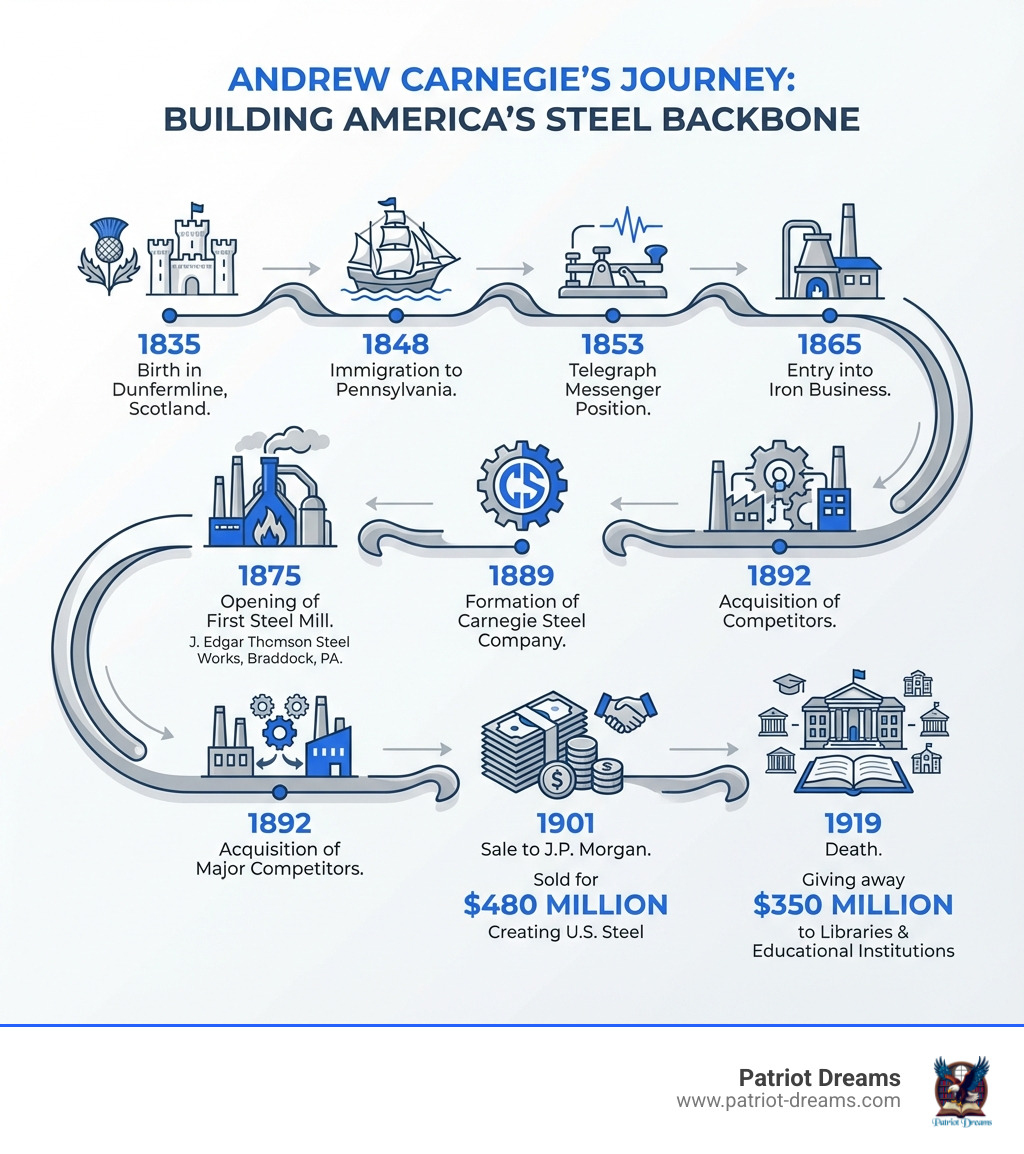
Andrew Carnegie's story truly begins not in the roaring furnaces of Pittsburgh, but in a small weaver's cottage in Dunfermline, Scotland. Born in 1835, Andrew came into a world that was rapidly changing, and not always for the better for working families. His family, like many others, faced increasing poverty as the industrial revolution swept through, making traditional weaving skills less and less valuable.

When Andrew was just 13 years old, in 1848, his family made the courageous decision to seek a new life in America, a land brimming with promise. They borrowed twenty pounds for their voyage and set sail for Pennsylvania, settling in Allegheny, a busy area near Pittsburgh. It's a testament to the enduring spirit of immigrants, isn't it, to leave everything behind for the hope of a brighter tomorrow?
Life in America wasn't easy at first. Andrew quickly found work as a bobbin boy in a cotton factory, toiling for 12 hours a day, six days a week, earning a mere $1.20. Imagine the grit and determination it must have taken for a young boy to endure such long hours. But Andrew possessed an insatiable curiosity and a drive to learn. He soon moved on to a job as a messenger boy in a telegraph office, a position that opened doors to new knowledge and connections. It was here that he even learned to translate telegraph signals by ear, a remarkable skill!
A turning point in young Andrew's life, and indeed for all of us who benefit from his later generosity, was the kindness of a local benefactor, Colonel James Anderson. Colonel Anderson opened his private library to working boys like Andrew, offering a sanctuary of knowledge and self-improvement. It was in these quiet hours, immersed in books, that Andrew's vision for a better future began to take shape. He later recalled making a resolution that if wealth ever came his way, he would use it to establish free libraries, a promise he would keep in magnificent fashion.
Andrew's keen mind and diligent work ethic caught the eye of Thomas A. Scott, a superintendent at the Pennsylvania Railroad. Scott took Andrew under his wing, hiring him as his private secretary and personal telegrapher in 1853, paying him $35 a month. This mentorship proved invaluable, providing Andrew with an education in business and management that few formal schools could offer.
With Scott's guidance, Andrew began making shrewd investments. He started with the Adams Express Company, an investment his mother bravely secured by mortgaging their humble home. Later, his foresight led him to invest in the Woodruff Sleeping Car Company, an investment that soon returned about $5,000 annually — more than three times his railroad salary! By the time he was 30, Andrew had diversified his interests, holding stakes in iron works, steamers on the Great Lakes, railroads, and even oil wells. It's wonderful to imagine how each step, each new venture, built upon the last, laying the groundwork for his grandest endeavor: steel.
Forging an Empire: The Rise of Andrew Carnegie Steel
As the United States rapidly expanded in the mid-19th century, Andrew Carnegie saw not just opportunity, but destiny. He recognized that the nation needed a strong, durable material to build its future. Iron, while useful, had its limitations. The future, he believed, was in steel.
His journey into steel began with investments in iron bridges, notably the Keystone Bridge Company, which he founded in 1865. This venture played a crucial role in replacing old wooden bridges with more resilient iron structures. But it was a trip to England where he witnessed the Bessemer process that truly ignited his vision. He saw how this method could mass-produce high-quality steel quickly and affordably. It was a revelation that would change America forever.
In 1875, Andrew Carnegie opened his first steel mill, the J. Edgar Thomson Steel Works in Braddock, Pennsylvania. This wasn't just another factory; it was the foundation of what would become a colossal enterprise. Our country's steel output was still relatively small, but Carnegie knew that with the Bessemer process, that was all about to change.
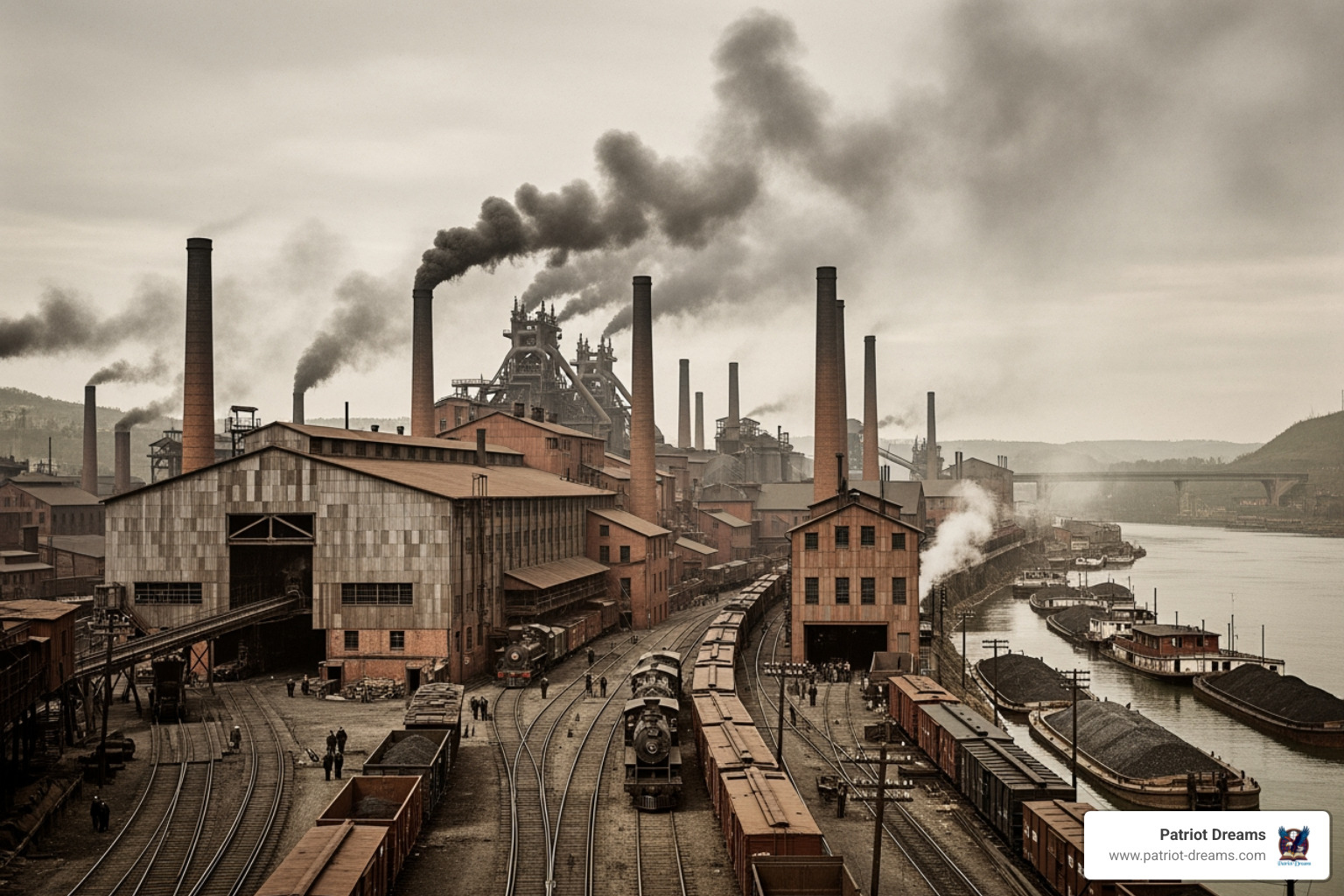
Carnegie's relentless focus on efficiency and cost reduction became legendary. He famously declared, "Watch the costs and the profits will take care of themselves." He was obsessed with finding ways to make steel cheaper and better, constantly reinvesting his earnings into the latest technology. This allowed him to outcompete others and consistently expand his operations. By 1888, he acquired his biggest rival, the Homestead Steel Works, and by 1889, he had consolidated a vast network of mills, including the Pittsburgh Bessemer Steel Works and the Lucy Furnaces, into what he formally launched as the Carnegie Steel Company.
This integrated network, combining steel and iron supply, manufacture, and transport, was truly groundbreaking. By the 1890s, the Carnegie Steel Company had not only become the largest and most profitable steel company in the world, but the United States itself had surpassed the United Kingdom in steel output. Imagine that! By 1900, Carnegie Steel alone produced more steel than all of Great Britain. This was the era where Andrew Carnegie steel became synonymous with American industrial might.
The Genius of the Bessemer Process
The Bessemer process, developed in 1857, was a true marvel of its time. Before this innovation, steel was incredibly expensive and difficult to produce, limiting its use to specialized applications. The Bessemer converter changed everything. This method allowed for the conversion of huge batches of molten iron into high-quality steel by blowing air through it to remove impurities.
The result? Steel became not only stronger and more versatile than iron but also much cheaper to produce on a massive scale. This affordability and strength were precisely what America needed. The Bessemer process fueled the explosive growth of our railroads, allowing for stronger tracks and more powerful locomotives to connect our vast nation. It provided the skeletal framework for towering bridges that spanned mighty rivers and laid the groundwork for the first true skyscrapers, changing our urban landscapes. It literally changed the fabric of American cities and industry.
The Strategy Behind the Andrew Carnegie Steel Empire
Andrew Carnegie's business acumen was truly remarkable. His empire wasn't built by chance, but by a carefully orchestrated strategy that we can still admire today. Central to his success was the concept of vertical integration. This meant that Carnegie didn't just own the steel mills; he owned every single step of the process, from the ground up.
He owned the iron ore mines where the raw materials were extracted. He owned the coke fields that produced the fuel necessary to fire his furnaces. He even owned the transportation networks – the river barges that carried raw materials along the Allegheny, Monongahela, and Ohio rivers, and the railroads that moved his finished Andrew Carnegie steel products across the country. This complete control allowed him to minimize costs, ensure a steady supply chain, and maintain unparalleled efficiency. Imagine the peace of mind knowing you control every ingredient and every delivery truck for your business!
Beyond vertical integration, Carnegie had another brilliant strategy: he reinvested his profits, especially during economic downturns. While others might pull back during a depression, Carnegie saw it as an opportunity. When costs were low and competitors were struggling, he would expand, buying up more mines, mills, and equipment at bargain prices. This foresight positioned him for explosive growth when the economy rebounded. He also fostered a unique partnership system, giving talented managers a stake in the company's success, which motivated them to innovate and drive efficiency. This combination of strategic ownership, relentless reinvestment, and empowered leadership created an unstoppable force in the American industrial landscape.
The Human Story Within the Mills
While we celebrate the incredible achievements of Andrew Carnegie steel in building our nation, it's also important to remember the human hands that forged that steel. The story of Carnegie's mills, like many industries of the Gilded Age, includes a challenging chapter about the lives of the laborers.
Imagine working a 12-hour shift, day in and day out, with little time for rest or family. This was the reality for many steelworkers in the late 19th century, earning around $10 a week. The work was incredibly demanding, dangerous, and physically exhausting. The roar of the furnaces, the intense heat, and the heavy machinery created an environment that required immense strength and courage.
This period was marked by significant tension between labor and capital, and one of the most poignant examples is the Homestead Strike of 1892. At the Homestead Steel Works, workers protested against wage cuts. The dispute escalated into a violent confrontation involving Pinkerton agents hired by the company, ultimately leading to a tragic loss of life on both sides. In the end, the union was ousted, and wages were decreased, with a lasting impact on the labor movement in the Pittsburgh area for decades.
It's a complex part of Andrew Carnegie's story. While he publicly advocated for the dignity of labor and considered himself a champion of working people, his actions during the Homestead Strike, where he largely supported his general manager Henry Clay Frick's aggressive stance against the union, paint a different picture. It’s a gentle reminder that even the most visionary leaders can have complexities and contradictions in their journey. Understanding these challenging moments helps us appreciate the full spectrum of industrial history and the human cost of progress.
The Sale of the Century and a New Purpose
By the turn of the 20th century, the Carnegie Steel Company was truly a titan. It wasn't just the largest; it was the most profitable steel company in the world, holding roughly one-quarter of the global market share by 1901. Andrew Carnegie had achieved an unprecedented level of industrial dominance.
But a new chapter was about to begin, one that would redefine American industry and Carnegie's personal legacy. The stage was set at a dinner in 1900, where Charles Schwab, Carnegie's brilliant protégé, delivered a captivating speech. Schwab passionately articulated the immense potential for growth and efficiency through the consolidation of the steel industry. His words resonated deeply with the country's most powerful financier, J.P. Morgan, who was present at the dinner.
Morgan saw the vision. He recognized that by merging the various steel companies, including Carnegie's formidable empire, he could create an even more powerful, stable, and profitable entity. What followed were intense negotiations, culminating in one of the most significant business transactions in American history. In 1901, Andrew Carnegie sold his steel company to a trust led by J.P. Morgan for an astounding $480 million. Carnegie's personal share from this sale was a staggering $225.6 million.
This monumental acquisition led to the creation of the United States Steel Corporation, or U.S. Steel. It merged Carnegie Steel with nine other companies, becoming the world's first billion-dollar corporation, capitalized at $1.4 billion. Imagine, this was significantly more than the entire federal government spent that year! For Andrew Carnegie, this sale marked not an end, but a grand new beginning, freeing him to pursue his true passion: philanthropy. He had become the wealthiest man in the world, and now, he was ready to give it all away.
The Gospel of Wealth: A Legacy of Giving
With his immense fortune secured, Andrew Carnegie started on what he considered his life's true work. He articulated his philosophy on wealth and the responsibilities of the rich in his influential 1889 essay, "The Gospel of Wealth." This essay became a guiding light for his philanthropic endeavors and continues to inspire thoughtful giving today.
Carnegie firmly believed that "the man who dies thus rich dies disgraced." He saw the accumulation of vast wealth not as an end in itself, but as a trust. The wealthy, he argued, had a moral obligation to administer their fortunes for the welfare and happiness of society during their lifetimes. He wasn't interested in simple charity; he advocated for what we might call "scientific philanthropy," providing "ladders" for self-improvement rather than mere handouts. He wanted to help people help themselves, believing that the best use of wealth was to create opportunities for others to learn and grow, just as he had.
Read Carnegie's "The Gospel of Wealth"
Building More Than Just Steel: Carnegie's Libraries
Perhaps Carnegie's most visible and beloved legacy is his unparalleled commitment to public libraries. This vision was deeply personal, stemming from his childhood experience with Colonel Anderson's library. He understood the transformative power of free access to books and knowledge.
Carnegie funded the construction of over 2,500 libraries worldwide, with a remarkable 1,795 of them right here in the United States. It's truly incredible to think that by 1920, nearly half of all public libraries in America had been built with Carnegie's funding. His generosity wasn't without conditions, however. To receive a Carnegie library, towns had to provide the land, commit to contributing 10% of the library's annual operating costs, and guarantee that the library would be free and accessible to all. This thoughtful approach ensured community ownership and long-term sustainability. These beautiful buildings became cornerstones of learning and community gathering in towns across our nation, a lasting testament to his belief in universal access to knowledge.
Other Gifts to the World from the Andrew Carnegie Steel Fortune
Carnegie's philanthropy extended far beyond libraries, touching almost every aspect of societal improvement. He gave away more than $350 million during the last 18 years of his life, nearly 90% of his entire fortune. His gifts helped establish and support:
- Carnegie Corporation of New York: Endowed with $135 million, this foundation was established in 1911 to promote the advancement and diffusion of knowledge and understanding, pioneering the concept of "scientific philanthropy" to adapt to changing times.
- Carnegie Mellon University: A world-renowned institution of higher learning in Pittsburgh, born from his vision for technical education.
- Carnegie Hall: A legendary venue for music and performing arts in New York City, built for $1.1 million, a testament to his love for culture and the arts.
- The Carnegie Endowment for International Peace: Established with a $10 million endowment in 1910, reflecting his fervent hope for a world free from conflict, especially poignant given the outbreak of World War I shortly thereafter.
- Carnegie Trust for the Universities of Scotland: A $10 million gift to support Scottish universities, remembering his homeland.
His fortune also funded the findy of insulin, helped establish Pell Grants, contributed to the creation of Sesame Street, and even provided for the installation of over 7,600 organs in churches across the country. He established pension systems for university teachers, which eventually led to the creation of TIAA-CREF, a retirement fund that still benefits countless educators today. Carnegie's vision for giving was truly comprehensive, inspiring future generations to use their resources for the greater good.
Frequently Asked Questions about Andrew Carnegie and Steel
What was Andrew Carnegie's main business strategy?
Andrew Carnegie's success was built on two key strategies: vertical integration, which meant controlling every step of the steelmaking process from raw materials to transport, and a relentless focus on lowering costs by investing in the latest technology.
Why was the Bessemer process so important to Carnegie?
The Bessemer process was a technology that allowed for the mass production of high-quality steel quickly and inexpensively. Carnegie adopted this process and perfected its use, enabling him to dominate the market and provide the steel needed to build America's railroads, bridges, and cities.
How much was Carnegie Steel sold for?
In 1901, Andrew Carnegie sold his steel company to a group of investors led by J.P. Morgan for approximately $480 million. This sale led to the creation of the U.S. Steel Corporation, the first billion-dollar corporation in the world.
The Enduring Legacy of Carnegie's Steel
Andrew Carnegie's journey from a Scottish immigrant boy to an industrial titan and then to a pioneering philanthropist is one of the most compelling stories in American history. His Andrew Carnegie steel empire literally built the physical backbone of modern America, providing the foundational material for our infrastructure and driving an era of unprecedented industrial growth. We can see his impact in every bridge, every skyscraper, and every mile of railroad track that still stands today.
But his legacy extends far beyond the physical. Through his "Gospel of Wealth" and his tireless philanthropic efforts, Carnegie also helped build the cultural and educational foundations of our nation. His libraries, universities, and foundations continue to empower individuals, advance knowledge, and foster peace, reminding us that true success is not just about accumulating wealth, but about using it to uplift humanity.
His story is one of perseverance, vision, and the profound act of giving back. It's a gentle reminder that every individual, regardless of their beginnings, has the potential to leave a lasting, positive mark on the world. As we reflect on Andrew Carnegie's incredible life, we are inspired by the idea that dreams, when nurtured with hard work and generosity, can truly build a better America for all.
Explore more inspiring stories from American history

Join the Patriot Dreams Community
Download the app today and start your journey through American history and personal legacy.

Explore Our Latest Insights
Dive into stories that shape our American legacy.