The Remarkable Eleanor Roosevelt: Champion of Human Rights and Social Change
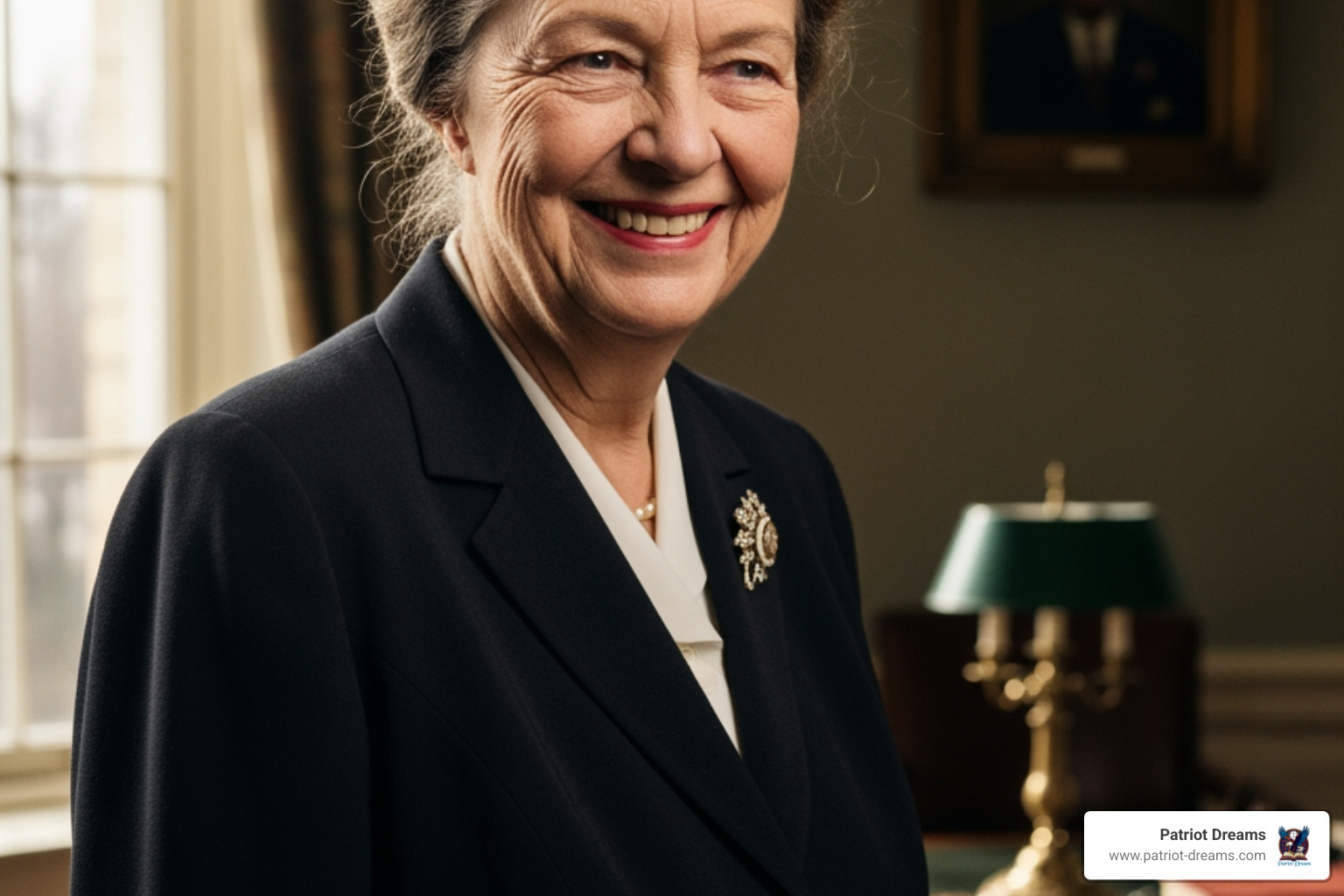

Why Eleanor Roosevelt Remains America's Most Beloved First Lady
Eleanor Roosevelt achievements transformed not only the role of First Lady but also shaped the modern human rights movement that continues to protect people around the world today. From the White House to the United Nations, this remarkable woman showed us that kindness and courage can change the course of history.
Eleanor Roosevelt's Major Achievements:
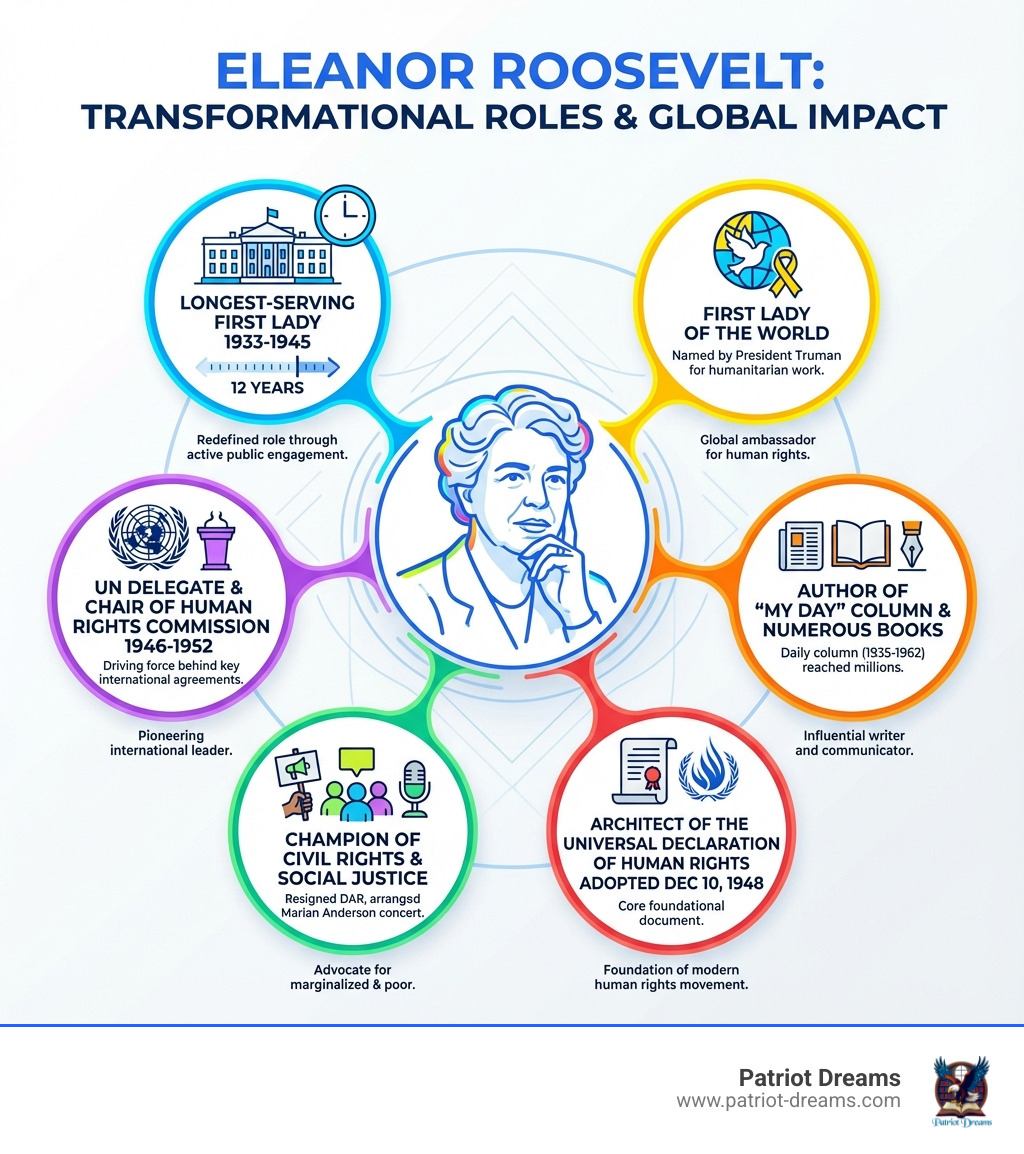
- Longest-Serving First Lady (1933-1945) who redefined the role through active public engagement
- First Chair of the UN Human Rights Commission and driving force behind the Universal Declaration of Human Rights (1948)
- First First Lady to hold regular press conferences (exclusively for female reporters)
- Author of the daily newspaper column "My Day" (1935-1962), reaching millions of Americans
- Champion of civil rights who resigned from the DAR and arranged Marian Anderson's historic Lincoln Memorial concert
- Advocate for the poor and marginalized during the Great Depression, visiting coal mines and impoverished communities
- "First Lady of the World" as named by President Harry S. Truman for her humanitarian work
Born into privilege in 1884, Eleanor could have lived a quiet, comfortable life. Instead, she chose to use her platform to lift up those who had no voice. She traveled to places other First Ladies wouldn't go, spoke truths that made powerful people uncomfortable, and never stopped believing that every person deserved dignity and respect.
Her story isn't just about politics or history—it's about what one person with compassion and determination can accomplish. It's a reminder that the best of America shines through when we care for one another, stand up for what's right, and refuse to accept that things can't get better.
Quick Eleanor Roosevelt achievements terms:
- Rosa Parks story
- Teddy Roosevelt: The Fearless Leader Every Young American Should Know
- Patrick Henry speech
From a Quiet Childhood to a Life of Service
To truly understand the remarkable woman Eleanor Roosevelt became, we must first look at the foundations of her life, which were, at times, quite challenging. Born Anna Eleanor Roosevelt in New York City in 1884, she came from a prominent, wealthy family. Her father, Elliott Roosevelt, was the younger brother of the future President Theodore Roosevelt. Her mother, Anna Hall Roosevelt, was known for her beauty. Despite this privileged start, Eleanor's early years were marked by profound tragedy and loneliness.
Her mother, whom she felt was critical of her appearance, died of diphtheria when Eleanor was just seven years old. Her father, whom she adored, struggled with alcoholism and died when she was ten. These losses left young Eleanor feeling like an "ugly duckling," fostering a deep sense of insecurity that she carried for many years. She and her surviving brother were primarily raised by their maternal grandmother, who, while providing for them, also contributed to Eleanor's feelings of isolation.
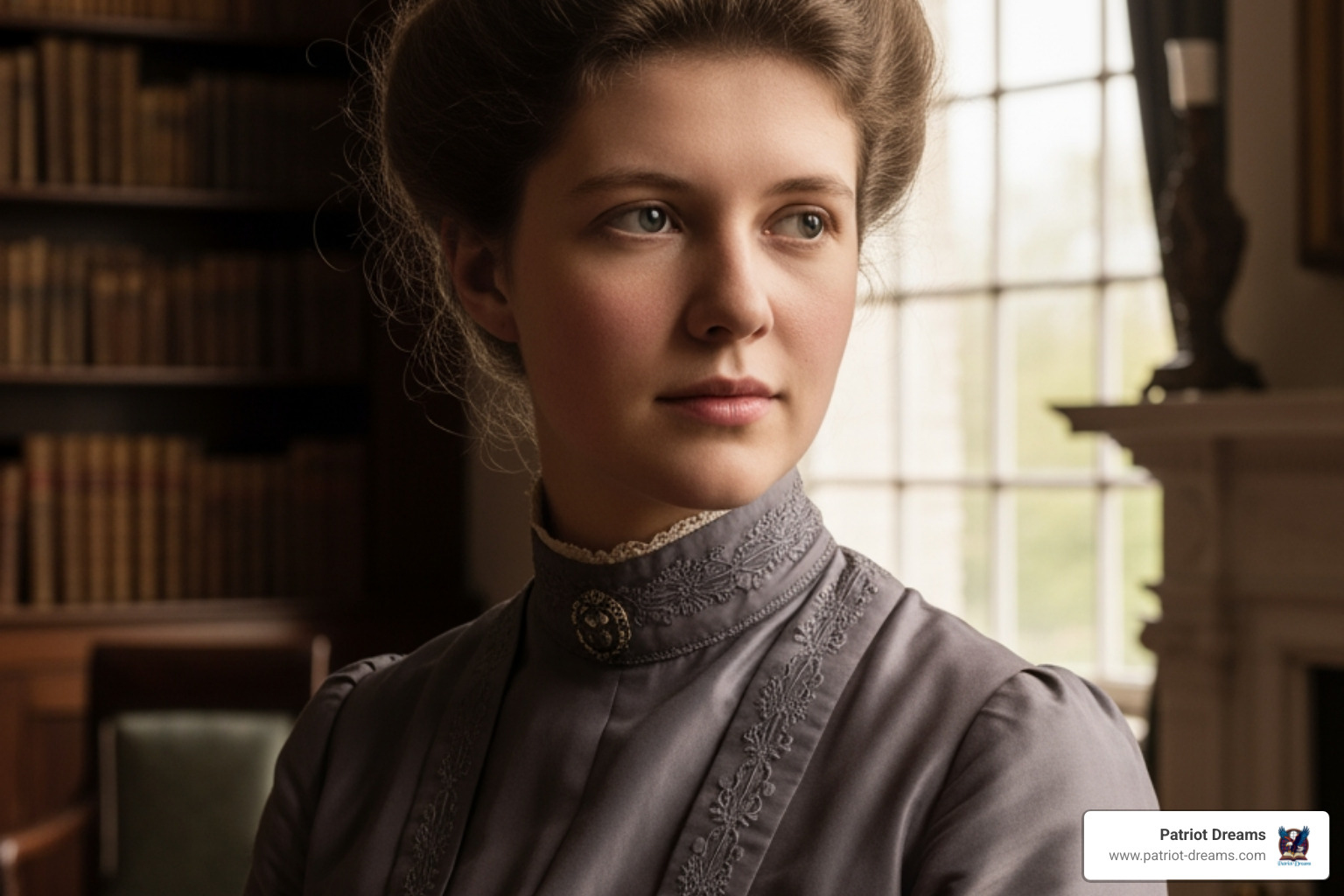
However, it was during her formative teenage years that Eleanor found a pivotal turning point. At the age of 15, she was sent to Allenswood, a girls' boarding school outside London. There, she met the French headmistress, Marie Souvestre, a woman of extraordinary intellect and progressive views. Souvestre took a special interest in Eleanor, recognizing her potential and nurturing her burgeoning intellectual curiosity. She instilled in Eleanor a strong sense of social duty and responsibility, encouraging her to look beyond herself and consider the needs of others. This experience helped Eleanor to come out of her shell, develop social ease, and cultivate an intellectual spirit, fundamentally shaping her worldview and setting the stage for her future humanitarian work.
Returning to New York, Eleanor began volunteering at a settlement house on Manhattan's Lower East Side, teaching calisthenics and dancing to immigrant girls and investigating working conditions. This early exposure to poverty and social inequality solidified her commitment to community service, a value her family had always emphasized. It was a stark contrast to the social whirl expected of a young woman from her background, but it was here that she truly began to find her purpose.
In 1902, a chance encounter with her distant cousin, Franklin Delano Roosevelt, led to a secret romance. They married in 1905, with her uncle, President Theodore Roosevelt, proudly giving her away. This marriage, however, would face its own set of profound challenges that would further shape Eleanor's independence and public life.
A Partnership Forged in Purpose
The marriage between Eleanor and Franklin Delano Roosevelt was undoubtedly a partnership, though one that evolved through significant personal trials. Early on, Eleanor found herself under the influence of her formidable mother-in-law, Sara Roosevelt, which initially restricted her domestic life. However, a major turning point came in 1918 when Eleanor discovered Franklin's affair with her social secretary, Lucy Mercer. This was a deeply traumatic event, and while the couple considered divorce, the implications for Franklin's promising political career and Sara's strong disapproval ultimately prevented it. This period of marital strain, however, is often credited by experts as a catalyst for Eleanor's increasing independence and her deeper devotion to political and social causes. It pushed her to forge her own identity outside the confines of a traditional marriage.
Another profound challenge arrived in 1921 when Franklin was struck by polio, paralyzing his legs. The disease was stigmatized at the time, and Franklin's political career seemed in jeopardy. It was Eleanor who stepped up, urging him to continue in public life and acting as his "eyes and ears." She traveled extensively on his behalf, attending events and reporting back to him, effectively becoming his physical presence in the world. This experience thrust her further into public life, where she found a sense of worth and purpose in advocating for social causes. Her growing involvement in the League of Women Voters, the Women's Trade Union League, and the Women's Division of the New York State Democratic Committee demonstrated her burgeoning political acumen and commitment to progressive ideals. This period was crucial in developing the resilience and public advocacy skills that would define her career as First Lady and beyond.
More about Teddy Roosevelt.
A New Kind of First Lady: Redefining the White House Role
When Franklin D. Roosevelt was elected president in 1932, Eleanor faced a prospect that, by her own admission, filled her with "turmoil." She knew the traditional role of First Lady was that of an ornamental hostess, a position she found deeply frustrating and ill-suited to her active, socially conscious spirit. "I knew what traditionally would lie before me," she later said, "and I cannot say I was very pleased with the prospect." Yet, one of the most significant Eleanor Roosevelt achievements was precisely how she transformed this seemingly restrictive role, redefining it for all future presidential spouses.
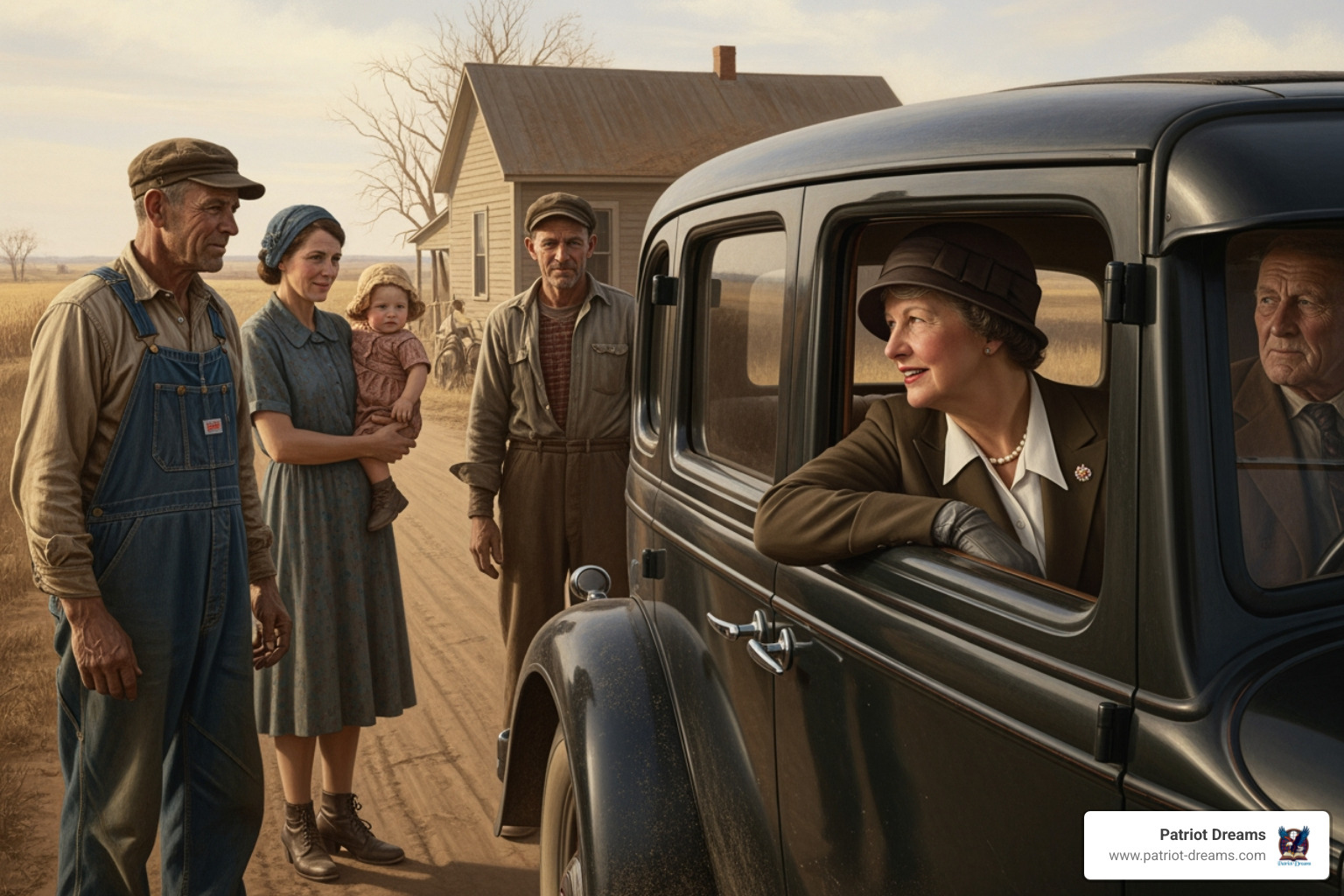
As the longest-serving First Lady, from 1933 to 1945, Eleanor broke every traditional mold. She was not content to remain in the background; instead, she became an active, visible force for change. She traveled relentlessly across the country, visiting farms, factories, schools, and impoverished communities. During the depths of the Great Depression, she made it her mission to see the struggles of ordinary Americans, particularly Depression-era workers and their families. This direct engagement allowed her to become a powerful voice for the poor and marginalized, bringing their stories and needs directly to the White House. Her unprecedented breadth of activities and her open advocacy for liberal causes sometimes made her as controversial a figure as her husband, but it also cemented her legacy as a First Lady who truly connected with the American people.
The Eyes and Ears of the New Deal
Eleanor Roosevelt became, quite literally, the President's "eyes, ears, and legs." Due to Franklin's paralysis, she undertook extensive tours on his behalf, reporting back on conditions and public opinion. This was an invaluable service during the Great Depression, as she provided a direct, unfiltered view of the nation's suffering. She visited coal mines in places like Morgantown, West Virginia, seeing the harsh realities faced by miners' families. Her concern led her to champion projects like Arthurdale, a subsistence homestead community designed to resettle unemployed miners and provide them with new opportunities. While Arthurdale faced its share of challenges and is often seen as a flawed experiment, Eleanor considered it a success because of the positive impact it had on the lives of the people it served.
Her tireless advocacy directly influenced New Deal policies. She pushed for expanded programs that would help women, children, and the poor cope with the economic downturn. She was instrumental in the establishment and promotion of the National Youth Administration (NYA), a New Deal agency that provided work and education for young Americans, ensuring they had opportunities during a time of widespread unemployment. Eleanor was a constant, passionate voice for struggling Americans, reminding the administration of the human faces behind the economic statistics.
Key Eleanor Roosevelt Achievements as First Lady
Eleanor Roosevelt's innovative approach to her role established many "firsts" for a First Lady, fundamentally shaping public engagement:
- Regular Press Conferences for Female Reporters Only: In a groundbreaking move, she held regular press conferences, but with a crucial stipulation: only women journalists were allowed to attend. This not only provided a platform for her to discuss issues important to women but also forced wire services to hire female correspondents, advancing women's careers in journalism. She held an astonishing 348 such press conferences during her husband's 12-year presidency.
- "My Day" Daily Newspaper Column: From 1935 until shortly before her death in 1962, Eleanor wrote a nationally syndicated daily newspaper column titled "My Day." In it, she shared her thoughts on social issues, her travels, and even glimpses into her private life, connecting with millions of Americans on a personal level.
- Weekly Radio Show and National Party Convention Speeches: She was the first First Lady to host a weekly radio show and to speak at a national party convention. These platforms allowed her to bypass traditional media filters and speak directly to the American people, promoting her causes and explaining her husband's policies.
- Using Her Platform to Connect: Beyond these formal roles, Eleanor constantly sought to connect with ordinary people. She traveled extensively, giving lectures and holding discussions, always eager to hear directly from citizens about their concerns. This direct engagement was one of the most powerful Eleanor Roosevelt achievements, building trust and understanding between the government and its people during a tumultuous time.
A Tireless Advocate for Justice and Equality
Among the most significant Eleanor Roosevelt achievements was her unwavering and courageous advocacy for civil rights and human dignity, particularly for African Americans and women. Her commitment to justice was deeply personal and often put her at odds with prevailing social norms and even some within her husband's administration.
Eleanor developed a close friendship and working relationship with Mary McLeod Bethune, a prominent African American educator and civil rights leader. This friendship was a testament to Eleanor's commitment and provided her with invaluable insights into the challenges faced by Black Americans. She actively pushed for anti-lynching legislation and worked to ensure that marginalized groups were included in New Deal programs and legislation. She championed racial justice, supporting organizations like the NAACP and the National Urban League, and even inviting African American guests to the White House, a practice that was highly controversial at the time.
Eleanor famously defied segregation laws herself, notably at a 1938 Southern Conference on Human Welfare in Birmingham, Alabama. When organizers attempted to force her to sit in a whites-only section, she simply moved her chair to the aisle, placing herself between the segregated sections—a quiet yet powerful act of protest.
A Stand for Dignity: The Marian Anderson Concert
Perhaps one of the most iconic Eleanor Roosevelt achievements in the field of civil rights was her decisive action in the case of Marian Anderson. In 1939, the Daughters of the American Revolution (DAR) denied the renowned African American contralto, Marian Anderson, the right to sing at their Constitution Hall in Washington, D.C., solely because of her race.
Eleanor Roosevelt, outraged by this blatant act of discrimination, immediately resigned her membership from the DAR in protest. This was not a quiet resignation; it was a public statement heard across the nation. But she didn't stop there. Working with the NAACP and Secretary of the Interior Harold Ickes, she arranged for Marian Anderson to perform on the steps of the Lincoln Memorial on Easter Sunday. The concert drew an unprecedented crowd of 75,000 people and was broadcast live on radio, becoming a powerful symbolic act for civil rights and a momentous occasion for racial equality in America. It showcased Eleanor's belief that dignity and respect were fundamental rights for all. The story of the historic concert continues to inspire us today.
Learn about another champion of civil rights, Martin Luther King Jr..
The Crowning Jewel of Eleanor Roosevelt's Achievements: The Universal Declaration of Human Rights
Even after Franklin D. Roosevelt's death in 1945, Eleanor's public service did not end. In fact, some of her most profound Eleanor Roosevelt achievements were yet to come. In 1946, President Harry S. Truman, recognizing her immense capabilities and global vision, appointed her as a delegate to the newly formed United Nations. This appointment marked the beginning of her post-White House career, a period during which she earned the enduring title of "First Lady of the World."
Truman's decision was a testament to Eleanor's humanitarian spirit and her deep understanding of human suffering, honed during her years as First Lady. She accepted this new role with characteristic vigor, seeing it as an opportunity to work towards a more peaceful and just world.
A Voice for Humanity on the World Stage
At the United Nations, Eleanor Roosevelt's leadership quickly became indispensable. She was appointed the first chair of the UN Human Rights Commission, a position that placed her at the forefront of a monumental task: to define and articulate universal human rights for all people. This was a complex and challenging endeavor, requiring her to steer intricate international politics, cultural differences, and competing ideologies among delegates from around the world.
With grace, determination, and an unwavering belief in the inherent dignity of every individual, Eleanor guided the commission through intense debates and negotiations. She understood that a document outlining fundamental human rights would be crucial for preventing future atrocities and fostering global peace. Her vision was for a document that transcended national borders and applied to every human being, regardless of race, religion, gender, or nationality. She often referred to it as a potential "international Magna Carta for all men everywhere," underscoring its profound importance.
Crafting a Legacy for All Humankind
The culmination of her tireless efforts and perhaps the most significant of all Eleanor Roosevelt achievements was her role as the driving force behind the Universal Declaration of Human Rights (UDHR). From 1946 to 1948, she led the drafting committee, working carefully to shape a document that would become a guide of hope and a standard for human dignity worldwide.
Her leadership was pivotal in bridging divides and finding common ground among diverse nations. On December 10, 1948, the Universal Declaration of Human Rights was adopted by the United Nations General Assembly. Upon its adoption, Eleanor Roosevelt received a thunderous standing ovation from the assembly—a fitting tribute to her extraordinary dedication and perseverance. The UDHR, with its 30 articles outlining fundamental human rights, has since influenced countless national constitutions and international laws, serving as a moral and legal compass for the global community. It stands as a testament to Eleanor Roosevelt's profound legacy, a framework for justice that continues to protect and inspire humankind. Learn about the UDHR's creation and understand the monumental effort behind this enduring document.
Frequently Asked Questions about Eleanor Roosevelt's Achievements
What is Eleanor Roosevelt's most famous achievement?
Eleanor Roosevelt's most celebrated achievement, and indeed her enduring legacy, is her pivotal role as the chairperson of the drafting committee for the Universal Declaration of Human Rights (UDHR). Adopted in 1948, this foundational document has become a cornerstone of modern international law and human rights, a truly global "Magna Carta" for humanity. Her leadership, diplomacy, and unwavering commitment were essential to its creation and adoption.
How did Eleanor Roosevelt help during the Great Depression?
During the Great Depression, Eleanor Roosevelt redefined the role of First Lady by becoming an active and visible advocate for suffering Americans. She traveled extensively across the United States, acting as her husband's "eyes and ears," personally witnessing the struggles of unemployed workers, impoverished families, and young people. She reported her findings back to President Roosevelt, directly influencing the shape and scope of New Deal programs. She championed initiatives like the National Youth Administration and the Arthurdale project, ensuring that the human element of the crisis was never forgotten and that government efforts reached those most in need.
Why is Eleanor Roosevelt considered a hero?
Eleanor Roosevelt is considered a hero for many reasons, primarily for her tireless humanitarianism, her courageous advocacy for civil rights and social justice, and for redefining the role of the First Lady into a powerful platform for meaningful change. She consistently used her influence to speak for the voiceless, challenge discrimination, and champion the dignity of every individual. From standing up against racial segregation to leading the charge for universal human rights at the United Nations, her life was a testament to compassion, courage, and a relentless pursuit of a more just and equitable world. She truly embodied the spirit of public service.
Conclusion: The Enduring Light of a Remarkable American
As we reflect on the remarkable Eleanor Roosevelt achievements, we are reminded that her life was a powerful journey from a shy, self-conscious girl to a global champion of human rights. Her story is one of overcoming personal adversity, challenging societal norms, and dedicating oneself to the betterment of humanity. She redefined the role of First Lady, changing it from a ceremonial position into an active platform for social and political change. Her tireless advocacy for civil rights, women's rights, and the marginalized during the Great Depression brought hope and tangible support to countless Americans.
But perhaps her most profound legacy, the crowning jewel of her contributions, is her instrumental role in the creation of the Universal Declaration of Human Rights. This document, born from her vision and determination, continues to serve as a guide of justice and a guide for nations striving for human dignity worldwide. She was, as President Truman so aptly called her, the "First Lady of the World."
Eleanor Roosevelt's impact transcends her time. Her belief that "you must do the thing you think you cannot do" is a powerful message that resonates with us still. It reminds us that courage often begins with a quiet resolve to step outside our comfort zones for a greater good. At Patriot Dreams, we believe in the power of stories like Eleanor's—stories that inspire, connect, and remind us of the best of America. Her life exemplifies kindness, resilience, and an unwavering commitment to community. It's an inspiring reminder that one person, with enough heart and determination, can truly make the world a kinder, more just place for all.
Discover more stories of great Americans like George Washington.

Join the Patriot Dreams Community
Download the app today and start your journey through American history and personal legacy.

Explore Our Latest Insights
Dive into stories that shape our American legacy.