All About Martin Luther King Jr.'s Early Life
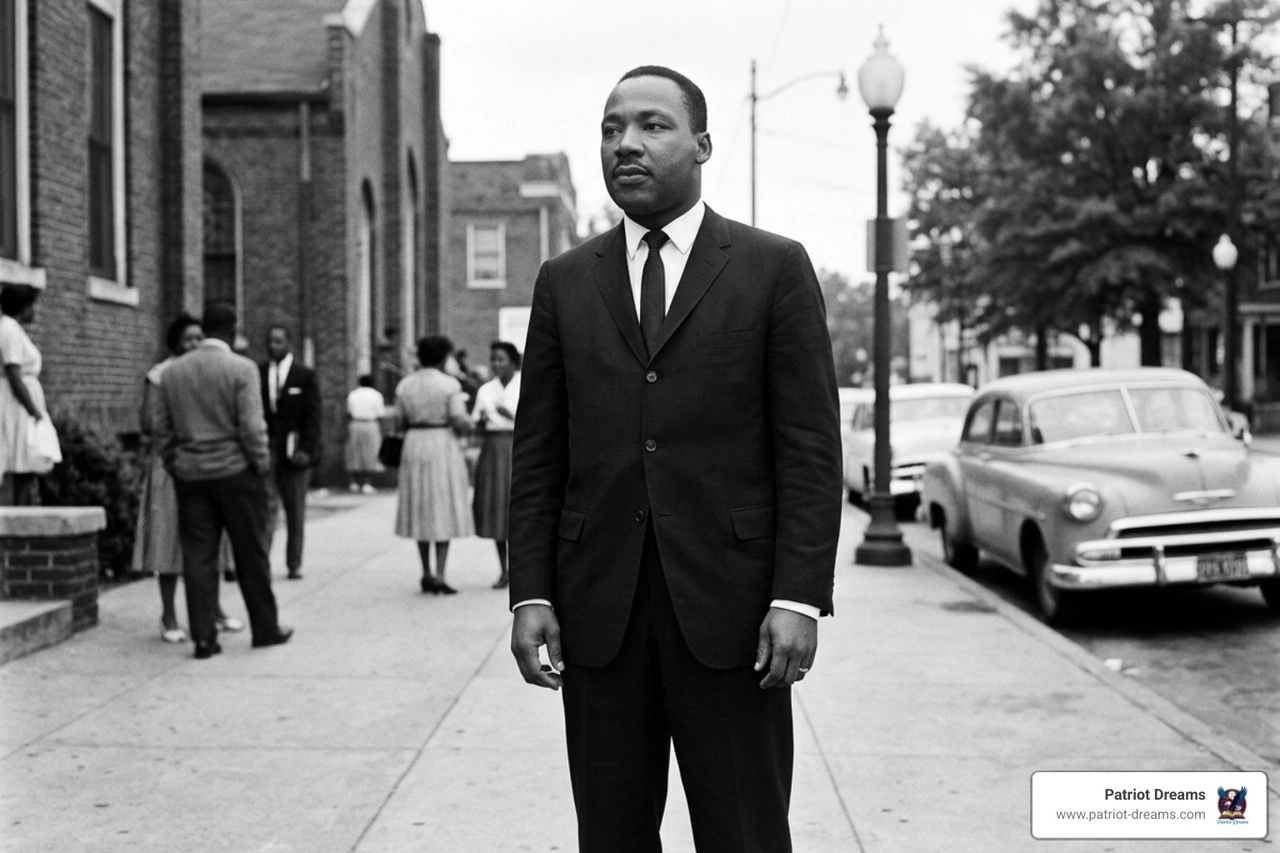

Martin Luther King Early Life: The Roots of a Lasting Legacy
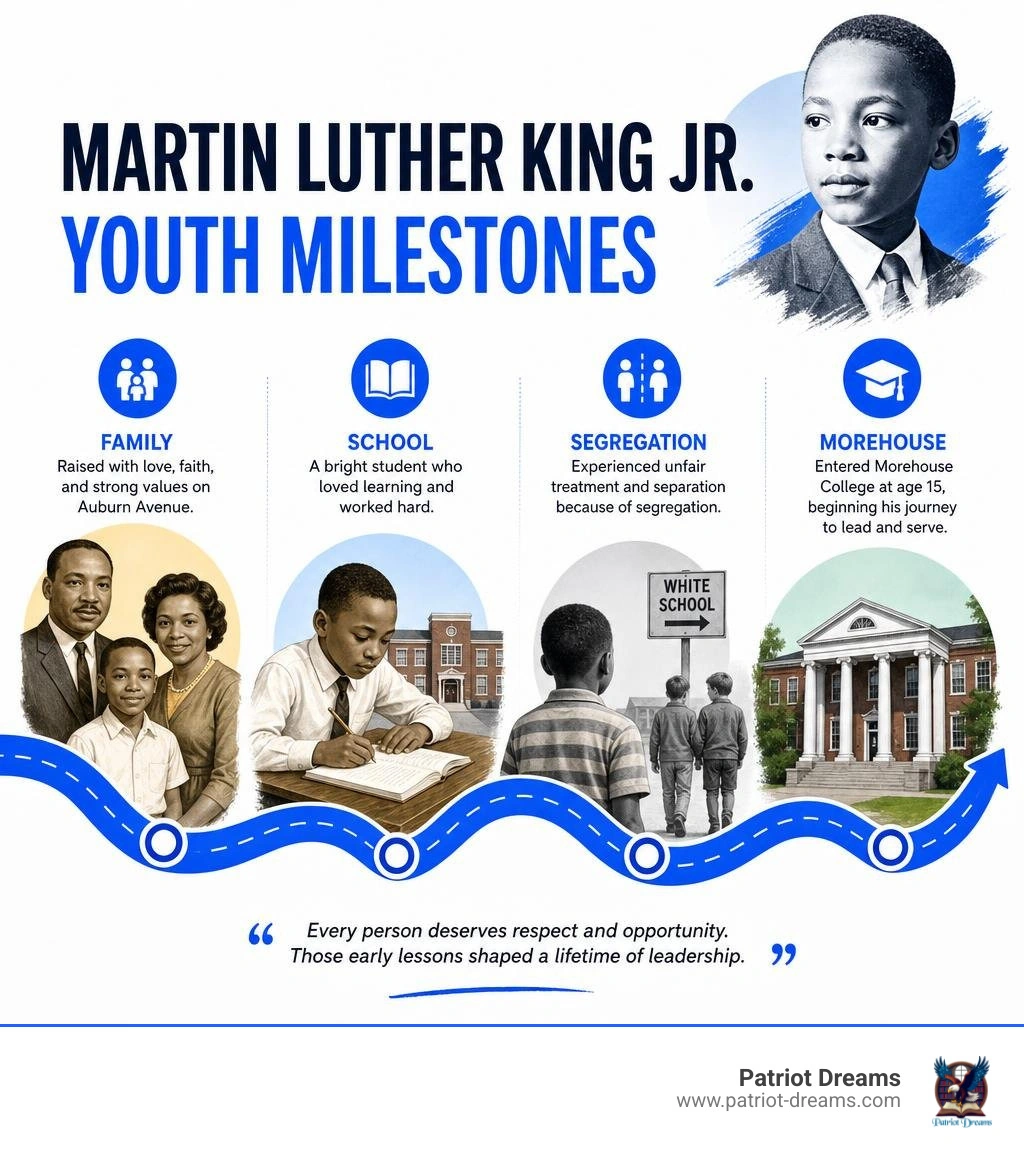
Martin Luther King Jr.'s early life was shaped by a close-knit family, deep church roots, strong schooling, and encounters with segregation in Atlanta, Georgia. Born on January 15, 1929, he grew up on Auburn Avenue in the Sweet Auburn community, where his parents and grandparents taught him faith, dignity, education, and care for others.
His father, Martin Luther King Sr., showed him that a person could meet unfair treatment without accepting it. His mother, Alberta Williams King, helped build his sense of worth and belonging. As a boy, King also felt the pain of being separated from a white playmate because of segregated schools. These moments helped form the moral courage he later brought to public life.
From childhood lessons in Atlanta to college at Morehouse at age 15, King's path was not prewritten. It was built through family love, hard questions, learning, and a growing belief that every person deserves respect.
Kyle & Emily invite you to explore the people, places, and early experiences behind this important American story.
Relevant articles related to martin luther king early life:
Foundations of Martin Luther King Early Life: Family, Faith, and Auburn Avenue
At noon on Tuesday, January 15, 1929, a baby boy was born in an upstairs bedroom at 501 Auburn Avenue in Atlanta, Georgia. Attended by Dr. Charles Johnson, the infant was originally named Michael King Jr. It was not until 1934, following his father's transformative journey to Europe for the Baptist World Alliance Congress in Berlin and historic Reformation sites, that both father and son adopted the name Martin Luther King in honor of the German reformer.
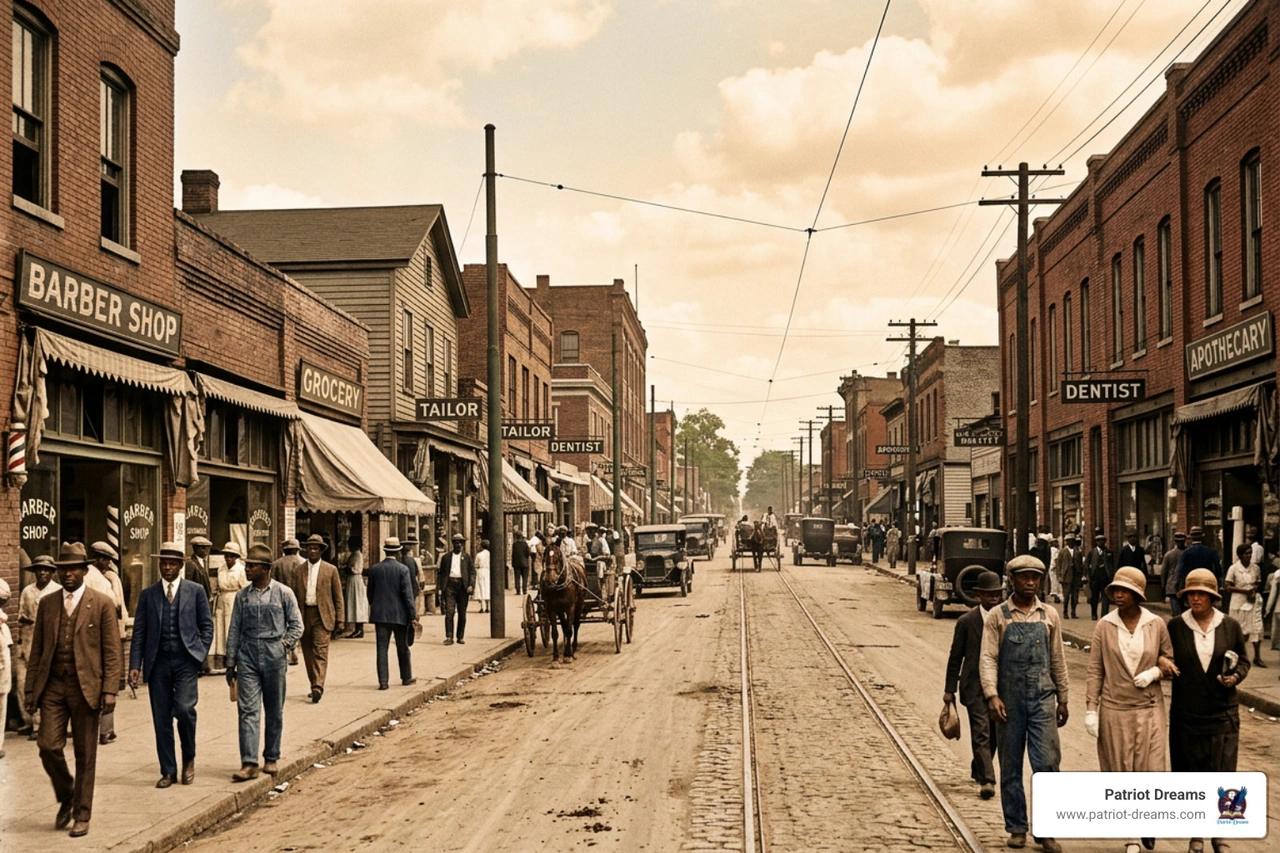
The King home was located in the heart of "Sweet Auburn," a vibrant neighborhood known throughout the country as a center of African American commerce, culture, and civic leadership. Growing up in a multi-generational household that included his parents, maternal grandparents, older sister Christine, and younger brother Alfred Daniel (A.D.), young Martin—affectionately nicknamed "Little Mike"—was surrounded by unconditional affection and unwavering moral guidance.
Faith was not merely a Sunday ritual; it was the atmosphere the family breathed. Young Martin's maternal grandfather, the Reverend Adam Daniel (A. D.) Williams, had transformed Ebenezer Baptist Church from a small congregation into one of the city's most respected spiritual institutions. When Reverend Williams passed away in 1931, Martin Luther King Sr. stepped into the pulpit, continuing a rich tradition of faith-centered community leadership explored in Martin Luther King, Jr.: From Youth to Leadership in Atlanta. This legacy of service surrounded Martin from his earliest childhood days.
Formative Lessons and Martin Luther King Early Life on Auburn Avenue
Within the warm walls of 501 Auburn Avenue, young Martin received lessons that would anchor his life. His mother, Alberta Williams King—an accomplished musician and devoted educator—instilled in her children a profound love for learning, music, and quiet personal dignity. Sitting beside him at the piano, she patiently taught him hymns while imparting a foundational truth: that he possessed inherent value and was as good as anyone else.
His maternal grandmother, Jennie Celeste Williams, showered Martin with deep tenderness. Her nurturing presence created an environment where empathy and kindness could flourish. In this supportive home, King developed what he later described as an enduring belief in human goodwill and a loving creator.
Outside the home, the bustling Sweet Auburn neighborhood served as an extended family. Neighbors, shopkeepers, and church members looked out for one another, modeling the spirit of unity and perseverance that defines famous figures in American history.
The Enduring Influence of Martin Luther King Sr.
If Martin's mother provided gentle reassurance, his father provided a living blueprint of moral courage. Martin Luther King Sr., known as "Daddy King," had risen from humble beginnings as the son of sharecroppers in Stockbridge, Georgia, to become an influential civic leader. He firmly believed that Christian faith must actively uplift the community and address everyday human needs.
Young Martin watched his father confront prejudice with calm, unyielding dignity:
- The Shoe Store Incident: When a downtown clerk insisted they move to the back of the store to be served, King Sr. took young Martin by the hand and walked out, declaring they would buy shoes sitting in the front seats or not buy them at all.
- The Traffic Stop: When a police officer stopped King Sr. and addressed him dismissively as "boy," Daddy King pointed directly to his young son and replied, "This is a boy. I'm a man, and until you call me one, I will not listen to you."
- Civic Leadership: In 1936, Daddy King helped organize several hundred citizens in a peaceful voting rights march to Atlanta City Hall, modeling civic participation for his impressionable son.
As documented in historical archives of King, Martin Luther, Sr., these everyday acts demonstrated that self-respect was non-negotiable, leaving an indelible imprint on young Martin's developing character.
Early Encounters with Segregation and the Awakening of Moral Courage
Despite the warmth of his home and community, young Martin could not remain entirely insulated from the rigid racial barriers of the 1930s South. Around the age of six, he experienced a moment that broke his young heart: the father of his neighborhood playmates, who were white, abruptly announced that the boys could no longer play together because they were entering separate, segregated elementary schools.
Confused and deeply saddened, Martin ran home in tears. His parents sat him down and gently explained the historical realities of segregation, reminding him never to let external circumstances make him feel inferior. This early experience planted a seed of curiosity and moral resolve, prompting him to wonder why barriers existed between neighbors and how communities might one day bridge those divides.
Turning Points in Childhood and Adolescence
As Martin grew into a bright, inquisitive teenager, his oratorical gifts began to shine. While attending Booker T. Washington High School, he joined the debate team, honing the vocabulary, cadence, and delivery that would one day inspire millions.
On April 17, 1944, fifteen-year-old Martin traveled to Dublin, Georgia, to participate in a statewide oratorical contest sponsored by the Black Elks. Delivering his winning address, titled "The Negro and the Constitution," he spoke eloquently on the nation's founding ideals of freedom and equality.
Yet the journey home presented a painful trial. On the bus ride back to Atlanta, the driver ordered young Martin and his teacher to give up their seats so white passengers could sit. Forced to stand in the aisle for the entire 90-mile trip, Martin grappled with intense frustration. He later reflected in Chapter 1: Early Years that this evening was one of the most formative moments of his youth, cementing his lifelong determination to work peacefully for equal dignity under the law.
How Martin Luther King Early Life Experiences Outside the South Reshaped His Vision
During the summers of 1944 and 1947, Martin took summer jobs working on shade tobacco farms in Simsbury, Connecticut, alongside fellow students. For a teenager who had grown up exclusively under Southern segregation laws, life in New England offered an eye-opening glimpse of everyday integration.
In Connecticut, Martin experienced simple freedoms that had been unavailable to him at home:
- Eating at downtown restaurants without assigned seating
- Sitting freely wherever he chose on trains and local buses
- Attending integrated church services alongside diverse congregations
Experiencing this open social landscape reinforced his conviction that communities could live together harmoniously. His time in the North, chronicled in our American historical figures complete guide, broadened his horizons and deepened his resolve to help his home region realize its full promise of equality.
Educational Journey: From Accelerated Youth to the Pulpit
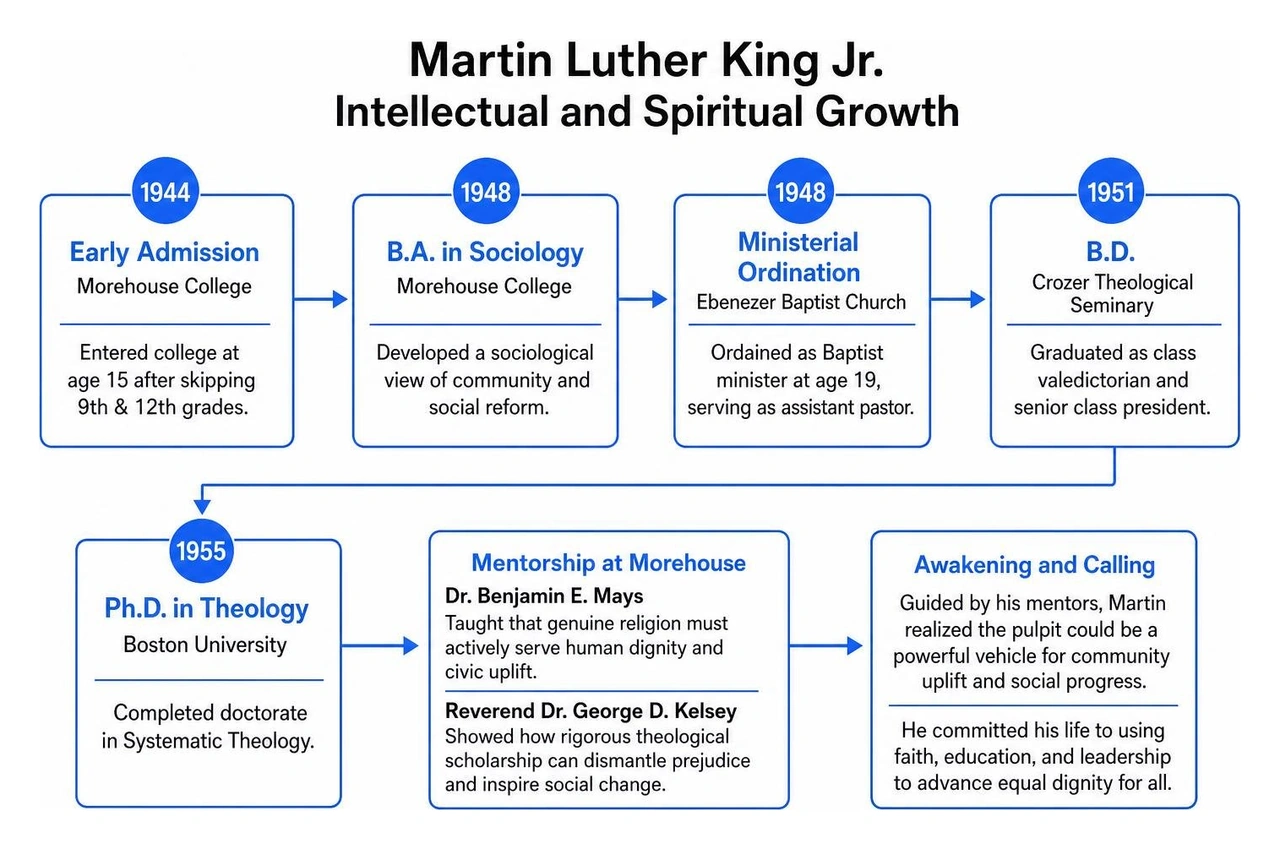
Recognized early on for his quick mind and academic dedication, Martin skipped both the ninth and twelfth grades. In the fall of 1944, at the remarkably young age of 15, he passed the entrance exams and enrolled at Morehouse College in Atlanta.
| Milestone / Degree | Institution | Year | Key Significance |
|---|---|---|---|
| Early Admission | Morehouse College | 1944 | Entered college at age 15 after skipping 9th & 12th grades |
| Bachelor of Arts (Sociology) | Morehouse College | 1948 | Developed a sociological view of community and social reform |
| Ministerial Ordination | Ebenezer Baptist Church | 1948 | Ordained as Baptist minister at age 19, serving as assistant pastor |
| Bachelor of Divinity | Crozer Theological Seminary | 1951 | Graduated as class valedictorian and senior class president |
| Doctor of Philosophy (Ph.D.) | Boston University | 1955 | Completed doctorate in Systematic Theology |
Mentorship and Intellectual Awakening at Morehouse College
At Morehouse, an acclaimed historically Black men's college, young King found an environment that encouraged rigorous questioning and intellectual discovery. During his early collegiate years, he wrestled with personal doubts, seeking a practical way to connect his deep Christian faith with meaningful social progress.
Two prominent mentors provided the guidance he needed:
- Dr. Benjamin E. Mays: The legendary president of Morehouse College was a gifted orator and moral philosopher who taught that genuine religion must actively serve human dignity and civic uplift. Mays became King's foremost intellectual mentor and "spiritual father."
- Reverend Dr. George D. Kelsey: King's religion professor demonstrated how rigorous theological scholarship could dismantle prejudice and inspire constructive social change.
Through their guidance, Martin realized that the pulpit could be an extraordinary vehicle for community uplift. In February 1948, at the age of nineteen, he was ordained into the Christian ministry at Ebenezer Baptist Church, graduating that spring with his sociology degree as highlighted in the Martin Luther King Jr. complete guide.
Graduate Studies, Theological Evolution, and Marriage
Determined to deepen his philosophical foundations, King enrolled at Crozer Theological Seminary in Chester, Pennsylvania, in the fall of 1948. At Crozer, he immersed himself in the works of great theologians and philosophers, exploring how Christian love could be combined with nonviolent social action.
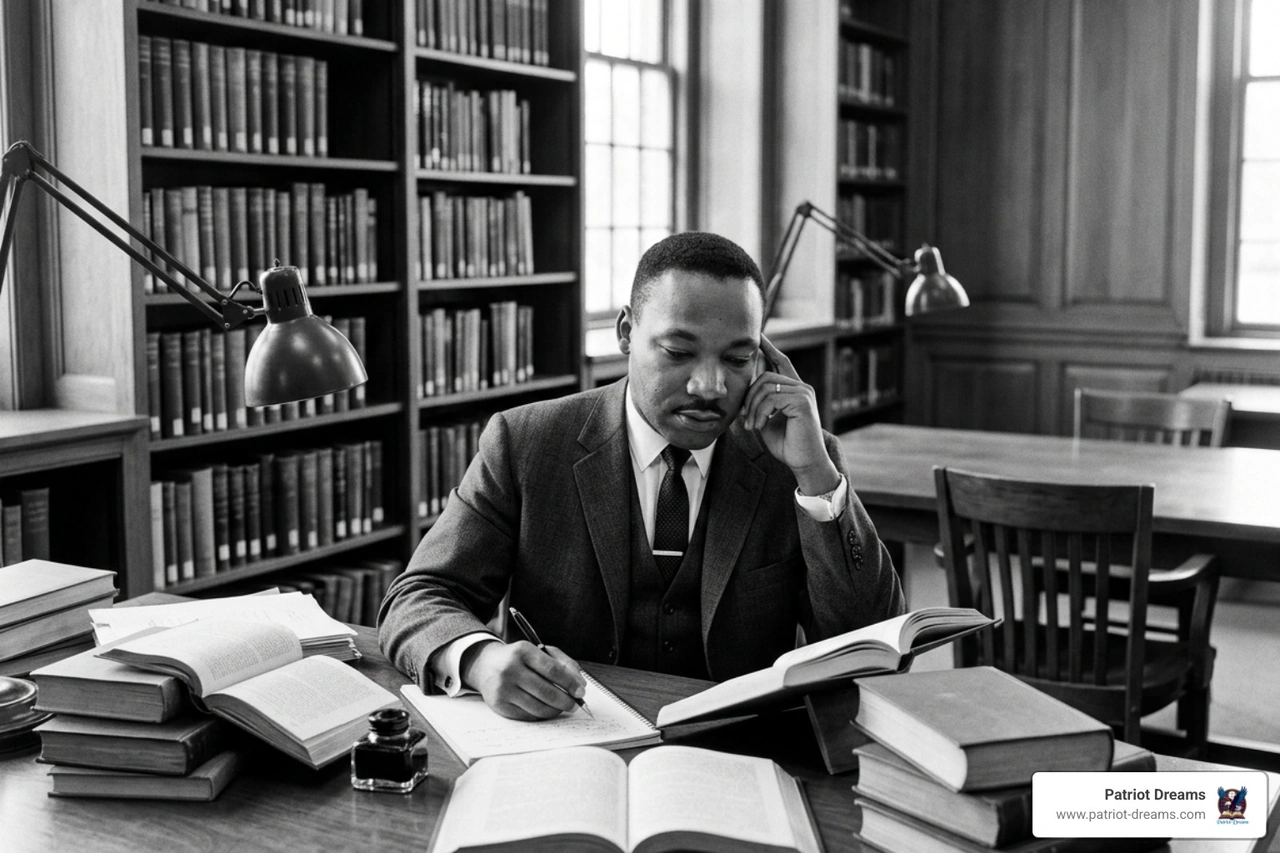
King excelled academically and socially, earning the respect of his peers. He was elected president of the student body and graduated in 1951 as class valedictorian, winning the prestigious Pearl Plafker Award for most outstanding student.
From Crozer, King moved on to Boston University to pursue a Ph.D. in Systematic Theology. It was in Boston that he met Coretta Scott, a talented and accomplished student studying concert voice at the New England Conservatory of Music. The two felt an immediate intellectual and spiritual kinship. They were married on June 18, 1953, on the lawn of the Scott family home in Marion, Alabama, in a ceremony officiated by Daddy King.
Coretta would become his equal partner in life and purpose, sharing in his dedication to service as they began their family, which eventually grew to include four children: Yolanda, Martin III, Dexter, and Bernice. By the time Dr. King received his doctorate in June 1955, his character, faith, and education had fully prepared him for the historic calling that lay ahead.
Frequently Asked Questions about Martin Luther King Jr.'s Early Life
What was Martin Luther King Jr.'s birth name, and why was it changed?
Martin Luther King Jr. was born Michael King Jr. on January 15, 1929. In 1934, his father, Reverend Michael King Sr., attended the Baptist World Alliance Congress in Berlin, Germany. Deeply inspired by the history of the Protestant Reformation and the courage of German theologian Martin Luther, King Sr. decided to change both his own name and his young son's name to Martin Luther King upon returning home.
At what age did Martin Luther King Jr. enter college, and what did he study?
Martin Luther King Jr. entered Morehouse College in Atlanta at just 15 years old in the fall of 1944. Because many college-age men were serving overseas in World War II, Morehouse opened its entrance exams to promising high school juniors. King passed with flying colors, skipped his senior year of high school, and went on to earn a Bachelor of Arts degree in Sociology in 1948 at the age of 19.
What early childhood experiences influenced Martin Luther King Jr.'s civil rights activism?
Several key childhood experiences shaped his worldview:
- Childhood Playmates: Being told at age six that he could no longer play with his white neighborhood friends due to segregated schools.
- Father's Example: Watching his father peacefully but firmly stand up to unfair treatment in shoe stores and during traffic stops.
- The Dublin Bus Ride: Being forced to stand for a 90-mile bus ride after winning a high school speech contest in 1944.
- Summer in Connecticut: Working on a farm in New England, where experiencing integrated public life showed him what a unified society could look like.
Conclusion: The Early Life That Shaped an American Legacy
The remarkable journey of Dr. Martin Luther King Jr. did not begin on the national stage in Washington, D.C., or during the historic marches of the 1960s. It began around a loving kitchen table on Auburn Avenue in Atlanta, in the warm fellowship of Ebenezer Baptist Church, and through the quiet courage of parents who taught their children that dignity is an inherent gift from God.
From an inquisitive boy nicknamed "Little Mike" to an accelerated college student guided by wise mentors, King's formative years remind us of the enduring power of family, education, and moral purpose. His early life proves that great leadership is nurtured through everyday moments of kindness, perseverance, and quiet conviction.
Here at Patriot Dreams, we are passionate about bringing these inspiring chapters of our shared American heritage to life. Through our interactive historical maps and rich audio storytelling experiences, we invite families, students, and travelers to step into the past and discover the places where history happened. We encourage you to explore the wider story of the Civil Rights Movement and celebrate the enduring lessons of hope and unity that continue to bring us together.

Join the Patriot Dreams Community
Download the app today and start your journey through American history and personal legacy.

Explore Our Latest Insights
Dive into stories that shape our American legacy.