Detailed Guide to Laura Ingalls Wilder

The Timeless Story of Laura Ingalls Wilder
Laura Ingalls Wilder is one of America's most beloved storytellers — a real woman who turned her pioneer childhood into a series of books that have warmed hearts for nearly a century.
Here's what you need to know at a glance:
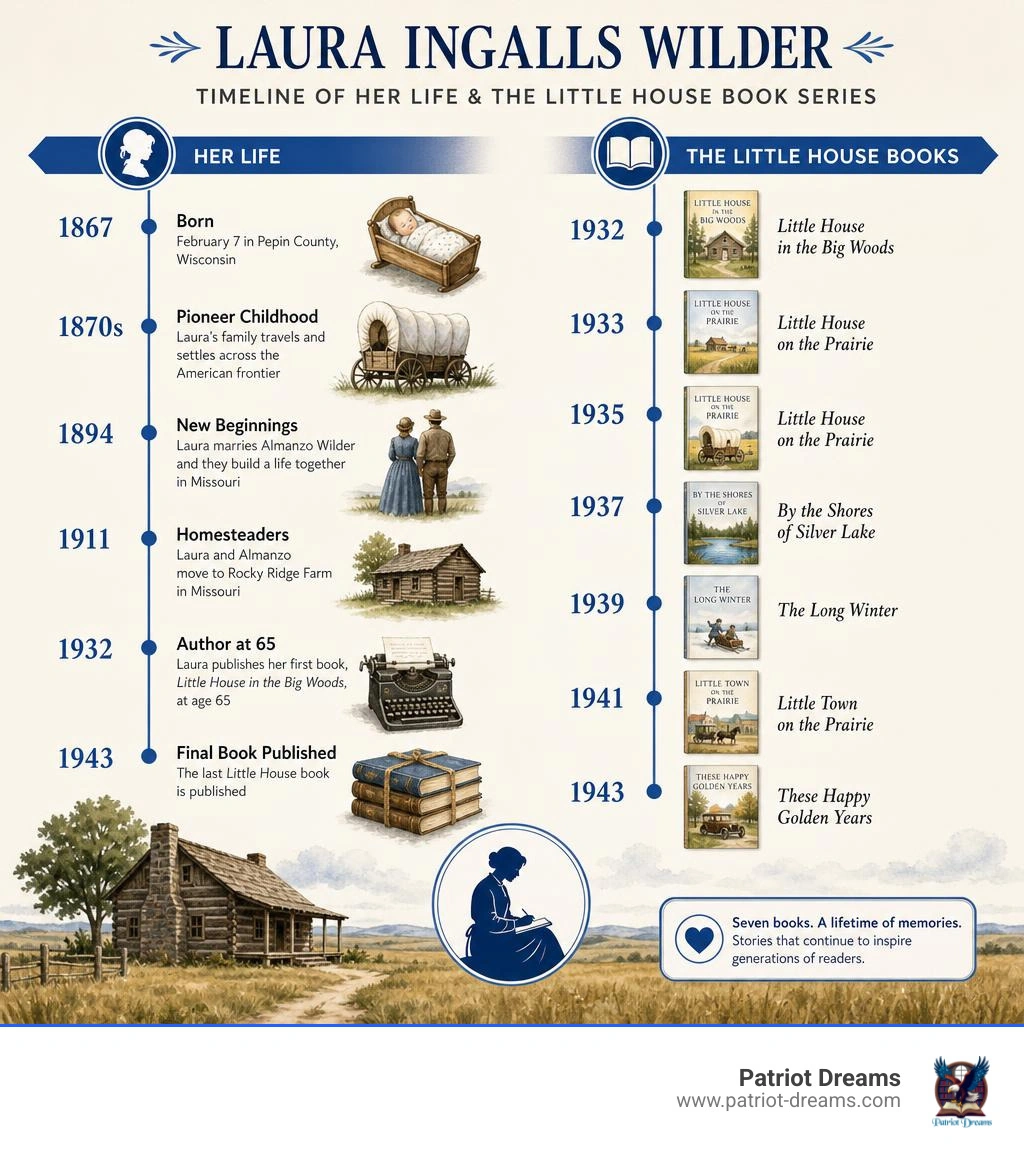
- Born: February 7, 1867, in Pepin County, Wisconsin
- Died: February 10, 1957, in Mansfield, Missouri (age 90)
- Best known for: The Little House book series, published 1932–1943
- Books sold: Over 60 million copies between 1932 and 2010
- Translated into: 40 languages, continuously in print since 1932
- Key collaborator: Her daughter, Rose Wilder Lane, helped shape the books for young readers
- First published at: Age 65 — proof it's never too late to share your story
Her books weren't just stories. They were memories — of family gathered around a warm fire, of a father's fiddle filling a small cabin with music, of a family that kept going no matter what the prairie threw at them.
Those stories still speak to us today. Whether you're a longtime fan, a parent reading aloud to your children, or someone curious about real American pioneer life, there's something here that feels like home.
This guide covers everything — her childhood travels, the real hardships behind the books, the mother-daughter partnership that brought them to life, and the legacy she left for all of us.
Simple guide to Laura Ingalls Wilder terms:
- Gunsmoke and Grit: Legends, Outlaws, and Lawmen of the Wild West
- mountain men frontier tales
- when was the wild west era
The Journey of a Pioneer Childhood: Locations and Legacy

The rhythm of Laura’s early life was defined by the turning of wagon wheels and the soft rustle of the prairie grass. For her father, Charles Ingalls, there was always a new horizon calling, a promise of fertile soil and open spaces just a little further west. For young Laura, this meant a childhood spent packing up their few cherished belongings and setting off into the beautiful, sometimes daunting, American landscape.
These constant moves were not just changes of address. They were the very canvas upon which her character was painted. Each new location taught her family how to pull together, how to find joy in a dark dugout or a drafty shanty, and how to look toward tomorrow with hope.
Growing Up on the Frontier with Laura Ingalls Wilder
Laura’s journey began in the deep, quiet woods of Pepin, Wisconsin, where she was born in 1867. The thick forests of Wisconsin provided a cozy, protective cocoon, but the call of the open frontier soon led the Ingalls family to Kansas, where they built a cabin on the open prairie. Though they lived there only a short time, the vast, windy skies left a permanent impression on Laura's young mind.
From Kansas, the family’s path wound through Walnut Grove, Minnesota, where they famously lived in a dugout home on the banks of Plum Creek. After a brief, difficult period in Burr Oak, Iowa—a chapter of their lives that Laura chose to leave out of her children's books—they finally settled in De Smet, South Dakota. It was in De Smet that Laura grew from a spirited girl into a young woman, taking her first teaching position at just fifteen years old to help support her family.
Each of these places holds a piece of the classic American Pioneer Stories that define our shared heritage. The resilience required to build a life from scratch in these wild places is a testament to the strength of the human spirit.
Hardships and History: From Locust Plagues to the Hard Winter
While the Little House books are filled with warmth, they do not shy away from the immense hardships of frontier life. Laura documented real historical events with striking clarity. In Minnesota, she witnessed the devastating locust plague of the 1870s, where swarms of grasshoppers ate entire crops in a matter of hours, leaving families with nothing.
Later, in South Dakota, she lived through the "Hard Winter" of 1880–81, which remains one of the most severe winters on record in the Dakotas. For months, continuous blizzards cut off the town of De Smet from all supplies and trains. The family survived on a meager diet of coarse brown bread made from wheat ground in a tiny hand-mill, keeping warm by burning twists of hay.
Laura also captured the complex realities of westward expansion, such as her family's temporary settlement on the Osage Indian reservation in Kansas. Historical records show the family lived there without legal right to the homestead before rumors of eviction prompted them to move once more. These historical details, preserved in her narratives and studied at places like the Laura Ingalls Wilder - Homestead National Historical Park, remind us of the grit and compromise that shaped the American frontier.
Real Life vs. Fiction: The True Story of Laura Ingalls Wilder

When we read Laura’s books, we are stepping into a beautifully crafted world. But it is helpful to remember that she was writing a fictionalized memoir for children, not a strict historical diary. She painted her childhood with the soft, warm brush of memory, choosing to emphasize the love and security of her family while gently smoothing over some of the darker, more painful realities of their journey.
Charles Ingalls and the Spirit of Family Resilience
At the heart of both the real and fictional stories stands Charles Ingalls—the beloved "Pa." With his gentle humor, deep optimism, and his treasured fiddle, Pa was the anchor of the family. He possessed a unique approach to parenting, often utilizing gentle redirection and finding quiet, teachable moments in the middle of difficult circumstances. When times were hard, Pa did not despair; instead, he picked up his fiddle and filled the cabin with music, reminding everyone that as long as they had each other, they had everything.
This musical heritage and the comforting lessons passed down around the hearth are beautiful examples of traditional folklore. You can explore similar timeless tales in our Ultimate Guide To American Folk Stories.
The De Smet Homestead: Fact vs. Fictionalized Memoir
In real life, the Ingalls family's path was even more complicated and challenging than the books suggest. To keep the narrative focused and appropriate for young readers, Laura omitted several painful family tragedies.
For instance, she never mentioned the birth and tragic death of her infant brother, Charles Frederic Ingalls, who died at just nine months old while the family was living in Minnesota. She also completely bypassed the family's time in Burr Oak, Iowa, where they ran a struggling hotel and faced deep financial debts.
Historical EventReal-Life RealityDepiction in the Little House BooksThe Burr Oak, Iowa PeriodThe family lived in Iowa from 1876–1877, running a hotel and facing deep poverty.Omitted entirely; the narrative jumps from Minnesota straight to South Dakota.Birth of Brother FreddieCharles Frederic was born in 1875 and died in infancy in 1876.Omitted entirely to protect young readers from the profound grief.Osage Reservation SettlementThe family lived on reservation land without legal title before being forced to leave.Portrayed as a simple misunderstanding about when the land would open to settlers.The Hard Winter of 1880–81Severe, life-threatening starvation and extreme cold in De Smet, South Dakota.Described in detail, emphasizing family unity, sharing, and spiritual strength.
From Memoir to Masterpiece: The Collaboration of Mother and Daughter
The journey of the Little House books from a simple handwritten manuscript to a global phenomenon is a story of a remarkable, and sometimes complicated, partnership between two strong women: Laura and her daughter, Rose Wilder Lane.
Rose Wilder Lane and the Path to Publication
By the time Laura decided to write down her memories, she was in her early sixties, living with her husband Almanzo at Rocky Ridge Farm in Mansfield, Missouri. She had spent years writing columns for the Missouri Ruralist, sharing her wisdom on poultry farming and rural life. But she wanted to preserve her family's stories before they were lost to time.
Her daughter, Rose Wilder Lane, was already an established, highly successful journalist and novelist. Rose recognized the magic in her mother's memories and encouraged her to shape them into a book. When Laura wrote her initial autobiography, Pioneer Girl, publishers found it too detailed and adult-focused. Together, mother and daughter began reworking the material into historical fiction for children.
This partnership bore fruit in 1932 with the publication of Little House in the Big Woods by Harper & Brothers. Laura’s first royalty check was for $500—equivalent to about $11,800 in 2025/2026 money—offering a lifeline to the family during the worst years of the Great Depression. You can learn more about Laura's early life and her Wisconsin roots through the Laura Ingalls Wilder | Wisconsin Historical Society.
The Authorship Debate: A Shared Literary Legacy
Over the years, scholars have debated just how much credit Rose deserves for the books. Some have suggested that Rose was a ghostwriter, pointing to her dramatic flair and purple prose compared to Laura's simple, understated style.
However, modern literary consensus, backed by extensive research, shows that the books were a true collaboration. Laura was the keeper of the facts, the memories, and the authentic pioneer voice, while Rose acted as a highly skilled editor, helping to structure the plots and polish the pacing. The heart, soul, and enduring literary legacy belong to Laura Ingalls Wilder herself.
Preserving the Legacy and Navigating Modern Perspectives
As the decades have passed, Laura’s stories have continued to guide and comfort new generations, even as we learn to look at history with wider, more understanding eyes.
Honoring the Legacy of Laura Ingalls Wilder
Today, Laura's final home at Rocky Ridge Farm is preserved as a museum, welcoming thousands of visitors every year. Towns across the Midwest celebrate "Wilder Days" (held on September 25 & 26, 2026, in Mansfield), where families gather to hear Pa’s actual fiddle play once more. Her books have inspired hit television adaptations, stage plays, and generations of young readers.
Preserving these stories is about more than just keeping old books on a shelf; it is about keeping our own family connections alive. If you want to learn how to capture and protect your own family's history, explore our guide on Family History Preservation.
Understanding Historical Context with Grace and Kindness
In recent years, modern scholars and readers have gently critiqued Laura’s depictions of Native Americans and race relations on the frontier. In 2018, the American Library Association renamed the Laura Ingalls Wilder Medal to the Children's Literature Legacy Award to reflect these evolving cultural sensitivities.
When we talk about these aspects of the books with our children, we can do so with grace, honesty, and kindness. We can explain that Laura was a product of her time, writing about the frontier as she experienced it as a child in the 19th century. By having these open, thoughtful conversations, we don't have to throw away the beautiful values of love, courage, and family that the books teach us. Instead, we can use them to teach empathy and build a deeper, more inclusive understanding of our history.
Frequently Asked Questions about Laura Ingalls Wilder
Where can you visit Laura Ingalls Wilder museums today?
You can walk in Laura's footsteps at several historic sites across the country:
- Pepin, Wisconsin: See a re-creation of the "Little House in the Big Woods."
- Walnut Grove, Minnesota: Visit the site of the dugout on Plum Creek.
- De Smet, South Dakota: Explore the surveyor's house and the Ingalls home on the prairie.
- Mansfield, Missouri: Tour Rocky Ridge Farm, where Laura wrote her books.
You can find more details and plan a trip by visiting the Laura Ingalls Wilder Park & Museum: Home.
How did the Great Depression affect the Little House books?
The first book was published in 1932, right in the middle of the Great Depression. During a time when millions of Americans were facing severe economic hardship, Laura’s stories of family warmth, simple pleasures, and overcoming adversity through self-reliance and community spirit offered immense comfort and hope to readers of all ages.
What was the role of Rose Wilder Lane in writing the series?
Rose Wilder Lane was Laura's daughter and a highly accomplished author in her own right. She served as a vital editor and mentor, helping her mother structure the memoirs into engaging fiction, navigating connections with publishers, and polishing the final manuscripts.
Conclusion
At Patriot Dreams, we believe that every family has a story worth telling. Laura’s books remind us that the quiet, everyday moments—a father playing the fiddle, a mother tucking her children into bed, a family sharing a simple meal—are the things that truly endure.
We are dedicated to bringing American history, heritage, and personal stories to life. Through our interactive map and unique listening experiences, we make it easy for you to explore the past and preserve your own family’s legacy for generations to come.
If you are inspired to capture your own family's memories, we invite you to read our Preserving Family Stories Guide or join us as we celebrate our shared heritage with Patriot Dreams: America 250 Years in the Making. After all, the stories we live today are the heritage of tomorrow.

Join the Patriot Dreams Community
Download the app today and start your journey through American history and personal legacy.

Explore Our Latest Insights
Dive into stories that shape our American legacy.