How Nellie Bly Invented Stunt Journalism

The Woman Who Changed Journalism Forever
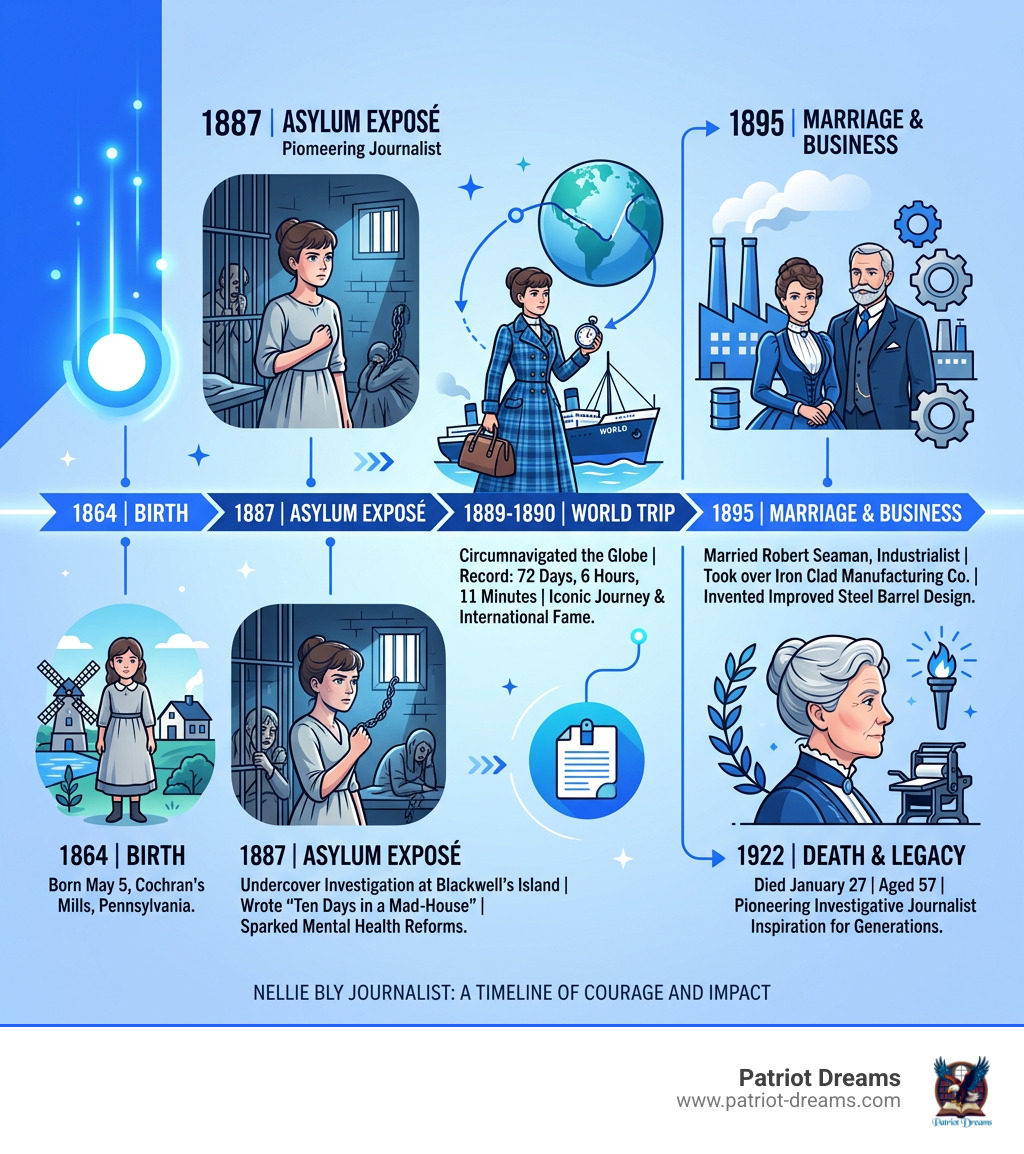
Nellie Bly journalist is one of the most remarkable figures in American history — a woman who didn't just report the news, but lived it to make the world a better place.
Here's a quick look at who she was and why she still matters:
- Real name: Elizabeth Jane Cochran (later Cochrane), born May 5, 1864 in Cochran's Mills, Pennsylvania
- Died: January 27, 1922, aged 57
- Known for: Undercover asylum investigation, record-breaking world trip, pioneering investigative journalism
- Biggest achievement: Circumnavigating the globe in 72 days, 6 hours, and 11 minutes (1889-1890)
- Lasting impact: Sparked mental health reforms, opened doors for women in journalism, and invented a new style of reporting we still use today
Nellie Bly grew up in a modest Pennsylvania family, lost her father young, and had little formal education. But she had something powerful: a voice, and the courage to use it.
When a Pittsburgh newspaper published a column dismissing women as fit only for housework, a young Elizabeth Cochran fired back with an angry letter signed "Lonely Orphan Girl." The editor was so impressed he hired her on the spot.
That gutsy move launched one of the most extraordinary careers in American journalism history.
"Could I pass a week in the insane ward at Blackwell's Island? I said I could and I would. And I did." — Nellie Bly, Ten Days in a Mad-House, 1887
What followed was a career built not on press releases or political dinners, but on genuine human empathy — and a willingness to go where no reporter had gone before.
Key terms for Nellie Bly journalist:
- Rosa Parks story
- Sojourner Truth speech
- Teddy Roosevelt: The Fearless Leader Every Young American Should Know
The Bold Beginnings of Nellie Bly Journalist
Every great story has a beginning, and Elizabeth’s began in the small town of Cochran’s Mills, Pennsylvania. Her father, Michael Cochran, was a wealthy landowner and local judge, but his sudden death when Elizabeth was only six years old left the family in a difficult spot. Without a will, the family's security vanished. Elizabeth saw how hard life could be for a woman without independent means, especially after her mother entered a brief, abusive second marriage that ended in a then-scandalous divorce.
Elizabeth tried to attend Indiana Normal School to become a teacher, but she had to drop out after just one term because the funds simply weren't there. She moved with her mother to Pittsburgh, where they ran a boarding house. It was here that she encountered a column in the Pittsburgh Dispatch titled "What Girls Are Good For," which argued that women were essentially useless outside of the home.
Her fiery response as the "Lonely Orphan Girl" didn't just get her a letter to the editor published; it caught the eye of managing editor George Madden. He recognized her "pioneering spirit" and offered her a job. In an era when most women were relegated to writing about tea parties and flower shows, Elizabeth was ready to join the ranks of Historical American Figures who refused to stay in the shadows.
How Nellie Bly Journalist Redefined the Pittsburgh Dispatch
When Elizabeth started at the paper, it was common practice for female writers to use a pen name. Her editor suggested "Nelly Bly," taken from a popular song by Stephen Foster, a famous songwriter also from the Pittsburgh area. A composing room error changed the spelling to "Nellie," and a legend was born.
As Nellie Bly journalist, she didn't waste any time. She went straight to the heart of the city's struggles, writing about the "factory girls" who worked in grueling conditions for pennies. She even traveled to Mexico as a foreign correspondent, spending six months documenting the lives of the poor and the corruption of the government. When she was eventually threatened with arrest for her honest reporting, she returned home, but her work had already marked her as an original muckraker.
She eventually grew tired of being pulled back to the "women’s pages" to write about society news. In a bold move, she left a note for her editor: "I am off for New York. Look out for me. BLY." She was ready to take her place among the most influential US Historical Figures of her time.
Breaking Barriers for Women in the Newsroom
Nellie’s journey wasn't easy. When she arrived in New York City, she spent four months being rejected by every major newspaper. They simply didn't think a woman could handle "hard news." But Nellie was persistent. She eventually talked her way into the office of Joseph Pulitzer’s New York World.
Her success was a victory for American Cultural History. By proving that a woman’s perspective could sell more papers than any dry political report, she opened the door for generations of women to follow. She didn't just want a job; she wanted to prove that "what girls are good for" was anything they set their minds to.

Ten Days in a Mad-House: A Mission of Mercy
In 1887, Pulitzer and his managing editor, Colonel John A. Cockerill, gave Nellie her most dangerous assignment yet: feign insanity and get committed to the Women’s Lunatic Asylum on Blackwell’s Island (now Roosevelt Island). The goal was to investigate reports of horrific abuse and neglect.
Nellie practiced her "insane" expressions in front of a mirror and checked into a boarding house under the alias "Nellie Brown." Within days, she had successfully duped several doctors and a judge. She was sent to the island, where she immediately dropped her act and began behaving normally. To her horror, she found that the more sanely she spoke, the more the doctors believed she was truly lost to madness.
A List of Abuses Uncovered
During her ten-day stay, Nellie witnessed:
- Brutal physical abuse: Nurses would beat, choke, and kick patients for minor infractions.
- Execrable food: Patients were fed rancid butter, spoiled meat, and dirty water.
- Extreme cold: In the dead of winter, patients were forced to take ice-cold baths and wear thin clothing.
- Filthy conditions: The wards were infested with vermin and lacked proper sanitation.
- Wrongful commitment: Nellie discovered many women were not "insane" at all, but were simply poor immigrants who couldn't speak English and had no one to advocate for them.
Impact of the Exposé: Before and After
Her two-part series, later published as the book Ten Days in a Mad-House, shocked the nation.
| Feature | Before Nellie Bly | After Nellie Bly |
|---|---|---|
| City Funding | $1.5 Million | $2.34 Million |
| Special Allocation | $0 | $50,000 for Blackwell's |
| Patient Care | Unregulated and abusive | Increased oversight and staffing |
| Public Awareness | Ignored and hidden | National conversation on mental health |
The Impact of Investigative Courage
The courage shown by Nellie Bly journalist led to immediate, tangible change. A grand jury was called, and Nellie herself led the jurors on a tour of the asylum. The Department of Public Charities and Corrections saw a massive budget increase to ensure better food and care. Most importantly, the asylum was eventually closed, and the way we treat some of our most vulnerable neighbors changed forever.
This story of reform is a perfect example of When Film Becomes History: How Movies Shape Our View of America, as Nellie’s life has been dramatized many times to remind us of the power of a single person standing up for what is right.
Around the World in 72 Days: A Journey of Human Spirit
In 1888, Nellie pitched an even more ambitious idea to her editors: she would travel around the world to beat the record of Phileas Fogg, the fictional hero of Jules Verne's Around the World in 80 Days. Her editor initially balked, saying only a man could travel alone and that she would need too much luggage. Nellie replied, "Very well. Start the man, and I’ll start the same day for some other newspaper and beat him."
She got the job.
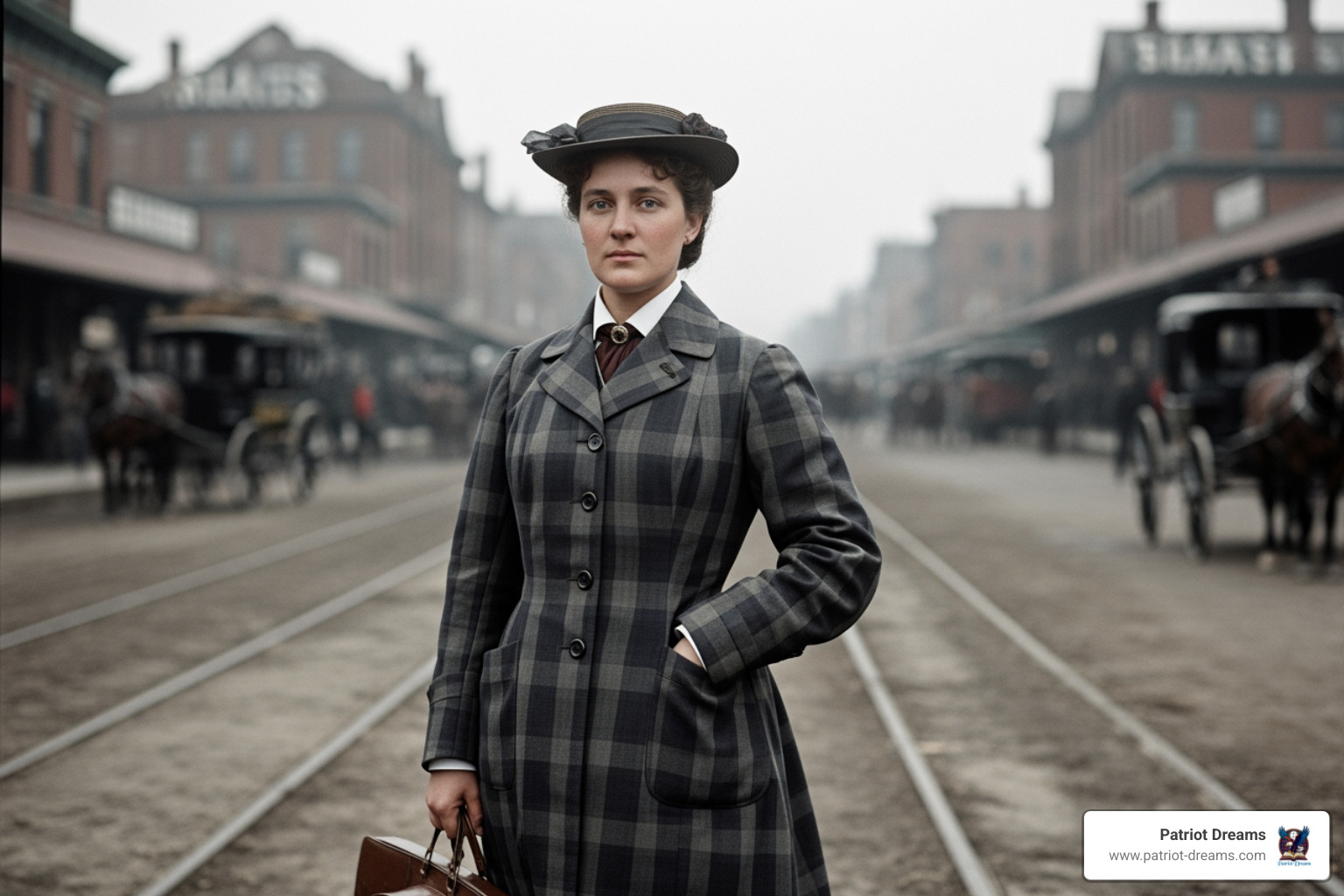
On November 14, 1889, Nellie set sail from New Jersey with nothing but the clothes on her back, a sturdy plaid coat, and one small satchel measuring 7 by 16 inches. She was determined to prove that a woman could travel as independently as any man.
A Global Itinerary
Nellie’s journey covered 24,898 miles. Some of her stops included:
- Amiens, France: Where she met Jules Verne himself. He was skeptical but wished her luck.
- Brindisi, Italy
- Port Said, Egypt and the Suez Canal
- Colombo, Ceylon (Sri Lanka)
- Singapore (where she bought a pet monkey named McGinty)
- Hong Kong and Canton, China
- Yokohama, Japan
- San Francisco, USA
She faced monsoon rains, delays in the mail, and even a rival! The magazine The Cosmopolitan sent their own reporter, Elizabeth Bisland, in the opposite direction to try and beat Nellie. But Nellie’s spirit was unbreakable. When she finally arrived back in New Jersey via a special chartered train, she was greeted by thousands of cheering fans. She had completed the trip in 72 days, 6 hours, and 11 minutes.
Challenging Stereotypes One Mile at a Time
Nellie’s trip was a landmark in American Innovation History. She used the cutting-edge technology of her day — steamships and telegraphs — to shrink the world. But more than that, she showed that the world wasn't a place to be feared. Her Around the World in 80 Days inspiration turned a fictional dream into a reality for women everywhere. She proved that a woman could travel light, stay safe, and conquer the globe with nothing but her wits and a small bag.
The Legacy of an Original Muckraker
After her world-famous trip, Nellie’s life took many interesting turns. At age 31, she married Robert Seaman, a 73-year-old millionaire industrialist. When he passed away, she took over his company, Iron Clad Manufacturing.
She wasn't just a figurehead; she was an inventor. Nellie was granted U.S. patent 697,553 milk can and a patent for a stacking garbage can. She ran her factories with the same heart she used in her reporting, providing her workers with health care, libraries, and gymnasiums. Unfortunately, her kindness was sometimes met with dishonesty from her employees, and the company eventually faced bankruptcy.
But Nellie wasn't done. She returned to journalism, covering the Eastern Front during World War I — the first woman to do so. She also remained a staunch advocate for women’s suffrage, famously predicting in 1913 that women would have the vote by 1920. She was right.
The Enduring Influence of Nellie Bly Journalist on Modern Media
Today, we see Nellie's influence every time a reporter goes undercover to expose an injustice. She pioneered "immersion journalism," a style that values the human experience over dry facts. She reminds us that we are all connected and that we have a responsibility to look out for one another.
Her story fits perfectly alongside the Who Are Founding Fathers of USA because, like them, she helped define what it means to be an American: to be brave, to be curious, and to always seek the truth.
Frequently Asked Questions about Nellie Bly Journalist
What was Nellie Bly’s real name and why did she use a pseudonym?
Her birth name was Elizabeth Jane Cochran. She later added an "e" to the end of her last name to seem more sophisticated. She used the pen name "Nellie Bly" because it was the fashion for female journalists at the time, and it protected her family's reputation while she was doing "unladylike" things like factory work and undercover investigations.
How did Nellie Bly’s asylum investigation change American laws?
While it didn't change a specific federal law immediately, it led to a massive increase in city funding for the mentally ill. It also changed the legal process for committing patients, ensuring that doctors had to be more thorough and that non-English speakers weren't simply "locked away" because of a language barrier.
Did Nellie Bly actually meet Jules Verne during her world trip?
Yes! She made a special detour to Amiens, France, to meet the author who inspired her journey. Despite a language barrier, they got along famously. Verne told her, "If you do it in seventy-nine days, I shall applaud with both hands." When she beat that by a week, he was among the first to congratulate her.
Conclusion
Elizabeth Cochrane Seaman passed away from pneumonia in 1922, but the fire she lit has never gone out. She was a woman of immense resilience and kindness, a reporter who believed that the truth could set people free.
At Patriot Dreams, we believe in the power of these stories to bring us together. Nellie Bly reminds us that no matter where we come from or how much education we have, we all have the ability to make a difference. Her life is a beautiful chapter in our shared heritage, reminding us of the best of the American spirit.
If you’ve felt inspired by Nellie’s journey, we invite you to explore more stories of historical-american-figures who have shaped our nation. There is so much beauty and heroism in our history, just waiting to be heard.
Read Time: 10 mins

Join the Patriot Dreams Community
Download the app today and start your journey through American history and personal legacy.

Explore Our Latest Insights
Dive into stories that shape our American legacy.