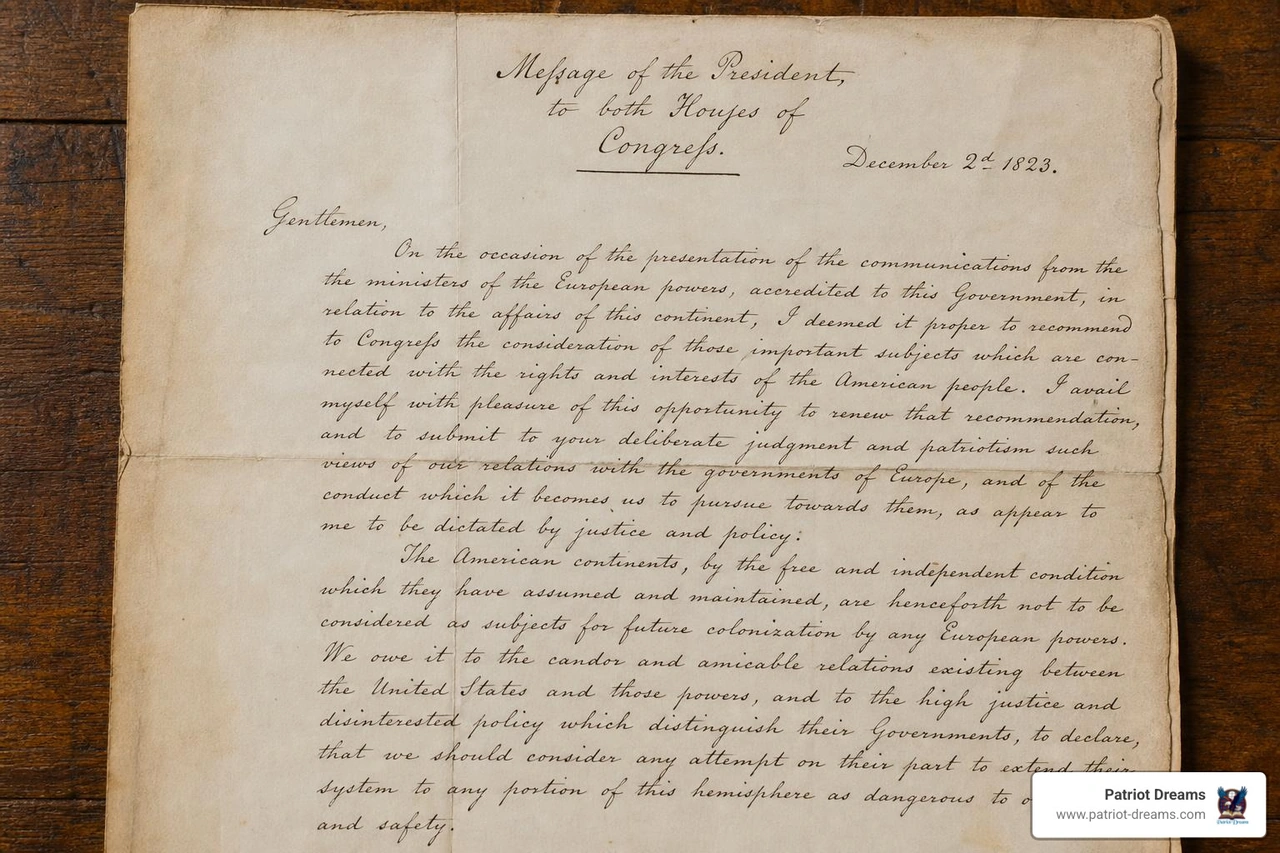
10 Essential Facts About the Founding Fathers of the USA
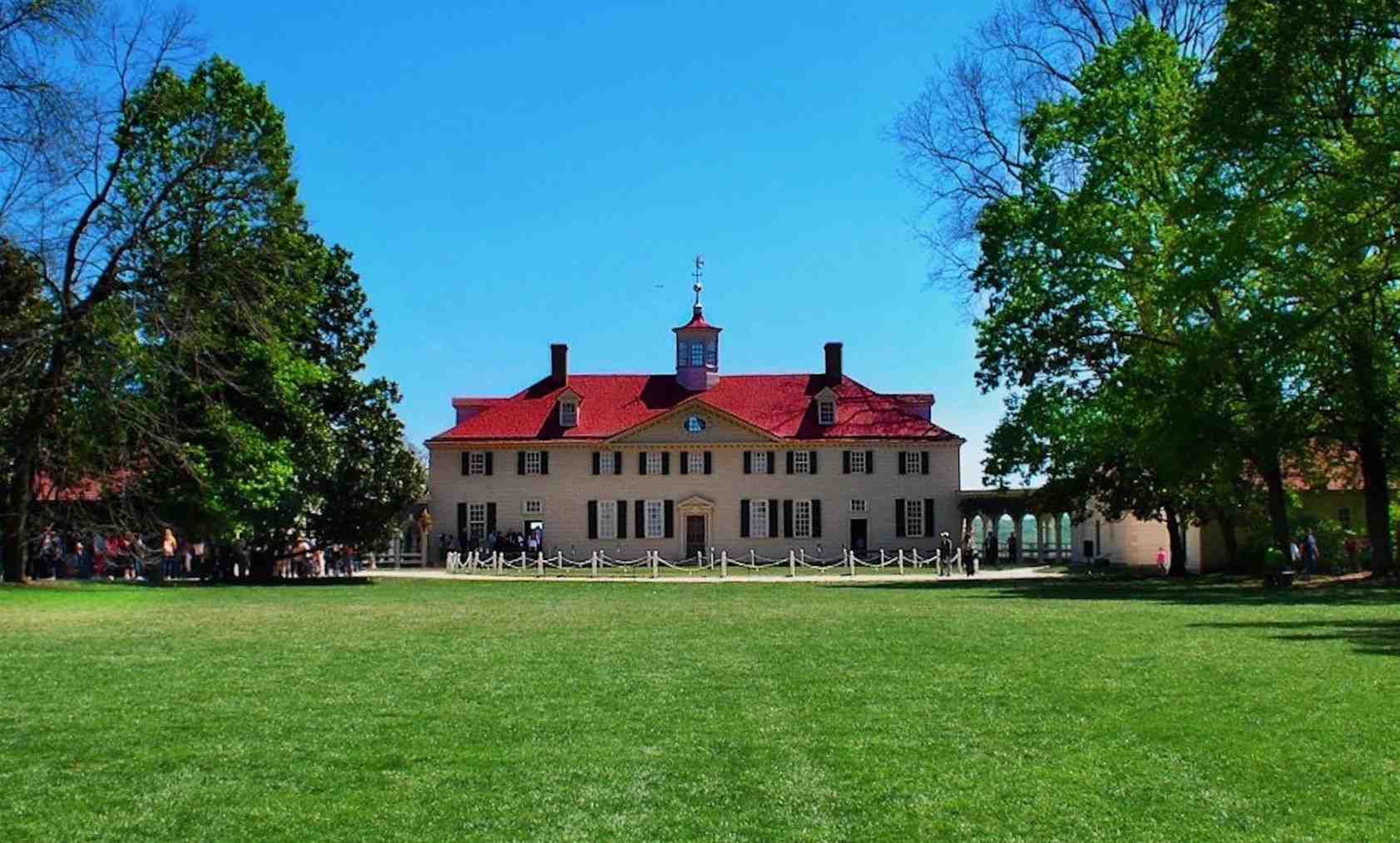

Why These Remarkable Americans Matter to Your Story
The Founding Fathers of the USA were a group of visionary leaders who came together in the late 1700s to do something extraordinary: they united thirteen separate colonies, led a war for independence, and created the framework for a brand new nation. These weren't distant, untouchable figures carved in marble—they were neighbors, farmers, printers, and lawyers who believed in something bigger than themselves.
Quick Answer: Who Are the Founding Fathers?
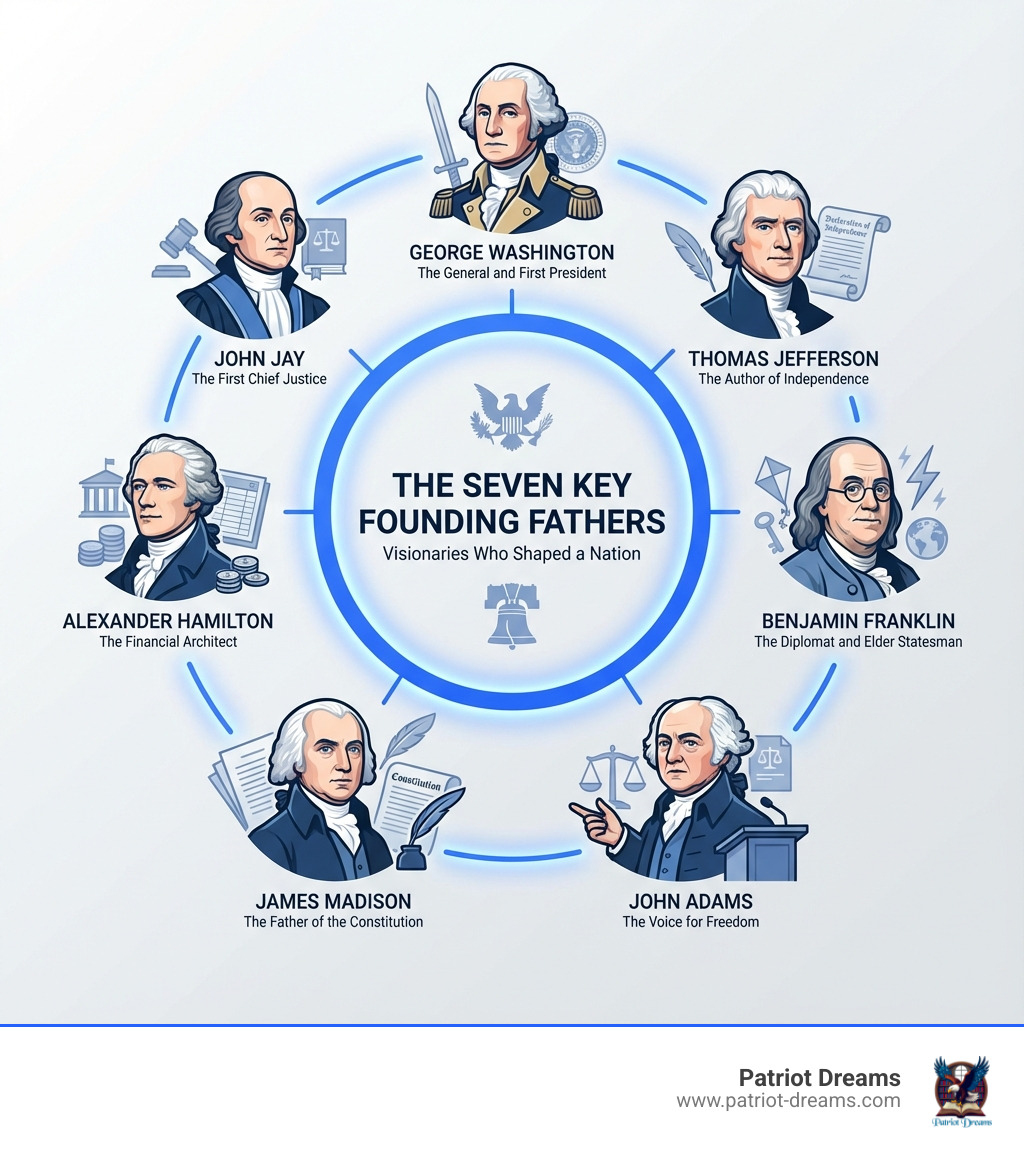
The term "Founding Fathers" refers to the political leaders who played pivotal roles in America's independence and the establishment of its government. While the list can vary, seven key figures are most often recognized:
- George Washington - Commander of the Continental Army and first President
- Thomas Jefferson - Primary author of the Declaration of Independence
- John Adams - Advocate for independence and second President
- Benjamin Franklin - Diplomat, inventor, and elder statesman
- James Madison - "Father of the Constitution" and architect of the Bill of Rights
- Alexander Hamilton - First Secretary of the Treasury and constitutional advocate
- John Jay - First Chief Justice of the Supreme Court
Broader Definition: The term also includes the 56 signers of the Declaration of Independence, the 39 signers of the Constitution, and other patriots who contributed to winning independence and establishing the new government.
This story isn't just about dates and documents. It's about real people who gathered in Philadelphia during hot summers, debated late into the night, and sometimes disagreed passionately—all while trying to create something the world had never seen before. Some were young (Thomas Jefferson was only 33 when he penned the Declaration of Independence), and some were elderly (Benjamin Franklin was 81 at the Constitutional Convention).
Their courage and vision gave us the freedoms we cherish today. And here at Patriot Dreams, we believe their story is your story too—a story of neighbors coming together, of families making sacrifices, and of everyday people doing extraordinary things.
Let's take a warm, gentle walk through history together and meet the people who started it all.
Who are founding fathers of usa terms explained:
- George Washington: The General Who Became America’s First President
- Thomas Jefferson and the Declaration of Independence: How a Nation Found Its Voice
- Revolutionary War heroes
Meet the Visionaries: Who Are the Founding Fathers of the USA?
When we think about Who are the Founding Fathers of the USA, we're talking about a truly special group of individuals. These were the political leaders from the thirteen colonies who, through immense courage and conviction, united a diverse populace, led a challenging war for independence from Great Britain, and then, perhaps even more remarkably, built the very framework for the United States government. Their vision was to create a society founded on principles of liberty and self-governance, a concept that was for its time.
The term "Founding Fathers" itself has an interesting history, gaining widespread recognition largely after President Warren G. Harding popularized it in speeches during the late 1910s and early 1920s. But the figures it refers to had been shaping our nation for generations. It’s a term that extends beyond those who merely signed important documents; it accepts all the politicians and leaders who helped America win the American Revolution and establish its lasting government. At Patriot Dreams, we invite you to dig into the personal stories behind these names, to truly understand their humanity and their dreams for our nation.
The Core Group: Seven Key Figures
While many contributed, historian Richard B. Morris identified seven key figures whose leadership, longevity, and statesmanship truly set them apart. These individuals are often considered the central architects of our new nation:
George Washington: Often hailed as the "Father of His Country," Washington's leadership as Commander of the Continental Army was indispensable to winning the Revolutionary War. He was also our first President, serving two terms, and presided over the Constitutional Convention. His steadfast character and commitment to republican ideals set a powerful precedent for the young nation. You can learn more about his incredible journey here: George Washington: The General Who Became America’s First President.
Thomas Jefferson: At just 33 years old, Jefferson penned the eloquent words of the Declaration of Independence, articulating the fundamental principles of liberty and self-governance that define America. His influence extended to diplomacy, serving as minister to France, and later as our third President. Explore his pivotal role in shaping our nation's voice: Thomas Jefferson and the Declaration of Independence: How a Nation Found Its Voice.
John Adams: A passionate advocate for independence, Adams's legal mind and unwavering commitment were crucial in the Continental Congress. He was a key diplomat in Europe during the war and later served as our first Vice President and second President. His deep insights into government and human nature continue to inspire us.
Benjamin Franklin: The oldest of the prominent Founders, Franklin was a true polymath—an inventor, scientist, writer, and diplomat. He played a critical role in securing the alliance with France during the Revolution and was a wise, mediating presence at the Constitutional Convention. His wit and wisdom shine through his writings, such as "Poor Richard's Almanack." Learn more about this amazing figure: All About Benjamin Franklin: Inventor, Diplomat, and Founding Father.
Alexander Hamilton: A brilliant economist and political thinker, Hamilton was a key author of the Federalist Papers, arguing persuasively for the Constitution's ratification. As the first Secretary of the Treasury, he established the nation's financial system, laying the groundwork for future prosperity.
John Jay: Our nation's first Chief Justice of the Supreme Court, Jay was also a skilled diplomat, co-negotiating the Treaty of Paris that ended the Revolutionary War and contributing significantly to the Federalist Papers. His dedication to justice and international relations helped define America's place in the world.
James Madison: Known as the "Father of the Constitution," Madison's diligent preparation and intellectual contributions at the Constitutional Convention were unparalleled. He also drafted the Bill of Rights, ensuring fundamental protections for individual liberties, and later served as our fourth President.
These seven individuals, through their diverse talents and shared commitment, truly shaped the destiny of the United States.
A Broader Circle of Patriots
While the "core seven" are frequently highlighted, the mix of our nation's founding is woven with the contributions of many more brave and dedicated individuals. The definition of Who are the Founding Fathers of the USA can certainly expand to include a wider circle of patriots. For instance, there were 56 courageous individuals who signed the Declaration of Independence, publicly pledging their lives, fortunes, and sacred honor to the cause of liberty.
Later, at the Constitutional Convention, 70 individuals were appointed by their states (all except Rhode Island), though 55 delegates attended the sessions in Philadelphia, and 39 ultimately signed the United States Constitution. These men, ranging in age from 26-year-old Jonathan Dayton to 81-year-old Benjamin Franklin, engaged in spirited debate and compromise to craft our nation's foundational document.
Beyond those who signed these pivotal documents, countless others played vital roles. Figures like Samuel Adams, a fiery orator and organizer of colonial resistance, and Patrick Henry, whose cry of "Give me liberty or give me death!" galvanized many, were indispensable. John Hancock, famous for his bold signature on the Declaration, and George Mason, who advocated for a bill of rights, also stand tall among these patriots. Their collective effort and shared sacrifice remind us that the founding of America was a grand, collaborative undertaking involving many hands and hearts.
The Great Challenge: Building a Nation from a Dream

The journey from a collection of discontented colonies to a unified nation was anything but easy. The monumental task before these Founders was to transform the dream of liberty into the reality of a functioning, self-governing country. This period was marked by profound challenges, from the growing discontent with British rule to the arduous struggle of nation-building after a long war.
The path to independence was paved with a series of escalating events, each pushing the colonists further from reconciliation and closer to revolution. These included:
- The Stamp Act (1765): One of the first direct taxes on the colonies, igniting widespread protest and the cry of "no taxation without representation."
- The Boston Tea Party (1773): A bold act of defiance against British taxation policies, leading to harsher British measures.
- The First Continental Congress (1774): Delegates from twelve colonies met to coordinate a unified response to British policies, issuing a declaration of rights and forming an association to boycott British goods.
- The Second Continental Congress (1775): With fighting already underway, this Congress assumed the role of a national government, forming the Continental Army and eventually declaring independence.
- The Revolutionary War (1775-1783): An eight-year struggle for freedom, led by General George Washington, against the formidable British Empire.
Navigating these tumultuous times required extraordinary leadership, resilience, and a shared belief in the principles they were fighting for. The Founders, in their wisdom and courage, guided the colonies through these trials, changing them into a nascent nation.
A Mix of Ideas: Different Visions, One Goal
Even with the shared goal of independence, the Founding Fathers held a vibrant mix of ideas about how the new nation should be governed. These differences, while sometimes threatening to pull the country apart, ultimately led to a stronger, more balanced government. We often see these debates through the lens of Federalists versus Anti-Federalists.
The Federalists, including figures like Alexander Hamilton and James Madison, championed a stronger central government to ensure stability, manage national debt, and promote economic growth. They believed a robust federal authority was necessary to bind the states together and project power on the world stage.
On the other side were the Anti-Federalists, such as Patrick Henry and George Mason, who feared that a powerful central government would infringe upon individual liberties and state sovereignty, echoing their recent struggle against British tyranny. They advocated for more power to remain with the states and insisted on a Bill of Rights to protect citizens from potential governmental overreach.
These were not easy conversations. Imagine the heat of a Philadelphia summer, with delegates debating issues like:
- Representation: How would states be represented in the new legislature? Large states wanted proportional representation based on population, while small states feared being overshadowed and demanded equal representation. This led to the ingenious "Great Compromise" (or Connecticut Compromise), creating a bicameral legislature with the House of Representatives based on population and the Senate offering equal representation to each state.
- Slavery: Perhaps the most profound and painful disagreement, the issue of slavery deeply divided the northern and southern states. While many Founders expressed moral opposition to slavery, economic interests and the need for unity led to compromises like the Three-Fifths Compromise and the continuation of the slave trade for a period. This unresolved tension would, tragically, cast a long shadow over the nation's future.
- Executive Power: How much power should the President have? The Founders grappled with creating a strong executive capable of effective leadership without becoming a monarch.
Despite these sometimes fierce disagreements, a spirit of collaboration and a shared commitment to forming a "more perfect Union" prevailed. Their ability to compromise and find common ground, even on deeply divisive issues, stands as a testament to their dedication to the new nation.
The Women Who Raised a Nation: Recognizing the Founding Mothers
While the spotlight often falls on the male figures of the founding era, we must also acknowledge the vital, though often-overlooked, role of women. These "Founding Mothers" contributed intellectually, emotionally, and practically to the cause of liberty, helping to raise a nation alongside their male counterparts.
Consider Abigail Adams, a formidable intellect and a constant correspondent with her husband, John Adams. Her famous plea to "Remember the Ladies" in a letter to John, urging him and the other Founders to consider women's rights in the new laws, is a powerful reminder of the voices advocating for greater equality even then.
Martha Washington, too, played a crucial role, not as a political figure, but as a steadfast supporter and presence at her husband's side, even enduring the harsh winter at Valley Forge, providing comfort and stability to the troops and officers. Women like Mercy Otis Warren used their literary talents to champion the Patriot cause through plays, poems, and pamphlets, shaping public opinion and inspiring fervor.
Beyond these prominent figures, countless women managed farms and businesses while their husbands were away fighting or serving in government. They boycotted British goods, spun homespun cloth for the troops, and nursed the wounded. Their resilience, resourcefulness, and unwavering spirit were the backbone of the nascent American society. Their contributions, though often unsung in traditional historical narratives, were absolutely essential to the survival and success of the Revolution. We encourage you to explore more about these remarkable women and their inspiring stories on Patriot Dreams.
The Charters of Freedom: Their Enduring Gift to America

Among the most tangible and enduring gifts left to us by the Founding Fathers are the three key documents that form the very foundation of our nation: the Declaration of Independence, the United States Constitution, and the Bill of Rights. These are often referred to as the "Charters of Freedom" and represent a profound promise of liberty and justice for all. They are not merely historical artifacts; they are living documents that continue to guide and inspire us.
The Declaration of Independence: A Statement of Ideals
Adopted by the Continental Congress on July 4, 1776, the Declaration of Independence was much more than a formal break with Great Britain. It was a soaring statement of ideals, articulating the core belief that "all men are created equal" and endowed with certain unalienable rights, including "Life, Liberty, and the pursuit of Happiness."
Thomas Jefferson, at the young age of 33, was primarily tasked with drafting this monumental document. With input from figures like Benjamin Franklin and John Adams, his words captured the moral foundation of the new nation. The Declaration summarized the colonists' motivations for seeking independence, listing their grievances against King George III and asserting their right to self-governance.
Beyond its powerful philosophical message, the Declaration also served a crucial diplomatic purpose. By formally declaring independence, the American colonies were able to seek official alliances with foreign powers. Benjamin Franklin, with his diplomatic finesse, had already hinted to French agents about the colonies' leanings towards independence, understanding that a formal declaration was necessary to secure the vital aid and recognition of France. This diplomatic success eventually led to the Treaty of Alliance with France in 1778, a turning point in the Revolutionary War.
From the Articles of Confederation to the Constitution
After declaring independence, the newly formed United States needed a governing structure. The first attempt was the Articles of Confederation, adopted in 1781. This document created a "league of friendship" among the states, with a weak central government and most power residing with the individual states. While it served its purpose during the war, its weaknesses soon became apparent. The national government lacked the power to tax, regulate commerce, or enforce laws effectively, leading to economic instability and interstate disputes.
It became clear that a stronger, more unified framework was needed. This realization led to the Constitutional Convention of 1787 in Philadelphia. Here, James Madison, often called the "Father of the Constitution" due to his meticulous preparation and profound contributions, played an instrumental role. He arrived with a detailed plan, the Virginia Plan, which heavily influenced the subsequent debates.
The Convention brought together 55 delegates from across the states (with the exception of Rhode Island), who engaged in four months of intense debate, negotiation, and compromise. Their goal was to create a lasting framework for a federal republic that balanced the powers of the national government with the rights of the states, and protected individual liberties. The result was the United States Constitution, a remarkable document that established a system of checks and balances, a separation of powers, and a flexible structure designed to endure through generations. Only 39 delegates ultimately signed this groundbreaking document, but their collective effort created a government that has stood the test of time.
The Legacy of the Founders and Their Influence Today
The legacy of the Founding Fathers is an enduring one, deeply woven into the fabric of American life. Their work created a government "of the people, by the people, for the people," and their ideals of liberty, democracy, and individual rights continue to influence the United States and inspire people around the world. The grand dome of the U.S. Capitol Building stands as a testament to the enduring impact of their vision.
How Their Backgrounds Shaped the Government They Created
The backgrounds and beliefs of the Founding Fathers were as diverse as the colonies they represented, and this diversity profoundly shaped the government they created. They were a mix of lawyers, farmers, merchants, and scholars, many of whom were well-educated and deeply influenced by the Enlightenment—a European intellectual movement emphasizing reason, individualism, and human rights. Thinkers like John Locke, with his ideas of natural rights and the social contract, heavily influenced their philosophy.
Their experiences under British rule instilled in them a deep suspicion of unchecked power and a commitment to republicanism, a form of government where power rests with citizens through elected representatives, rather than a monarchy. They sought to create a government of laws, not of men, ensuring that no single individual or branch could become too powerful. This led to the system of checks and balances and the separation of powers that are hallmarks of our Constitution.
For example, George Washington, a seasoned military leader, understood the importance of civilian control over the military. James Madison, a scholar of history and political philosophy, carefully studied various forms of government to design a republic that could avoid the pitfalls of past democracies. Their practical experiences and intellectual foundations combined to forge a government that was both innovative and resilient.
A Deeper Look: Who are the Founding Fathers of the USA in Our Modern World?
The perception of Who are the Founding Fathers of the USA has evolved significantly over time, and rightly so. For generations, they were often viewed with an almost mythical reverence, seen as infallible demigods who laid down perfect principles. However, modern scholarship and a more nuanced understanding of history encourage us to acknowledge their complexities and humanity. We recognize that they were products of their time, with both profound strengths and significant flaws.
One of the most challenging aspects of their legacy is the issue of slavery. As we learned, nearly half of the signers of the Declaration of Independence were slaveholders, and all profited from the institution in various ways. This stark contradiction between their espoused ideals of liberty and the reality of slavery is a painful truth we must confront. Their failure to abolish slavery at the nation's founding left a profound and lasting scar on American society, a challenge that later generations would have to address through immense struggle and sacrifice.
Yet, their vision was a starting point, not an endpoint. The ideals they enshrined in documents like the Declaration of Independence—that "all men are created equal"—provided the moral compass for future movements for civil rights and equality. Their work laid the foundation for a nation capable of self-correction, of striving towards a "more perfect Union."
Their debates, their compromises, and even their imperfections offer us valuable lessons. They remind us that nation-building is an ongoing process, requiring constant engagement, dialogue, and a commitment to our shared principles. The story of America is a story we all share and continue to write, inspired by the courage and vision of those who came before us, and continually striving to live up to the highest ideals they set forth.
Conclusion
As we gently close our journey through the lives and legacies of the Founding Fathers, we hope you've felt a warm connection to these remarkable individuals. They were, in essence, neighbors, friends, and family men who answered a great call—a call to create a nation built on the promise of liberty and self-governance. Their stories are not just chapters in a history book; they are a source of inspiration and a unifying thread that connects us all as Americans.
They faced immense challenges, made difficult choices, and sometimes grappled with their own limitations, yet their unwavering dedication to a better future for their communities ultimately forged the United States of America. At Patriot Dreams, we believe that understanding these personal histories helps us connect with the past in a truly meaningful way, reminding us of the kindness, perseverance, and unity that have always been at the heart of the American spirit.

Join the Patriot Dreams Community
Download the app today and start your journey through American history and personal legacy.

Explore Our Latest Insights
Dive into stories that shape our American legacy.