The Definitive Guide to Abraham Lincoln

From a Log Cabin to the White House: The Story of Abraham Lincoln
Abraham Lincoln was the 16th President of the United States — a man who rose from a one-room frontier log cabin to lead a nation through its darkest, most divided hour.
Here are the most important facts about him at a glance:
| Fact | Detail |
|---|---|
| Born | February 12, 1809, Hardin County, Kentucky |
| Died | April 15, 1865 (assassinated, age 56) |
| Presidency | March 4, 1861 – April 15, 1865 (16th President) |
| Party | Republican (first Republican president) |
| Key Achievement | Led the Union through the Civil War; issued the Emancipation Proclamation |
| Famous Quote | "With malice toward none, with charity for all..." |
| Education | Largely self-taught; less than 12 months of formal schooling |
| Height | 6 ft 4 in (193 cm) |
There is something quietly remarkable about Abraham Lincoln's story. He had almost no formal schooling. He lost his mother as a young boy. He faced failure in business and in politics — more than once. And yet, something inside him never quit.
His law partner once described Lincoln's ambition as "a little engine that knew no rest." That feels right. Not a loud, boastful engine. A quiet, steady one.
This is a story about resilience. About the power of reading a borrowed book by firelight. About a man who believed — deeply — that every person deserved to be free.
Whether you are a lifelong history enthusiast or just beginning to explore America's past, Lincoln's journey has something to offer all of us. It reminds us that where you start does not determine where you can go.
Simple Abraham Lincoln glossary:
The Humble Beginnings of Abraham Lincoln
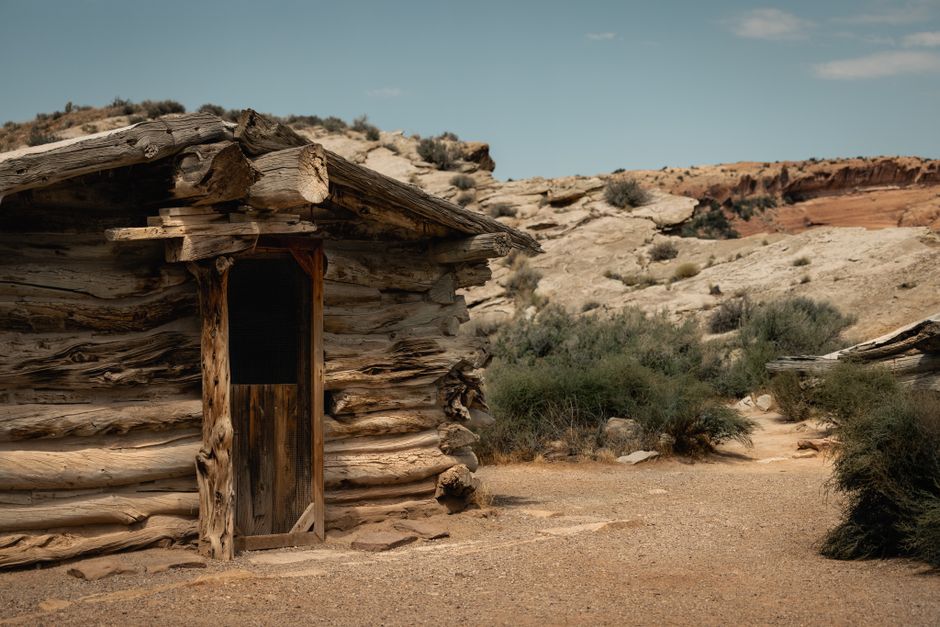
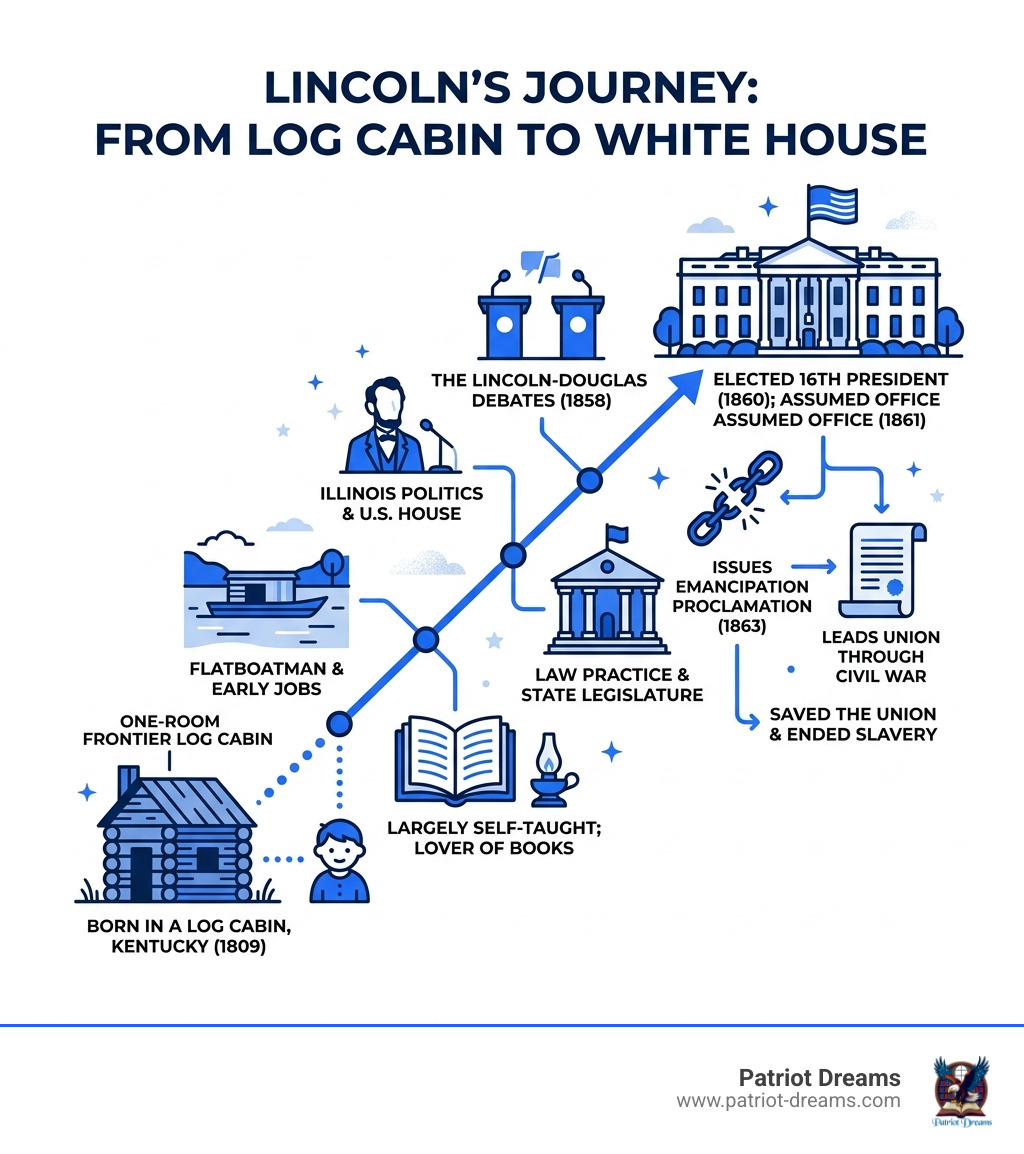
The story of Abraham Lincoln begins in the wild woods of Kentucky on February 12, 1809. Born in a tiny, one-room log cabin near Hodgenville, his early years were defined by the hard, honest work of the American frontier. When he was just seven, his family moved to Indiana, a journey through thick forests that required the young boy to help clear the way with an axe.
Life on the frontier was not just physically demanding; it was often heartbreaking. In 1818, when Lincoln was only nine years old, his mother, Nancy Hanks Lincoln, died from "milk sickness." This loss left a deep void in the young boy's heart. However, a year later, his father, Thomas Lincoln, married Sarah Bush Johnston. Sarah was a kind and encouraging woman whom Lincoln grew to love dearly, often calling her "Mama." She recognized the spark of curiosity in him and encouraged his hunger for knowledge.
Even though he had less than 12 months of formal schooling by the time he was 15, Lincoln never stopped learning. When books were rare treasures, he would walk miles just to borrow one. This period of his life is a beautiful example of Us Historical Figures who overcame immense obstacles through sheer perseverance. For more on his early homes, you can explore the Abraham Lincoln (U.S. National Park Service) resources.
A Journey of Self-Education and Integrity

How does a boy from the backwoods become one of the most eloquent leaders in history? The answer lies in his "self-taught" spirit. Abraham Lincoln didn't have a university, but he had a mind that never rested. He would read by the flickering light of the fireplace long after the day's chores were done. He famously "read law" on his own, studying Blackstone's Commentaries on the Laws of England until he understood the foundations of justice.
But Lincoln wasn't just a bookworm; he was also a man of great physical strength. Standing 6 feet 4 inches tall, he was a formidable wrestler. One of the most famous stories from his youth involves a match with Jack Armstrong, the leader of the "Clary's Grove boys." Lincoln won not just the match, but the respect of the entire community. This combination of physical toughness and moral integrity earned him the nickname "Honest Abe." He was a man who would walk miles to return a few cents of change to a customer at the general store he co-owned. You can find more about his character among other Famous Figures In American History.
The Early Professional Life of Abraham Lincoln
Before he entered the White House, Lincoln wore many hats. He was a surveyor, a postmaster, and even a tavern keeper for a short time. Eventually, he settled into a career as a "prairie lawyer" in Illinois. He was incredibly successful in this role, appearing before the Illinois Supreme Court in 411 cases.
Interestingly, Lincoln is the only U.S. President to hold a patent. In 1849, he invented a flotation device designed to help riverboats navigate through shallow water. This inventive spirit showed his practical approach to solving problems—a trait that would serve him well during his presidency. His official biography at Abraham Lincoln – The White House highlights how these early experiences shaped the leader he would become.
Leading a Nation with a Gentle Heart
When Abraham Lincoln was elected as the first Republican president in 1860, he received about 39.8 percent of the popular vote in a four-way race. His victory was the final straw for many Southern states, who feared he would restrict the expansion of slavery. By the time he took office in May 1861, seven states had already seceded from the Union.
Lincoln faced a challenge that would have broken most men. The Civil War began shortly after his inauguration when Confederate forces fired on Fort Sumter. Throughout the war, which lasted more than four years and claimed over 600,000 American lives, Lincoln led with a "gentle heart" but a firm hand. He famously built a "Team of Rivals," appointing his political opponents to his cabinet because he believed the country needed the best minds, regardless of their past disagreements.
One of his most significant acts was the Emancipation Proclamation, issued on January 1, 1863. This document declared that all enslaved people in Confederate territory were "thenceforward, and forever free." It transformed the war from a struggle to preserve the Union into a moral crusade for human freedom. By the end of the conflict, more than 200,000 Black soldiers and sailors had joined the Union forces, contributing significantly to the national fight for liberty. Their bravery is a vital part of our heritage, as seen in stories like Rising From The Shadows How Cathay Williams And African American Soldiers Inspired New Hope During The Civil War.
Words of Hope and the Promise of Freedom
Lincoln had a way with words that could heal a fractured nation. On November 19, 1863, he stood on the blood-soaked ground of a Pennsylvania battlefield to deliver the Gettysburg Address. In just 272 words, he redefined the American purpose, honoring those who died so that "government of the people, by the people, for the people, shall not perish from the earth."
His Second Inaugural Address, delivered as the war was nearing its end, is perhaps his most beautiful speech. Instead of calling for vengeance, he called for healing, famously saying, "With malice toward none, with charity for all... let us strive on to finish the work we are in, to bind up the nation's wounds." These words remain a beacon of hope for unity in our country today. You can learn more about the context of these speeches by visiting Civil War Battlefields or reading the scholarly insights at the Abraham Lincoln | Miller Center.
The Legacy and Memory of Our 16th President
Behind the heavy burden of the presidency, Abraham Lincoln was a family man. He married Mary Todd Lincoln in 1842, and together they had four sons. Sadly, only one, Robert Todd Lincoln, lived to adulthood. The loss of his children, combined with the weight of the war, often led Lincoln into periods of deep sadness, or "melancholy," yet he continued to serve with kindness.
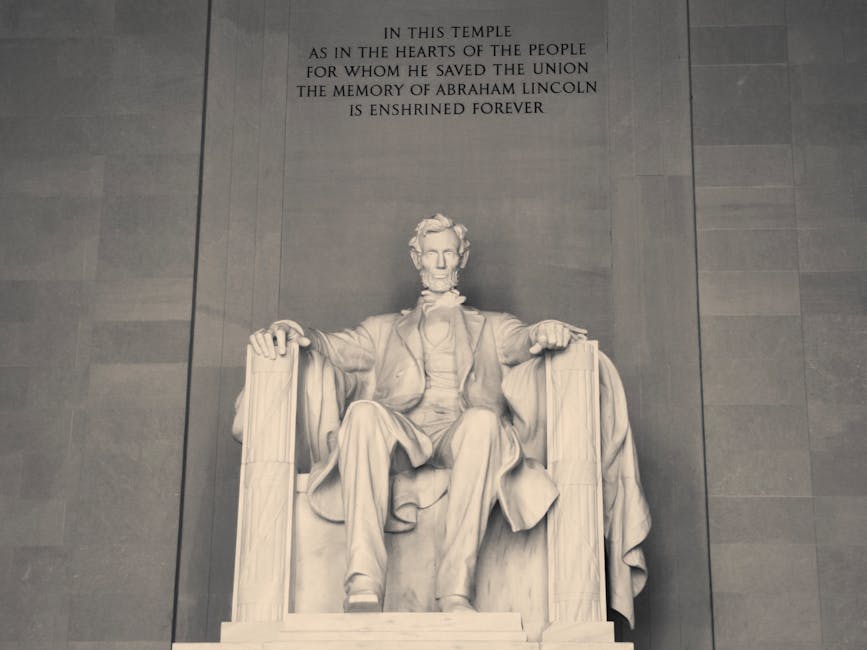
On April 14, 1865, just days after the Confederate surrender, Lincoln's life was tragically cut short by an assassin's bullet at Ford's Theatre. While his death was a national tragedy, his work was already cemented. He had successfully advocated for the 13th Amendment, which officially abolished slavery in the United States. His life remains one of the most studied and admired in the world, ranking him among the greatest Historical American Figures.
The Enduring Spirit of Abraham Lincoln
The spirit of Lincoln is one of kindness, perseverance, and an unshakable belief in the American dream. He showed us that a person can be both strong and gentle, both ambitious and humble. Today, as we look back from May 2026, his legacy continues to inspire us to be better neighbors and more dedicated citizens. He is a cornerstone of our national identity, as detailed in the American Historical Figures Complete Guide.
Frequently Asked Questions about Abraham Lincoln
How did Abraham Lincoln educate himself?
Lincoln was almost entirely self-educated. Growing up on the frontier with very little access to schools, he read every book he could get his hands on, including the Bible, Aesop’s Fables, and Pilgrim’s Progress. He taught himself law by reading legal texts like Blackstone's Commentaries while working as a storekeeper and surveyor.
What was the significance of the Emancipation Proclamation?
The Emancipation Proclamation was a turning point in American history. It changed the legal status of more than 3.5 million enslaved African Americans in the South from "slave" to "free." While it didn't end slavery everywhere immediately, it shifted the war’s purpose to include the abolition of slavery and allowed Black men to enlist in the Union Army.
What was Lincoln's role in the Civil War?
As Commander-in-Chief, Lincoln was deeply involved in military strategy. He spent countless hours in the telegraph office and visited his generals in the field. He navigated complex political waters, managing a cabinet of rivals and suspending habeas corpus when he felt it was necessary for national security, all with the singular goal of preserving the Union.
Conclusion
At Patriot Dreams, we believe that history is more than just dates and names on a page. It is a collection of human stories—stories of struggle, triumph, and the enduring American spirit. Abraham Lincoln reminds us that even in our most divided moments, there is a path toward "charity for all."
Through our interactive map and unique storytelling, we aim to bring the heritage of figures like Lincoln to life, helping you preserve your own family’s place within the great American story. History is a bridge that connects us, and by understanding where we’ve been, we can better navigate where we are going together.
Discover more stories at the Creator Hub
Read Time: 10 mins

Join the Patriot Dreams Community
Download the app today and start your journey through American history and personal legacy.

Explore Our Latest Insights
Dive into stories that shape our American legacy.