Detailed Guide to Adobe Walls, Texas History

A Place Where American History Came Alive
Adobe Walls, Texas is a ghost town in Hutchinson County — located 17 miles northeast of Stinnett in the Texas Panhandle — and one of the most remarkable frontier history sites in the American West.
Here's a quick overview of what makes this place so special:
- What it is: A historic ghost town and former trading post established in 1843
- Where it is: Hutchinson County, Texas, north of the Canadian River, ~17 miles northeast of Stinnett
- Why it matters: Site of two major battles between Native American tribes and Anglo forces (1864 and 1874)
- Key figures: Kit Carson, Quanah Parker, Billy Dixon
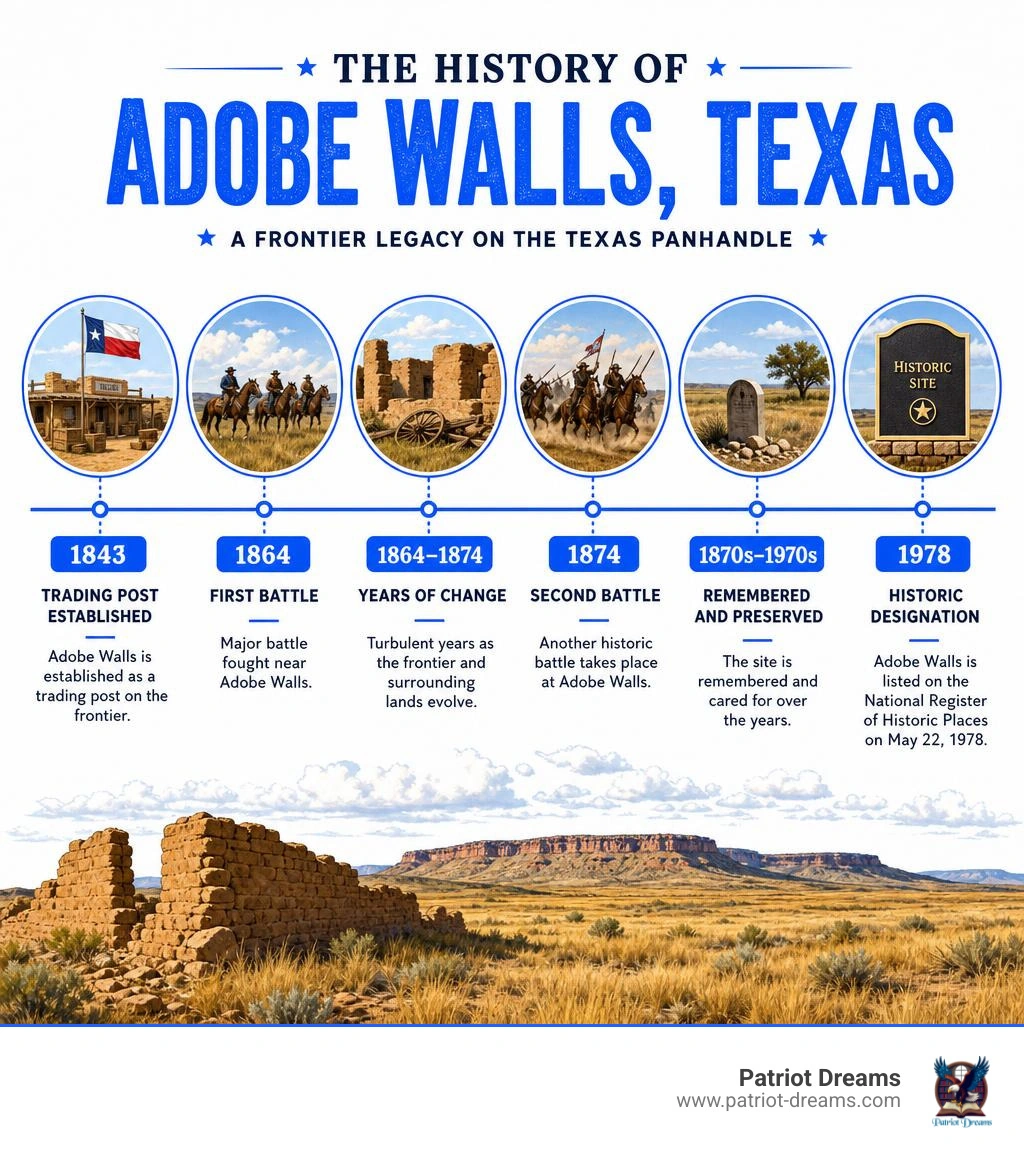
- Historic status: Listed on the National Register of Historic Places since May 22, 1978
- Current condition: A preserved site on private ranch land with monuments and grave markers
Some places carry a feeling you can't quite explain. You stand on quiet ground, look out at an open sky, and somehow know that something important happened here.
Adobe Walls is one of those places.
Twice in the span of ten years, this small patch of the Texas Panhandle became the center of something much bigger than itself — a meeting point of cultures, a test of courage, and a turning point in the story of the American frontier.
From its humble beginnings as a trading post, to the thunder of two historic battles, to the soft silence it holds today, Adobe Walls has a story worth knowing. And more than that — it's a story worth feeling.
Easy Adobe Walls, Texas word list:
- Gunsmoke and Grit: Legends, Outlaws, and Lawmen of the Wild West
- mountain men frontier tales
- when was the wild west era
The Origins of Adobe Walls, Texas as a Frontier Trading Post
To understand the magic of Adobe Walls, we have to travel back in time to the early 1840s. The Texas Panhandle was a vast, wind-swept sea of grass, home to millions of free-roaming buffalo and the ancestral hunting grounds of the Comanche, Kiowa, Cheyenne, and Plains Apache.
In 1843, representatives of the famous trading firm Bent, St. Vrain & Company arrived in this remote valley north of the Canadian River. They wanted to open a trade route with the Comanches and Kiowas, who often avoided the famous Bent’s Fort further north in Colorado due to the heavy presence of their rivals, the Cheyenne and Arapaho.
Initially, the traders built a simple log structure to conduct their business. But the frontier could be a dangerous and unpredictable place. To protect their investments, they decided to build something much more permanent. Mexican adobe makers were hired to construct a massive fort. Completed around 1845, this "Fort Adobe" was an impressive sight: an 80-foot square structure with solid adobe walls rising 9 feet high, featuring a single, heavily secured entrance.

For a few years, the fort was a bustling hub of exchange. Native Americans traded beautifully tanned buffalo robes for blankets, metal tools, and other goods. However, peace on the frontier was fragile. During a particularly tense encounter with restive Comanches in 1848, the traders were so fearful of an outbreak of violence that they conducted all their business through a small window cut directly into the thick adobe wall.
By 1849, the risks had grown too great. After finding a portion of his livestock slaughtered by local tribes, William Bent decided to abandon the Panhandle trade. To ensure that his rivals or hostile forces couldn't use the fort as a stronghold, Bent blew up the interior of the building with gunpowder.
Though the wooden roofs and interiors were gone, the massive adobe walls survived, standing like silent, sun-baked sentinels in the wilderness. It was these very ruins that gave the area its lasting name: Adobe Walls. To dive deeper into how this trading post evolved, you can explore The History of Adobe Walls: Trading Post to Historic Landmark.
The First Battle of Adobe Walls (1864)
As the years passed, tensions between the United States government and the Southern Plains tribes reached a boiling point. By 1864, the Civil War was raging in the East, but on the Western frontier, a different kind of conflict was unfolding. Native warriors, determined to protect their lands and way of life, frequently raided wagon trains along the Santa Fe Trail.
In response, the U.S. Army turned to a legendary figure of the American West: Colonel Christopher "Kit" Carson.
In November 1864, Carson marched into the Texas Panhandle at the head of 372 U.S. Army troops, primarily consisting of the New Mexico Volunteer Cavalry, along with a small contingent of Allied Ute and Jicarilla Apache scouts. Carson's mission was to locate and punish the Kiowa and Comanche villages responsible for the raids.
On November 25, 1864, Carson's forces discovered a large Kiowa village near the ruins of Fort Adobe. Carson's men attacked and sacked the village, but they quickly realized they had stepped into a hornets' nest. As the morning wore on, thousands of Comanche, Kiowa, and Plains Apache warriors began pouring in from neighboring encampments along the Canadian River.
Carson found himself severely outnumbered, facing an estimated 3,000 Native American warriors. Realizing the gravity of the situation, Carson retreated to the thick, protective ruins of the old adobe fort. From behind the crumbling walls, Carson’s men used two small mountain howitzers (cannon) to keep the overwhelming force of warriors at bay.
The cannon fire proved to be the deciding factor, preventing the warriors from launching a full-scale charge. Recognizing that a prolonged siege would mean certain death for his command, Carson executed a brilliant, fighting tactical retreat under the cover of artillery fire. While the battle was technically a standoff, Carson’s ability to successfully withdraw his men without being wiped out was considered a tactical victory. It was a close call that nearly mirrored the tragic fate that would later befall George Custer a decade later.
| Feature | First Battle of Adobe Walls (1864) | Second Battle of Adobe Walls (1874) |
|---|---|---|
| Date | November 25, 1864 | June 27, 1874 |
| U.S. / Civilian Leader | Colonel Kit Carson | James N. Hanrahan / Billy Dixon |
| Native American Leader | Dohäsan (Kiowa) | Quanah Parker (Comanche) & Isa-tai |
| Defenders' Strength | 372 U.S. Army Troops & Scouts | 28 men, 1 woman (civilians) |
| Native Forces Strength | Estimated 3,000 warriors | Estimated 700 warriors |
| Key Defensive Position | Ruins of the 1845 Adobe Fort | 1874 Trading Post Buildings |
| Outcome | Tactical U.S. retreat; fort abandoned | Successful civilian defense; tribal retreat |
The Second Battle of Adobe Walls (1874)
Ten years after Kit Carson's retreat, the landscape of the Panhandle had changed dramatically. The great buffalo herds, which had sustained the Plains tribes for generations, were being systematically wiped out by commercial buffalo hunters.
In the spring of 1874, a group of enterprising merchants from Dodge City, Kansas, decided to follow the hunters south into the Texas Panhandle, establishing a new trading post just a mile away from the original Adobe Walls ruins. By late spring, this small settlement had grown into a bustling frontier outpost, boasting the Myers and Leonard Store, the Charles Rath and Company store, a busy saloon operated by James N. Hanrahan, and Tom O'Keefe’s blacksmith shop. At any given time, between 200 and 300 buffalo hunters used the post as a base of operations.
For the Native American tribes, this was an intolerable invasion of their treaty-guaranteed hunting grounds. A brilliant young Comanche chief named Quanah Parker, partnering with a powerful medicine man named Isa-tai, began organizing a massive alliance. Isa-tai claimed to have a powerful medicine that would make the warriors immune to the white men's bullets.
Before dawn on June 27, 1874, a force of approximately 700 Comanche, Cheyenne, and Kiowa warriors silently approached the sleeping trading post.
Inside the buildings, only 28 defenders — including 27 men and one woman, Mrs. William Olds — were asleep. By a stroke of absolute luck, the ridgepole of Hanrahan’s saloon cracked with a sound like a pistol shot in the middle of the night. Fearing the roof would collapse, several men stayed up late to repair it. Because of this, they were awake and armed when the first sounds of the charging war party echoed across the valley.
The defenders quickly retreated into the thick sod and wood buildings of the trading post, turning the storefronts into improvised fortresses. Though heavily outnumbered, the defenders possessed a massive advantage: they were expert marksmen equipped with high-powered, long-range Sharps buffalo rifles.
The initial, furious charges led by Quanah Parker were repelled by a wall of accurate, heavy-caliber gunfire. Despite their courage, the warriors could not breach the sturdy buildings. As the day wore on, the battle turned into a tense, long-distance siege.
Billy Dixon and the Legendary Shot at Adobe Walls, Texas
As the second and third days of the siege arrived, the Native warriors withdrew to the surrounding mesas, well out of normal rifle range, to plan their next move. They believed they were completely safe from the defenders' guns.
Among the defenders was a young, soft-spoken buffalo hunter named Billy Dixon. Dixon was already known as one of the finest marksmen on the plains. On June 29, 1874, a group of warriors appeared on a high bluff roughly a mile away, watching the post.
Encouraged by his companions, Dixon took aim with his heavy .50-caliber Sharps rifle, carefully calculated the wind and the massive drop of the bullet, and pulled the trigger.
Seconds passed in absolute silence. Then, to the astonishment of everyone present, a warrior was knocked clean off his horse.
While modern ballistics experts like Luke Haag suggest the actual distance of this legendary shot was closer to 1,300 yards, historical estimates have placed it at an incredible 1,538 yards (nearly nine-tenths of a mile). Regardless of the exact yardage, the psychological impact of the shot was devastating. Realizing that the defenders could strike them down from almost a mile away, the remaining warriors lost faith in Isa-tai's protective medicine and withdrew, ending the siege.
Just a few months later, on September 12, 1874, Billy Dixon would find himself fighting for his life again in the Buffalo Wallow Fight, where he and a small group of scouts survived an attack by over 125 warriors. For his extraordinary gallantry during that engagement, Billy Dixon was awarded the Congressional Medal of Honor on November 4, 1874. Though the medal was later caught up in a bureaucratic sweep in 1916 that revoked civilian awards, it was rightfully restored to his memory in 1989.
The Legacy and Impact on the Texas Panhandle
The Second Battle of Adobe Walls was a watershed moment in Western history. The defeat of the allied tribes at Adobe Walls directly triggered the Red River War of 1874-1875. The U.S. government launched a relentless, multi-pronged military campaign that eventually forced the Southern Plains tribes to relocate to reservations in Indian Territory (modern-day Oklahoma). It marked the painful, poignant end of an ancient way of life and the rapid decline of the great free-roaming buffalo herds.
But life at Adobe Walls didn't end with the battles. In the years that followed, the land transitioned from a place of conflict to a place of community. The vast valley became part of the famous Turkey Track Ranch.
Billy Dixon himself returned to the peaceful valley, homesteading near the original ruins of Fort Adobe. On August 3, 1887, Adobe Walls received its own official post office, and Dixon was appointed as its very first postmaster, running the operations directly out of his home. He also served as the county’s first sheriff, helping to bring quiet law and order to the region.
During this ranching era, Adobe Walls became a warm, tight-knit community hub. In the late 19th century, voting at Adobe Walls was a legendary, multi-day event. Families from ranches dozens of miles away would travel to the site, camp out under the stars, cast their ballots, and enjoy a massive community barbecue. It was a beautiful display of the neighborly, supportive frontier spirit.
Over the decades, as modern highways bypassed the area, the community slowly faded away. From the 1940s through the 1970s, the population of Adobe Walls hovered at just 15 residents, eventually becoming a quiet ghost town. To read more about the post-battle history and the lives of those who stayed, check out Adobe Walls, Texas.
Preserving the Memory of Adobe Walls, Texas Today
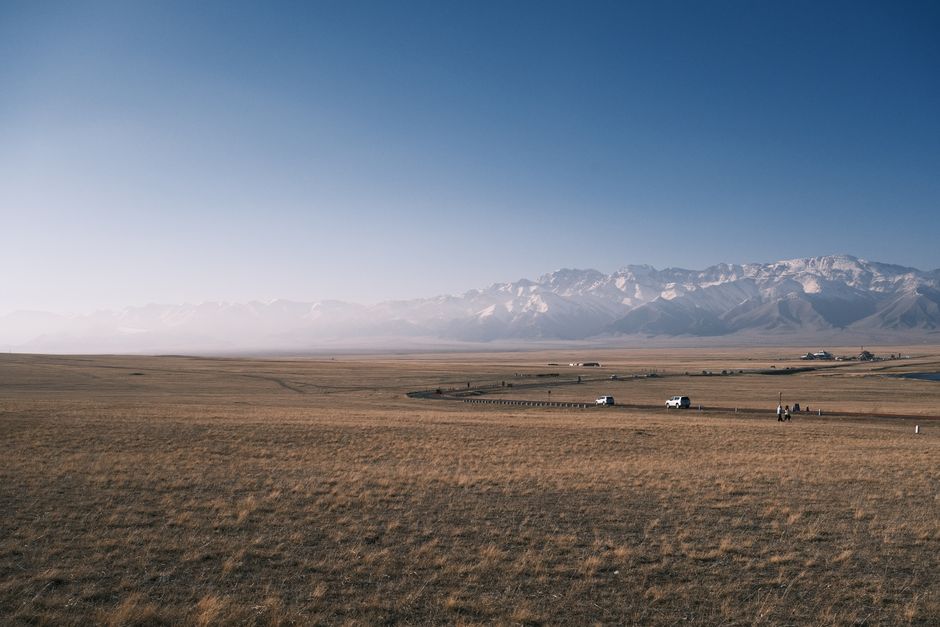
Today, the Adobe Walls site is a peaceful sanctuary of memory covering a modest 2 acres. Recognizing its incredible historical value, the site was officially added to the National Register of Historic Places on May 22, 1978, and was designated a Texas State Archeological Landmark in 1979.
The Panhandle-Plains Historical Society, which first acquired a six-acre tract of the land back in 1923, works to preserve the area. Visitors to the quiet site will find stone monuments dedicated to the defenders and the Native American casualties, along with the grave of Billy Dixon, who was reinterred at the site of his most famous hour in 1929.
Because the battlefield is located on private ranch land (part of the historic Turkey Track Ranch), preserving and accessing the site has occasionally sparked gentle discussions. Over the years, changes in ranch ownership have sometimes led to new fencing, warnings, and gate restrictions to protect the working ranch. While this can sometimes make the site feel a bit remote or difficult to access, it has also succeeded in keeping the surrounding landscape remarkably pristine, looking almost exactly as it did in 1874.
Frequently Asked Questions about Adobe Walls
We know that exploring history often brings up wonderful questions. Here are a few of the most common things people ask about this historic Texas landmark:
Where is Adobe Walls located?
Adobe Walls is located in the northeastern portion of Hutchinson County in the Texas Panhandle, approximately 17 miles northeast of the town of Stinnett. It sits just north of the scenic Canadian River valley.
Who won the battles of Adobe Walls?
The First Battle (1864) was a tactical standoff; while Kit Carson successfully defended his outnumbered troops using howitzers, he was forced to execute a strategic retreat. The Second Battle (1874) was a decisive victory for the 28 civilian defenders, who successfully held off a force of 700 warriors using long-range buffalo rifles.
Can you visit the Adobe Walls site today?
Yes, but it requires some planning and deep respect for private property. The site is located on the private Turkey Track Ranch. To get there from Borger, Texas, you travel north on Highway 136/207 through Stinnett, turn onto a marked county dirt road, and follow it for about 16 miles. The roads are gravel and dirt, which are easily passable in dry weather but can become very difficult when wet. There are no visitor centers or public facilities at the site—only quiet monuments, graves, and the beautiful, whispering Texas wind.
Conclusion
The story of Adobe Walls, Texas is more than just a collection of dates, statistics, and military strategies. It is a deeply human story of courage, survival, and the bittersweet march of time. It reminds us of the incredible resilience of the families, hunters, and Native warriors who all looked out at the very same Panhandle horizon and saw their own versions of the American dream.
Here at Patriot Dreams, we believe that these stories—the ones that took place on the quiet, dusty corners of our beautiful country—are the threads that bind us together. Our history is a shared heritage, and every voice from our past deserves to be remembered with kindness, respect, and wonder.
If you love hearing the heartbeat of America's past, we invite you to join us. Listen to the stories of America's frontier on Patriot Dreams and discover the rich, moving tapestry of our nation’s journey, one story at a time. Let's keep these memories alive together.

Join the Patriot Dreams Community
Download the app today and start your journey through American history and personal legacy.

Explore Our Latest Insights
Dive into stories that shape our American legacy.