The Definitive Guide to The Legacy of Fred Rogers

Why The Legacy of Fred Rogers Still Matters Today
The legacy of Fred Rogers is one of the most enduring and beloved in American cultural history — built on a simple but powerful idea: every child deserves to feel loved, seen, and valued exactly as they are.
Here is a quick overview of what that legacy means:
- Who he was: Fred Rogers (1928–2003) was the creator and host of Mister Rogers' Neighborhood, a children's television program that ran for 31 seasons and 912 episodes on PBS.
- What he stood for: Kindness, emotional honesty, self-worth, and the belief that feelings are mentionable and manageable.
- Why it matters: His work was grounded in real child development science, not guesswork — and it changed how America thinks about children's media.
- His reach: The show reached millions of children across the U.S. for over three decades. Fred Rogers Productions now produces seven children's series airing in nearly 200 countries.
- His influence today: A 2023 survey found that 81% of early childhood professionals said his legacy influenced them professionally — even those who never watched the show as children.
When Fred Rogers first appeared on television, most children's programming was designed to sell products. He chose a different path. He chose public broadcasting, puppets, slow conversation, and the radical idea that a child's inner life deserves our full attention.
His mother once told him that when scary things happen in the news, you should look for the helpers. That quiet wisdom shaped everything he would go on to do.
Whether you grew up watching him lace up his sneakers or you're just now discovering his work, there is something in Fred Rogers' story that feels like home — gentle, steady, and deeply human.
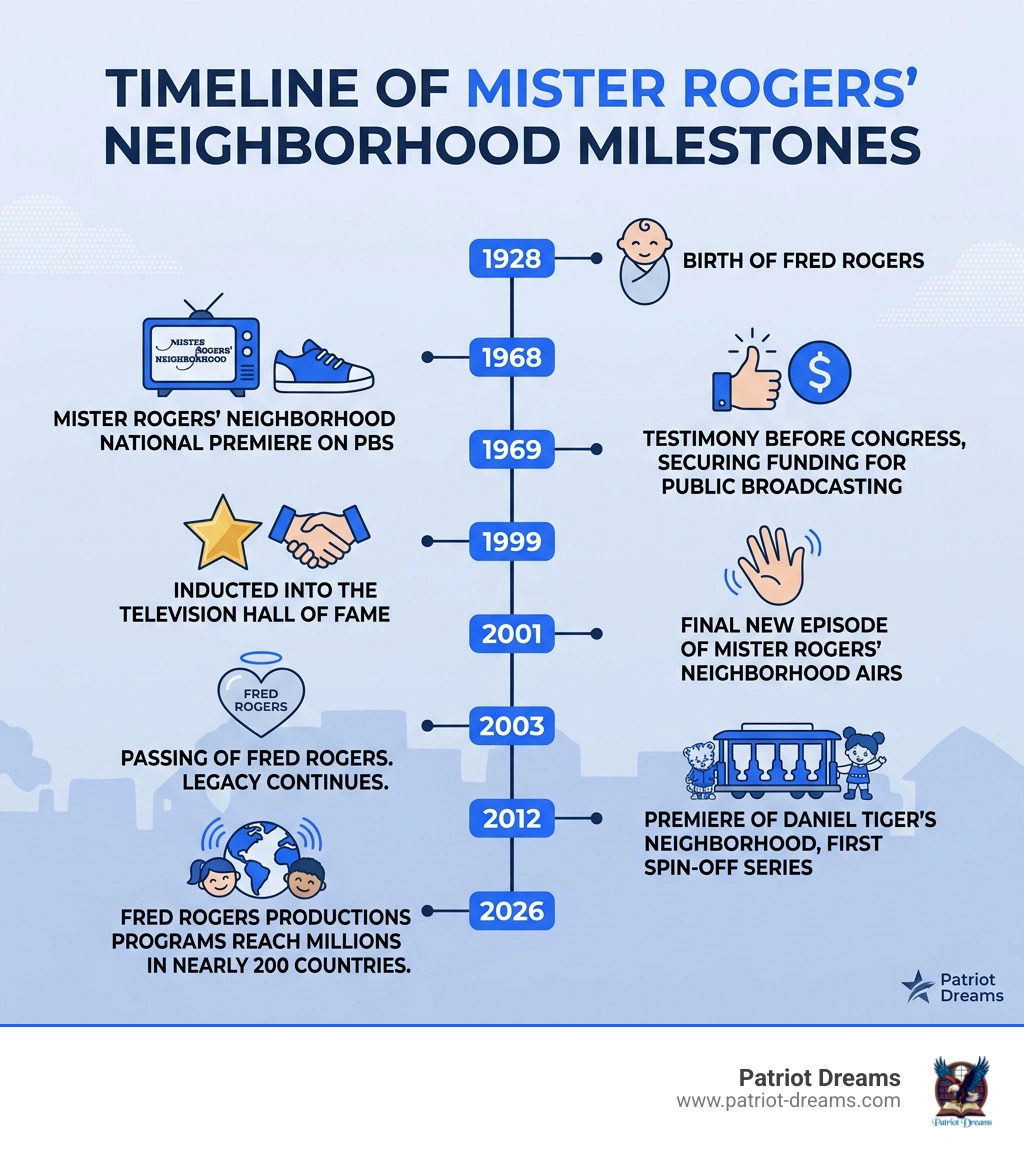
The Legacy of Fred Rogers terms at a glance:
From Latrobe to Rollins College: Formative Years of a Visionary
To truly understand the legacy of Fred Rogers, we must travel back to where his journey began. Fred McFeely Rogers was born in Latrobe, Pennsylvania, in 1928. As a young boy, Fred faced significant personal challenges. He suffered from severe asthma, which often confined him to his home, isolating him from peers. During these times of solitude, he dealt with intense feelings of loneliness and insecurity. He was also a sensitive child who occasionally experienced bullying.
These early struggles did not harden him; instead, they became the fertile soil from which his profound empathy grew. Because Fred knew what it felt like to be lonely, scared, and misunderstood, he dedicated his life to ensuring other children would not have to carry those burdens alone.
A pivotal figure in his early life was his maternal grandfather, Fred McFeely. His grandfather loved him unconditionally and famously told him, "Freddie, you make my day very special." This single sentence became the emotional cornerstone of Fred’s life and, decades later, the core message he shared with millions of children through their television screens.
In 1948, Fred transferred from Dartmouth College to Rollins College in Winter Park, Florida, to pursue his passion for music, graduating in 1951 with a degree in music composition. His time at Rollins was incredibly formative. He was deeply active in campus life, participating in student leadership, theater productions (even sharing the stage with actor Anthony Perkins), and serving on the campus Race Relations Committee.
It was also at Rollins that he met his future wife, Sarah Joanne Byrd. The couple once won a campus costume contest dressed as Raggedy Ann and Andy—a testament to the playful, joyful spirit they shared.
Most importantly, Rollins instilled in Fred a lifelong commitment to community service. He carried a laminated quote in his wallet taken from a stone plaque on the Rollins campus: "Life is for service." This simple motto guided every professional and personal decision he made. You can read more about how his early experiences shaped his path through the Fred Rogers' early life and education archives.
The Core Philosophy: Ministry, Music, and the Neighborhood of Make-Believe
Fred Rogers did not view television merely as an entertainment medium; he saw it as a profound instrument for good. After graduating from college, he entered the television industry, working at NBC in New York before returning to Pennsylvania to help launch WQED in Pittsburgh, the nation’s first community-supported public television station.
While working in television, Fred continued his education, graduating from Pittsburgh Theological Seminary. In 1963, he was ordained as a Presbyterian minister with a unique and historic charge: to continue his ministry to children and families through the medium of television.
Fred’s creative genius lay in his ability to weave his diverse talents—music, writing, faith, and child development—into a coherent, comforting whole. Mister Rogers' Neighborhood was designed to be a safe harbor. Every element of the show was intentional. He famously began each episode by changing from his formal street clothes into a hand-knit cardigan and comfortable sneakers. This simple ritual signaled to young viewers that they were safe, that the outside world was being set aside, and that they were entering a space of trust and quietude.

At the heart of the program was the Neighborhood of Make-Believe, connected to the "real" neighborhood by a cheerful red trolley. The puppets who lived in Make-Believe were not just characters; they were externalizations of children’s inner lives:
- Daniel Striped Tiger: Represented vulnerability, self-doubt, and the fear of not being good enough.
- King Friday XIII: Represented authority, the desire for control, and the fear of change.
- X the Owl: Represented curiosity and the struggle to learn new things.
- Lady Elaine Fairchilde: Represented mischief, defiance, and the search for boundaries.
Through these characters, Fred gave children an emotional vocabulary. He addressed complex topics like divorce, death, anger, and jealousy in ways that made sense to young minds. When children felt overwhelmed by big feelings, Fred offered constructive outlets, such as his iconic song, "What Do You Do with the Mad that You Feel?" By modeling healthy emotional expression, he taught generations of Americans that feelings are not things to be feared, but natural parts of being human.
Grounded in Science: The Collaboration with Dr. Margaret McFarland
While Mister Rogers' Neighborhood felt warm and spontaneous, every second of the broadcast was grounded in rigorous scientific research. While working at WQED, Fred began graduate studies in child development at the University of Pittsburgh, where he met Dr. Margaret McFarland, a renowned child psychologist.
Dr. McFarland became Fred’s close mentor and collaborator. For decades, they met weekly to discuss scripts, puppet dialogues, and show themes. Nothing appeared on the program without first passing through a strict filter of developmental science. Together, they made sure the show met the highest academic standards of the day, aligning with theories from prominent figures like Erik Erikson, Jean Piaget, and Lev Vygotsky.
Fred and Dr. McFarland identified six fundamental cornerstones required for children to learn, grow, and thrive. To understand how radical his approach was, we can compare these six fundamentals with the traditional academic metrics that dominated (and still dominate) early childhood education:
Fred Rogers' Six Fundamentals of LearningTraditional Academic MetricsCuriosity: Nurturing a child's natural wonder and desire to ask "why?"Rote Memorization: Prioritizing the recall of facts, dates, and spelling words.Capacity to Play: Valuing open-ended play as the essential "work" of childhood.Standardized Testing: Evaluating progress through rigid, quantitative assessments.Sense of Self-Worth: Helping children understand they are loved exactly as they are.Class Ranking: Creating competitive environments based on performance.Sense of Trust: Building secure relationships with reliable adults and peers.Behavioral Compliance: Focusing on obedience and conformity over emotional safety.Capacity for Solitude: Creating quiet spaces for reflection, creativity, and self-regulation.Constant Stimulation: Keeping children occupied with packed schedules and digital noise.Capacity to Listen: Teaching children to listen carefully to others and their own feelings.Information Consumption: Emphasizing the passive intake of instructional content.
This scientific foundation ensured that Fred’s work was far more than simple entertainment. It was a masterclass in social-emotional learning that respected the psychological pace of early childhood.
The Legacy of Fred Rogers in Modern Classrooms
Today, contemporary educators continue to keep Fred's philosophy alive. Across the United States, teachers use his techniques to create classrooms where emotional safety is prioritized alongside academic achievement.
Programs like the "FrED Camp" initiative in Pennsylvania offer professional development that helps educators integrate Fred’s principles of kindness, respect, and slow communication into their daily routines. In modern classrooms, this looks like starting the day with "together time" conversation circles, protecting recess for unstructured play, and establishing "wisdom corridors" where students interview community members. You can explore how these practices are implemented today in this article on How educators apply Fred Rogers' lessons today.
Furthermore, Fred Rogers served as an unintentional mentor to generations of early childhood professionals. Many teachers report that watching him on television as children—or studying his methods as adults—provided their most practical training in child development. His legacy remains a cornerstone of professional training, as detailed in this study on The Legacy of Fred Rogers in professional development.
The Legacy of Fred Rogers and the Science of Child Development
The intersection of Fred Rogers' philosophy and modern educational standards is perhaps most visible in the joint position statement issued by the National Association for the Education of Young Children (NAEYC) and the Fred Rogers Center. This landmark document provides guidelines for the intentional use of technology and interactive media with young children.
Fred was never anti-technology; after all, he used television—the cutting-edge digital media of his day—to reach millions. However, he believed technology should always be a tool to foster human relationships and active learning, rather than a passive distraction. In our current landscape of smartphones and tablets, this principle is more critical than ever. Educators are encouraged to select interactive media that invites conversation, encourages physical movement, and respects a child’s developmental pace, avoiding the frenetic, overstimulating content that can hinder cognitive and emotional growth.
Preserving The Legacy of Fred Rogers through Family and Spinoffs
Fred Rogers’ family and successors have been deeply committed to preserving the integrity of his memory while adapting his message for new generations. His sons, James and John Rogers, have selectively participated in public events and documentaries—such as the award-winning 2018 film Won't You Be My Neighbor?—to share a realistic, human portrait of their father. By showing that Fred was a real, imperfect man who worked hard to choose kindness every day, they keep his legacy grounded in reality rather than sanitized myth.
This commitment to continuity is also evident in the beloved PBS Kids animated spinoff, Daniel Tiger's Neighborhood. Launched in 2012, the show features the children of the original puppet characters from the Neighborhood of Make-Believe. It preserves Fred's original music, theme, and gentle tone while expanding the emotional vocabulary for contemporary audiences. To learn more about how his family and creative successors continue this work, explore Fred Rogers' family and show spinoffs.
Navigating the Digital Age: Fred Rogers’ Lessons for Today’s Challenges
We live in a world filled with digital distractions, commercialism, and rapid social change. Children today face developmental challenges that are in many ways different—yet fundamentally similar—to those Fred Rogers identified during his lifetime. While technology has changed, children's core emotional needs have remained exactly the same: they still need to feel safe, loved, and heard.
Fred Rogers was a fierce defender of childhood. He famously resisted the commercialization of children's television, refusing to license his character or show for commercial endorsements. He believed that treating children as consumers was a betrayal of their trust.
His commitment to public service was perhaps most famously demonstrated in May 1969, when he testified before the Senate Subcommittee on Communications. Facing a proposed budget cut that would have devastated public broadcasting, Fred spoke from the heart to the cynical committee chairman, Senator John Pastore. In just six minutes of gentle, powerful testimony, Fred explained how his program helped children manage their emotions and build self-worth. Moved by Fred's sincerity, Senator Pastore famously replied, "I think it's wonderful. Looks like you just earned the twenty million dollars."
Today, as we navigate the complexities of the digital age, Fred's message of quietness, empathy, and community remains a vital antidote to the noise. You can read about how his message continues to inspire communities in How Fred Rogers' message of kindness lives on in 2026.
Frequently Asked Questions about Fred Rogers
Is Fred Rogers really who he seemed to be on television?
Yes. This is perhaps the most common question asked about Fred Rogers. The Fred Rogers Archive, which houses over 20,000 items documenting his life and work, reveals that the "Mister Rogers" seen on television was not a performance or a character. It was simply Fred Rogers himself, using the medium of television to minister to children. His off-screen life was marked by the same humility, kindness, and deep respect for others that he modeled on the air.
How did Fred Rogers want to be remembered?
Fred Rogers was a deeply humble man who felt uneasy with the idea of personal celebrity. In a beautiful, reflective interview, he expressed that he wanted to be remembered simply as a compassionate human being who was fortunate enough to use his talents and the medium of television to help others. He believed that the best legacy anyone can leave is to love what they do and to share that love openly with the world. You can watch and read more about his humble reflections in this feature on Fred Rogers' reflections on his legacy.
What are the six fundamentals Fred Rogers identified for children's growth?
Fred Rogers identified six essential fundamentals that children need to learn and grow:
- Curiosity: A natural drive to explore and understand the world.
- Capacity to play: The ability to engage in creative, open-ended play.
- Sense of self-worth: Knowing that they are valuable just as they are.
- Sense of trust: Having reliable, loving relationships with adults and peers.
- Capacity for solitude: Having quiet time for self-reflection and inner peace.
- Capacity to listen: Developing the patience to listen carefully to others.
Conclusion
At Patriot Dreams, we believe that the stories we tell shape the world we build for our children. Our mission is to bring American history, heritage, and personal stories to life, helping families preserve their own legacies and connect across generations.
The legacy of Fred Rogers reminds us that the greatest gift we can give to the next generation is our honest, loving attention. By listening to children, sharing our talents, and choosing kindness in our daily lives, we carry Fred's neighborhood forward into the future.
We invite you to join us in exploring the rich, beautiful tapestry of our shared history. Together, let's discover the stories, the places, and the people who have shaped our communities. Discover America's 250-year journey and learn how you can preserve your family's unique place in the American story today.

Join the Patriot Dreams Community
Download the app today and start your journey through American history and personal legacy.

Explore Our Latest Insights
Dive into stories that shape our American legacy.