Tall Tales and Legendary American Folklore Characters
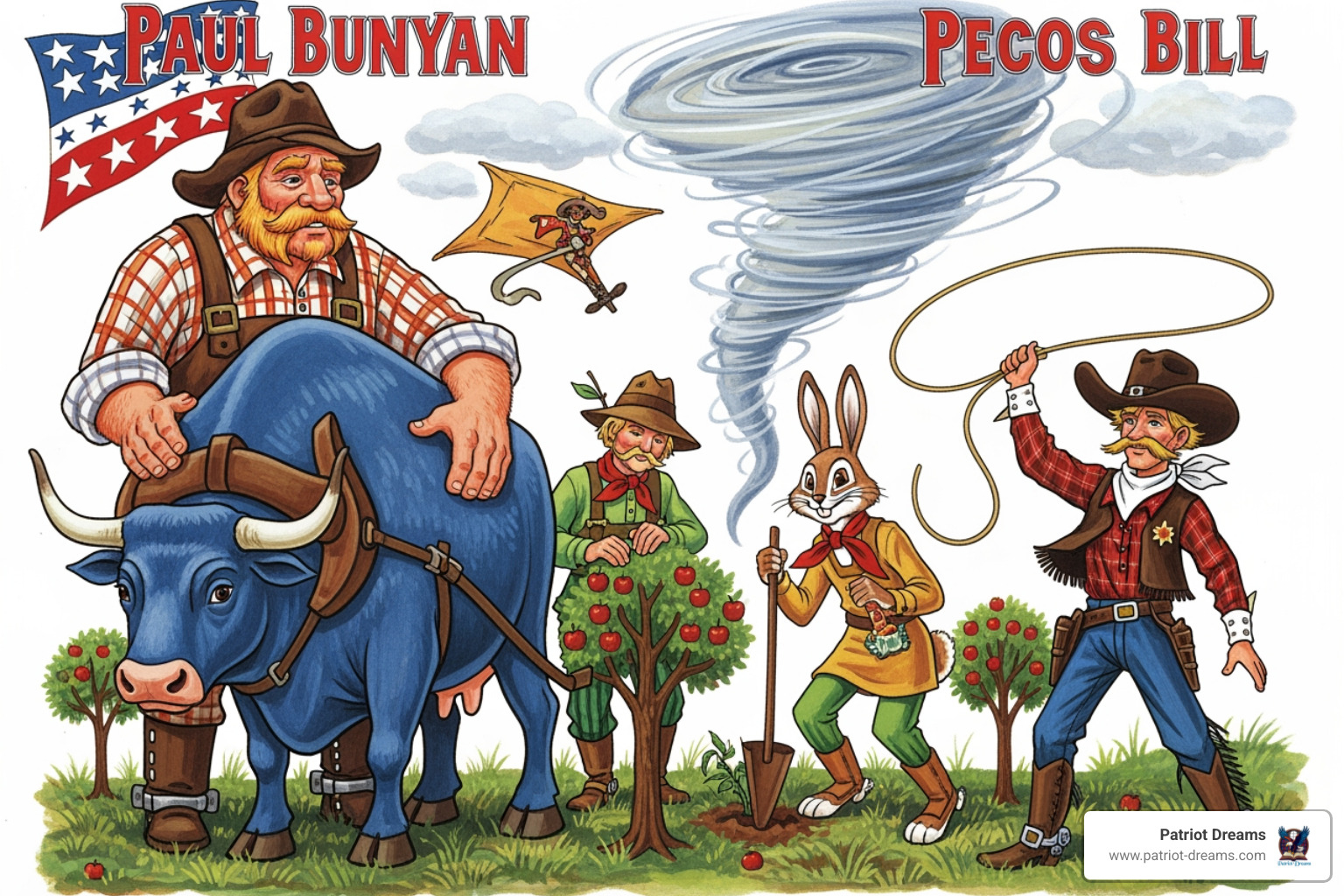

The Stories That Built a Nation: American Folklore Characters We All Know and Love
American folklore characters are the larger-than-life heroes, tricksters, monsters, and everyday legends that have shaped how we understand who we are as a people. From giant lumberjacks to clever rabbits, these characters carry the heart of America's stories across generations.
Here are some of the most iconic American folklore characters you should know:
CharacterTypeKnown ForPaul BunyanTall tale heroGiant lumberjack who dug the Grand CanyonPecos BillTall tale heroCowboy who lassoed tornadoesJohnny AppleseedHistorical legendGentle wanderer who planted apple orchardsDavy CrockettHistorical legendFrontiersman and congressmanJohn HenryCultural heroSteel-driver who raced a steam machineBr'er RabbitTrickster figureClever rabbit outsmarting stronger foesBigfootSupernatural creatureMysterious giant of the Pacific NorthwestThe Jersey DevilRegional legendWinged creature of the New Jersey Pine Barrens
These characters didn't just entertain people around a campfire. They taught something — about courage, kindness, cleverness, and what it means to keep going when things get hard.
Think of them as America's way of passing wisdom from one generation to the next. Long before books and movies, families gathered together and told these stories out loud. A grandmother's voice. A fireplace crackling. A child listening wide-eyed in the dark.
That is where American folklore lives.
Whether they were born in lumber camps, on cattle trails, or in the quiet hearts of people who needed hope, these characters still speak to us today. This list celebrates the best of them — and the timeless values they carry.
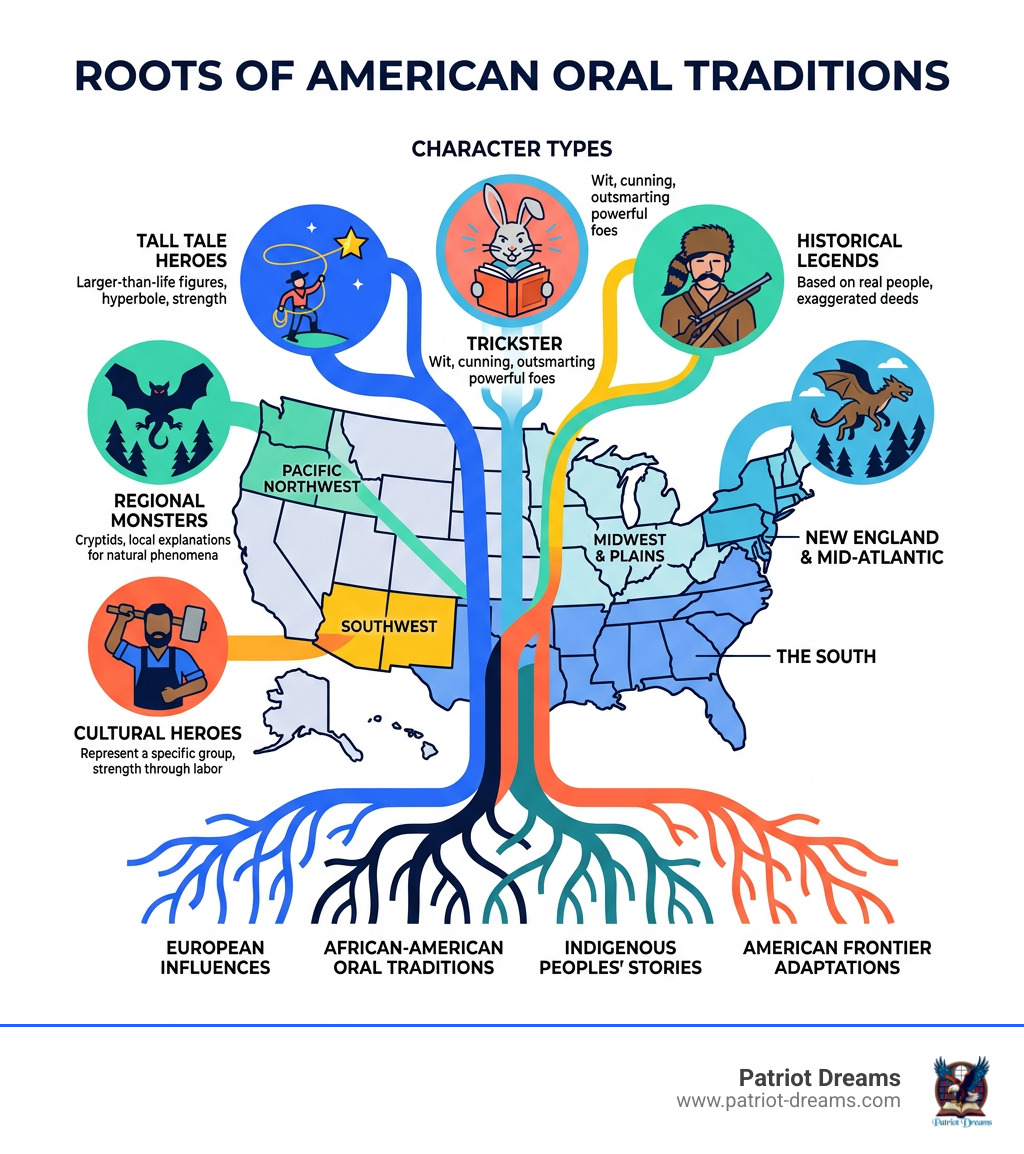
The Heart of the Frontier: Iconic American Folklore Characters
There is something truly special about the American frontier. It was a place of vast horizons and even bigger challenges. To match the scale of the land, our ancestors created characters who were "larger than life" — literally! These stories, often called "tall tales," used humor and extreme exaggeration to celebrate the resilience and spirit of the people who settled the wilderness.
When we talk about American folklore characters, we are talking about the "frontier spirit." It’s that wonderful feeling that no matter how big the mountain or how wild the river, a little bit of hard work and a lot of imagination can see us through. These stories weren't just about being strong; they were about the joy of discovery and the bond of community shared in logging camps and around cattle drives.
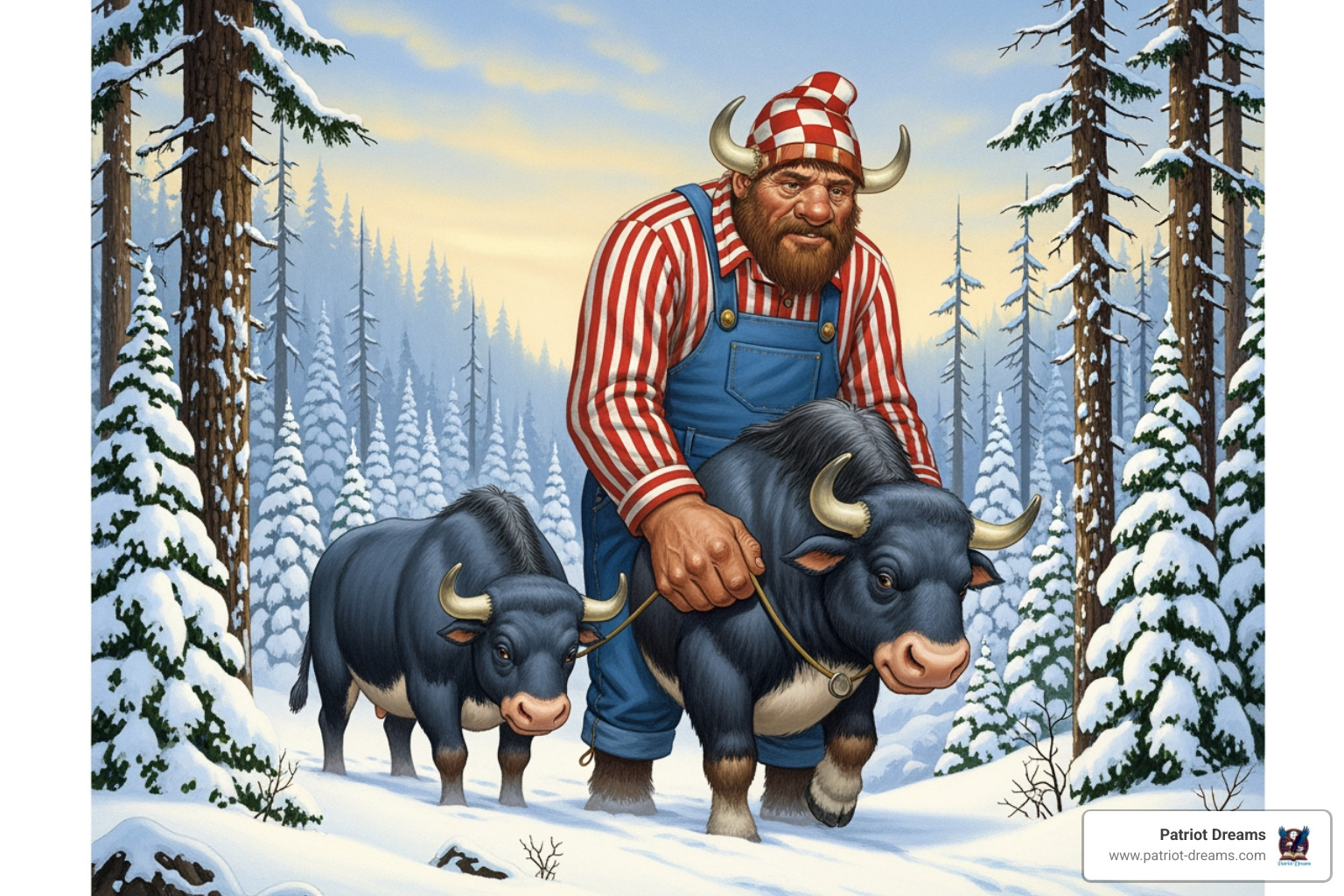
For a deeper look into how these stories traveled from the woods to our modern world, you can explore the tall-tale tradition from loggers and lumberjacks to today's storytellers.
Paul Bunyan and the Giant Lumberjacks
If there is one character who embodies the sheer scale of the American dream, it’s Paul Bunyan. Legend says it took five giant storks to deliver him as a baby, and his first bed was a lumber wagon pulled by a team of horses! Paul grew up to be a giant lumberjack of incredible strength and vitality.
He wasn't alone in his adventures, though. Every hero needs a best friend, and Paul’s was Babe the Blue Ox. Babe was so big that it was said he created Minnesota's 10,000 lakes simply by leaving footprints in the ground during the "Winter of the Blue Snow." Together, they cleared forests and even dragged a heavy axe behind them to accidentally carve out the Grand Canyon.
In the lumber camps, these stories were a way for hardworking men to find a bit of laughter after a long day. They told of "stove skating," where cooks would strap sides of bacon to their feet to grease a griddle that was an acre wide! It’s a whimsical image that reminds us of the warmth and humor found in early American life. You can read more about his legacy at from-folk-hero-to-film-icon-the-story-of-paul-bunyan--his-place-in-american-myth-making.
Pecos Bill: The Greatest Cowboy of the West
While Paul Bunyan ruled the Northwoods, Pecos Bill was the king of the Southwest. His story is a classic example of what folklorists sometimes call "fakelore"—stories that were professionally written but captured the heart of the people so well they became part of our shared heritage. Created by Edward O’Reilly in 1923, Bill was a feral child raised by coyotes who grew up to be the ultimate cowboy.
Bill didn't just ride horses; he rode cougars and used a live rattlesnake as a lasso. His most famous feat involved lassoing a literal tornado and riding it like a bucking bronco! He was also responsible for digging the Rio Grande with a stick and creating the Gulf of Mexico by lassoing a storm cloud to end a drought.
Despite his toughness, Bill had a soft heart, especially for his sweetheart, Slue-Foot Sue. Sue was a daring rider herself, famously riding a giant catfish down the Rio Grande. Their stories are a testament to courage and the wild, beautiful freedom of the American West. Organizations like The American Folklore Society continue to study how these tales reflect our national character.
Real People, Legendary Deeds: Historical Figures as Heroes
Sometimes, the most inspiring American folklore characters started out as real people. Over time, their real-life kindness and bravery became so celebrated that their stories grew into legends. This process of "mythologizing history" helps us remember the values these people stood for—values like perseverance, stewardship, and everyday heroism.
FeatureTall Tale (e.g., Paul Bunyan)Historical Legend (e.g., Johnny Appleseed)OriginOften entirely fictional or "fakelore"Based on a documented real personFeatsPhysically impossible (lassoing twisters)Exaggerated but rooted in real virtuePurposeHumor and regional prideMoral lessons and national identityLandmarksCreated the Grand CanyonPlanted orchards across the Midwest
Johnny Appleseed: A Gentle Soul Among American Folklore Characters
John Chapman, better known as Johnny Appleseed, is perhaps the kindest of all our folk heroes. He wasn't a giant or a warrior; he was a gentle wanderer who spent nearly 50 years planting apple orchards across Pennsylvania, Ohio, Indiana, and Illinois.
Johnny was a steward of the land who walked barefoot and wore a tin pot for a hat (at least in the stories!). He didn't plant apples for profit, but to ensure that future settlers would have food and beauty waiting for them. His life was a lesson in generosity and peace. He was known for his kindness to animals and his ability to move safely through the wilderness, treating everyone he met with respect. In a world that can sometimes feel loud and fast, Johnny Appleseed reminds us of the power of a quiet, dedicated life.
Davy Crockett and Daniel Boone: Heroes of the Wild
On the more rugged side of history, we find explorers like Davy Crockett and Daniel Boone. These men were real-life pioneers who helped open the American frontier, but their legends often outpaced their actual deeds.
Davy Crockett, the "King of the Wild Frontier," famously claimed he killed a bear when he was only three years old! While that was likely a bit of his own "tall tale" marketing during his time in Congress, it reflected the very real resilience required to survive in the 1700s and 1800s. Crockett was known for his coonskin cap and his trusty rifle, "Old Betsy." He eventually gave his life at the Alamo, securing his place as a symbol of sacrifice.
Daniel Boone was a similarly mythologized figure, an explorer and woodsman whose exploits in Kentucky became the stuff of legend. Both men represent the bravery of those who looked at the unknown and decided to move forward anyway. To see how these frontier myths still shape us, check out the-frontier-myth-today-what-the-old-west-tells-us-about-modern-america.
Strength and Spirit: African-American and Native American Traditions
Folklore is a beautiful tapestry woven from many different threads. The stories of African-American and Native American heroes are deeply rooted in cultural identity, wisdom, and the incredible strength of the human spirit. These American folklore characters often represent resistance against hardship and the triumph of wit and determination.
These traditions have played a vital role in preserving heritage. As noted in research on How African American folklore saved cultural memory, these stories were essential for maintaining community bonds and identity during the era of slavery.
John Henry: The Steel-Driving Man
John Henry is a hero of legendary proportions. A "steel-driving man," his story is usually set during the construction of the Big Bend Tunnel in West Virginia. When a steam-powered drill was brought in to replace the workers, John Henry took it as a challenge. He raced the machine to prove that the human spirit and hard work were still more powerful than any cold engine.
John Henry won the race, but the effort was so great that he died with his hammer in his hand. His story is one of ultimate sacrifice and dignity. It resonates with anyone who has ever felt the world changing too fast around them. John Henry reminds us that there is an inherent value in human work and that our spirits are something no machine can ever truly replace.
Br’er Rabbit: Wits and Wisdom in American Folklore Characters
In the South, the stories of Br’er Rabbit brought laughter and hope to many. These "trickster tales" have deep roots in African traditions, particularly the hare stories of West and Central Africa. Br’er Rabbit is small and not very strong, but he is incredibly clever.
He is most famous for outsmarting Br’er Fox and Br’er Bear, often by using their own strength or anger against them. The most well-known story is the "Tar-Baby" tale, where Br’er Rabbit gets stuck to a doll made of tar. Just when it seems he is caught, he tricks the Fox into throwing him into the "briar patch" — which is exactly where a rabbit is safest! These stories were more than just fun; they were a way for enslaved people to share the wisdom that wits and community bonds could overcome even the most powerful adversaries.
Wonders of the Wild: Supernatural Creatures and Regional Mysteries
Not all American folklore characters are heroes or historical figures. Some are the mysterious residents of our forests, lakes, and mountains. These "cryptids" and supernatural beings reflect our curiosity about the unknown and our respect for the vast, untamed wilderness that still exists across our country.
Exploring these mysteries helps us connect with the local flavor of different regions. You can find more about these "forgotten legends" at folklore-files-forgotten-american-legends-and-what-they-reveal-about-us.
Bigfoot and the Great North Woods
Bigfoot, or Sasquatch, is perhaps the most famous modern legend in America. Associated primarily with the Pacific Northwest, this massive, hairy, ape-like creature has been part of indigenous oral traditions for centuries. Today, the mystery continues, with Over 100 sightings yearly reported across North America.
Whether or not Bigfoot is real, the story of Bigfoot is a permanent part of our culture. It represents the mystery of the deep woods — the feeling that there is still something out there that we haven't fully mapped or understood. It keeps our sense of wonder alive.
The Jersey Devil and Modern Anomalies
On the East Coast, the Pine Barrens of New Jersey are home to the Jersey Devil. Legend says it was the 13th child of "Mother Leeds," born with wings and hooves before flying into the night in 1735. In West Virginia, the Mothman became a regional sensation in the 1960s, described as a man-sized bird with glowing red eyes.
In more recent years, "Alternate American Folklore" has reimagined our history with a bit of a spooky twist. These modern legends include the "Ship Jester" (a mysterious figure tied to colonial history) and "Minutefauna" (the idea of Revolutionary War soldiers training local wildlife). These stories show that folklore isn't just something from the past — it’s a living, breathing part of our imagination that continues to grow.
Frequently Asked Questions about American Folklore
Who is the most famous American folk hero?
While it’s hard to pick just one, Paul Bunyan is often considered the most iconic fictional folk hero due to his massive size and the way his stories spread through the logging industry. Among historical figures, Johnny Appleseed and Davy Crockett are equally famous for representing the kinder and more adventurous sides of the American spirit.
What is the difference between a tall tale and a legend?
A tall tale is a story that relies on extreme exaggeration for humor (like Pecos Bill riding a tornado). A legend is usually rooted in a real historical person or event, though the details have been "mythologized" over time to emphasize certain virtues (like George Washington and the cherry tree).
Are folk characters based on real people?
Many are! Johnny Appleseed (John Chapman), Davy Crockett, Daniel Boone, and even John Henry are believed to have been real people. Their real lives were impressive, but the stories we tell today have been polished by generations of storytellers to make them even more inspiring.
Conclusion: Carrying the Torch of Our Shared Stories
As we look back at these American folklore characters, we see more than just old stories. We see a reflection of ourselves. We see the kindness of Johnny Appleseed, the determination of John Henry, and the playful imagination of Pecos Bill. These characters are part of our shared heritage — a gift from those who came before us to help us navigate the world today.
At Patriot Dreams, we believe that every family has its own folklore, too. Your grandfather’s stories about the farm or your mother’s memories of her first job are just as important as the tales of Paul Bunyan. They are the threads that connect us to our past and give us hope for the future.
We invite you to keep these stories alive. Share them with your children, talk about them with your neighbors, and remember that we are all part of a grand, ongoing American story. For more ways to explore your heritage and preserve your own family legends, visit our website.
Let’s carry the torch of these stories together, with kindness and a sense of wonder. After all, as long as we keep telling them, these legends never truly fade away.

Join the Patriot Dreams Community
Download the app today and start your journey through American history and personal legacy.

Explore Our Latest Insights
Dive into stories that shape our American legacy.