Johnson's Trial: When Congress Challenged the President

A President on Trial in a Divided Nation
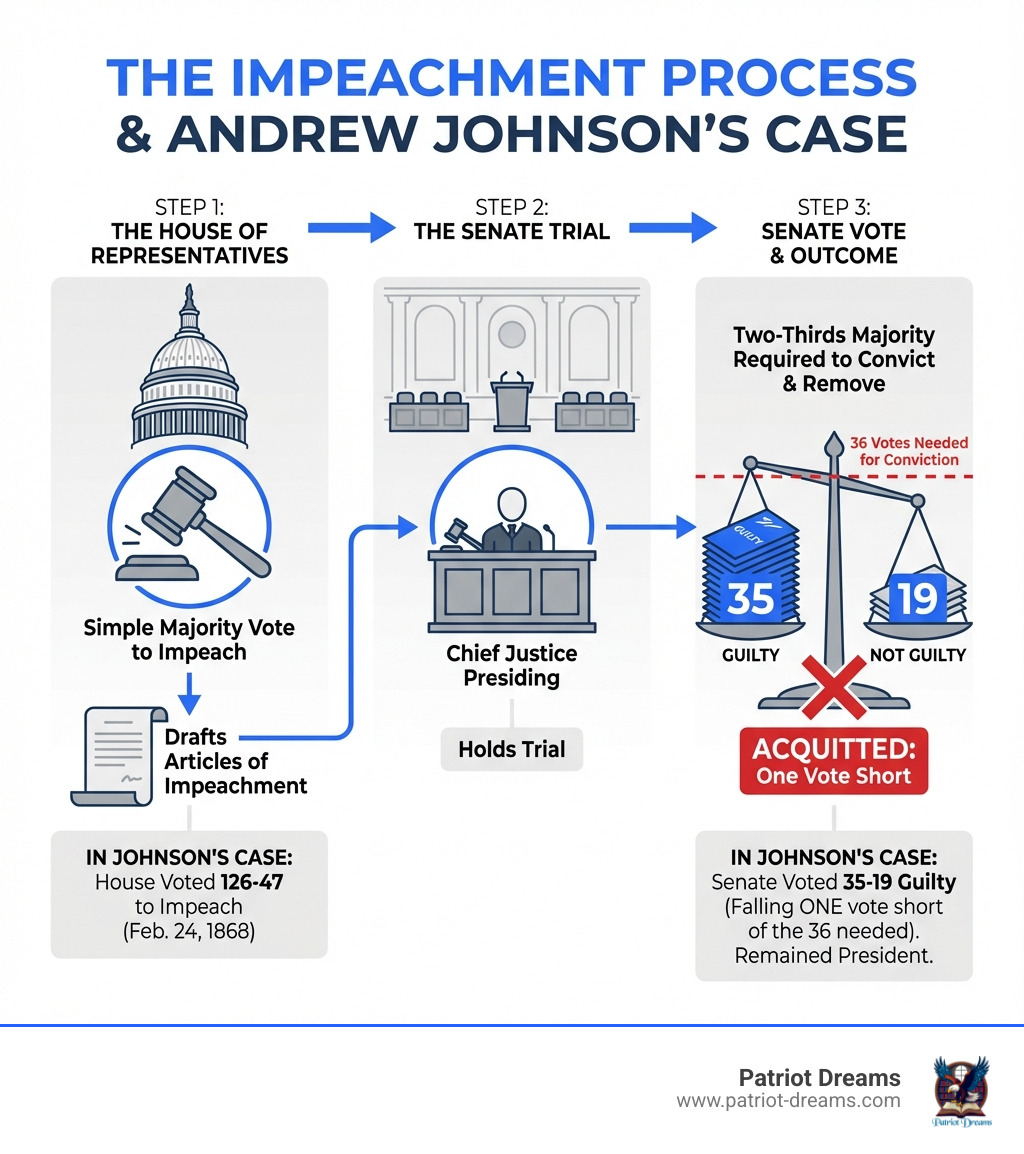
Andrew Johnson impeachment was the first time in American history that a sitting president faced trial for removal from office. In 1868, the House of Representatives voted 126 to 47 to impeach President Johnson, charging him with "high crimes and misdemeanors" — primarily for violating the Tenure of Office Act by dismissing Secretary of War Edwin M. Stanton without Senate approval.
Quick Facts About the Andrew Johnson Impeachment:
- When: House voted to impeach on February 24, 1868; Senate trial lasted from March to May 1868
- Primary Charge: Alleged violation of the Tenure of Office Act by firing Secretary of War Edwin Stanton
- Underlying Conflict: Deep disagreement between Johnson and Congress over how to rebuild the South after the Civil War
- The Vote: Senate voted 35 guilty to 19 not guilty — falling just one vote short of the two-thirds majority needed for conviction
- Outcome: Johnson was acquitted and remained president
- Significance: Helped shape how carefully and thoughtfully impeachment would be used in the future
The story of Andrew Johnson's impeachment is really a story about a nation trying to heal after its most terrible wound. The Civil War had ended just three years earlier. President Abraham Lincoln had been assassinated. And the fundamental question facing America was: How do we become one country again?
In those uneasy years, many Americans—North and South, Black and white, farmers and factory workers—were trying to figure out how to rebuild their homes, their towns, and their trust in one another. People were tired, hearts were heavy, and yet there was a quiet courage in the way families went back to work, reopened schools and churches, and tried, in their own small ways, to start over.
Johnson, a Southerner who had remained loyal to the Union, believed in a lenient approach to bringing Confederate states back into the fold. The Republican-controlled Congress — especially the Radical Republicans led by figures like Thaddeus Stevens — wanted stronger protections for newly freed slaves and tougher conditions for former rebels.
This wasn't just a policy disagreement. It was a clash over the very soul of the nation and the meaning of the war that had just been fought.
When Johnson repeatedly vetoed congressional Reconstruction legislation and then dismissed Secretary Stanton (who was sympathetic to Congress), it became the spark that ignited a constitutional crisis. The House moved swiftly to impeach, and the nation watched as the Senate transformed into a courtroom to decide the president's fate.
Yet even in this tense time, there were countless acts of everyday kindness: neighbors sharing food, teachers opening makeshift classrooms, church groups helping widows and orphans. While leaders in Washington argued over laws and powers, ordinary Americans quietly showed that patience, mercy, and determination could help hold the country together.
The trial that followed would test whether our young democracy could survive such a profound challenge — and whether the Constitution's system of checks and balances would hold.
Easy Andrew Johnson impeachment glossary:
A Nation at a Crossroads: The Struggle Over Reconstruction
As the smoke of the Civil War cleared, our nation faced the immense task of Reconstruction. It was a time filled with hope for a new beginning, but also deep uncertainty about how to move forward together. President Andrew Johnson, who unexpectedly stepped into office after Lincoln's tragic assassination, found himself at the center of this national conversation.
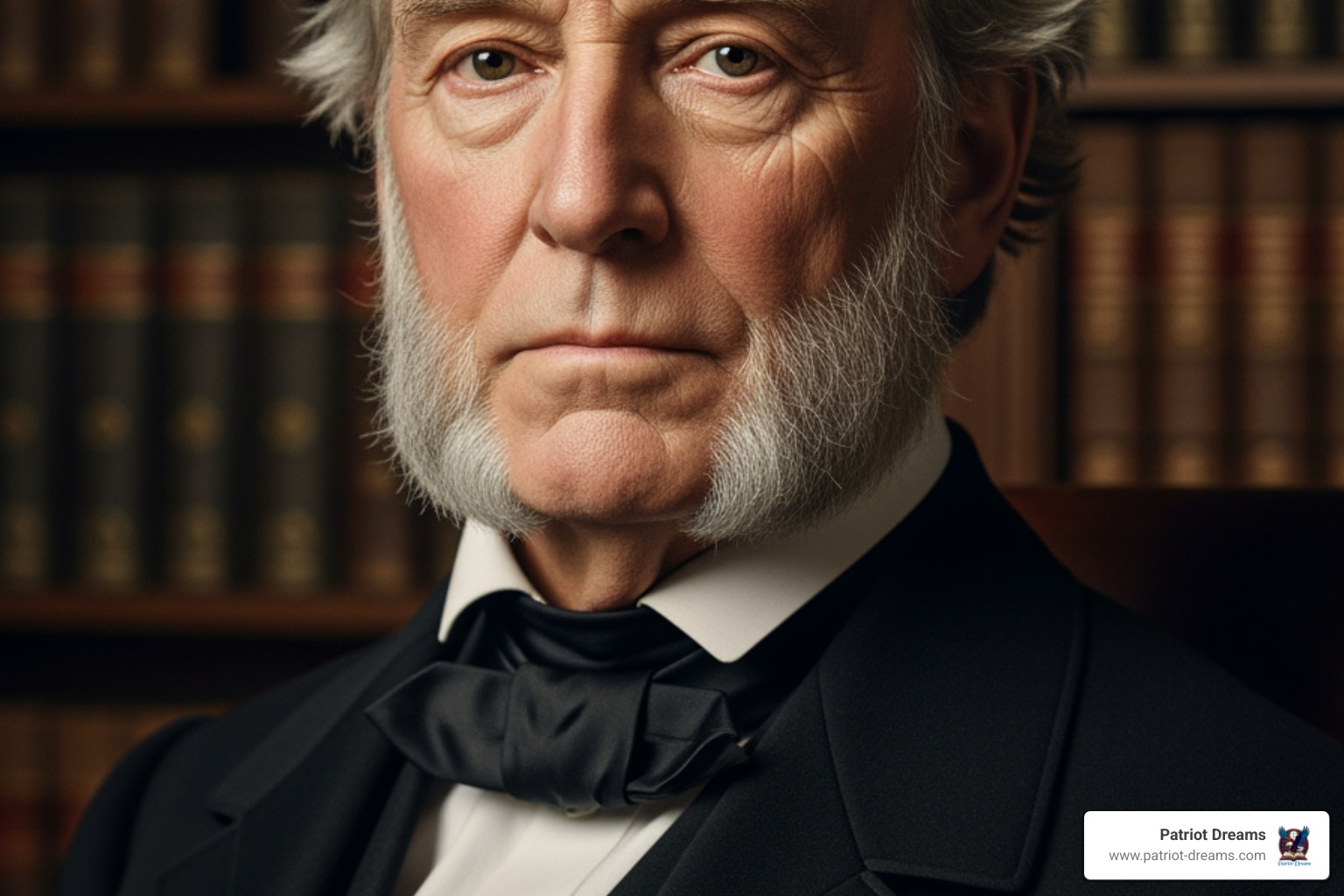
Johnson, a man of humble origins who had risen through the ranks of Tennessee politics, held a vision for Presidential Reconstruction that emphasized quick reunification and leniency towards the defeated Confederate states. He believed in granting pardons to many ex-Confederates and allowing Southern states to largely manage their own affairs, often with limited federal direction. His words and decisions reflected his own experiences and beliefs, but they also stirred strong disagreement in Washington.
However, many in Congress, particularly the powerful bloc of Radical Republicans, held a different view. Figures like Thaddeus Stevens of Pennsylvania championed Congressional Reconstruction, calling for stronger federal intervention to protect the rights of freed slaves, ensure their enfranchisement, and impose stricter conditions on former rebel states before their full readmission to the Union. They believed the war's sacrifices would be in vain if the South quickly returned to old patterns and injustices.
This fundamental disagreement created an escalating constitutional crisis. Johnson repeatedly used his presidential veto power to block congressional Reconstruction legislation, aiming to preserve his vision for the South. In turn, Congress, with its overwhelming Republican majority, just as consistently overrode his vetoes—more times than any other President at that time. This cycle of presidential opposition and congressional override highlighted a deep disagreement on the best path to healing our fractured nation.
If you imagine the country as a family gathered around a kitchen table after a long, painful argument, you can sense what this moment felt like. People agreed on one important thing: America needed to stay together. But they wrestled over how to do that fairly and kindly for everyone who called this country home.
Amid these struggles, countless Americans did what families and communities so often do in hard times: they helped one another. Former soldiers leaned on each other as they returned to farms and workshops. Faith communities took in children who had lost parents. In small towns and big cities, people tried, step by step, to knit their lives back together.
The Tenure of Office Act: A Constitutional Showdown
The conflict reached a boiling point with the passage and subsequent violation of the Tenure of Office Act. This Act, passed by Congress in 1867 over President Johnson's veto, was a direct legislative challenge to presidential power. It mandated that the President could not remove certain officeholders, particularly Cabinet members appointed with Senate approval, without the Senate's consent. Many historians believe the Act was specifically designed to protect Edwin M. Stanton, Johnson's Secretary of War.
Stanton, a Lincoln appointee, was a staunch ally of the Radical Republicans and a key figure in implementing Congressional Reconstruction policies. Johnson viewed him as an obstacle and a disloyal member of his Cabinet. In a bold move, Johnson first suspended Stanton in August 1867 while Congress was in recess, appointing Ulysses S. Grant as Secretary of War ad interim. However, when the Senate reconvened and refused to concur with Stanton's suspension, Grant, fearing legal repercussions and not wanting to jeopardize his own political future, resigned. Stanton promptly reclaimed his office.
Undeterred, President Johnson escalated the conflict on February 21, 1868, by formally dismissing Edwin M. Stanton and attempting to replace him with General Lorenzo Thomas. Stanton, however, refused to vacate his office, barricading himself inside and effectively daring Johnson to remove him by force. This direct defiance of the Tenure of Office Act was the immediate trigger for the House of Representatives to act.
News of Stanton's dismissal spread rapidly through Washington. The House, already frustrated by Johnson's obstruction of Reconstruction, moved swiftly. Just three days later, on February 24, 1868, the House of Representatives voted to impeach President Andrew Johnson by a vote of 126 to 47. This historic vote, largely along party lines, made him the first U.S. President to be impeached. The House then adopted eleven articles of impeachment, with eight of them specifically dealing with Johnson's alleged violation of the Tenure of Office Act. Other articles accused him of bringing disgrace upon Congress through "intemperate, inflammatory, and scandalous harangues."
Behind these formal words and grave decisions were human beings—representatives and senators who had families, hopes, and fears. Many of them had seen the war up close. They wanted to make sure the Constitution remained strong enough to guide the country through disagreement without falling apart.
The stage was set for a dramatic confrontation between the executive and legislative branches, a clash that would define a crucial moment in American constitutional history. For a broader understanding of how the values of resilience and renewal shaped the era, you can explore More about the era's culture.
The Great Trial: The Andrew Johnson Impeachment in the Senate
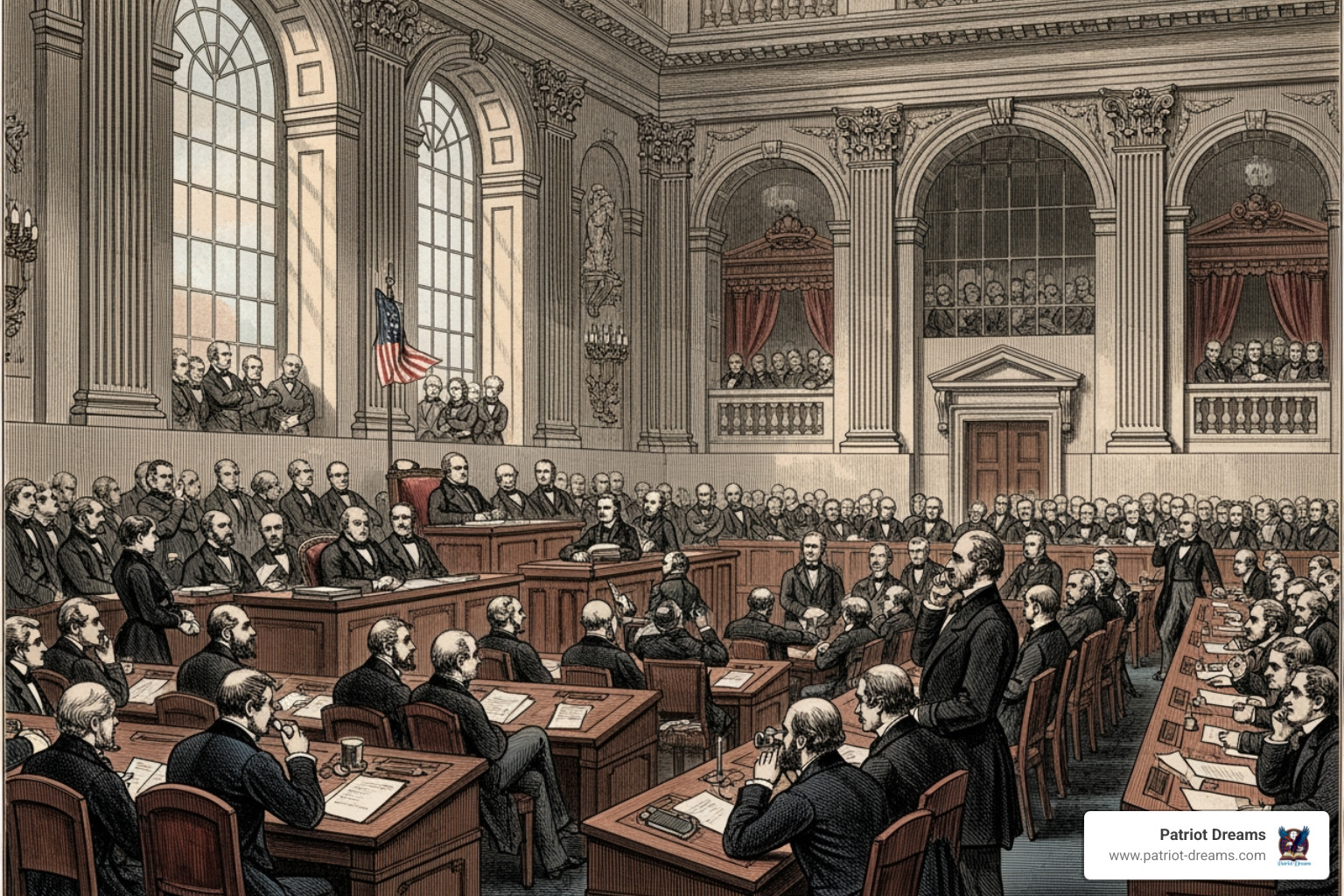
With the House having impeached President Johnson, the focus shifted to the Senate, which transformed into a high court of impeachment. This was no ordinary legislative session; it was a solemn constitutional proceeding, a courtroom unlike any other. The public interest was immense, and tickets were issued to manage the overflow crowds eager to witness history unfold.
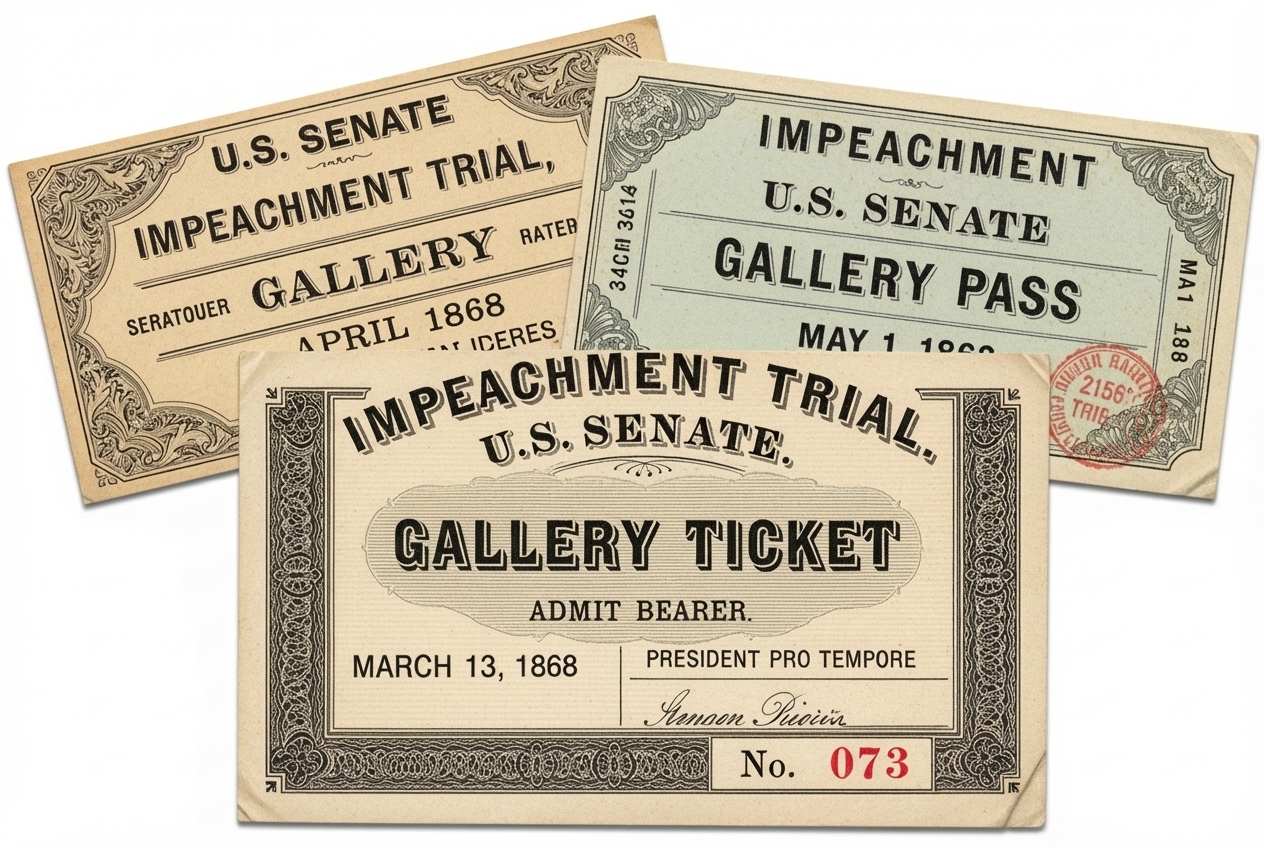
The trial officially commenced on March 5, 1868, and lasted for eleven grueling weeks. Presiding over this unprecedented event was Chief Justice Salmon P. Chase, an appointment made by Abraham Lincoln. Chase's role was crucial; he was tasked with maintaining order and ensuring fair procedure in a highly charged political atmosphere.
The prosecution, known as the House Managers, comprised some of the most prominent Radical Republicans of the era. Led by the formidable Thaddeus Stevens of Pennsylvania and the eloquent Benjamin F. Butler of Massachusetts (who served as chief prosecuting attorney), the team also included John A. Bingham of Ohio, George S. Boutwell of Massachusetts, James F. Wilson of Iowa, Thomas Williams of Pennsylvania, and John A. Logan of Illinois. Their primary task was to present the case that President Johnson had committed "high crimes and misdemeanors" warranting his removal from office.
The prosecution's arguments centered on several key points:
- Violation of the Tenure of Office Act: They argued that Johnson's dismissal of Secretary Stanton was a clear and deliberate breach of federal law.
- Abuse of Power: They contended that Johnson had systematically undermined Congressional Reconstruction and attempted to usurp legislative authority.
- Disgrace to Congress: Johnson's public speeches, often critical and inflammatory towards Congress, were presented as conduct unbecoming of a president.
Defending President Johnson was a distinguished team of legal minds, including Henry Stanbery (Johnson's former Attorney General), Benjamin Robbins Curtis, William M. Evarts, and Thomas A. R. Nelson. Their defense was multi-pronged and aimed to poke holes in the prosecution's case while upholding the integrity of the presidency:
- Unconstitutionality of the Tenure of Office Act: The defense argued that the Act itself was an unconstitutional infringement on presidential powers and that Johnson had every right to test its legality. They claimed Johnson's intent was not to defy the law, but to challenge it before the Supreme Court.
- Stanton's Appointment: They asserted that Stanton was a holdover from Lincoln's administration, and therefore, the Tenure of Office Act, if constitutional, did not apply to him.
- No Criminal Intent: The defense maintained that Johnson's actions, even if technically in violation of the Act, did not constitute a "high crime or misdemeanor" as understood by the Constitution, especially since his motivation was to maintain an efficient War Department.
- Preserving the Balance of Power: Crucially, the defense argued that removing a president for policy disagreements would risk upsetting the constitutional balance of power between the executive and legislative branches.
The trial became a grand public spectacle, filled with powerful oratory and intense legal maneuvering, captivating the nation as it grappled with profound questions about presidential authority and the rule of law.
If you close your eyes and imagine the Senate chamber then, you might picture more than arguments and speeches. You might see clerks carefully taking notes, Capitol staff whispering directions, and everyday visitors sitting in the gallery, holding their breath as each witness spoke. Many of them had traveled far, leaving families and farms behind, just to see if their young nation could weather one more test.
The Decisive Moment: The Vote on the Articles
As the weeks turned into months, the nation held its breath. The Senate, having heard all the arguments, prepared for the most pivotal moment: the vote on the articles of impeachment. A two-thirds majority was required for conviction, a high bar designed to protect the executive from politically motivated removal.
On May 16, 1868, the Senate proceeded to vote on Article XI, which was widely considered the broadest and strongest article, encompassing many of the charges against Johnson, including the violation of the Tenure of Office Act and his alleged efforts to bring Congress into disrepute. The atmosphere was incredibly tense. Each senator's name was called, and their "guilty" or "not guilty" reverberated through the chamber.
When the final tally was announced, the result was 35 votes for "guilty" and 19 votes for "not guilty." This meant President Johnson was acquitted. The "guilty" votes fell short by just one vote of the 36 needed for conviction.
This single vote, often attributed to Senator Edmund G. Ross of Kansas, became legendary. Ross, a Republican, chose to vote "not guilty" despite immense pressure from his party. He, along with six other Republican senators, became known as the "Republican Recusants." These seven men defied their party and, in doing so, prioritized what they saw as the constitutional balance of power over partisan demands to remove an "unacceptable President." One of these senators was David Patterson of Tennessee, President Johnson's own son-in-law, who also voted to acquit.
The list of the seven Republican senators who voted to acquit, effectively saving President Johnson from removal, included:
- William Pitt Fessenden (Maine)
- Joseph S. Fowler (Tennessee)
- James W. Grimes (Iowa)
- John B. Henderson (Missouri)
- Lyman Trumbull (Illinois)
- Peter G. Van Winkle (West Virginia)
- Edmund G. Ross (Kansas)
Ten days later, on May 26, the Senate took votes on Articles II and III. The results were identical: 35 "guilty" to 19 "not guilty." With the outcome clear, the Senate decided to adjourn the trial, and President Andrew Johnson remained in office.
In the end, beyond who won and who lost, the trial showed something quietly hopeful about America: when the moment was hardest, some leaders tried to look past party labels and think about the long-term health of the country. They knew that, someday, children and grandchildren would read about their choices.
It was a dramatic conclusion to the first presidential impeachment trial in our nation's history. To understand the foundational leaders who shaped our nation's executive branch, you might be interested in Learn about the first president's legacy.
The Verdict's Echo: How One Vote Shaped the Presidency
The acquittal of President Andrew Johnson by a single vote had immediate and profound implications for American governance. The most direct outcome was that Johnson remained in office, serving out the remainder of his term, though his power and influence were significantly diminished. He continued to clash with Congress, vetoing Reconstruction bills that were then often overridden.
More importantly, the trial's outcome sent a powerful message about the balance of power between the executive and legislative branches. The Senate's failure to convict was not necessarily an endorsement of Johnson's policies or conduct. Instead, it was largely a reminder that removing a president should be done with great care and only in the most serious circumstances. Several senators explained that they were thinking not just about the man in office, but about every future president and Congress.
The "Republican Recusants" made it clear that they voted to preserve what they believed was the constitutional integrity of the presidency, not to support Johnson personally. As Senator James Grimes famously stated, "I cannot agree to destroy the harmonious working of the Constitution... for the sake of getting rid of an Unacceptable President."
This helped establish a lasting understanding: impeachment should be reserved for genuine "high crimes and misdemeanors," not for policy disputes or personal unpopularity. It set a remarkably high bar for presidential removal, helping to ensure that the executive branch would not become simply an arm of the legislative branch. The trial served as a check on congressional attempts to establish dominance over federal policy and relegate the President's role, ultimately preserving a careful balance among the branches of government.
A Lasting Precedent for American Government
The Andrew Johnson impeachment trial was a constitutional crucible that left an indelible mark on American government. It affirmed the strength and resilience of our system of checks and balances, proving that even in times of extreme political turmoil, the foundational principles of the Constitution could endure.
The trial also reminds us of something very human and very American: that good people can disagree strongly and still be committed to the same larger home—the United States. The senators who voted on those articles had different ideas, different loyalties, and different pressures, but they shared a responsibility to think about what was best for the country in the long run.
The experience of Johnson's impeachment reinforced the idea that removing a president is an extraordinary measure, a last resort in cases of profound constitutional breaches. It reminds us of the delicate balance our Founders envisioned—a strong executive, accountable to the people and to the law, but protected from the changing winds of everyday politics.
For students and families looking back on this story today, there is a gentle lesson: our system is not perfect, and our leaders are not perfect, but our commitment to rules, fairness, and peaceful debate has helped us weather very hard storms. The trial was a test of the Constitution, and in the end, the Constitution held firm, guiding our nation through a moment of intense division and setting a standard for the future. For those interested in how this trial compares to others in our history, consider reading Comparing presidential impeachments.
Frequently Asked Questions about This Historic Trial
The Andrew Johnson impeachment remains one of the most studied and debated events in American history. Here are some common questions we often hear about this pivotal moment:
Why did the Andrew Johnson impeachment happen?
The primary reasons for the Andrew Johnson impeachment were a fundamental disagreement over Reconstruction policy and his alleged violation of the Tenure of Office Act. President Johnson favored a lenient approach to readmitting former Confederate states, while the Radical Republicans in Congress demanded stronger protections for freed slaves and harsher terms for the South. This clash over policy escalated into a constitutional crisis when Johnson directly defied Congress by dismissing Secretary of War Edwin M. Stanton, an act prohibited by the recently passed Tenure of Office Act. This act of defiance provided the specific legal grounds for the impeachment proceedings.
Was Andrew Johnson removed from office?
No, President Andrew Johnson was not removed from office. While he was impeached by the House of Representatives, he was acquitted by the Senate during his trial. The Senate vote on the key articles of impeachment was 35 "guilty" to 19 "not guilty." This fell one vote short of the two-thirds majority (36 votes) required by the Constitution for conviction and removal from office.
What is the legacy of the Andrew Johnson impeachment?
The legacy of the Andrew Johnson impeachment is profound and far-reaching. It significantly contributed to preserving the independence of the presidency and reinforcing the system of checks and balances envisioned by our Founders. By setting a high bar for conviction, the trial established a precedent against removing a president solely for policy disagreements or political unpopularity. It affirmed that a president should only be removed for genuine "high crimes and misdemeanors," not for legislative disputes. This outcome helped prevent impeachment from becoming a routine tool for political battles, thus stabilizing the relationship between the executive and legislative branches for future generations.
Conclusion: A Story of Constitutional Courage
The story of the Andrew Johnson impeachment is more than just a chapter in a history book; it's a testament to the enduring strength of our constitutional framework. In a time of deep national division, when the wounds of civil war were still fresh, our leaders faced an unprecedented challenge to the very structure of our government.
What we learn from this period is the immense responsibility inherent in governing and the courage it takes to stand by one's convictions, whether as a President facing impeachment or as a Senator casting a defining vote. Behind every famous name were ordinary people—clerks, messengers, journalists, and neighbors—who kept showing up, doing their jobs, and believing that their country could find its way.
It reminds us that even amidst profound disagreements, the principles of law and constitutional order can guide us. It also reminds us that healing a nation, like healing a family, takes time, patience, and a willingness to listen.
At Patriot Dreams, we believe that understanding these moments of constitutional courage helps us appreciate the resilience of our nation and inspires us to uphold the unifying principles that bind us together. When we look back at a difficult moment like the Andrew Johnson impeachment and see that our system held, it can give us quiet confidence about our own time.
We invite you to sit with these stories the way you might sit with an old family album—looking not only at the conflicts, but at the perseverance, the hope, and the shared desire to build something better. Listening to history's lessons, especially those from challenging times, helps us find common ground and remember the shared journey that has shaped America. We invite you to dig deeper into these inspiring stories and find the rich mix of our past. Explore more of America's story.

Join the Patriot Dreams Community
Download the app today and start your journey through American history and personal legacy.

Explore Our Latest Insights
Dive into stories that shape our American legacy.