Beyond the Battlefield: Clara Barton's Enduring Impact on Nursing and Humanity


Who Was Clara Barton, Nurse and Founder of the American Red Cross?
Clara Barton nurse is one of the most searched names in American history — and for good reason. Here is a quick look at who she was and why she still matters:
- Born: December 25, 1821, in North Oxford, Massachusetts
- Died: April 12, 1912, at age 90
- Known for: Nursing wounded soldiers on Civil War battlefields, founding the American Red Cross on May 21, 1881, and locating over 22,000 missing Union soldiers after the war
- Nickname: "Angel of the Battlefield"
- Key achievement: Led the American Red Cross for 23 years, expanding disaster relief to floods, fires, and hurricanes — not just war
There is something quietly extraordinary about a person who shows up where it hurts the most and simply gets to work.
Clara Barton was that person.
She had no formal medical training. She was, by her own account, painfully shy as a child. And yet, when soldiers were bleeding on Civil War battlefields and families were desperate for news of missing loved ones, she was there — lantern in hand, supplies loaded, ready to help.
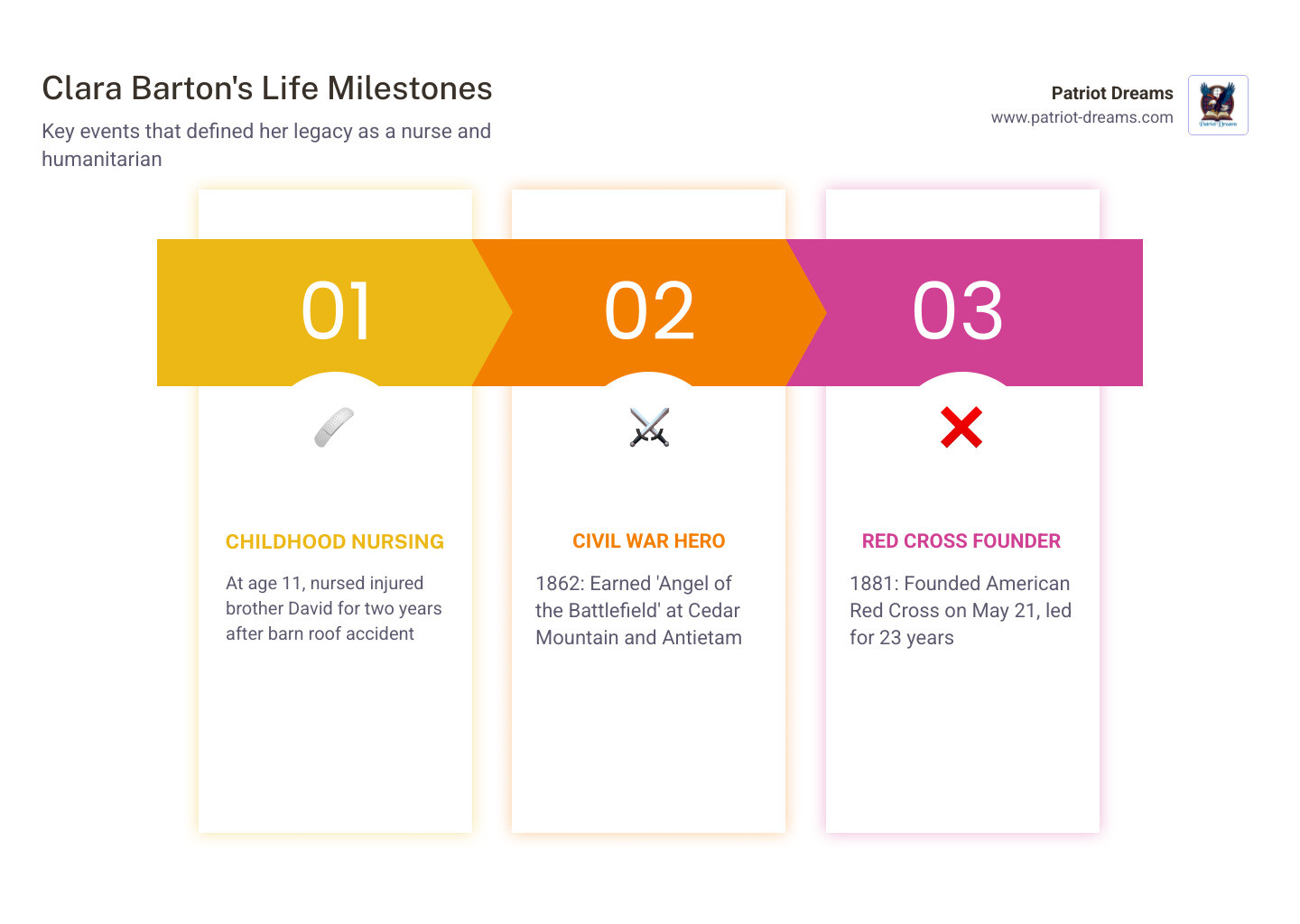
Her story begins long before the war, in a small Massachusetts home where an 11-year-old girl sat beside her injured brother's bed, administering medicines and handling leeches, refusing to leave his side for nearly two years. That early act of devotion shaped everything that came after.
From that farmhouse bedroom to the front lines of Antietam, from the Missing Soldiers Office in Washington D.C. to the founding of the American Red Cross — Clara Barton's life is a story about what one caring, determined person can do.
It is also, at its heart, a very American story.
Important Clara Barton nurse terms:
- Rosa Parks story
- Sojourner Truth speech
- Teddy Roosevelt: The Fearless Leader Every Young American Should Know
The Heart of a Caregiver: Early Life and the First Patient

Every great journey has a beginning, and for Clara, it started in the quiet town of North Oxford, Massachusetts. Born on Christmas Day in 1821, Clarissa Harlowe Barton was the youngest of five children. As a child, she was so painfully shy that her mother actually consulted a phrenologist — a person who studied the shape of the skull to determine character traits. The expert, L.N. Fowler, suggested that Clara’s shyness could be managed if she found a career that allowed her to serve others, specifically recommending teaching.
But Clara’s true calling as a nurse was revealed at the tender age of 11. Her older brother, David, fell off a barn roof while helping with a raising, suffering a traumatic head injury. For the next two years, young Clara stayed by his side. She learned to administer his complex medications and even handled "great, loathsome, crawling leeches," which she later admitted felt like snakes to her. This two-year vigil wasn't just an act of family love; it was her first training ground. She learned the patience, stamina, and attention to detail that would one day save thousands of lives. We often find that our greatest strengths are forged in the quiet moments of caring for those we love, and Clara was no exception. You can read more about other historical-american-figures who found their purpose through early challenges.
From the Schoolhouse to the Patent Office
Following the phrenologist's advice, Clara began teaching at age 17. She wasn't just a teacher; she was a pioneer. In 1852, while visiting Bordentown, New Jersey, she noticed many boys loitering on the streets because they couldn't afford school. She convinced the community to let her start a free public school — the first of its kind in the area. It was a massive success, growing from just six students to over 600.
However, Clara’s sense of justice was as strong as her heart. When the school board hired a man to be the principal at twice her salary, she resigned in protest. She said, “I may sometimes be willing to teach for nothing, but if paid at all, I shall never do a man's work for less than a man's pay.” This led her to Washington D.C., where she became one of the first female clerks at the U.S. Patent Office. Despite harassment from male colleagues, she earned $1,400 a year — the same as the men. Her time in D.C. was a vital chapter in american-cultural-history, proving that a woman’s skill and dedication were worth every bit as much as a man’s.
The Angel of the Battlefield: Clara Barton Nurse in the Civil War
When the Civil War broke out in 1861, Clara didn't wait for an invitation to help. After the Baltimore Riot, she saw the wounded soldiers of the 6th Massachusetts Infantry arriving in Washington with nothing but the clothes on their backs. She immediately began collecting supplies, using her own home as a storeroom. She realized that while the government was trying to provide, the bureaucracy was slow, and men were dying of hunger and cold before help arrived.
Clara operated independently, which was almost unheard of at the time. She believed her place was at the front. By 1862, she finally gained permission to bring her supplies directly to the battlefields. From Cedar Mountain to Fredericksburg, she was a constant presence. At Cedar Mountain, she arrived at a field hospital at midnight with a wagon full of bandages and lanterns. The exhausted surgeons, working in near-darkness, were so relieved they called her an "angel." This was the birth of her most famous title. Her story is a shining example of military-patriotism and the power of individual initiative. To learn more about how her work changed the medical landscape, you can explore the scholarship on Clara Barton’s Nursing Career.
Courage Under Fire: The Clara Barton Nurse at Antietam
The Battle of Antietam remains the bloodiest single day in American history, and it was here that the Clara Barton nurse legacy was truly cemented. As bullets whizzed through the air, Clara was right there in the thick of it. In one terrifying moment, as she was giving a drink of water to a wounded soldier, a bullet tore through the sleeve of her dress, killing the man she was helping. She never mended that sleeve, keeping it as a reminder of the thin line between life and death.
The conditions were dire. When the surgeons ran out of bandages, Clara showed her resourcefulness by using corn-husks to bind wounds. She even assisted in surgery, extracting a bullet from a soldier's face using a pocketknife when no other tools were available. By the end of the day, her face was "the color of gunpowder, a deep blue," a physical mark of her proximity to the fight. You can read more about her harrowing experiences in her own words through letters written after the Battle of Antietam.
Leading with Compassion: The Clara Barton Nurse as Superintendent
Clara’s work wasn't just about bandages and medicine; it was about the human spirit. In 1864, she was appointed the "lady in charge" of the diet and nursing at the tent hospitals for the Army of the James. She oversaw the care of thousands, ensuring they had proper nutrition and emotional support. She understood that a kind word or a letter written home was often just as important as a clean bandage. Her leadership style focused on discipline through kindness rather than harshness. This era of her life also saw her working alongside formerly enslaved people, providing aid and support to those seeking freedom, a precursor to the values later celebrated in the civil-rights-movement.
Healing the Wounds of War: The Missing Soldiers Office
As the cannons fell silent, a new kind of agony swept across the nation: the agony of the unknown. Thousands of families had no idea what had happened to their sons, husbands, and fathers. Clara Barton, ever the servant of the people, recognized this need. With the personal permission of President Abraham Lincoln, she established the "Office of Correspondence with Friends of the Missing Men of the United States Army" in Washington D.C.
This was a massive undertaking. Over the course of four years, her office received more than 63,000 inquiries. Clara and her small team worked tirelessly, ultimately identifying and notifying the families of 22,000 missing Union servicemen. One of her most significant contributions involved the notorious Andersonville Prison camp. Working with a young former prisoner named Dorence Atwater, who had secretly kept a list of the dead, Clara went to the site to identify and mark the graves of nearly 13,000 Union soldiers. She wanted to ensure that no hero was forgotten, much like the revolutionary-war-heroes who came before them.
A Vision for Humanity: Founding the American Red Cross
Exhausted by her war work, Clara traveled to Europe in 1869 for a rest. But even on vacation, she couldn't stop helping. She learned about the International Red Cross in Geneva and saw their efficiency during the Franco-Prussian War. She was awestruck that European nations had a system to protect the wounded regardless of which side they fought on. She returned to the United States with a new mission: to bring the Red Cross to America.
It wasn't easy. The U.S. government was hesitant to join international treaties, and Clara spent years campaigning through lectures and pamphlets. Finally, on May 21, 1881, she founded the American Red Cross and served as its president for the next 23 years. Her first major relief effort wasn't for a war, but for the devastating Michigan forest fires later that year, which left 14,000 people homeless. Clara proved that the American Red Cross was a vital part of American life, in peace and in war.
The American Amendment and Peacetime Relief
One of Clara's most significant contributions to the global Red Cross movement was what became known as the "American Amendment." She argued that the Red Cross should respond not just to the man-made disaster of war, but also to natural calamities like floods, fires, and famines. This was a idea that changed the mission of the Red Cross worldwide.
| Relief Category | Wartime Efforts | Peacetime Efforts (The American Amendment) |
|---|---|---|
| Focus | Wounded soldiers, POWs | Disaster survivors, civilians |
| Events | Civil War, Spanish-American War | Johnstown Flood, Galveston Hurricane |
| Key Actions | Battlefield nursing, supply lines | Orphanages, temporary housing, food |
| Innovation | Frontline supply distribution | National First Aid Association |
Under her leadership, the Red Cross responded to the Johnstown Flood in 1889 with 50 doctors and nurses, and the Galveston Hurricane in 1900, where Clara, at age 77, personally led the relief efforts and helped establish an orphanage for the victims.
An Enduring Legacy: Honors and Modern Inspiration
Clara Barton passed away in 1912 at the age of 90, but her spirit remains a guiding light. Today, her home in Glen Echo, Maryland, is preserved as the Clara Barton National Historic Site. It’s a fascinating place where the walls were once covered in muslin — the same material used for bandages — to remind everyone of the organization’s humble, hands-on beginnings.
Her legacy even reaches beyond our world; a crater on Venus is named in her honor. But perhaps her most meaningful legacy is found in the millions of nurses and volunteers who continue her work today. During the recent global health crises, many looked for “The Next Clara Barton.” to lead with the same courage and selflessness she displayed on the battlefields of the 1860s.
Frequently Asked Questions about Clara Barton
What was Clara Barton's first nursing experience?
Clara's first experience was nursing her older brother, David, for two years after he suffered a serious head injury from a barn roof fall. She was only 11 years old at the time but learned to administer medicine and apply leeches.
Why was Clara Barton called the "Angel of the Battlefield"?
She earned the nickname from surgeons and soldiers who saw her arrive at the front lines with essential supplies, often at night and under enemy fire. A surgeon at the Battle of Cedar Mountain first coined the phrase after she arrived at midnight with lanterns and bandages.
How did Clara Barton start the American Red Cross?
After witnessing the International Red Cross in Europe, she spent years campaigning for the U.S. to join the Geneva Convention. She founded the American Red Cross on May 21, 1881, and led it for 23 years, expanding its mission to include natural disaster relief.
Conclusion
Clara Barton’s life reminds us that the best of America is found in our willingness to care for one another. She showed us that one person, armed with nothing but a lantern and a heart full of compassion, can change the course of history. Whether she was extracting a bullet at Antietam or organizing relief for flood victims, her focus was always on the person right in front of her.
At Patriot Dreams, we believe that these stories of everyday heroism are the threads that bind our nation together. Our heritage is more than just dates and battles; it is the legacy of kindness and resilience passed down through families and communities. We invite you to explore more stories of American perseverance and to preserve your own family’s legacy on our interactive map. Let’s keep the spirit of Clara Barton alive by remembering that we are all, in our own way, capable of being an "angel" to someone in need. Visit Patriot Dreams today to start your journey into the heart of the American story.

Join the Patriot Dreams Community
Download the app today and start your journey through American history and personal legacy.

Explore Our Latest Insights
Dive into stories that shape our American legacy.