From Diaries to Memoirs: Exploring Personal Stories in History

Why Personal Historical Accounts Matter Now More Than Ever

Personal historical accounts are first-person narratives that capture individual experiences of the past through diaries, letters, memoirs, autobiographies, oral histories, and other intimate records. Unlike traditional historical documents that record facts and dates, these accounts reveal the emotions, daily struggles, and human connections that shaped real lives in specific moments of history.
What defines personal historical accounts:
- First-person narratives written or spoken by individuals who lived through historical events
- Subjective perspectives that capture the "life-sensation" of a particular time and place
- Various formats including diaries, journals, letters, memoirs, autobiographies, and oral histories
- Preservation of voice that conveys authentic experiences, especially from underrepresented groups
- Historical context embedded in everyday moments, not just major events
There's something deeply moving about reading the actual words of someone who lived generations before us. When Ron Casanova opened his memoir with "I have used my art as an escape and to remember," he wasn't just sharing facts about his life—he was inviting us into his world, his pain, and his resilience. That's the power of personal narratives.
These accounts do more than fill in historical gaps. They transform names in history books into real people with hopes, fears, and dreams much like our own. The Slave Narrative Collection preserves over 2,300 first-person accounts of slavery—stories that challenge sanitized versions of history and honor the dignity of those who endured unimaginable hardship. Similarly, collections like North American Women's Letters and Diaries with approximately 150,000 pages reveal the quiet strength and daily lives of women whose contributions were often overlooked.
Personal historical accounts remind us that history isn't just about presidents and battles. It's about the grandmother who kept a diary during the Depression, the immigrant who wrote letters home describing a new land, and the child who survived internment camps and later chose education over bitterness.
These stories are our shared heritage, connecting us across time and reminding us of the resilience, kindness, and perseverance that define the American spirit.
The Heartbeat of History: Defining Personal historical accounts
When we look at history, it can sometimes feel like a collection of cold dates and distant names. But when we open a family photo album or read a handwritten letter from a great-grandfather, history starts to breathe. We call these Personal historical accounts, and they are truly the heartbeat of our shared past.

A personal account is more than just a report of what happened. It’s a "life-sensation"—a term used to describe the unique feeling of being alive in a specific time. Whether it’s a mother describing the "cotton-like" white bread she tasted for the first time after immigrating to Canada, or a young man in an internment camp hunting rattlesnakes to pass the time, these stories capture the texture of life.
Subjectivity is often seen as a flaw in science, but in history, it is a treasure. It allows us to see the world through someone else's eyes. We learn not just that a war happened, but how it felt to wait for a letter that never came. We see the everyday moments—the laughter in a kitchen, the fear during a storm, and the quiet pride of a job well done. These authentic voices help us understand the human condition in a way a textbook never could. For those interested in keeping these voices alive, family history preservation is a wonderful way to start.
Differentiating Narratives from Traditional Records
It helps to think of traditional records—like census data, land deeds, and birth certificates—as the skeleton of history. They provide the structure. They tell us that a person existed, where they lived, and what they did for a living. These vital statistics are essential, but they are often missing the "soul."
Personal historical accounts provide the "flesh and blood." While a census margin might note a person's occupation as "seamstress," her diary might reveal she was a "powerhouse protester" for women's voting rights. A military enlistment file tells us a soldier's height and eye color, but his letters home tell us about the courage he found in his friends and the kindness he showed to strangers. This emotional truth is what makes history feel real and relevant to us today.
Why Personal Stories are the Foundation of Our Shared Past
Every person’s story is a thread in the great tapestry of America. For many years, the stories of everyday people—especially those from under-documented groups—were tucked away in attics or passed down only through whispers. Today, we recognize that these stories are the very foundation of our history.
Personal accounts are crucial for understanding the lives of those who didn't always make it into the official record books. For example, the North American Women's Letters and Diaries collection includes 150,000 pages of writings from over 600 women. These documents show us how women navigated colonial life, the Civil War, and the push for suffrage, often through unpublished materials that capture their unfiltered thoughts.
These narratives highlight resilience and the strength of community bonds. They remind us that even in the darkest times, people found ways to support one another, share a meal, and keep hope alive.
The Role of Personal historical accounts in Reshaping the Past
When we listen to the voices of those who were there, our understanding of the past often changes. The Slave Narrative Collection, gathered by the Federal Writers' Project in the 1930s, is a powerful example. It contains over 2,300 accounts that provide a "collective portrait" of life under slavery from the perspective of those who endured it. These stories, like that of Mary Reynolds who lived to be 105, challenge myths and provide a raw, honest look at our history.
We also see this in the stories of early American leaders and activists. While we know the public deeds of Abigail Adams, her personal letters reveal a woman of sharp intellect and deep conviction who urged her husband to "remember the ladies." Similarly, hearing the strength in a Sojourner Truth speech helps us feel the weight of her journey from enslavement to a powerful voice for justice. These personal accounts don't just add to history; they reshape it, making it more inclusive and truthful.
From Attic Trunks to Digital Archives: Types of Personal Narratives
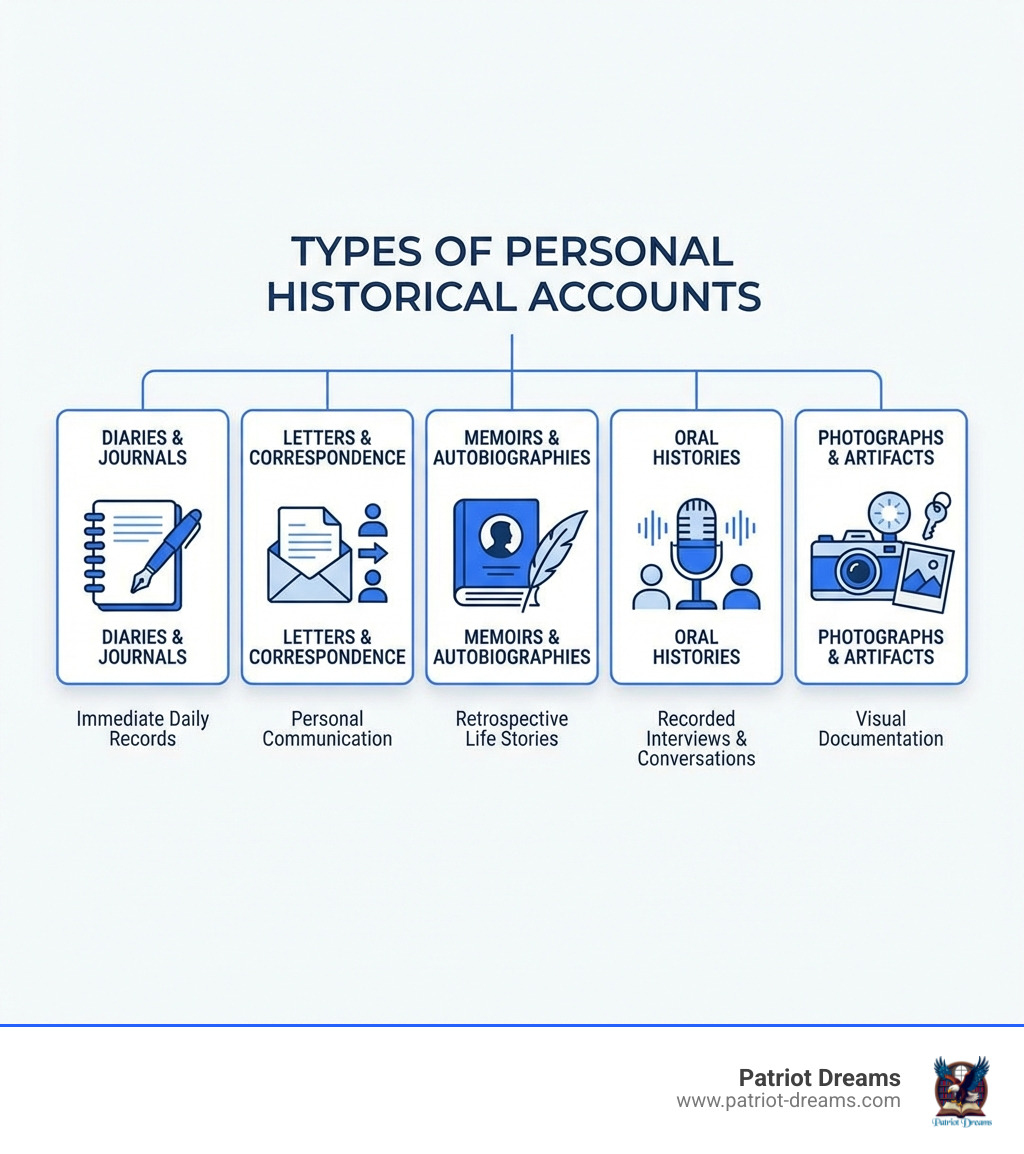
Personal history comes in many shapes and sizes. Sometimes it’s a thick, bound memoir; other times, it’s a collection of postcards or a single military badge that sparks a memory.
- Memoirs and Autobiographies: These are retrospective accounts where someone looks back on their life to find meaning. They often focus on a specific theme, like a "microhistory" of surviving a major event.
- Diaries and Journals: These are immediate. They capture thoughts as they happen, providing a day-to-day look at life. Martha Ballard’s 18th-century diaries, for instance, give us a rare glimpse into the life of a midwife.
- Letters and Correspondence: Letters are "conversations across distance." They show us the relationships between people, like the coded letters families used during wartime to stay connected.
- Oral Histories: These are spoken stories, often captured through interviews. They are vital for preserving the traditions of communities that rely on storytelling, such as American pioneer stories or Appalachian folk traditions.
- Immigrant Narratives: Collections like the North American Immigrant Letters (1800-1950) include 37,500 pages of information illustrating the courage it took to move to a new world and the challenges of building a new home.
Where to Find These Hidden Treasures
If you’re looking to explore these stories, there are incredible resources available. The Library of Congress hosts the American Memory project, which includes the "Born in Slavery" collection—representing one-third of all documented slave testimonies in the U.S.
You can also find wealths of information in:
- Digital Collections: Many libraries, like the NYPL and Harvard, have digitized thousands of diaries and letters.
- Special Collections: University libraries often hold "finding aids" for specific topics, such as student life in the 1800s or maritime sea narratives.
- The WPA Slave Narrative Collection: A unique achievement of the 1930s that ensures the voices of former slaves are never forgotten. You can explore it through the Library of Congress.
- Public Programs: Museums often host "First Person" programs where survivors share their histories in person.
Learning about these historical American figures through their own words is a journey that can change the way you see the world.
Navigating the Beauty and Bias of Personal Historical Accounts
When we read a personal story, we are entering into a sacred trust with the author. However, it’s important to remember that human memory is a bit like an old photograph—it can fade at the edges or become slightly colored by time.
Personal historical accounts are inherently subjective. This isn't a bad thing! The author's perspective is exactly what we are looking for. But as we read, we should consider "authorial intent." Was the story written for a family to remember a loved one, or was it a bestseller meant to influence public opinion? For example, some antebellum slave narratives were edited by abolitionists to help the cause, which adds a layer of cultural history to the personal experience.
Memory distortion is also natural. An informant being interviewed at age 100 about events that happened when they were 10 might remember things through the lens of childhood or the many years that passed in between.
How to Listen with a Kind and Critical Heart
To get the most out of these narratives, we should approach them with what historians call "healthy skepticism and a certain faith." Here is how you can analyze a personal story:
- Check the Form: Was it a diary written that night, or a memoir written 50 years later?
- Understand the Motivation: Why did the person tell this story? Was it to explain an extraordinary event or to document everyday life?
- Consider the Transmission: How did the story reach you? Was it passed down through family, or edited by a scholar?
- Look for Context: Does the story match what we know about the time period? Even if small details are off, the "emotional truth" often remains.
| Feature | Diary / Journal | Memoir / Autobiography |
|---|---|---|
| Timing | Written immediately or daily | Written years later (retrospective) |
| Perspective | "In the moment" reactions | Reflective and analytical |
| Focus | Daily details and routines | Major life themes and turning points |
| Audience | Often private (self) | Usually intended for others (public) |
Preserving Your Own Legacy for Future Generations
At Patriot Dreams, we believe that your story is your heritage. It is something you own, and it is a gift to those who will come after you. Just as we cherish the diaries of the past, future generations will cherish the stories we save today.
Technology has made it easier than ever to capture these moments. You don't need to be a professional writer to leave a legacy. A simple audio recording of a grandparent talking about their first job or how they met their spouse can become a priceless family tribute. Recording family stories ensures that the sound of a loved one's voice and the wisdom of their experiences are never lost.
Finding Personal historical accounts in Your Own Family
You might be surprised by what you find when you start digging. A quiet relative might turn out to have been a trailblazer in their community. You can preserve these discoveries in many ways:
- Heirloom Books: Compiling photos, letters, and stories into a physical book.
- Audio Accounts: Using platforms like Patriot Dreams to narrate and map your family's journey across the country.
- Ethical Wills: A document that passes down values, life lessons, and hopes rather than just material possessions.
- Annotated Photo Albums: Adding the "who, what, and why" to old pictures so the stories don't disappear when the people do.
Whether your ancestors were explorers and trailblazers or quiet heroes who built a home and raised a family, their stories deserve to be told.
Frequently Asked Questions about Personal Historical Accounts
What is the difference between a memoir and a diary?
A diary is a daily record of events and thoughts written as they happen. It's very "in the moment." A memoir is written later in life, looking back at specific themes or periods to provide a broader perspective and reflection on what those events meant.
Why are personal accounts important for groups often left out of history books?
Official records often focus on people in power. Personal accounts—like letters from immigrants or narratives from enslaved people—provide a voice to those who were marginalized. They ensure that history is a complete picture of all people, not just a few.
How can I start documenting my own family's history?
Start small! Look through old photos, ask a relative for an interview, or write down your own favorite childhood memory. You can use tools like the Patriot Dreams app to record these stories and pin them to a map, creating a living legacy for your family.
Conclusion
History is more than a series of events; it is a collection of lives. From the 105-year-old memories of Mary Reynolds to the rocket-scientist reflections of Sam Mihara, Personal historical accounts remind us of our shared humanity. They teach us about unity, perseverance, and the everyday heroism that exists in every family.
When we take the time to listen to these stories, we find that we are not so different from those who came before us. We all share the same hopes for our children, the same resilience in the face of hardship, and the same capacity for kindness. By preserving these narratives, we honor our past and inspire our future.
We invite you to start your journey with the Patriot Dreams app. Let’s work together to ensure that no story is forgotten and that every voice finds its place in the great American narrative. Your history is waiting to be told.

Join the Patriot Dreams Community
Download the app today and start your journey through American history and personal legacy.

Explore Our Latest Insights
Dive into stories that shape our American legacy.