Uncover the Rich Creation Myths and Legends of the Creek Indians


What Creek Creation Myths and Legends Tell Us
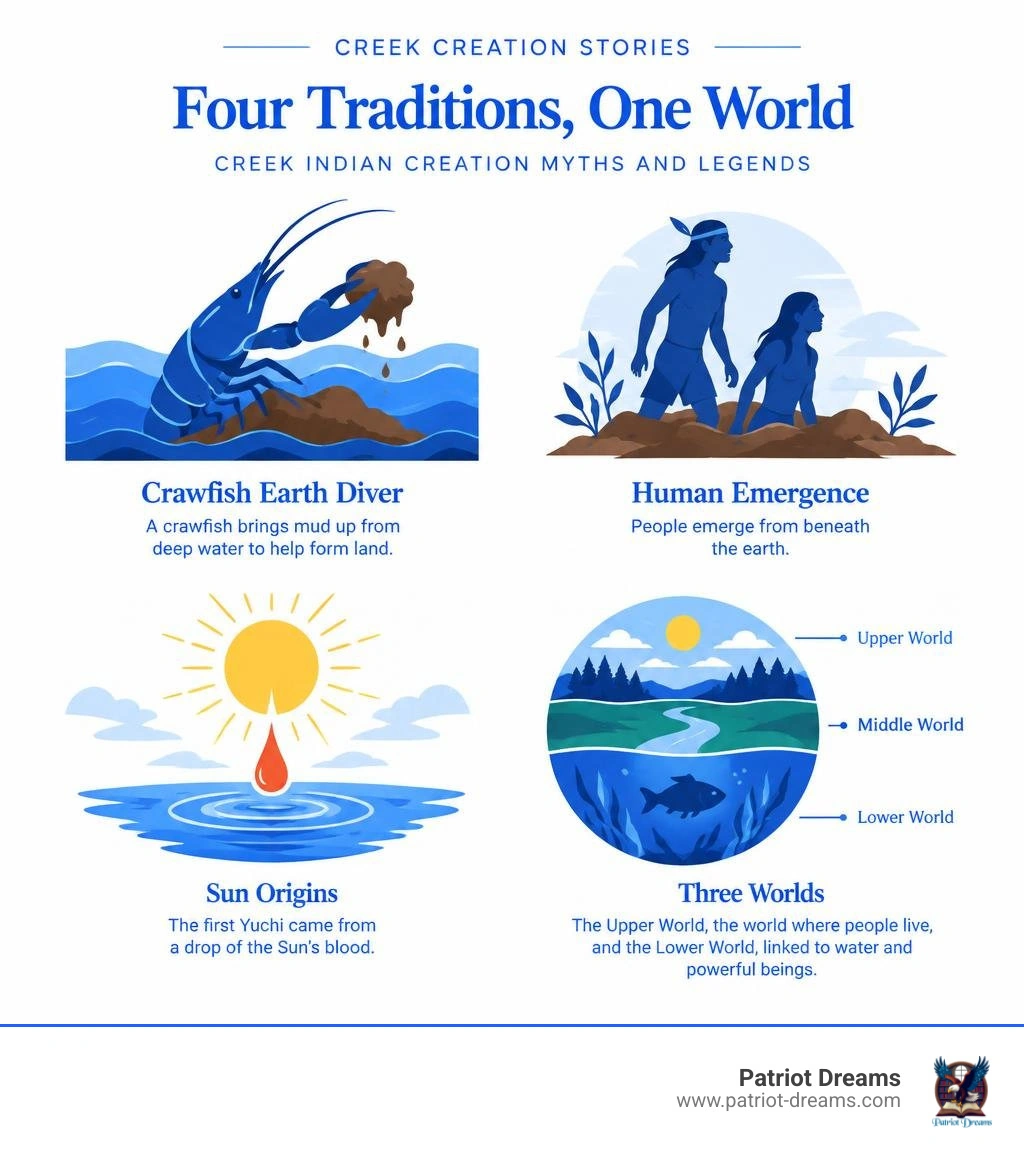
Creek creation myths and legends do not tell just one origin story. In some, a Crawfish brings mud up from deep water to help form land. Others tell of people emerging from beneath the earth. A Yuchi account says the first Yuchi came from a drop of the Sun's blood. These stories come from different peoples whose histories became part of the Creek Confederacy.
Many Creek traditions also describe an Upper World, the world where people live, and a Lower World linked to water and powerful beings. The stories help explain not only where life began, but how people relate to the world around them.
We're Kyle & Emily, and we'll explore these traditions with care for the people who continue to share them.
Simple guide to creation myths and legends of the creek indians:
- american indian myths and legends by richard erdoes
- Lewis and Clark expedition
- The Legacy of Fred Rogers
Cosmological Architecture: The Three Worlds of Creek Mythology
To truly appreciate the oral histories of the Muscogee (Creek) people, it helps to understand how they viewed the cosmos. Long before European contact, ancestral Southeastern peoples envisioned the universe not as an empty void, but as a carefully balanced, tiered structure. At the heart of this worldview is Hesaketvmesē (the Maker of Breath or Breath Holder), the supreme spiritual force who bestows life, motion, and sacred order.
The universe consists of three distinct yet connected realms:
- The Upper World: A realm of perfect order, light, and stability, inhabited by celestial spirits, the Sun, the Moon, Thunder beings, and benign spirit elders.
- The Middle World: The terrestrial plane where humans, animals, and plants dwell. It is a fragile space that requires constant care and ritual renewal to stay balanced between the realms above and below.
- The Lower World: A shadowy, watery realm beneath the earth and deep inside springs and rivers. It is associated with fertility, change, and chaotic power, home to aquatic beings and subterranean spirits.
Connecting these realms is the axis mundi, often represented as a sacred world tree, a central ceremonial fire, or a towering earthen mound. This architecture forms a foundational chapter within the broader traditions of Native American history.
| Cosmic Realm | Primary Inhabitants | Spiritual Qualities | Symbolic Associations |
|---|---|---|---|
| Upper World | Hesaketvmesē, Sun, Moon, Thunder Beings | Perfect order, light, constancy | Sky, celestial fire, soaring birds |
| Middle World | Humans, land animals, sacred flora | Balance, mortality, ritual stewardship | Earthly ground, ceremonial grounds, axis mundi |
| Lower World | Horned Serpent (Tie Snake), Underwater Panthers | Chaos, primal fertility, raw power | Deep springs, dark waters, subterranean caves |
Core Creation Myths and Legends of the Creek Indians
The stories of how our world began vary across the towns and tribal groups that formed the historic Creek Confederacy. Rather than a single monolithic culture, the confederacy united communities speaking distinct Muskogean dialects (such as Muskogee, Hitchiti, Alabama, and Koasati), along with distinct linguistic neighbors like the Yuchi (an isolate language family) and the Shawnee (Algonquian).
Scholars often categorize these narratives into two primary traditions:
- The Eastern Creek Tradition (including Yuchi, Hitchiti, and Tuskegee groups), which frequently features the Earth Diver motif and solar descents.
- The Western Creek Tradition (including Muskogee, Alabama, and Koasati groups), which centers on human emergence from subterranean realms and clay sculpting.
As documented in ethnographic studies like the scholarly study on the Creation Myths and Legends of the Creek Indians, these oral traditions were actively sustained through regular community storytelling.
Earth Diver Traditions in Creation Myths and Legends of the Creek Indians

In the beginning, according to the Eastern Creek tradition, there was only a boundless expanse of primordial water beneath the sky. The celestial beings looked down and longed for a place where creatures could walk and thrive. Several aquatic birds and animals attempted to dive into the deep abyss to retrieve earth, but none could reach the bottom until the humble Crawfish volunteered.
The brave Crawfish plunged deep into the dark waters, staying under for days. When he finally surfaced, he carried small grains of mud trapped in his claws. The animal council took this mud and spread it across the waters, where it expanded to form the earth.
Among the Yuchi, human origin is intimately tied to the cosmos itself. Yuchi tradition recounts that after the land was formed, the Sun traveled across the sky. As she passed overhead, a single drop of her blood fell to the newly formed earth, giving birth to the first Yuchi people—the Tsoyaha, or "Children of the Sun." Such vivid narratives sit proudly alongside stories found in indigenous collections like American Indian Myths and Legends by Richard Erdoes.
Emergence from the Earth: Western Tradition and Clay Origins
In contrast to the Earth Diver tales, the Western tradition explains human origins through subterranean emergence. Alabama and Muskogee accounts describe human beings resting in the dark, warm womb of Mother Earth until the Maker of Breath opened a passage in the ground, allowing them to climb into the sunlight.
Other traditions describe Hesaketvmesē shaping human forms from native red clay and blowing life into their nostrils. Spiritual life in these traditions was deeply complex:
- Muskogee Dual Soul Concept: The Muskogee traditionally recognized a dual spiritual nature—the primary soul located in the head or heart, and the ghost spirit associated with the physical body and intestines.
- Yuchi Four-Soul Doctrine: The Yuchis believed each individual possessed four distinct souls. Upon passing, one soul remained at the resting site, two hovered protectively around family and community, and the fourth traveled the path of souls across the sky to the haven of ancestors.
The Kasihta Migration Narrative and Formation of the Creek Confederacy
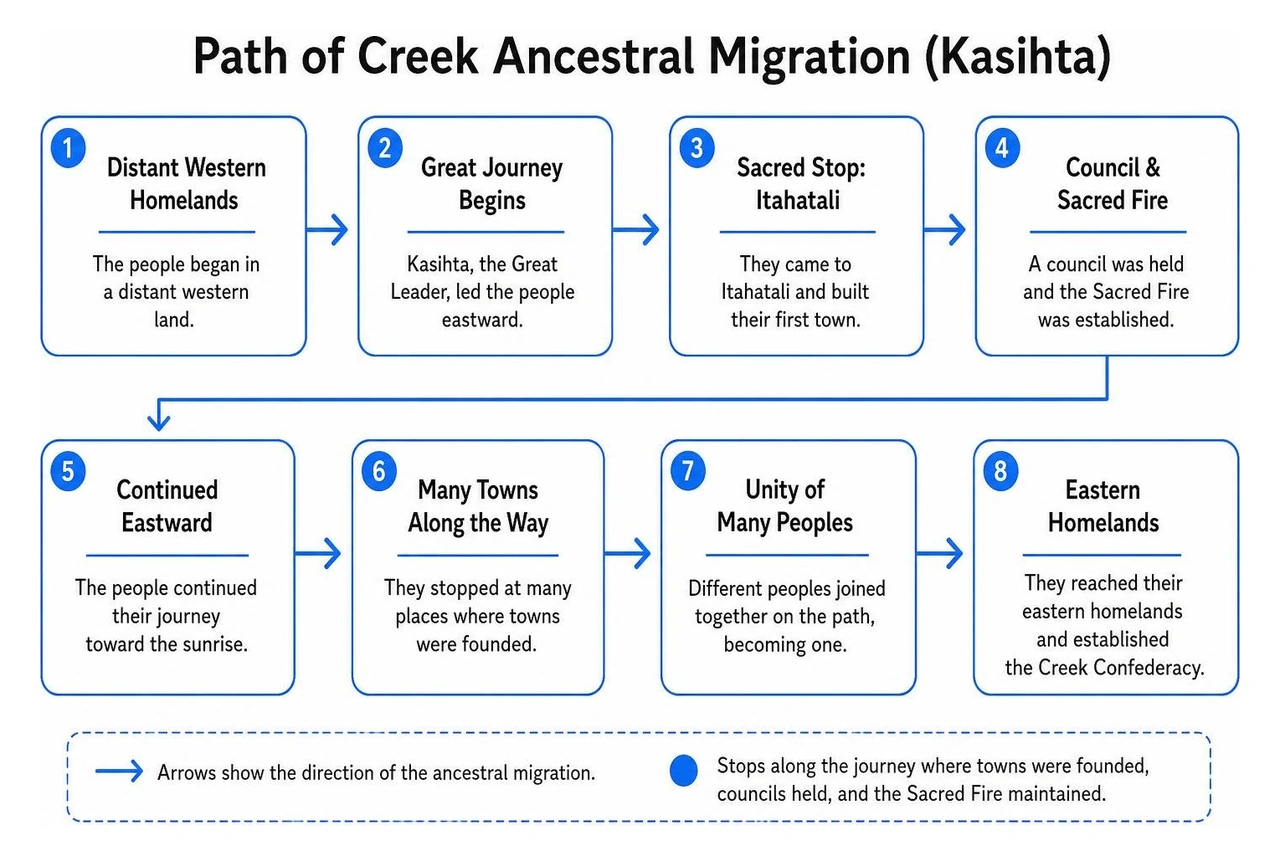
The historical assembly of the Creek Confederacy is commemorated in the famous Kasihta migration legend, famously recorded in the 1735 speech of Chief Chikili before colonial authorities in Savannah. This narrative serves as both a geographical journey and an origin account of tribal alliances, sharing narrative depth with regional migration parallels in Iroquois Confederacy origin stories.
To better understand this epic journey, readers can consult A Modern Translation of the Migration Legend of the Creek People.
The Mythic Journey Eastward and Sacred Fires
The migration account begins in the far west, where the earth opened and shook. Guided by spiritual signs, the ancestors began a long trek toward the rising sun. Along their route, they encountered a roaring mountain that produced distinct colored fires from four directions:
- North: Red-and-yellow fire
- South: Blue fire
- West: Black fire
- East: White fire
The travelers took the singing red-and-yellow fire and carried it forward as their perpetual sacred flame. During their eastward march, they encountered mythic trials, including a giant blue predator bird and its companion, a red rat. Overcoming these challenges, the Kasihta followed the "White Path" of peace and virtue, eventually arriving in their ancestral southeastern homelands along the Chattahoochee, Coosa, and Tallapoosa rivers.
Linguists and historians have long debated the exact geography of this journey, a subject analyzed thoroughly in Gatschet’s 1884 translation of the Creek Migration Legend.
Sacred Botanicals and Ritual Warfare
During their mythic journeys, the ancestors discovered four foundational medicinal herbs, each believed to sing its own sacred song of healing:
- Pasaw (Rattlesnake root)
- Micoweanochaw (Red root)
- Sowatchko (Wild fennel)
- Eschalapoochke (Little tobacco)
These plants became integral to the Green Corn Ceremony (Busk or Posketv), an annual midsummer observance of forgiveness, thanksgiving, and cosmic renewal. The migration accounts also describe the creation of the sacred war emblem—a symbolic war club shaped to protect the community—establishing a balance between "White Towns" (dedicated to peace, civil leadership, and diplomacy) and "Red Towns" (dedicated to military defense and martial discipline).
Lower World Powers, Sacred Flora, and Celestial Entities
Creek cosmology is populated by extraordinary beings that maintain balance across the three worlds. These beings serve as powerful reminders of human responsibility toward nature, echoing motifs found across mythic beasts in the ultimate American folklore creatures guide.
The Horned Serpent and Tie Snake as Cosmic Powers
The most revered being of the Lower World is the Horned Serpent (often referred to interchangeably with the Tie Snake or Tcinto Saktco). Described as an immense serpent armored with iridescent crystalline scales and crowned with a brilliant, luminous crystal on its forehead, it rules deep river bends, whirlpools, and underground caverns.
The Horned Serpent embodies the raw, unpredictable forces of water and transformation. While dangerous to those who treat nature with disrespect, fragments of its crystalline horn were considered potent medicine for hunting, healing, and courtship. Encounters with the Tie Snake in oral lore emphasize moral restraint, cautioning hunters never to take more game than needed.
Corn Woman and the Origins of Agriculture
Agricultural origins center on the beloved story of Corn Woman. In Creek tradition, an elder woman lived with an orphaned boy. Every day, she produced bountiful, delicious corn without an apparent field. Curious and suspicious, the youth secretly watched her and discovered that the corn dropped from her body as she rubbed her hands and feet.
Sensing that her secret had been witnessed, Corn Woman gently explained that her time on earth had ended. She instructed the youth to clear a patch of soil, drag her body across the ground after her death, and tend the soil carefully. The youth obeyed, and from the cleared ground grew the first green shoots of sweet maize. Corn Woman's gift established the sacred law of reciprocal harvest, honored annually at the Green Corn Dance.
Cosmic Balance and Prophecy: Creation Myths and Legends of the Creek Indians
Celestial bodies were viewed as living spiritual watchers:
- The Sun: A maternal or paternal life-giver whose daily journey sustains living things.
- The Moon: Associated with timekeeping, night travelers, and inner reflection.
- The Man-Eating Bird: A mythic avian predator from ancient times that tested the courage and ingenuity of early warriors before being overcome.
Both Yuchi and Muskogee traditions contain thoughtful prophecies regarding cosmic balance:
- Yuchi Prophecy: Warns that if the people ever abandon the ceremonial dances taught to them by the Sun, the Sun will refuse to rise in the morning, setting instead in the east and casting the world into eternal twilight.
- Muskogee Eschatology: Foretells a distant day of purification when the physical world will be cleansed by sacred fire. The dead will rise, and Hesaketvmesē will return to gather all individuals who walked gently and lived good lives.
Cultural Continuity, Removal, and Mythological Preservation
During the 1830s, the Muscogee, Yuchi, Alabama, and neighboring peoples were forcibly removed from their ancestral homelands in the American Southeast along the catastrophic Trail of Tears to Indian Territory (present-day Oklahoma). Despite immense loss, the Creek people carried their sacred fire embers, songs, and creation narratives across hundreds of miles.
Their cultural resilience parallels the enduring cultural memory alongside Cherokee Trail of Tears stories. Today, sovereign communities such as the Muscogee (Creek) Nation in Oklahoma and the Poarch Band of Creek Indians in Alabama maintain active ceremonial grounds, keeping ancient creation traditions alive for new generations.
Frequently Asked Questions about Creek Mythology
What is the primary difference between Eastern and Western Creek creation myths?
Eastern Creek traditions (such as those of the Yuchi and Hitchiti) emphasize the Earth Diver motif—where a crawfish brings up mud from primordial waters—and solar origins, such as humans springing from the blood of the Sun. Western traditions (Muskogee and Alabama) center on human emergence from subterranean realms or being sculpted directly from red riverbed clay.
What does the Horned Serpent represent in Muscogee cosmology?
The Horned Serpent represents the majestic, chaotic, and fertile power of the Lower World. It rules deep waters, teaches moral respect toward nature, and provides potent medicine through its crystalline horns when approached with spiritual reverence.
What role does the Green Corn Ceremony play in Creek mythic tradition?
The Green Corn Ceremony (Busk) is the central ritual reenactment of Creek cosmology. Held during the midsummer maize harvest, it honors Corn Woman's sacrifice, rekindles the sacred communal fire, forgives social grievances, and renews spiritual balance across the community.
Conclusion
The creation myths and legends of the Creek Indians remind us of how deeply interconnected we all are with the land, the waters, and one another. These stories are living traditions carried forward by resilient families and communities who continue to gather around ceremonial fires. By listening to these ancestral voices, we gain a deeper appreciation for the rich cultural tapestry of America. To hear more stories of our shared past, we invite you to experience the full scope of heritage on America: 250 Years in the Making.

Join the Patriot Dreams Community
Download the app today and start your journey through American history and personal legacy.

Explore Our Latest Insights
Dive into stories that shape our American legacy.