Riding Through History With the Black Cowboys of the West

The History of Black Cowboys in the American West
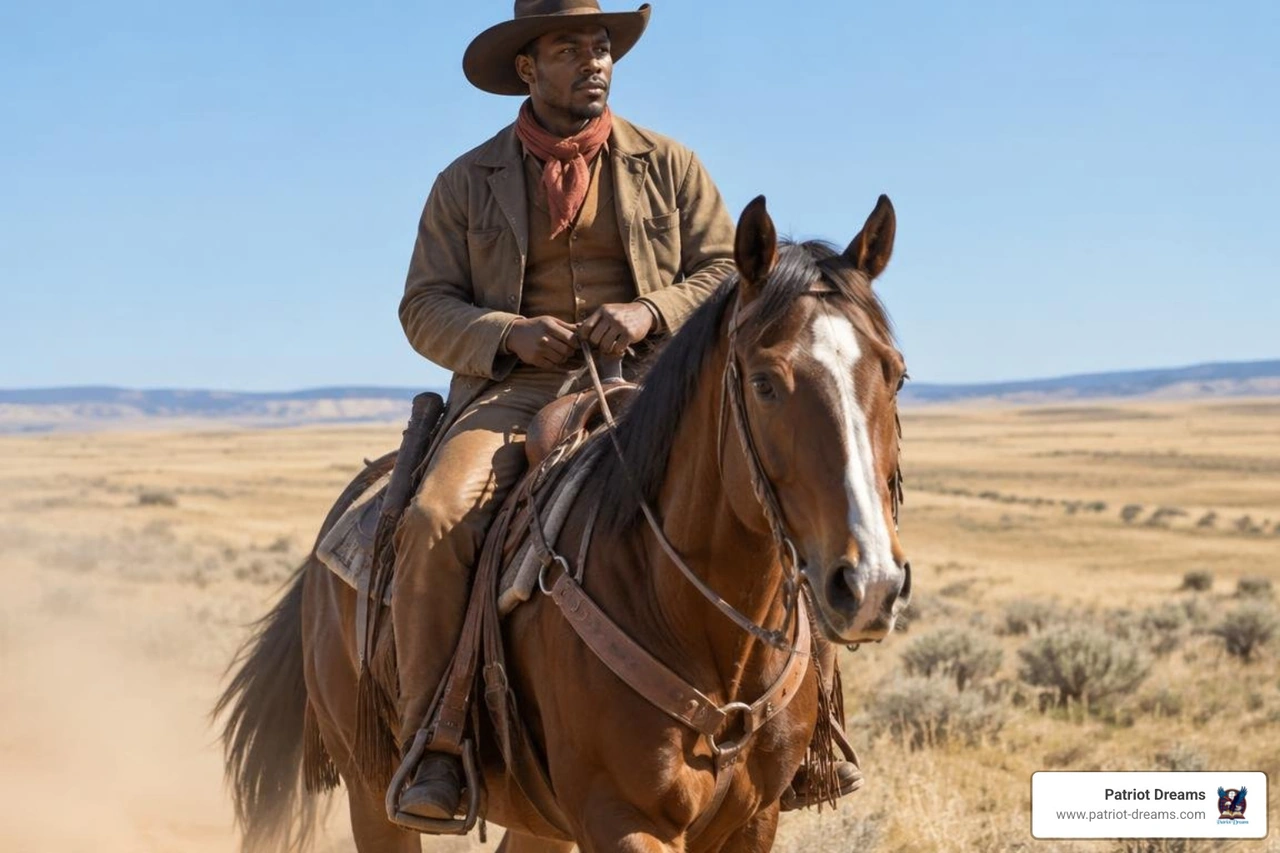
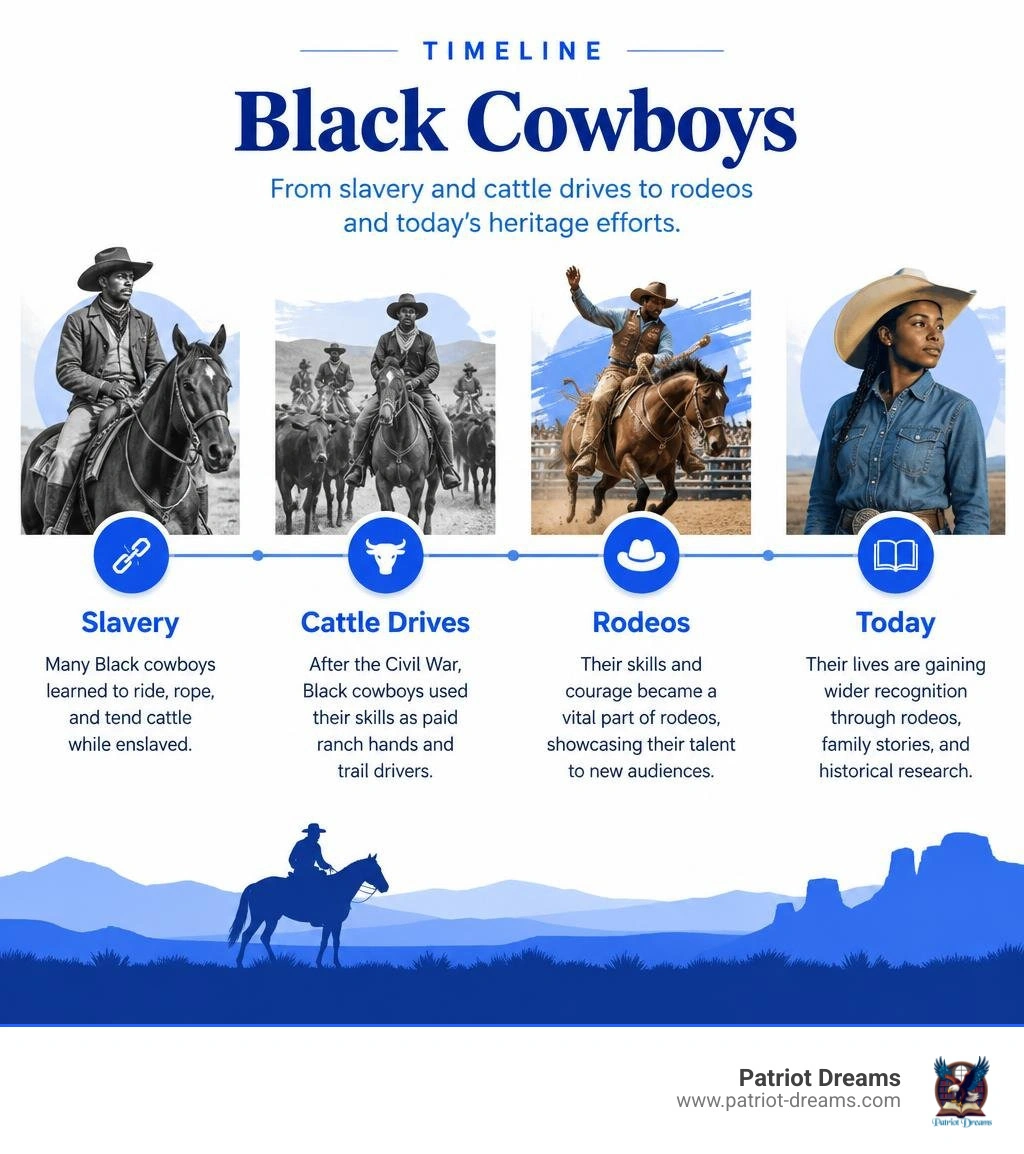
Black cowboys helped build the cattle industry of the American West. Historians estimate that as many as one in four cowboys on cattle drives during the late 1800s were Black. Many had learned to ride, rope, and tend cattle while enslaved. After the Civil War, they used those skills as paid ranch hands and trail drivers.
Their work was vital, but classic Western stories rarely showed them. Today, their lives are gaining wider recognition through rodeos, family stories, and historical research. We're Kyle & Emily, and we'd love to explore the history of Black cowboys with you.
History black cowboys word list:
Origins and Rise: The History of Black Cowboys on the Frontier
When we picture the wide-open prairies of the nineteenth century, it is wonderful to step back and look at the full picture of the men and women who shaped that land. Long before the great cattle drives began, rich traditions of open-range herding were already thriving. Historians have noted that some enslaved Africans brought to colonial South Carolina came from regions such as coastal Senegal, where raising cattle across vast grasslands was a respected way of life. These herders brought deep knowledge of livestock behavior, veterinary care, and handling techniques to American shores.
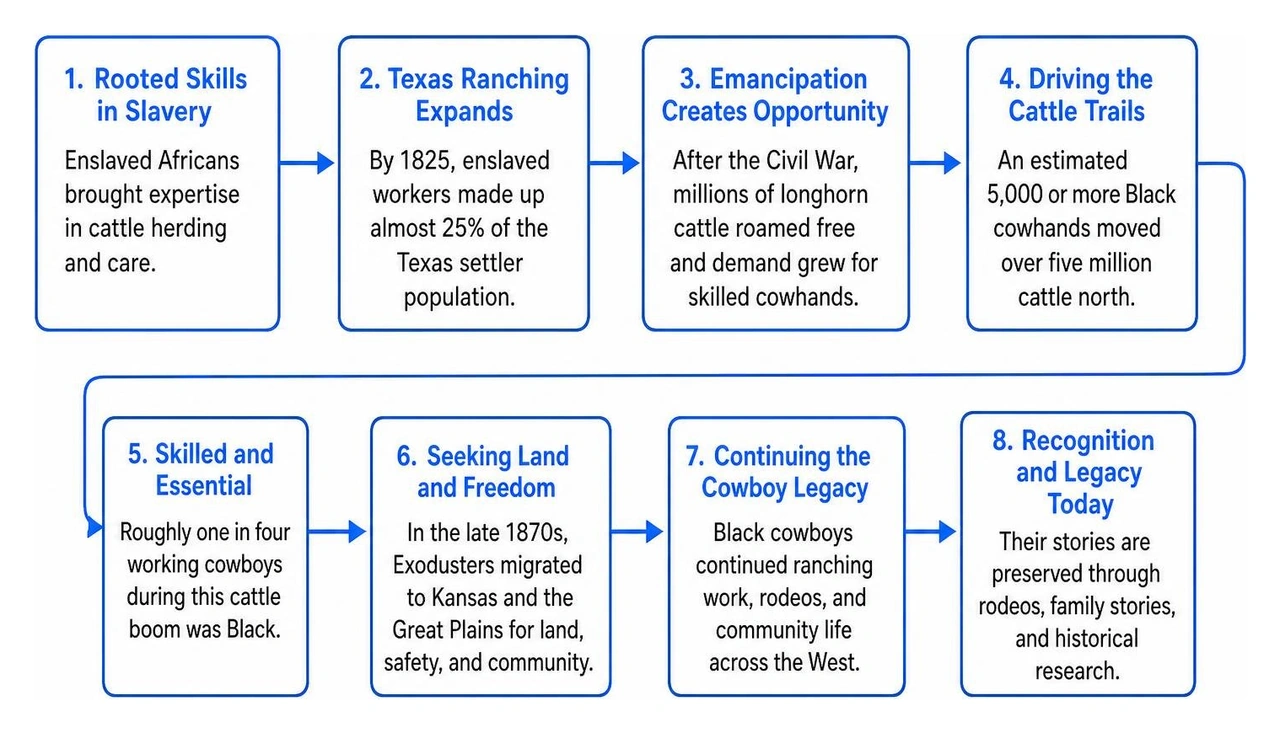
As settlement expanded into Texas during the 1820s and 1830s, ranching became the backbone of the local economy. Enslaved workers managed herds, broke horses, cleared brush, and branded cattle across brushy river bottoms and coastal plains. When the Civil War ended, millions of longhorn cattle roamed free across Texas, while booming cities in the north and east were hungry for beef.
This created an extraordinary demand for skilled drovers. Ranchers looked to newly freed men who already had unmatched horsemanship and herd-management abilities. Together with Hispanic vaqueros and white drovers, an estimated 5,000 or more Black cowhands helped move over five million cattle northward along famous routes like the Chisholm and Goodnight-Loving trails during the defining timeline of the Wild West era. Detailed Smithsonian research on African-American cowhands confirms that roughly one in four working cowboys during this cattle boom was Black.
Roots in Slavery, Texas Expansion, and the Exoduster Migration
Understanding the deep roots of these horsemen begins with the demographic history of early Texas. By 1825, enslaved workers made up almost 25% of the Texas settler population. By the eve of the Civil War in 1860, that figure had climbed to over 30%, representing 182,566 enslaved people. Many were tasked with handling cattle daily, mastering lariat work and trail-riding across challenging terrain.
Following emancipation, the West offered a fresh horizon of self-determination. In the late 1870s, tens of thousands of African Americans left the South in search of land, safety, and community. Known as the Exodusters, more than 20,000 migrants journeyed to Kansas and the Great Plains between 1879 and 1884, organized by leaders like Benjamin "Pap" Singleton.
Many settled historic towns like Nicodemus, Kansas, while others found work on ranches across the plains. These families joined countless other homesteaders and Old West journeys in building resilient, self-governing communities where neighbor helped neighbor through harsh winters and frontier hardships.
Etymology and Evolution: How Racial Labels Bounded the Term Cowboy
Words carry powerful histories, and the term "cowboy" itself holds a revealing past. In the antebellum South and early Texas, ranch hands were often designated by the types of labor they performed alongside racialized labels—such as "house-boy" or "cow-boy." White ranch hands, by contrast, were typically referred to as cowhands, drovers, cattlemen, or herders.
Over the decades, as trail hands rode side by side through storms and stampedes, the term gradually shifted. By the late 1880s, the wider public adopted "cowboy" as an adventurous title for anyone who worked cattle on the open range. What began as a restrictive label evolved into a legendary symbol of rugged American perseverance.
Life on the Range: Duties, Compensation, and Social Realities
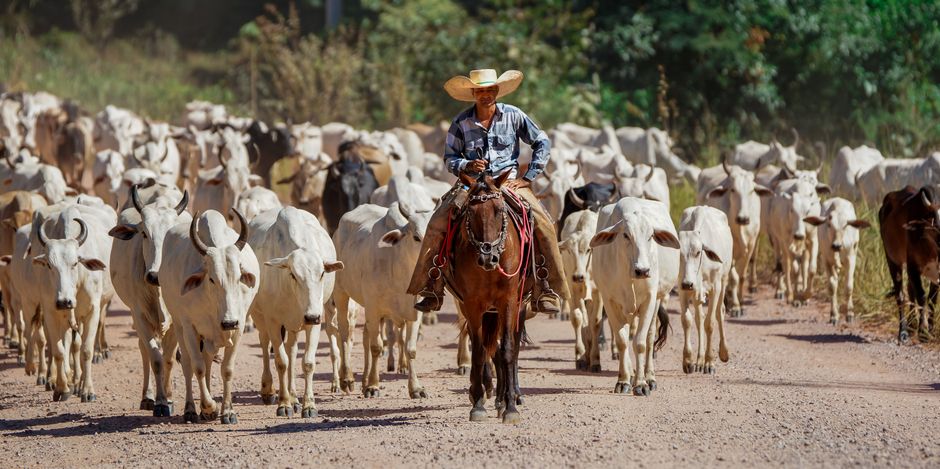
Out on the open trail, survival depended entirely on trust, skill, and cooperation. Day-to-day life during a cattle drive was demanding. Drovers spent eighteen hours a day in the saddle, swallowing dust, crossing swollen rivers, and calming nervous herds through violent prairie thunderstorms.
In many respects, the trail acted as a practical meritocracy. Cattle owners cared far more about whether a man could turn a midnight stampede or rope a runaway steer than his background. As detailed in a landmark University of Oklahoma Press study on Black cowboys, Black drovers generally received wages comparable to their white peers on the trail—typically $25 to $40 a month. However, they were often entrusted with the most challenging tasks, such as gentling unbroken horses, scouting ahead, or guarding the herd through the night. You can read more about daily trail routines in our guide to American cowboy ranch life.
Essential Occupations from Trail Drovers to Horse Wranglers
A trail outfit was a finely tuned team where every person had a specific, crucial duty:
- Mustangers and Horse Wranglers: Wranglers managed the remuda—the herd of 50 to 100 saddle horses needed for the drive. Famed mustanger Bob Lemmon was legendary for his ability to track wild mustang herds for weeks, patiently blending in with them until he could gently guide the entire herd right into a corral.
- Camp Cooks: The cook was the heart of any outfit, driving the chuckwagon, serving warm meals, and often acting as a doctor, dentist, and camp counselor all in one.
- Trail Hands and Fiddlers: Many cowhands carried fiddles or harmonicas in their bedrolls. At night, their songs soothed restless longhorns and lifted the spirits of tired men around the fire.
- Scouts and Security: Experienced riders guarded herds against rustlers. Their courage mirrored the dedication seen among Black soldiers and pioneers of the frontier, who provided protection across the western territories.
| Trail Crew Role | Primary Responsibility | Daily Challenge Level | Key Contributions |
|---|---|---|---|
| Horse Wrangler | Managing the remuda (camp horses) | High | Gentling broncs, ensuring fresh mounts |
| Trail Drover | Keeping cattle moving in line | High | Calming stampedes, river crossings |
| Camp Cook | Managing chuckwagon, meals, medicine | Moderate to High | Fueling the crew, morale, first aid |
| Mustanger | Tracking and corralling wild horses | Extremely High | Sourcing horses, herd instinct reading |
| Trail Scout / Security | Navigating routes and herd defense | Extremely High | Trail safety, water sourcing |
Trail Integration Versus Cattle Town Segregation
While the open plains fostered shared respect and camaraderie, reaching the end of the trail brought stark contrasts. When drovers arrived in boomtowns like Dodge City, Abilene, or Cheyenne to sell their cattle, town ordinances and local prejudices often reappeared.
Black cowboys could celebrate with their trail mates in certain establishments, but they were frequently barred from local hotels, restaurants, or main-street saloons. Despite these restrictions, the shared bonds formed during months on the trail remained strong, with fellow cowhands often standing up for one another in unfamiliar towns.
Legendary Trailblazers in the History of Black Cowboys
The story of the American West is filled with individuals whose grit, ingenuity, and warm character left an indelible mark on our heritage.
Nat Love and Bose Ikard: Champions of the Cattle Trails
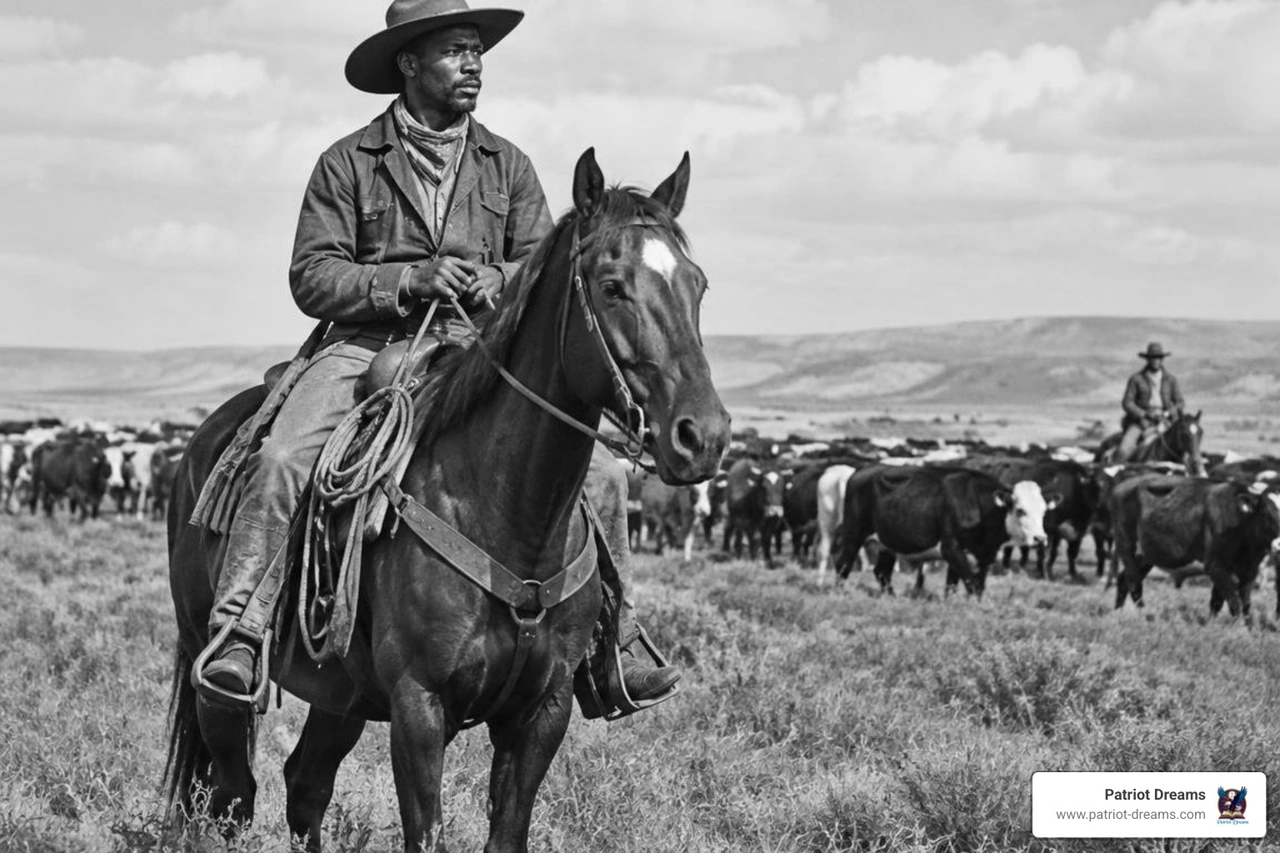
Born into slavery in Tennessee in 1854, Nat Love headed west as a teenager with extraordinary natural talent for horsemanship and roping. Arriving in Deadwood, South Dakota, on July 4, 1876, Love entered a local Fourth of July cowboy competition. He roped, threw, tied, bridled, and saddled a wild mustang in record time, winning the contest and earning the celebrated moniker "Deadwood Dick." Love later published a famous autobiography detailing his thrilling adventures across Texas, Arizona, and the Dakotas.
Bose Ikard, born enslaved in Mississippi, became one of the most trusted cowhands and trailblazers in Texas. Working alongside rancher Charles Goodnight, Ikard helped map the historic Goodnight-Loving Trail. Goodnight trusted Ikard completely, often having him carry thousands of dollars in ranch earnings across unsettled territories. Their lifelong friendship inspired the beloved character Joshua Deets in Larry McMurtry’s Pulitzer Prize–winning novel Lonesome Dove.
Bill Pickett: Rodeo Legend and the Invention of Bulldogging
Born in Williamson County, Texas, in 1870, Bill Pickett revolutionized western performance by inventing the rodeo event known as "bulldogging" (modern steer wrestling). Pickett noticed how herding bulldogs could subdue stubborn steers by biting their sensitive upper lips.
Adopting the technique, Pickett would leap from his horse onto a running steer, wrestle its head up, and bite its lip to bring the steer down without harming it. Performing with the 101 Ranch Wild West Show, Pickett amazed crowds of up to 20,000 spectators across North America and Europe. In 1972, he became the first African American inducted into the National Rodeo Hall of Fame.
John Ware: Pioneer of the Canadian Prairie
The spirit of the frontier reached far beyond borders. John Ware, who was born enslaved in the American South, journeyed to Texas after the Civil War to master ranching before driving 3,000 head of cattle north in 1882 to Sir Hugh Allan’s North-West Cattle Co in Alberta, Canada.
Standing over six feet tall with legendary strength and gentle good nature, Ware became one of Alberta’s most celebrated ranchers. He introduced innovative irrigation techniques to the prairie and earned universal respect for his unmatched ability to handle horses that no one else could ride. Today, multiple Alberta landmarks bear his name, as honored in The Canadian Encyclopedia profile of John Ware.
Reclaiming Media Portrayals and the History of Black Cowboys
For much of the twentieth century, popular books, television shows, and Hollywood Westerns left Black cowboys out of the narrative. Early dime novels romanticized the frontier, but early cinema predominantly cast white actors as western heroes.
Yet Black performers consistently created their own platforms. In the late 1930s, singer and actor Herb Jeffries starred in all-Black Western musicals such as Harlem on the Prairie, blending classic western storytelling with jazz and blues. Decades later, films like Blazing Saddles (1974) used humor to challenge old cinematic tropes, while contemporary films like The Harder They Fall (2021) have brought real historical figures like Nat Love, Stagecoach Mary, and Cherokee Bill back into popular culture. You can learn more about how western legends evolved in our exploration of the frontier myth in modern storytelling.
Soul Circuits and Contemporary Black Rodeos
When mainstream rodeos excluded Black competitors during the Jim Crow era, Black riders organized their own competitive networks, affectionately known as the "soul circuits."
These events preserved vital riding traditions and offered fair competition. In 1982, Charles Sampson made history by becoming the first Black bull rider to win the PRCA World Championship. Two years later, in 1984, the Bill Pickett Invitational Rodeo was founded. For over four decades, it has traveled across the United States, providing a welcoming stage for world-class athletes and delighting families of all backgrounds.
Modern Riding Clubs, Country Music, and Heritage Preservation
Today, the spirit of the Black cowboy is flourishing nationwide. In urban centers and rural pastures alike, historic riding organizations continue to inspire new generations:
- The Compton Cowboys and Oakland Black Cowboy Association: These groups introduce inner-city youth to equine therapy, horseback riding, and agricultural heritage.
- The Black American West Museum and Heritage Center: Founded in Denver in 1971 by Paul Stewart, this museum preserves artifacts, saddles, and letters chronicling Black western pioneers.
- The Modern "Yeehaw Agenda": Contemporary musicians, photographers, and filmmakers have revitalized western aesthetics, celebrating the diverse roots of cowboy culture in mainstream music and art.
Frequently Asked Questions About Black Cowboy History
What percentage of cowboys in the American West were Black?
Historians estimate that approximately 25%—or one in four—of working cowboys in the late nineteenth century were Black. Between 5,000 and 9,000 African American drovers worked on cattle drives and ranches throughout Texas, Kansas, New Mexico, and the northern plains.
What rodeo events were pioneered by Black cowboys?
Steer wrestling, originally known as "bulldogging," was invented by Black cowboy Bill Pickett. His innovative method of subduing running steers became a foundational event in professional rodeo competitions worldwide.
Why were Black cowboys excluded from classic Western movies?
Early Hollywood Westerns drew heavily on romanticized dime novels and twentieth-century studio formulas that catered to segregated audiences. While real nineteenth-century trail crews were diverse, film studios largely overlooked historical accuracy until independent filmmakers and modern historians helped restore these stories.
Conclusion
The story of the American West is at its best when we remember all the neighbors who built it together. Across dusty trails, sun-drenched pastures, and quiet night watches under prairie stars, Black cowboys showed remarkable resilience, skill, and heart. Their contributions laid the groundwork for an enduring American cattle industry and gifted our culture with innovations in horsemanship, music, and rodeo that continue to inspire us today.
At Patriot Dreams, we love bringing these rich, warm, and uplifting stories of our shared heritage to life. Through our interactive audio maps and personal heritage storytelling, you can explore the real journeys of everyday heroes and celebrate the diverse pioneers who shaped the country we love. We invite you to continue your journey by exploring America's founding heritage and discovering the stories that connect us all.

Join the Patriot Dreams Community
Download the app today and start your journey through American history and personal legacy.

Explore Our Latest Insights
Dive into stories that shape our American legacy.