
Understanding the Tragedy and Symbolism in American History by Judith Ortiz Cofer


What Is Judith Ortiz Cofer's "American History" About?
Judith Ortiz Cofer's "American History" follows Elena, a Puerto Rican girl living in Paterson, New Jersey. On November 22, 1963, President Kennedy's assassination leaves her neighborhood in mourning. That same day, Elena faces a private hurt: Eugene's mother turns her away when she visits his home.
The story brings national grief and personal heartbreak together. Through Elena's eyes, Cofer explores loneliness, prejudice, and the wish to belong. We're Kyle & Emily, and we'll look at how one girl's difficult day gives the story's title a deeper meaning. Along the way, we can also reflect on how american stories smithsonian collections help us see the human side of our shared past, and how figures like bessie coleman history remind us that courage often grows from quiet determination.

Must-know american history judith ortiz cofer terms:
The Historical and Biographical Backdrop
To truly understand this narrative, it helps to step into the author who created it. Judith Ortiz Cofer lived through the very transitions she wrote about with such care and honesty. Born in Hormigueros, Puerto Rico, in 1952, she moved with her family to Paterson, New Jersey, in 1956. Her early childhood was defined by moving between the island of Puerto Rico and mainland urban neighborhoods while her father served in the U.S. Navy.
When she was fifteen, her family relocated south to Augusta, Georgia, introducing her to yet another regional culture within the United States. As noted in historical accounts of Cofer, Judith Ortiz 1952- | Encyclopedia.com, navigating these different geographic and cultural landscapes helped her develop a keen eye for how people find a sense of belonging in unfamiliar places.
Author Biography and Puerto Rican Heritage
Judith Ortiz Cofer's literary career was rooted in the oral traditions passed down by her grandmother, whose vivid storytelling sparked Cofer's lifelong devotion to the written word. After earning her bachelor’s degree in English from Augusta College in 1974 and her master’s from Florida Atlantic University in 1977, Cofer emerged as a transformative voice in American literature.
Her novel The Line of the Sun (1989) was nominated for the Pulitzer Prize, and her acclaimed 1993 collection The Latin Deli: Prose and Poetry—which features the story American History—earned the Anisfield-Wolf Book Award in Race Relations in 1994. That same year, she became the first Hispanic author to receive the prestigious O. Henry Prize. Cofer shared her gifts as a professor of creative writing at the University of Georgia for 26 years before retiring in 2013 and entering the Georgia Writers Hall of Fame. Her work remains a beacon of bicultural empathy and resilience.
November 22, 1963: The JFK Assassination and National Grief
The narrative takes place on a Friday that forever reshaped modern American memory: November 22, 1963. In Paterson, the sudden death of President John F. Kennedy cast an immediate, solemn hush over the entire community.
In Elena’s neighborhood, the apartment building known as "El Building"—typically pulsating with Latin music like a "monstrous jukebox"—fell completely silent. Teachers wept openly, including the stern physical education instructor Mr. DePalma, whose public tears revealed the depth of collective national trauma. For immigrant families who saw Kennedy as a symbol of hope and inclusion, his loss felt deeply personal.
Themes and Literary Symbolism in American History Judith Ortiz Cofer

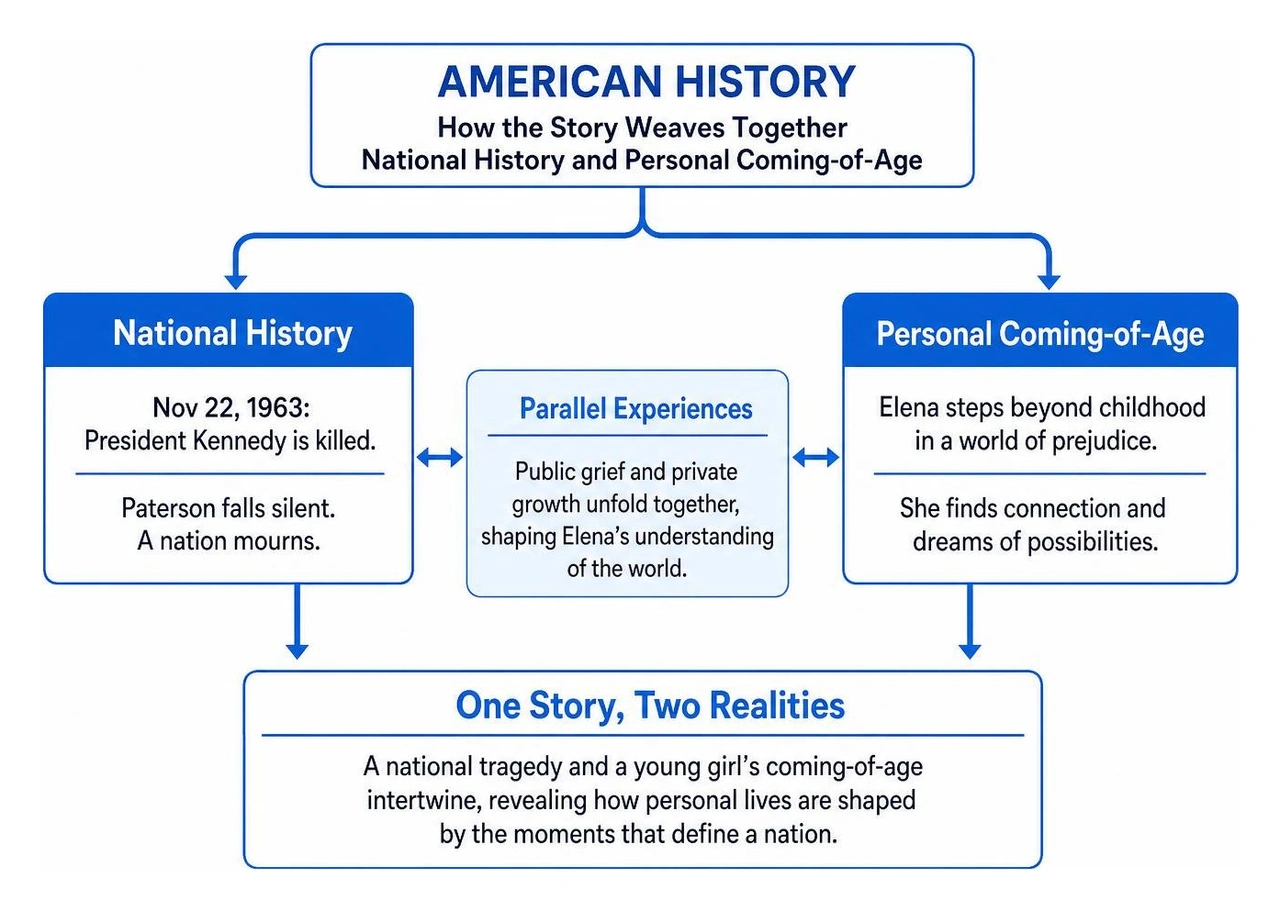
At the heart of the short story is a dual experience of grief. Cofer weaves together the public mourning of a nation with the private, silent ache of a young girl stepping out into the world. Through this lens, we see how large-scale historical events and quiet, personal milestones share the same human landscape. Elena's story reminds us that history is not only found in textbooks; it lives in the hallways of apartment buildings, on front porches, and in the hopeful glances between neighbors.
Plot and Setting in American History Judith Ortiz Cofer
The setting of Paterson serves as a physical reflection of Elena's internal world. "El Building" is crowded, lively, and filled with the warmth of shared immigrant experiences, yet it is also viewed with condescension by outside neighbors. From the vantage point of her fire escape, Elena finds a quiet sanctuary where she can read books, look down into the yard next door, and dream about what life might look like beyond the borders of her immediate surroundings. The fire escape becomes a kind of threshold—a place between the familiar comfort of home and the wider world she longs to understand.
Character Dynamics in American History Judith Ortiz Cofer
The dynamic between Elena and Eugene reflects two gentle souls finding common ground despite their different origins. In the schoolyard, their peers mock them with unkind nicknames—calling Elena "Skinny Bones" and Eugene "the Hick" because of his southern accent. Yet, inside their shared love for books, they discover a safe harbor of mutual respect. Their friendship shows how kindness can bloom even when the world outside feels unkind.
| Character | Cultural & Geographic Origin | Living Environment | Peer Perception & Challenges |
|---|---|---|---|
| Elena | Puerto Rico / Paterson, NJ | Urban tenement ("El Building") | Teased as "Skinny Bones"; faces ethnic prejudice |
| Eugene | Rural Georgia | Single-family home next door | Teased as "the Hick"; isolated newcomer |
The Title and Metaphor of Gray Snow
The title American History carries a deliberate double meaning. On the surface, it refers to the monumental presidential tragedy being recorded in textbooks. Yet, it also refers to the everyday reality of growing up, learning difficult lessons about human nature, and experiencing exclusion. In this way, Cofer gently suggests that the story of a nation is made up of many smaller stories—each one carrying its own weight of hope and heartache.
At the end of the day, as Elena looks out into the evening chill, she watches snow falling from the sky. While the snow is pure and white as it drifts downward, it turns gray the moment it touches the soot and dirt of the pavement below. In a moving act of quiet resilience, Elena consciously looks up at the sky rather than down at the gray slush, choosing to keep her sense of wonder alive despite her disappointment. That small gesture speaks to something tender and true: even when life leaves marks on us, we can still choose to look upward.
Cultural Identity and Prejudice in 1960s America

During the early 1960s, American communities were undergoing profound demographic shifts. As families moved between regions and urban neighborhoods evolved, cultural boundaries were often tested. Elena's journey highlights how ordinary individuals sought dignity, connection, and understanding in times of rapid social change. Her story is not only about one girl's disappointment; it is also a gentle invitation to notice the quiet courage of neighbors who keep reaching out, even when the welcome they hope for does not come.
Elena and Eugene's Relationship
Elena and Eugene's bond develops through simple, heartfelt interactions: walking home together, talking about books like Gone with the Wind, and sharing the universal awkwardness of adolescence. Their friendship proves that when given the chance, young people easily see past regional or cultural differences. In their shared love of reading, they find a language that needs no translation—a reminder that curiosity and kindness can build bridges where suspicion might otherwise stand.
Rejection at the Green Door
The turning point occurs when Elena walks over to Eugene's house to study. She is met at the doorway by Eugene's mother. Standing behind the screen door, the mother politely but firmly turns Elena away, explaining that Eugene cannot study with her and mentioning that their family will not be living there long anyway. It is a moment that stings with quiet confusion, the kind of hurt that settles deep and lingers long after the door closes.
The green door—initially an invitation of fresh hope—becomes a physical barrier. Eugene's mother is grieving the president's passing, yet she is unable to extend kindness to the neighbor on her porch. It is a moment that shatters Elena's youthful idealism, teaching her that overcoming social barriers takes patience, grace, and time. Still, Elena's willingness to walk up those steps at all speaks to a hopeful spirit that no closed door can fully extinguish.
Frequently Asked Questions About the Short Story
Who is the main character in American History and what is her background?
The protagonist is Elena, a fourteen-year-old Puerto Rican girl living in Paterson, New Jersey, in 1963. She is a thoughtful, observant student who loves reading and is learning how to navigate her bicultural identity within an urban neighborhood.
What does Eugene's mother's rejection reveal about 1960s prejudice?
The rejection illustrates how subtle social distance and unspoken assumptions created barriers between neighbors. Rather than overt hostility, it shows how misunderstandings and cultural separation prevented people from recognizing the shared humanity of those living right next door.
What is the significance of the title American History?
The title connects two parallel threads: the shared historical event of President Kennedy's assassination and the personal history of an immigrant teenager learning hard truths about life in America. It reminds us that our country's history is composed of both great national milestones and the everyday stories of ordinary people.
Conclusion
Judith Ortiz Cofer leaves us with a story that is honest about life's challenges yet filled with enduring hope. Elena's story reminds us that every neighborhood, every porch, and every family holds a vital piece of the broader American tapestry. When we take the time to listen to each other's experiences, we build bridges of kindness that help bring communities closer together. Her quiet courage invites us to remember that belonging is not always immediate, but it is always worth pursuing.
Here at Patriot Dreams, we believe that exploring our shared heritage helps us understand where we have been and where we can go together. Just as we cherish personal stories of growth and courage, we can also look back at the vision of our early leaders—from the ideals established by the founding fathers to the voices shaping our culture today. By opening our doors and listening with an open heart, we can help ensure that every story has a welcoming place to call home. In the end, the most meaningful chapters of American history are often the ones written quietly, in ordinary moments, by people who simply choose to keep hoping.

Join the Patriot Dreams Community
Download the app today and start your journey through American history and personal legacy.

Explore Our Latest Insights
Dive into stories that shape our American legacy.