Why Ida B. Wells is the Ultimate Investigative Icon


Why Ida B. Wells Journalist Stands as One of America's Most Courageous Voices
Ida B. Wells journalist is one of the most important figures in American history — a fearless reporter, a devoted mother, and a tireless champion for justice who spent nearly five decades fighting for the rights of Black Americans and women.
Here is a quick look at who she was and why she still matters:
Key FactDetailBornJuly 16, 1862, Holly Springs, MississippiDiedMarch 25, 1931, Chicago, IllinoisKnown ForInvestigative journalism, anti-lynching activism, women's suffrageMajor WorksSouthern Horrors (1892), A Red Record (1895)Organizations FoundedNAACP, NACW, Alpha Suffrage ClubKey Honor2020 Pulitzer Prize Special Citation; 2025 U.S. Quarter
Her great-granddaughter, Michelle Duster, once described her simply: "My great-grandmother was a very brave woman." That quiet, personal truth says everything.
At a time when speaking out could cost you your life, Ida B. Wells picked up a pen and wrote the truth anyway. She used facts, statistics, and eyewitness accounts to expose the brutal reality of lynching in America. She sued a railroad company at age 22. She marched for the right to vote. She built community organizations from the ground up — all while raising four children.
She was not just a journalist. She was a one-woman movement.
This guide explores her remarkable life — from a small town in Mississippi to the halls of international influence — and explains why her legacy still feels so alive and so necessary today.
Terms related to Ida B Wells journalist:
The Courageous Beginnings of Ida B. Wells Journalist
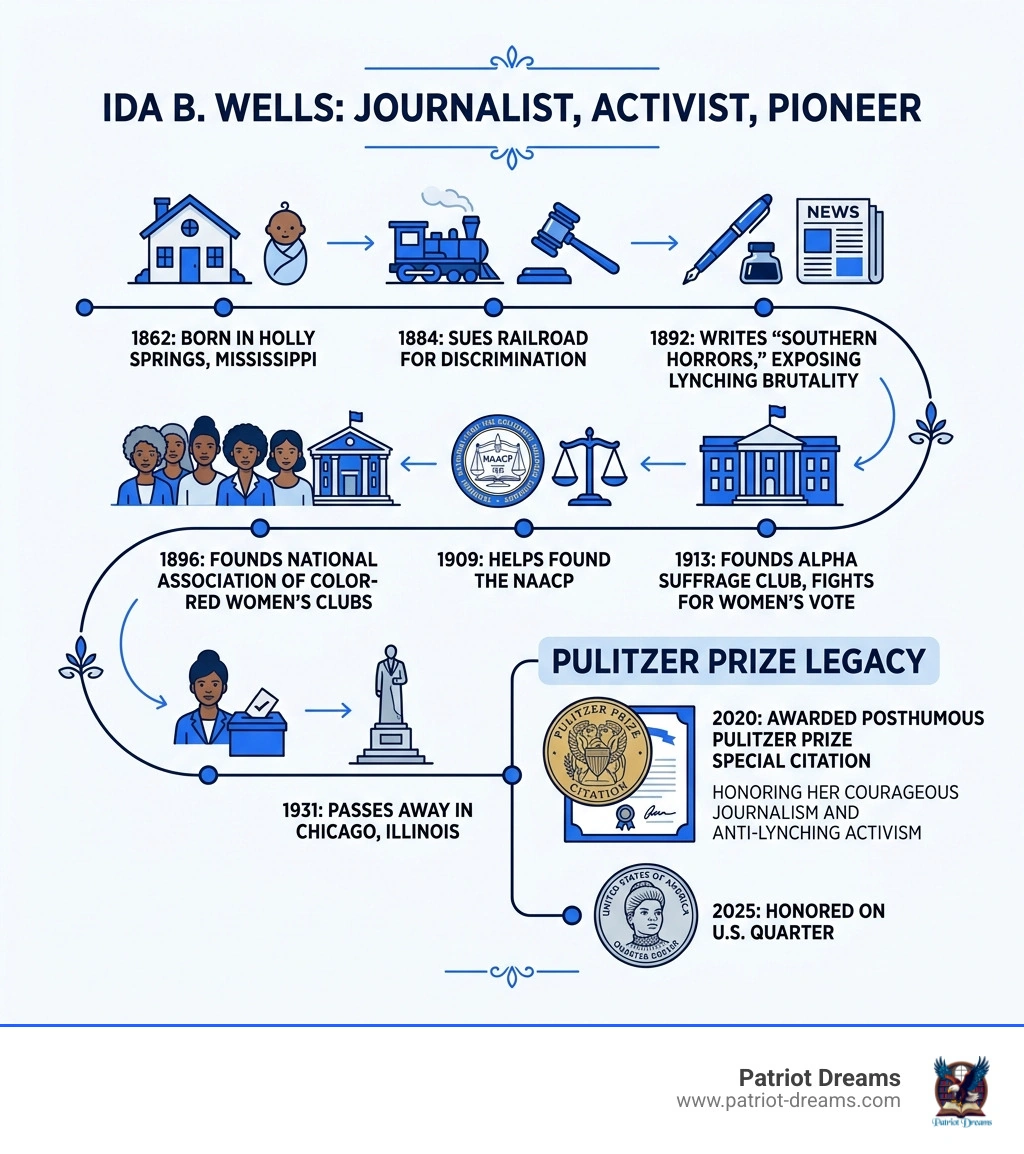
To understand the fire that drove Ida B. Wells journalist, we have to look back at her roots in Holly Springs, Mississippi. Born into slavery in 1862, Ida was the oldest of eight children. Her parents, James and Lizzie Wells, were deeply involved in their community during the Reconstruction era. They taught Ida the importance of education and standing up for one’s beliefs.
However, tragedy struck when Ida was just 16. A yellow fever epidemic swept through the region, claiming the lives of both her parents and her youngest brother. While many suggested the remaining children be split up and sent to foster homes, Ida refused to see her family broken apart. Showing a level of resilience that would define her life, she convinced a school administrator she was 18 to secure a teaching job. She became the breadwinner, keeping her siblings together and continuing her own education at Rust College (then Shaw University). This early devotion to family and community was the bedrock of her character. You can learn more about her early surroundings via the Ida B. Wells (U.S. National Park Service) archives.
A Seat for Justice: The 1884 Train Incident
Long before the modern Rosa Parks story became a household name, Ida B. Wells took a stand on a train. In 1884, while traveling on the Chesapeake & Ohio Railway, Ida purchased a first-class ticket. Despite her ticket, the conductor ordered her to move to the smoking car because of her race.
Ida refused to budge. When the conductor tried to physically remove her, she bit his hand to defend herself. It took three men to drag the 22-year-old off the train. Rather than backing down, she sued the railroad. A local circuit court initially granted her a $500 award—a massive sum equivalent to nearly $18,000 today. Though the Tennessee Supreme Court later overturned the decision, this moment sparked her public career as an activist. It taught her that the legal system often failed those it was meant to protect, and that the "power of the pen" might be her strongest weapon.
Finding Her Voice as Iola
While teaching, Ida began writing for The Living Way, a church weekly. She used the pen name "Iola" to critique the poor conditions of Black schools and the injustices of Jim Crow laws. Her writing was so sharp and insightful that she quickly gained national recognition, earning the nickname "Princess of the Press."
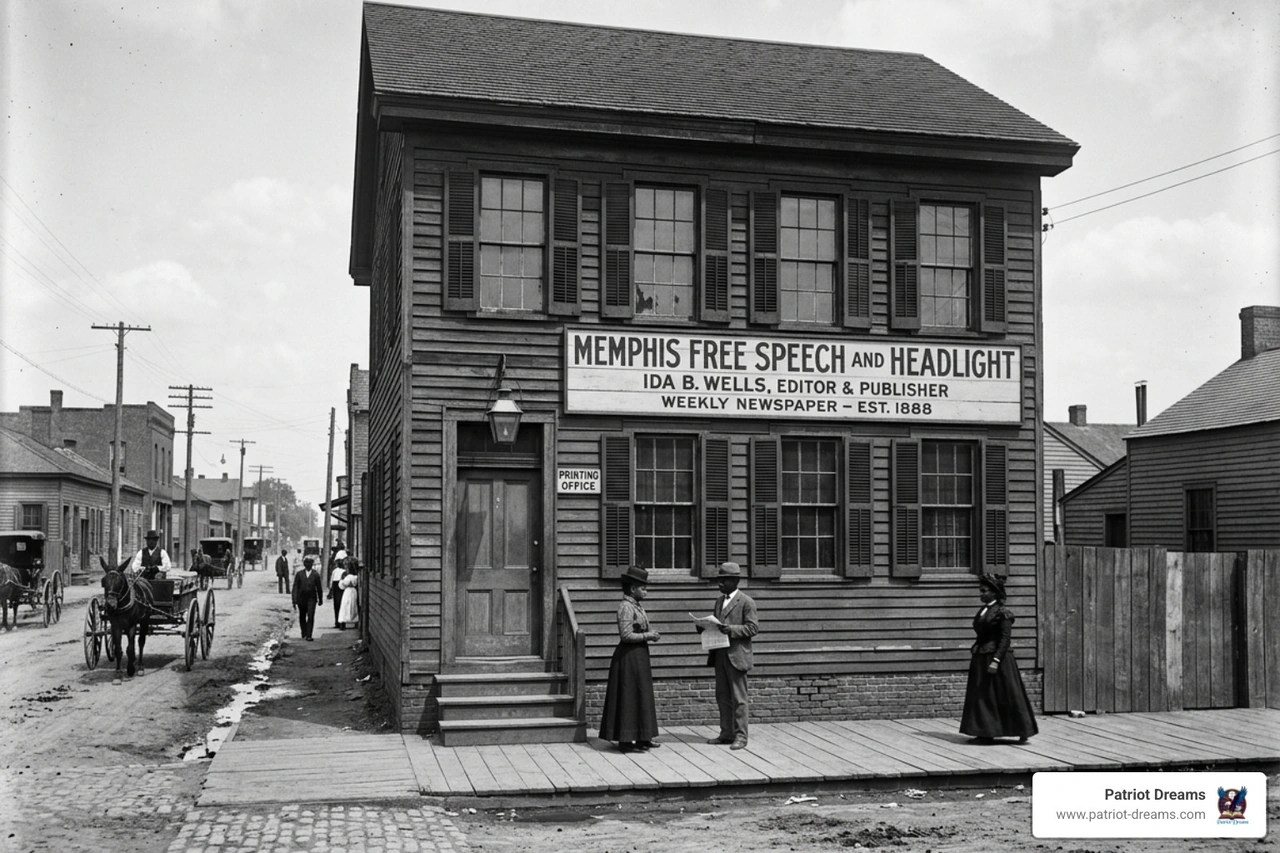
Eventually, her bold honesty cost her her teaching job, but it opened a new door. She became a co-owner and editor of the Memphis Free Speech and Headlight. Much like the famous Nellie Bly journalist who was making waves in New York, Ida used her platform to investigate the truth that others were too afraid to touch. She wasn't just reporting the news; she was leading her community.
Shining a Light on Truth: The Anti-Lynching Crusade
The turning point of her life came in 1892. Three of Ida’s close friends—Thomas Moss, Calvin McDowell, and William Stewart—opened the People’s Grocery in Memphis. Their store was successful, which drew the ire of a white grocer across the street. After a series of confrontations, a white mob attacked the store. Ida’s friends defended themselves, but they were eventually arrested and then brutally lynched by the mob.
This wasn't just a news story for Ida; it was a personal heartbreak. She realized that the common excuse for lynching—that it was a punishment for criminal behavior—was a "threadbare lie." In reality, it was a tool used to eliminate Black economic and political competition. She urged the Black community in Memphis to leave the city, leading to an exodus of over 6,000 people and a massive boycott of white businesses. Her investigation into the truth behind these murders is detailed in her biography at the Ida B. Wells-Barnett | National Women's History Museum.
The Power of the Pen in Southern Horrors
Forced to flee Memphis after a mob destroyed her newspaper office, Ida moved to New York. She didn't stop her work; she intensified it. She published Southern Horrors: Lynch Law in All Its Phases in 1892. In this pamphlet, she used investigative journalism to debunk the myths surrounding lynching.
She argued that lynchings were a form of domestic terrorism meant to keep Black Americans in a state of fear. Much like the powerful oratory found in a Sojourner Truth speech, Ida's writing was a call to action. She suggested that a "Winchester rifle should have a place of honor in every Black home" for self-defense and championed economic boycotts as a way to hit the pocketbooks of those who permitted lawlessness.
A Red Record and the Birth of Data Journalism
In 1895, Ida published A Red Record, a 100-page sociological investigation. This was a pioneering work in what we now call "data journalism." Instead of just sharing anecdotes, she compiled hard statistics from white-owned newspapers to prove her points. She knew that white audiences would be harder-pressed to dismiss data from their own sources.
Her research was staggering. She compiled statistics showing that between 1899 and 1908, 959 people were lynched in the U.S., with 857 of those victims being Black. By documenting the "cold hard facts," she forced the world to look at the Civil Rights Movement through a lens of undeniable truth. Her investigative techniques—eyewitness interviews, record examination, and statistical analysis—set the standard for modern reporting.
A Heart for Community and the Suffrage Movement
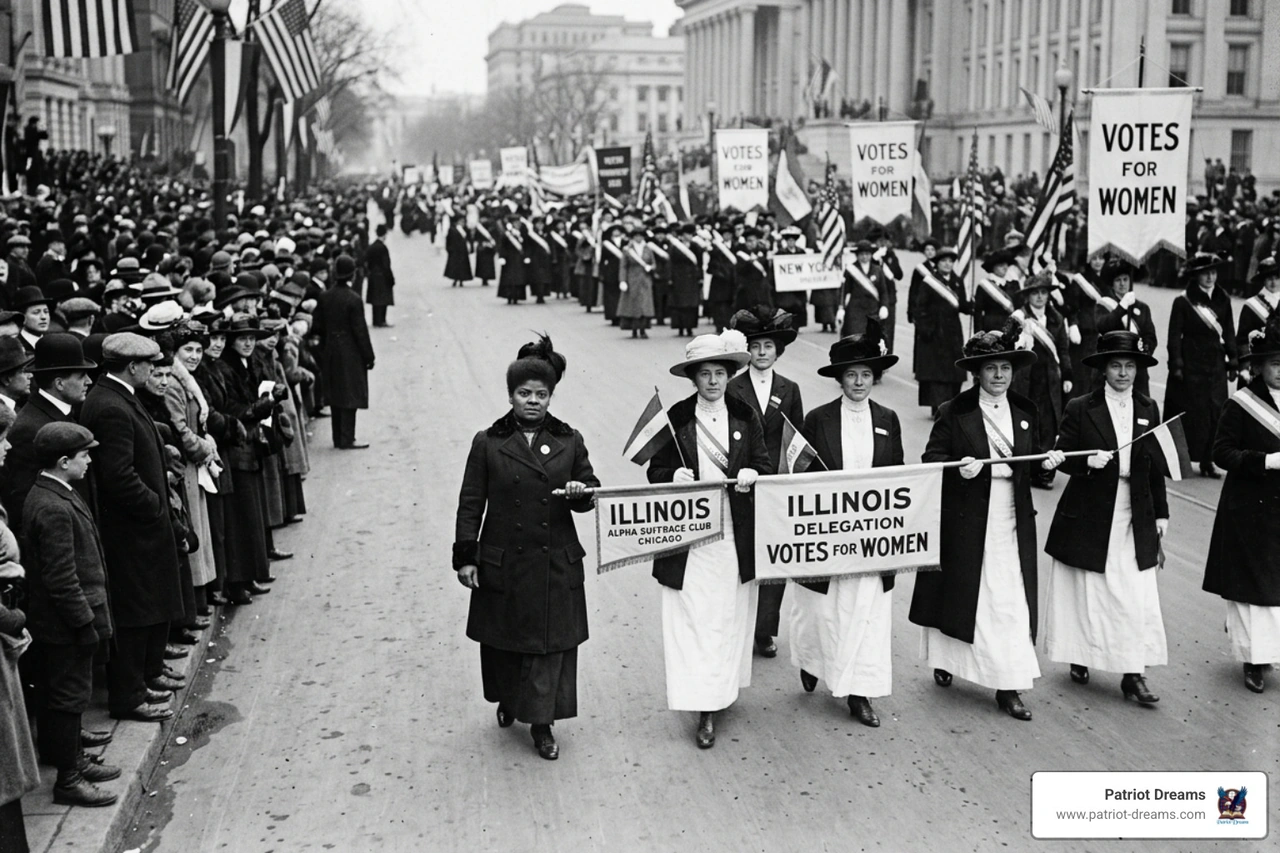
Ida B. Wells was a firm believer that the right to vote was essential for protection and progress. In Chicago, she founded the Alpha Suffrage Club in 1913, the first Black women's suffrage organization in the city. However, she often found herself at odds with white suffragists who wanted to exclude Black women to appease Southern supporters.
During the 1913 Women's Suffrage Procession in Washington, D.C., organizers asked Black women to march at the very back of the parade. Ida refused. She waited on the sidewalk until the Illinois delegation passed by, then stepped right into her place at the front of the group. She understood that justice cannot be segregated. Her courage paved the way for leaders like Martin Luther King Jr The Dream The Struggle The Legacy to continue the fight for equal voting access decades later.
Building Bridges with the NAACP and NACW
Ida’s activism extended to the founding of some of America's most enduring organizations. She was a founding member of the National Association for the Advancement of Colored People (NAACP) and the National Association of Colored Women (NACW).
In Chicago, she established the Negro Fellowship League, which served as a social service center for Black men migrating from the South. It provided housing, employment assistance, and a sense of community. While history often highlights Famous Black Men of the era, Ida was a foundational pillar who built the infrastructure for social justice in the urban North.
Balancing a Life of Purpose and Family
One of the most inspiring aspects of Ida B. Wells journalist was her ability to balance a world-changing career with a rich personal life. In 1895, she married Ferdinand L. Barnett, a widower and the editor of the Chicago Conservator. Unusually for the time, she kept her maiden name, becoming Ida B. Wells-Barnett.
Together, they had four children. Ida was a devoted mother who often brought her nursing babies with her on lecture tours. She proved that one could be a fierce warrior for justice and a nurturing parent at the same time. Her home in Chicago, which is now a national landmark, was a place of both family warmth and political strategy.
The Global Impact of an Ida B. Wells Journalist
Ida knew that the eyes of the world could help shame the United States into change. She took her anti-lynching campaign across the Atlantic, embarking on two speaking tours in Great Britain in the 1890s. Her lectures led to the formation of the British Anti-Lynching Committee.
By gaining international support, she put pressure on American politicians and business leaders. Her work abroad was reminiscent of the humanitarian spirit of Clara Barton Nurse, who also looked beyond borders to advocate for the suffering. Ida showed that the fight for human rights is a global responsibility.
Frequently Asked Questions about Ida B. Wells
What was the most famous work of Ida B. Wells journalist?
While she wrote hundreds of articles, her most famous works are the investigative pamphlets Southern Horrors and A Red Record. These publications were because they used data and sociology to expose the economic motives behind racial violence. Her work gave voice to those who had been silenced, much like the stories of resilience found in Rising From The Shadows How Cathay Williams And African American Soldiers Inspired New Hope During The Civil War.
Why is she considered an investigative icon?
Ida B. Wells is an investigative icon because she pioneered techniques that are still the gold standard today. She didn't just report what she was told; she went to the scene, interviewed eyewitnesses, and analyzed official records to find the truth. She was a master of "fact-checking" before the term existed. Her bravery in the face of physical danger is comparable to the daring feats of figures like Robert Smalls, whose story of courage is told in Stealing Freedom How Robert Smalls Commandeered A Confederate Warship.
How did Ida B. Wells journalist change American history?
She changed history by forcing America to confront the reality of lynching and by integrating the women's suffrage movement. She provided the statistical foundation for the anti-lynching laws that would eventually be passed decades later. Her work laid the groundwork for the 20th-century civil rights movement, ensuring that the legacy of a Sojourner Truth speech would be carried forward into a new era of activism.
A Legacy That Continues to Inspire
As we look at the world today, the legacy of Ida B. Wells journalist is more visible than ever. In 2020, she was posthumously awarded a Pulitzer Prize Special Citation for her "courageous reporting on the horrific and vicious violence against African Americans." In 2025, the United States Mint honored her as part of the American Women Quarters program, ensuring that her face—and her story—reaches millions of people every day.
At Patriot Dreams, we believe that stories like Ida’s are the heartbeat of our heritage. She reminds us that one person, armed with the truth and a heart full of love for their community, can indeed change the world. Her life was a testament to the idea that we are all responsible for one another, and that the best way to honor our ancestors is to continue their work for a fairer, kinder world.
We invite you to explore more stories of Historical American Figures on our interactive map. Let Ida’s resilience inspire you to find your own voice and use it for good. After all, as Ida herself showed us, the truth is a light that can never be fully extinguished.

Join the Patriot Dreams Community
Download the app today and start your journey through American history and personal legacy.

Explore Our Latest Insights
Dive into stories that shape our American legacy.