
The Peacemaker and Hiawatha: The True Origin of the Iroquois Confederacy


Before the Constitution, There Was the Great Law of Peace
The Iroquois confederacy origin stories are among the most powerful founding narratives in all of North American history — and they began long before any European set foot on this land.
Here is a quick overview of what these stories tell us:
- Who: The Confederacy was founded by three key figures — Dekanawida (the Great Peacemaker), Hiawatha, and Jigonhsasee (the Mother of Nations)
- What: They united five warring nations — Mohawk, Oneida, Onondaga, Cayuga, and Seneca — under a single Great Law of Peace
- When: Estimates range from 1142 (based on a solar eclipse) to around 1450 (based on archaeological evidence)
- Why: To end cycles of violence, grief, and revenge among the nations and replace them with justice, unity, and peace
- How: Through diplomacy, ceremony, wampum, and a shared constitution — the Great Law of Peace
Five nations that had been locked in generations of war chose peace instead. They buried their weapons beneath a great white pine tree. They built a government so thoughtful that centuries later, it would help inspire the founders of the United States.
That is a remarkable story. And it deserves to be told carefully and fully.
We are Kyle & Emily, and we are so glad you are here to explore this chapter of America's earliest heritage with us.
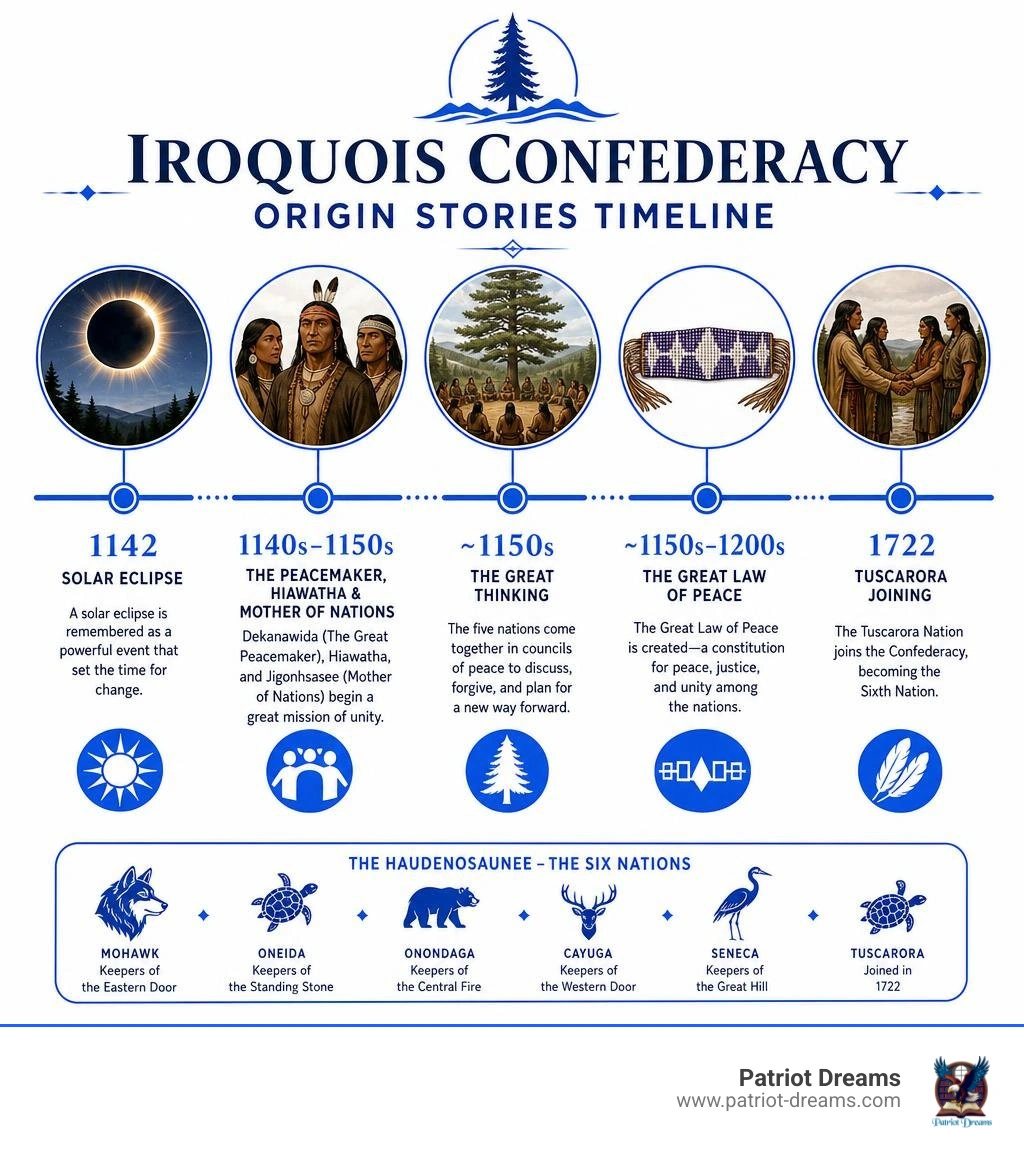
Iroquois confederacy origin stories terms explained:
The Dark Days of Discord Before the Great Law
To understand the beauty of peace, we must first look gently at the darkness that preceded it. Long before the Confederacy was established, the beautiful forests, lakes, and valleys of what is now upstate New York were places of deep fear and sorrow. The five original nations—the Mohawk, Oneida, Onondaga, Cayuga, and Seneca—were locked in a seemingly endless cycle of violent conflict.
This tragic era was defined by "Mourning Wars." When a loved one was lost in battle, the grieving family felt a deep, agonizing void. To fill this void, warriors would launch raids to capture members of neighboring nations. These captives were either adopted to replace the deceased family member or subjected to ritual execution to ease the community's grief. Instead of healing the pain, however, these actions only fueled more rage, sparking retaliatory raids. It was a cycle of sorrow that no one knew how to break.
At the center of this darkness stood a fearsome figure named Atotarho (sometimes spelled Tadadaho), a powerful Onondaga sorcerer. Traditional stories tell us that Atotarho's mind and body were so twisted by hatred, malice, and the pain of war that he had living snakes writhing in his hair. He was a tyrant who blocked every effort toward peace, striking terror into the hearts of anyone who dared to dream of a better way to live.
It was during these dark days of discord that the Creator looked down with compassion and sent a message of hope to the people. This message would forever change Native American History and light a path toward healing.
The Three Messengers of Peace in Iroquois Confederacy Origin Stories

Every beautiful journey begins with someone willing to take the first step. In the rich tapestry of the Iroquois confederacy origin stories, peace was brought to earth not by a mighty army, but by three gentle messengers who carried a message of righteousness, health, and power.
These three figures—the Great Peacemaker, Hiawatha, and Jigonhsasee—each played an indispensable role. Together, they proved that when different strengths are joined in a common purpose, even the most stubborn walls of hatred can crumble. To learn more about how their lives intertwined, you can read the detailed account of De-Ka-Nah-Wi-Da and Hiawatha - World History Encyclopedia.
The Great Peacemaker and the Power of His Message in Iroquois confederacy origin stories
The primary messenger was Dekanawida, known simply as the Great Peacemaker. Born of a virgin mother among the Huron people, he was a spiritual prophet sent by the Creator to establish the Great Peace. Because he had a speech impediment, he was a man of few words, but his actions carried supernatural authority.
To prove the divine power of his message, the Peacemaker traveled across Lake Ontario in a canoe made of white stone, a vessel that defied physical laws by floating gracefully and swiftly across the water. When he arrived among the Mohawk, they were understandably skeptical of his message of peace. To test his authority, they asked him to perform a miracle.
The Peacemaker climbed a tall tree perched high on a cliff overlooking a roaring waterfall. He instructed the Mohawk warriors to chop the tree down, sending him plunging into the deep, churning waters below. The warriors did so, believing he could not possibly survive. Yet, the next morning, they walked to a nearby clearing and found the Peacemaker sitting peacefully by a campfire, cooking a quiet meal. Witnessing his resilience and absolute faith, the Mohawk became the first nation to accept the Great Law of Peace.
Hiawatha and the Healing Power of Wampum in Iroquois confederacy origin stories
While the Peacemaker carried the spiritual vision, he needed a voice to speak it and a heart that understood the depths of human suffering. He found that partner in Hiawatha (Hayenwatha), an Onondaga chief whose name means "he who seeks the wampum belt."
Hiawatha had suffered unimaginable grief. The evil sorcerer Atotarho, opposing Hiawatha’s early advocacy for peace, had used his dark magic to cause the deaths of Hiawatha’s seven beloved daughters. Stricken with a grief so heavy it clouded his mind, Hiawatha wandered into the wilderness, unable to find comfort.
During his wanderings, Hiawatha sat by a lake. As a flock of ducks flew up from the water, their wings carried away the lake water, exposing the dry bed below. There, Hiawatha found beautiful white and purple shells. He gathered them and strung them together, creating the very first strings of wampum. He realized that these shells could be used to record thoughts, laws, and, most importantly, comfort the grieving.
When the Peacemaker met Hiawatha in the forest, he saw the grieving father's suffering. Using Hiawatha’s wampum strings, the Peacemaker performed the first Condolence Ceremony. He wiped the tears from Hiawatha’s eyes so he could see clearly, cleared the obstruction from his throat so he could speak, and comforted his heart so he could feel peace once more. This beautiful ritual transformed Hiawatha from a broken wanderer into the eloquent spokesperson for the Great Law of Peace, cementing his place among the most cherished American Folklore Characters.
Jigonhsasee and the Political Power of Women
The third crucial figure in the founding narrative was Jigonhsasee, a Seneca woman known as the Mother of Nations. She lived in a home situated along a major crossroads where warriors from different nations traveled.
Jigonhsasee was famous for her hospitality. She kept her home as a sacred sanctuary of peace. No matter what nation a traveler belonged to, she welcomed them, fed them, and gave them a safe place to rest. When the Peacemaker visited her, he explained his vision of the Great Law of Peace. She immediately understood its wisdom and agreed to help.
Because of her wisdom and her pivotal role in uniting the nations, the Peacemaker decreed that women would hold a sacred, central place in the new government. Jigonhsasee’s legacy established the matrilineal system of the Haudenosaunee. Under this system, the Clan Mothers (the elder women of each clan) held the ultimate political power. They were given the responsibility of choosing the chiefs, guiding their decisions, and holding the veto power to depose any leader who failed to act with kindness, honesty, and selflessness.
Planting the Tree of Peace and Burying the Hatchet
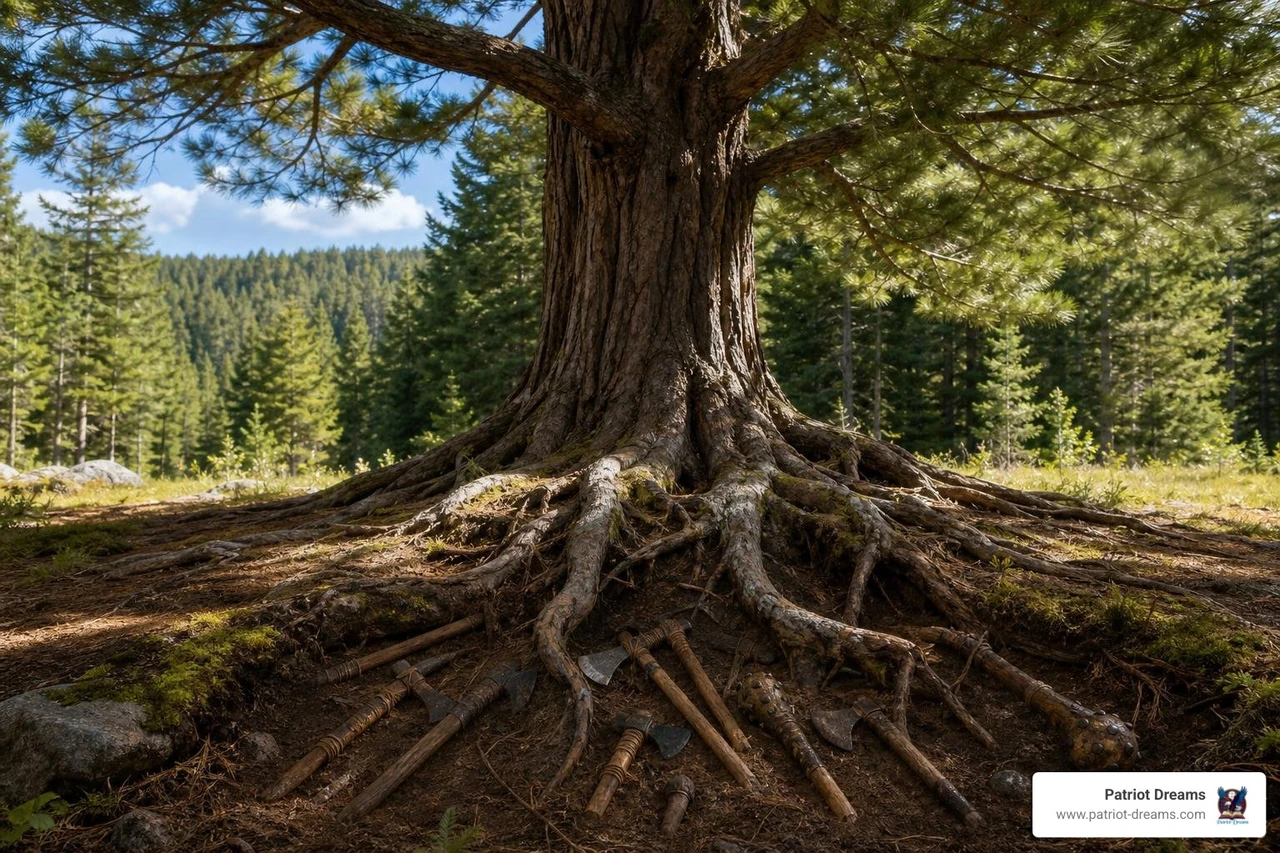
Once the five nations were convinced of the message of peace, the Peacemaker and Hiawatha led them to Onondaga territory to confront the final obstacle: the fearsome sorcerer Atotarho.
Instead of fighting him with weapons, the united people marched toward Atotarho singing the sacred Peace Hymn. The Peacemaker sat beside the twisted tyrant, sang to him, and gently rubbed his crooked body. Hiawatha used his wampum strings to offer words of condolence, healing the ancient wounds of Atotarho’s mind.
As the songs of peace washed over him, a miracle occurred: the snakes were gently combed from Atotarho's hair, his body straightened, and his mind was restored to sanity. To show him that he was valued, the Peacemaker made Atotarho the head firekeeper of the Grand Council. It is a beautiful lesson in reconciliation—rather than destroying their enemy, they transformed him into a friend and leader.
With all five nations finally united, the Peacemaker uprooted a giant white pine tree, creating a deep chasm that reached down into the waters of the earth. He instructed the chiefs of the five nations to throw all of their weapons of war into the cavern. The weapons were swept away by the underground currents, never to be seen again. This profound act is the literal origin of the common phrase "burying the hatchet." For a deeper look at this historic event, explore the article on How the Iroquois Confederacy Was Formed.
The Peacemaker replanted the Great Tree of Peace, and its roots grew deep and wide. These four "white roots of peace" extended to the north, south, east, and west, inviting any other nation that wished to live in peace to follow the roots to the tree and find shelter beneath its branches. At the very top of the tree, the Peacemaker placed a great eagle to watch over the people and sound the alarm if any danger approached, symbolizing the eternal vigilance required to protect peace.
Dating the Dawn of Democracy: 1142 vs. 1450
For generations, Western scholars and Indigenous historians have discussed the exact timeframe of the Confederacy's founding. While many modern archaeologists and anthropologists estimate that the League was formed around 1450, a powerful combination of oral history and astronomical science points to a much earlier, highly specific date: August 31, 1142.
According to Haudenosaunee oral tradition, the final agreement to form the League occurred on a day when the sun darkened and the sky turned to night—a total solar eclipse. By cross-referencing this oral description with historical astronomical data, researchers identified a total solar eclipse that passed directly over the Onondaga territory on August 31, 1142.
| Founding Theory | Estimated Date | Supporting Evidence | Key Focus |
|---|---|---|---|
| Astronomical Theory | August 31, 1142 | Solar eclipse records, oral traditions | Aligning natural phenomena with ancestral storytelling |
| Archaeological Theory | Circa 1450 | Ceramic styles, village settlement patterns | Physical artifacts and carbon dating of longhouse sites |
| Colonial Historical Theory | 1550–1660 | Early European trade goods, Jesuit records | Written documentation and contact-era accounts |
Whether founded in 1142 or 1450, the Haudenosaunee Confederacy stands as one of the oldest continuously operating participatory democracies in the entire world, showing us how deeply rooted the ideals of freedom and unity are in North American soil.
The Living Legacy of the Longhouse Government
The political structure established by the Great Law of Peace was beautifully modeled after the traditional longhouse, where up to twenty families lived together under one metaphorical roof. The Confederacy referred to themselves as the Haudenosaunee, which translates to "People of the Longhouse."
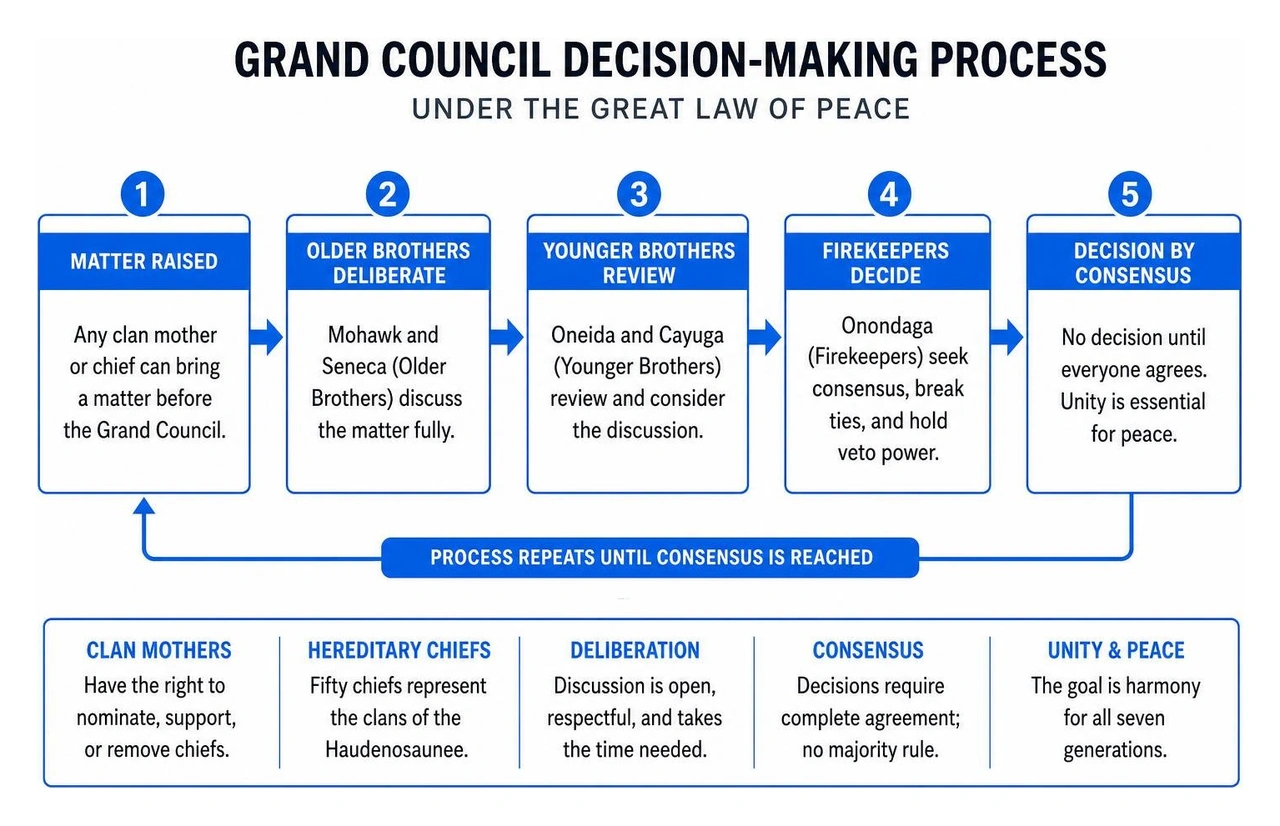
The government was led by the Grand Council, consisting of fifty hereditary chiefs representing the various clans of the five nations. Each nation had a specific role in this "two-house" legislature:
- The Mohawk and Seneca acted as the "Older Brothers," who first debated matters.
- The Oneida and Cayuga acted as the "Younger Brothers," who reviewed the decisions.
- The Onondaga acted as the "Firekeepers," who kept the council fire, broke ties, and held veto power.
Decisions in the Grand Council were made through absolute consensus, requiring patience, mutual respect, and a "skin seven spans thick" to withstand criticism and anger.
This unity was beautifully recorded in the Hiawatha Wampum Belt. The belt features four purple squares representing the Mohawk, Oneida, Cayuga, and Seneca, all connected by a white band of peace to a central symbol—the Great Tree of Peace—representing the Onondaga.
In 1722, the Tuscarora nation, fleeing colonial conflict in the south, followed the white roots of peace northward. They were warmly adopted into the league, turning the five nations into the Six Nations. This remarkable adaptation proved that the longhouse was always wide enough to welcome those seeking a peaceful home. This enduring system of governance remains a shining beacon of American Cultural History.
Frequently Asked Questions about Iroquois Confederacy Origin Stories
When was the Haudenosaunee Confederacy founded?
While early European scholars estimated the founding to be around 1450 to 1660, astronomical research linking a documented total solar eclipse in the region to Haudenosaunee oral history strongly suggests the Confederacy was founded on August 31, 1142.
What does the name Haudenosaunee mean?
Haudenosaunee means "People of the Longhouse" or "those who build the longhouse." It symbolizes their political and social unity, representing the idea that all six nations live together as one large family under a single, protective roof.
How did the Tuscarora join the Confederacy?
The Tuscarora joined the Confederacy in 1722 as the sixth nation after migrating from North Carolina to escape colonial war and displacement. They were adopted under the protection of the Great Tree of Peace, showing the expandable nature of the Haudenosaunee democratic model.
Conclusion
The Iroquois confederacy origin stories teach us that peace is not merely the absence of war; it is a gentle, active practice of healing, listening, and community. Long before the United States was born, the Haudenosaunee showed the world how to replace the pain of conflict with the warmth of consensus and the strength of a shared home.
At Patriot Dreams, we believe that every family, community, and nation has a story worth preserving. Our interactive map and audio storytelling platform are designed to bring these beautiful, unifying chapters of our shared heritage to life, helping you connect with the past and preserve your own family legacy for the generations to come.
We invite you to take a gentle step into our shared past. Explore the interactive map of early America and discover the inspiring voices of the Peacemaker, Hiawatha, and the Mother of Nations today.

Join the Patriot Dreams Community
Download the app today and start your journey through American history and personal legacy.

Explore Our Latest Insights
Dive into stories that shape our American legacy.