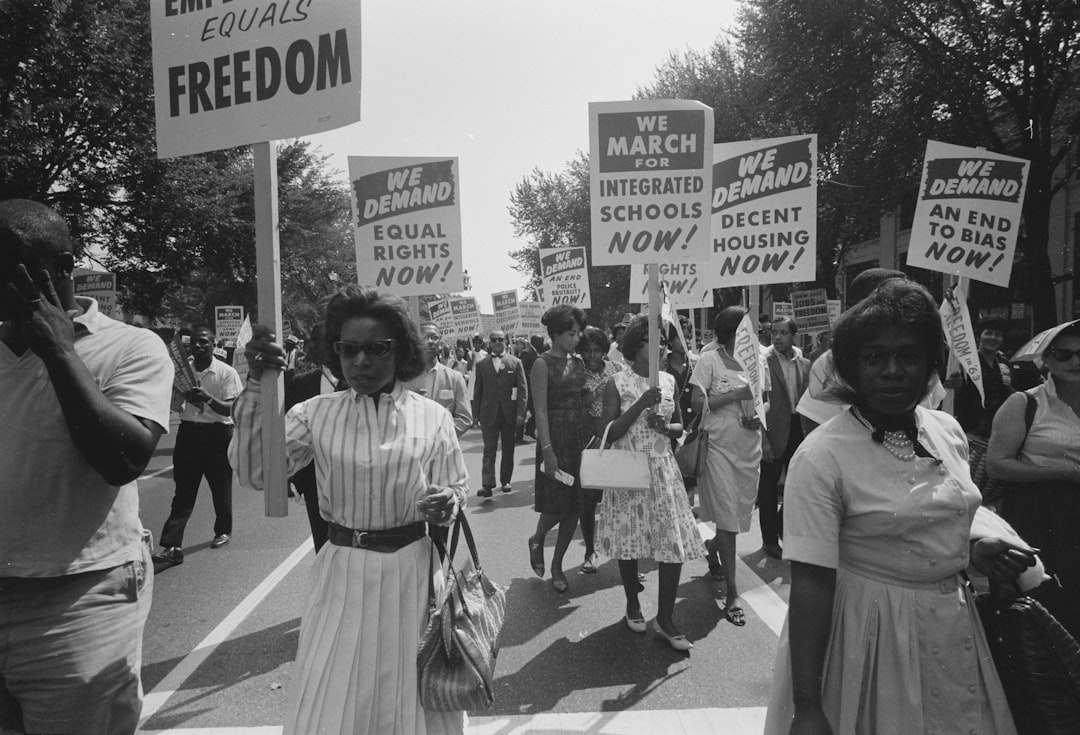
Step-by-Step Guide to Understanding MLK's Dream for America

Understanding MLK's Dream for America
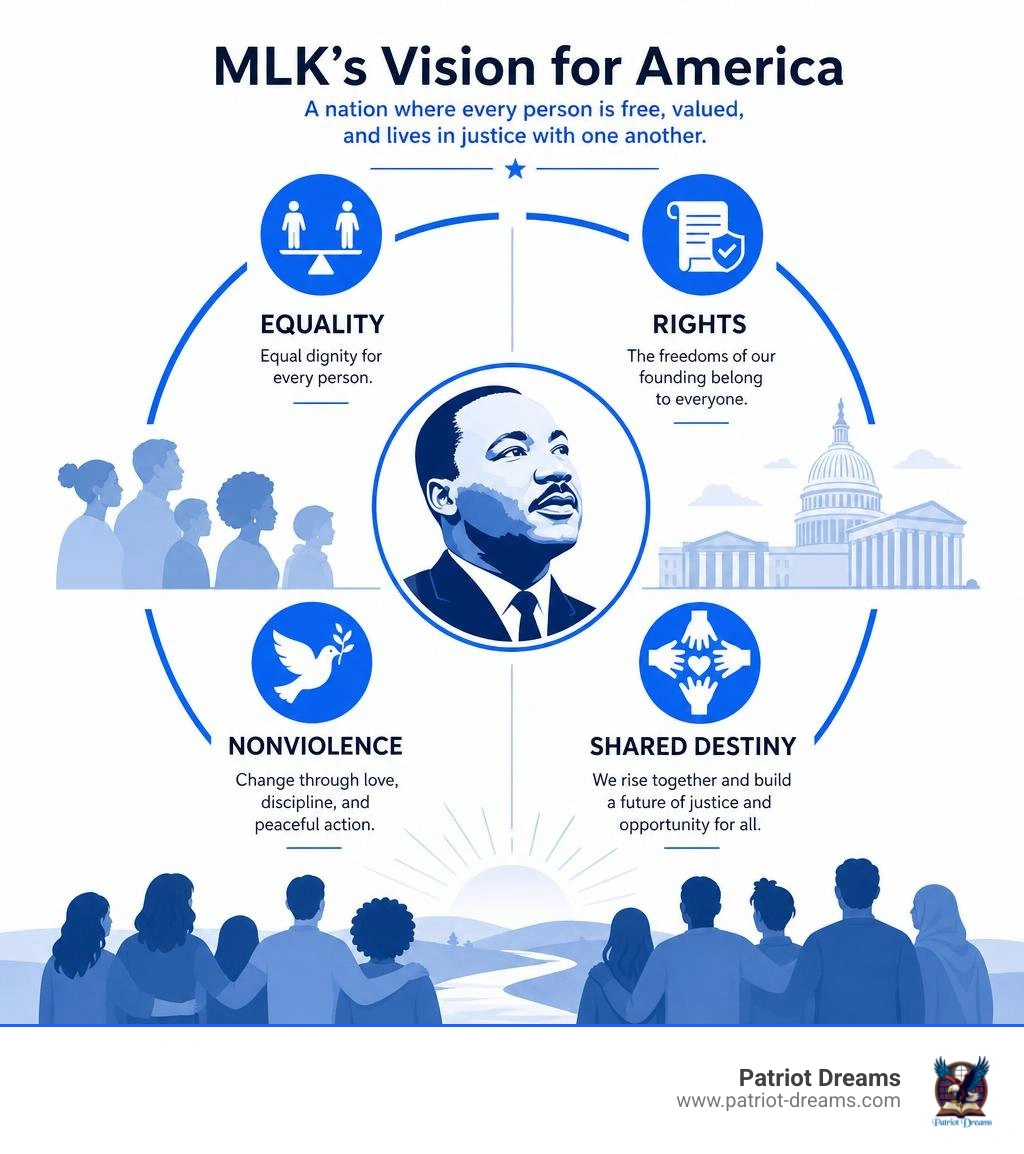
The MLK dream for America was a call to make the nation's own promise of equality real for every person. To understand it, start with three ideas:
- Equal dignity: People should be valued for their character, not their race.
- Equal rights: The freedoms named in America's founding ideals should belong to everyone.
- Shared responsibility: Change should come through disciplined, nonviolent action and a commitment to treat one another as neighbors.
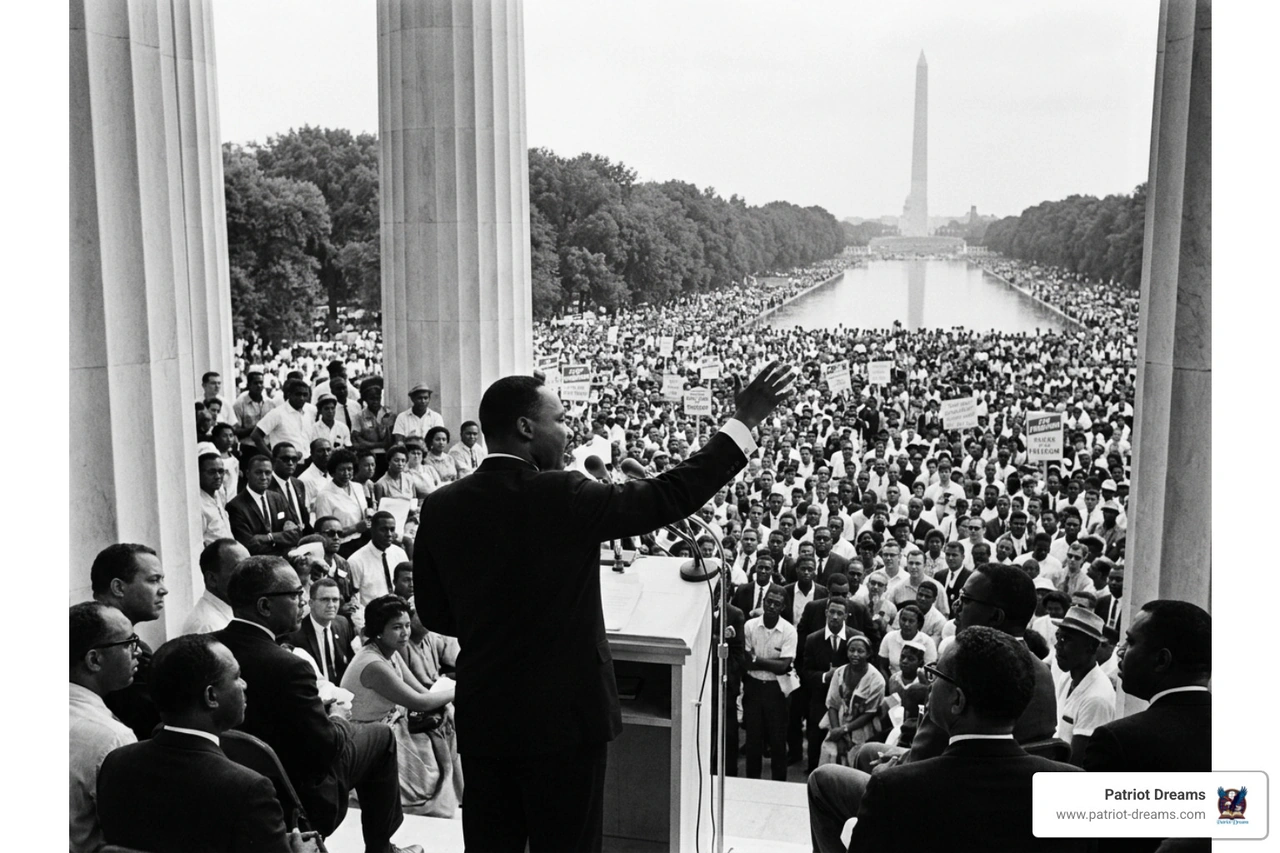
When Dr. Martin Luther King Jr. spoke at the Lincoln Memorial on August 28, 1963, more than 250,000 people had gathered for the March on Washington for Jobs and Freedom. He did not describe his dream as separate from America. He described it as America living up to its best principles - liberty, justice, opportunity, and brotherhood.
His vision was hopeful, but never passive. It asked the country to face unfinished work with courage and to build a future where freedom is more than a promise on paper.
We are Kyle & Emily, and we invite you to explore this enduring American vision one clear step at a time.
Easy MLK dream for America word list:
Core Foundations of the MLK Dream for America

To truly understand Dr. King’s vision, we have to look at the ground beneath his feet that warm August afternoon. Standing in the symbolic shadow of Abraham Lincoln—exactly one hundred years after the Emancipation Proclamation was signed in 1863—Dr. King looked out at an ocean of hopeful faces. He did not introduce a foreign philosophy or suggest abandoning the American experiment. Instead, he reached straight into our shared national heritage.
Reading the full text of King's landmark 1963 address, one immediately discovers that the dream was rooted in unity, moral integrity, and foundational law. In our deep exploration of Martin Luther King Jr.: The Dream, The Struggle, The Legacy, we see how this defining address bridged the nation's historic past with an optimistic vision for tomorrow.
Historical Roots of the MLK Dream for America
Dr. King anchored his message in the foundational creeds that defined the birth of the United States. He explicitly cited the Declaration of Independence and the U.S. Constitution, declaring that every individual possesses inherent dignity derived from our Creator. In his view, the civil rights struggle was not an adversarial attack on American traditions, but a patriotic campaign to help the country fulfill its original purpose.
By calling upon natural rights and moral universalism, King spoke to the conscience of all citizens. He envisioned an America where:
- Sons of former slaves and sons of former slave owners could sit down together at the table of brotherhood.
- The nation’s founding promise of unalienable rights—life, liberty, and the pursuit of happiness—applied to all people across every community.
- Neighborly goodwill and mutual respect replaced old divisions.
The Promissory Note and the Call for Justice
One of the most memorable metaphors in the address compared the Constitution and the Declaration of Independence to a financial promissory note. Dr. King explained that when the architects of our republic wrote those magnificent words, they were signing a promise to every American citizen.
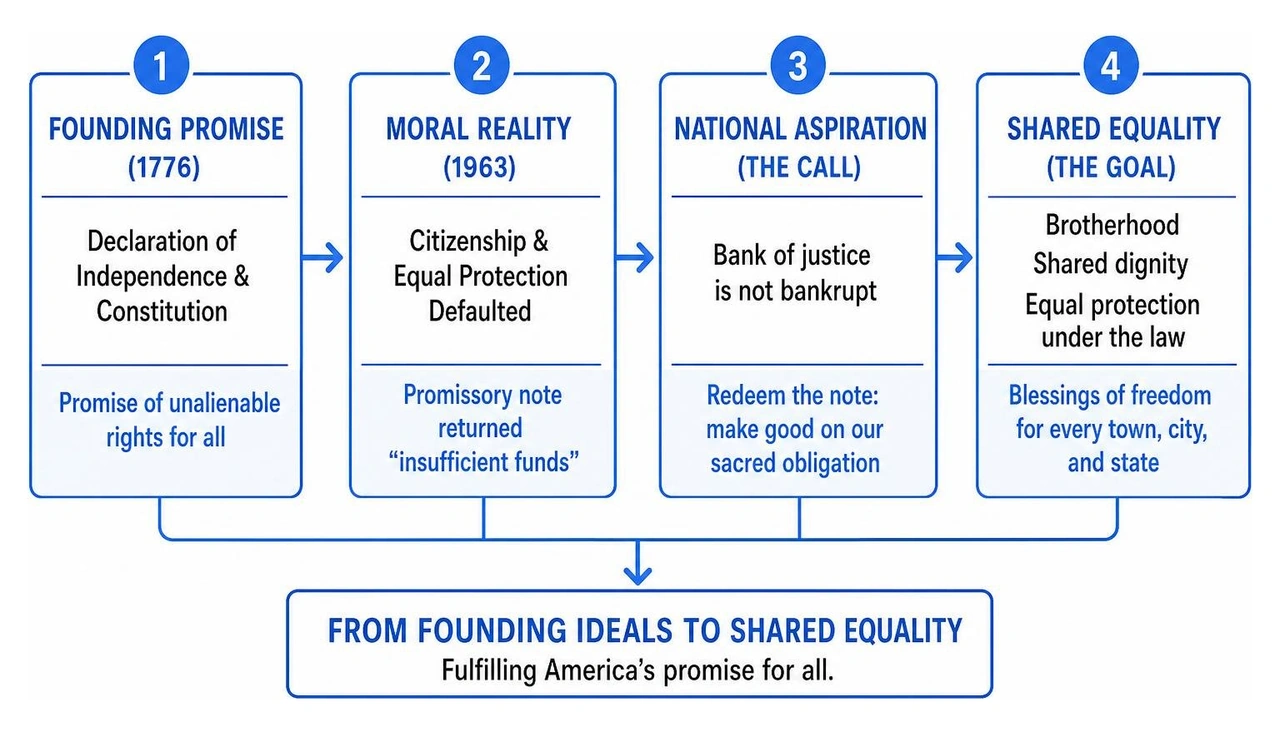
King noted that for generations of Black Americans, that promissory note had been returned marked "insufficient funds." Yet, his response was filled with extraordinary optimism. He refused to believe that the "bank of justice" was bankrupt. Instead, he called upon the country to make good on its sacred obligation, ensuring that every town, city, and state extended the blessings of freedom and equal protection under the law.
The Moral Engine: Nonviolent Resistance and the Fierce Urgency of Now

A dream without a clear, constructive path forward remains an abstract thought. Dr. King gave his vision life through the discipline of nonviolent direct action. From Christian theology, the teachings of Mahatma Gandhi, and American constitutional principles, he demonstrated that real, lasting change happens when people conduct their efforts on the highest moral ground.
According to the Avalon Project historical speech record, Dr. King reminded the nation that dignity and self-control were essential to social progress. For those wishing to learn more about the everyday heroes who walked these roads, our Civil Rights Movement Ultimate Guide offers a comprehensive look at the remarkable men and women who stood up for their neighbors.
Dismantling the Tranquilizing Drug of Gradualism
Dr. King spoke powerfully of the "fierce urgency of now." He cautioned against the tranquilizing drug of gradualism—the mistaken belief that society should simply sit back and wait for time alone to heal historical wounds. Progress, he argued, requires dedicated human effort, neighborly engagement, and courageous legislative reform.
He set clear, measurable milestones for national health and civic fairness:
- An end to discrimination in public accommodations, motels, and transit.
- Protection of voting access for every eligible citizen in every state.
- Equal legal protection against unfair treatment and unlawful violence.
By pairing clear legislative goals with an unwavering belief in peaceful persuasion, King helped pave the way for monumental laws like the Civil Rights Act of 1964 and the Voting Rights Act of 1965.
The Power of Soul Force and Shared Destiny
Central to King’s philosophy was the concept of meeting physical force with "soul force." He urged his listeners never to allow creative protest to degenerate into bitterness, hatred, or physical retaliation. Instead, he taught that nonviolence is guided by Agape—an unconditional, understanding goodwill that seeks to turn opponents into friends.
He also emphasized that the destiny of Black Americans is inextricably bound up with the destiny of white Americans. Freedom could never be a zero-sum contest where one group gains at the expense of another. When any community is lifted up, the entire fabric of American life is strengthened.
The Evolution of King's Vision: Beyond Domestic Civil Rights
As the mid-1960s progressed, Dr. King broadened his focus to address challenges that touched all people, regardless of their background. His perspective evolved from legal desegregation toward building a society where every family had the chance to work, grow, and flourish.
In his July 4th American Dream speech transcript, King expanded upon the idea of an interconnected world. He observed that true human flourishing requires both strong moral character and genuine economic opportunity. To explore how these foundational hopes continue to inspire people today, see our reflection on Why the American Dream Still Resonates: A Cultural Deep Dive.
From Legal Desegregation to Economic Opportunity
Securing the legal right to sit at a lunch counter was a monumental triumph, but Dr. King recognized that a person must also have the economic ability to buy the meal. In his later work, including the Poor People's Campaign, he advocated for:
- Vocational excellence and educational opportunities for all working-class families.
- Decent, affordable housing and fair wages.
- Uplifting impoverished rural and urban communities across our nation.
He often reminded his listeners to take personal pride in their daily work, noting that if a person is called to be a street sweeper, they should sweep streets even as Michelangelo painted pictures or Beethoven composed music.
A Global Garment of Destiny
Dr. King’s vision extended far beyond our national borders. In an increasingly connected twentieth century, he observed how rapid travel and communication brought humanity closer together. He famously remarked that if a flight is fast enough, you can take off in one city and arrive so quickly that you feel like you left tomorrow.
He noted that all humanity is tied together in an "inescapable network of mutuality, tied in a single garment of destiny." Whether observing anti-colonial movements across Africa and Asia or reflecting on international poverty, Dr. King maintained that true peace is not merely the absence of tension, but the presence of justice, cooperation, and mutual goodwill among nations.
Interpreting the Legacy: Character, Community, and Enduring Meaning
Decades later, Dr. King’s words continue to resonate across the entire American political landscape. His famous desire—that his four young children would one day live in a nation where they would not be judged by the color of their skin, but by the content of their character—stands as one of the most celebrated moral aspirations in world history.
| Dimension of King's Dream | Legal / Civic Milestone | Broader Moral & Cultural Aspiration |
|---|---|---|
| Individual Worth | Equal protection under the 14th Amendment | Judging people solely by the content of their character |
| Civic Participation | Voting Rights Act of 1965 | Active, engaged citizenship and universal voter protection |
| Public Life | Civil Rights Act of 1964 | The table of brotherhood; shared public spaces without hostility |
| Economic Dignity | Fair labor standards and housing acts | Meaningful work, vocational pride, and poverty alleviation |
| Community Relations | De-escalation and constitutional policing | Multiracial solidarity and mutual neighborly care |
Visiting the Martin Luther King Jr. Memorial along the Tidal Basin in Washington, D.C., one is reminded of the timeless bridge his life built between our highest ideals and daily civic responsibilities.
How the MLK Dream for America Inspires Future Generations
The beauty of Dr. King’s dream is that it belongs to every generation of Americans. It serves as a gentle yet steady mirror, asking each of us how we can be kinder neighbors, more responsible citizens, and better stewards of freedom. When we honor everyday heroism and foster unity in our neighborhoods, we help keep that sacred promise alive.
Frequently Asked Questions About King's Vision
What was the central message of Martin Luther King Jr.'s 1963 speech?
The central message was that America should fulfill its founding democratic promise that all people are created equal. King called for an end to racial segregation, universal voting rights, and a culture where individuals are evaluated by their character and actions rather than their background.
Why did MLK describe the Constitution and Declaration as a promissory note?
He used the metaphor of a promissory note to explain that the founding documents guaranteed unalienable rights—life, liberty, and the pursuit of happiness—to all citizens. While the country had historically fallen short of that guarantee for Black Americans, King expressed complete faith that America had the moral resources to make good on its commitment.
How did Dr. King define nonviolent resistance?
Dr. King defined nonviolent resistance as "soul force"—a disciplined method of social reform grounded in unconditional goodwill (Agape love). It seeks to overcome unfair systems and reconcile divided communities without resorting to physical violence, bitterness, or personal malice.
Conclusion
The enduring power of Martin Luther King Jr.’s dream is that it calls forth the best within us. It reminds us that our differences need not divide us, and that our national story is richest when every voice has a place in the chorus of freedom.
At Patriot Dreams, our mission is to bring these inspiring chapters of American history to life. Through our interactive heritage map and immersive digital audio storytelling, we help families discover the places, people, and quiet moments of perseverance that shaped our country. We invite you to explore the complete history of the civil rights movement, preserve your family’s unique heritage, and celebrate the shared journey of an America striving toward brotherhood, dignity, and unity for all.

Join the Patriot Dreams Community
Download the app today and start your journey through American history and personal legacy.

Explore Our Latest Insights
Dive into stories that shape our American legacy.