Uncovering the History and Facts of the Civil Rights Movement

Why Civil Rights Movement Facts Still Matter Today
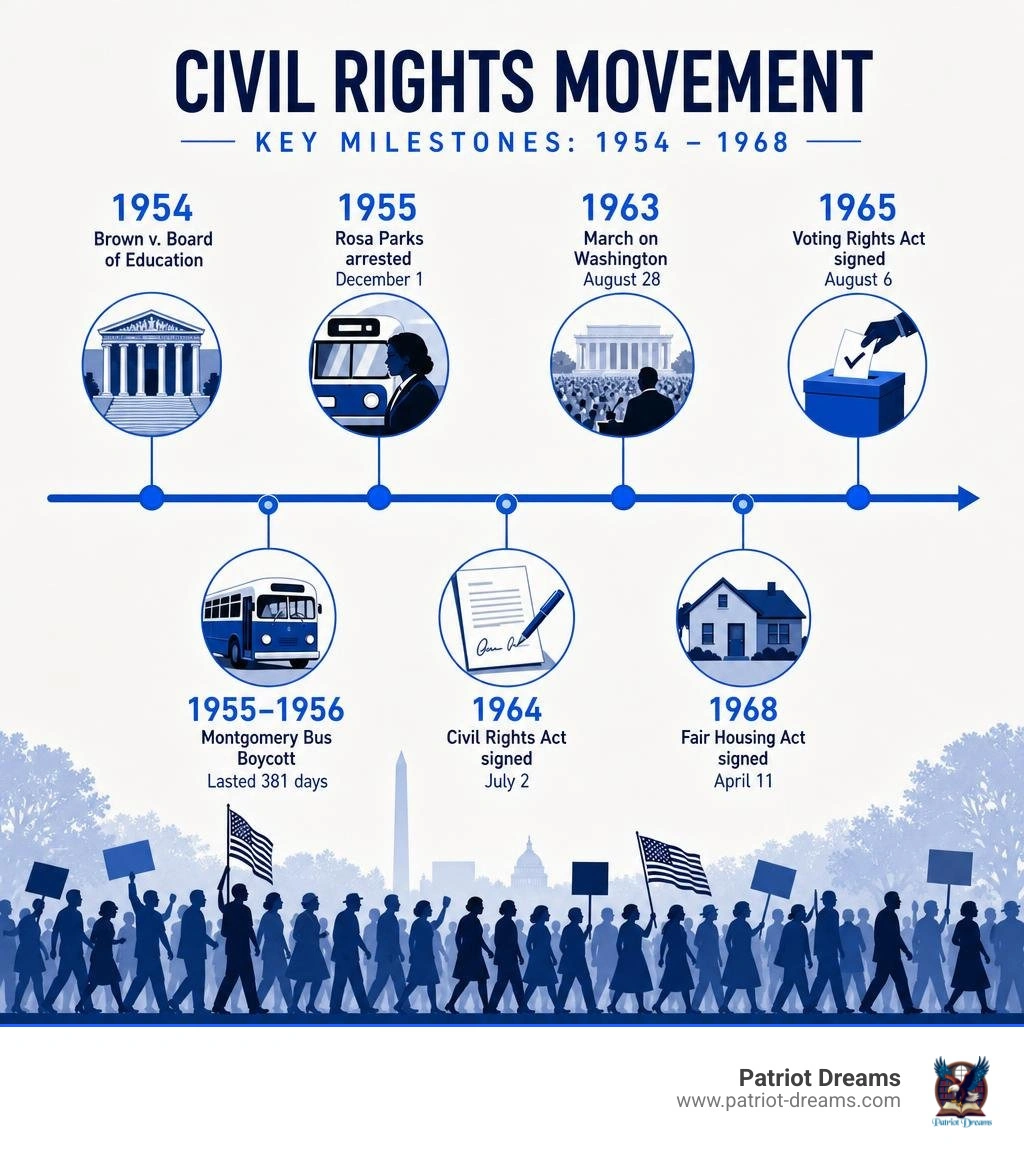
The most important Civil Rights Movement facts every American should know, at a glance:
| Key Fact | Detail |
|---|---|
| Movement dates | 1954 – 1968 |
| Sparked by | Brown v. Board of Education (1954) |
| Rosa Parks arrested | December 1, 1955 |
| Montgomery Bus Boycott | Lasted 381 days |
| March on Washington | 250,000 people, August 28, 1963 |
| Civil Rights Act signed | July 2, 1964 |
| Voting Rights Act signed | August 6, 1965 |
| Fair Housing Act signed | April 11, 1968 |
There is a story at the heart of America — one about ordinary people doing extraordinary things.
It is the story of a seamstress in Montgomery who quietly refused to give up her seat. Of students who sat down at a lunch counter and would not leave. Of hundreds of thousands of people who walked together toward the Lincoln Memorial on a warm August morning, hoping for something better.
These are not just history lessons. They are reminders of what Americans are capable of when they stand together with courage and kindness.
The Civil Rights Movement stretched from 1954 to 1968. In those fourteen years, everyday people — neighbors, teachers, students, preachers — changed the laws of an entire nation. They did it largely through peaceful, determined action.
This guide walks through the key facts, people, and moments that shaped that era. Whether you are a history enthusiast, a teacher, or a family wanting to share these stories with the next generation, you will find something here worth holding on to.
The Spark of Hope: Essential Civil Rights Movement Facts
To truly understand how this beautiful movement blossomed, we have to look back at the soil from which it grew. It was a time of great challenge, but also of quiet, enduring hope.
Following the American Civil War and the promise of the Reconstruction era, many Black Americans faced a difficult reality. Across the South, local laws known as "Jim Crow" laws enforced strict racial segregation. These rules kept people apart in schools, parks, restaurants, and on public transit. In 1896, the Supreme Court case Plessy v. Ferguson ruled that "separate but equal" facilities were perfectly fine under the law. But as many families knew all too well, separate was rarely ever equal.
Change, however, was whispering in the wind. During the early to mid-20th century, nearly seven million African Americans packed up their lives and moved from the rural South to the North and West. This historic journey, known as the Great Migration, transformed neighborhoods, built vibrant communities, and set the stage for a national conversation about equality.
Then came World War II. Black soldiers fought bravely overseas to protect freedom. When they returned home, they rightfully believed that the same freedom should belong to them and their families. Recognizing their courage, President Harry Truman signed Executive Order 9981 in 1948, officially ending segregation in the United States military. It was a monumental step forward, proving that when we stand shoulder-to-shoulder, we are stronger. To learn more about this journey toward justice, you can read the historical overview provided by the Civil Rights Movement | ADL .
The Foundations of a Peaceful Struggle
The roots of this quiet revolution were planted decades before the 1950s. Peaceful change requires deep, steady groundwork, and several organizations and historical figures paved the way.
In 1909, a group of dedicated Black and white activists came together to form the National Association for the Advancement of Colored People (NAACP). They believed that the courtroom and the printing press could be powerful tools for justice. The NAACP grew wonderfully over the years. By 1917, they had about 9,000 members, which jumped to 90,000 by 1919 across more than 300 local branches. By 1946, that family of advocates had grown to roughly 600,000 members.
Leaders like Walter White—who bravely investigated lynchings to bring truth to light—and Thurgood Marshall, a brilliant lawyer who would later become the first Black Supreme Court Justice, worked tirelessly. They drew inspiration from a long line of American heroes who stood for liberty, such as:
- Harriet Tubman, who guided dozens of souls to safety along the Underground Railroad with unmatched courage.
- Sojourner Truth Speech advocates, who spoke with unforgettable grace about the dignity of women and Black Americans.
- Crispus Attucks Martyr, a patriot who became the very first casualty of the American Revolution, proving that the struggle for freedom has always been shared.
Everyday Heroes Who Answered the Call
Sometimes, the gentlest actions make the biggest waves. On a cold December day in 1955, a quiet seamstress named Rosa Parks boarded a bus in Montgomery, Alabama. When asked to give up her seat so a white passenger could sit, she calmly said no.
While nine-year-old Claudette Colvin had bravely done the same thing months earlier, Mrs. Parks' arrest became the catalyst that brought a community together. To discover the personal side of this historic moment, explore the heartfelt Rosa Parks Story.
Her quiet "no" sparked the Montgomery Bus Boycott, which lasted an incredible 381 days—from December 5, 1955, to December 20, 1956. For over a year, neighbors walked to work, shared carpools, and supported one another, costing the transit system vital revenue and showing the world the power of peaceful cooperation.
This boycott also introduced America to a young, eloquent minister named Dr. Martin Luther King Jr. He believed deeply in the philosophy of nonviolence, drawing inspiration from his Christian faith and the peaceful methods of Mahatma Gandhi. Dr. King taught that love and peaceful persistence could heal a divided community far better than anger ever could. For a deeper look at his life and teachings, you can visit our Martin Luther King Jr. Complete Guide.
Courage in Action: Key Events and Peaceful Protests
As the late 1950s turned into the 1960s, the spirit of peaceful protest spread like a warm light across the country. Young people, in particular, stepped up with incredible dignity.
In February 1960, four college students walked into a Woolworth's lunch counter in Greensboro, North Carolina. They sat down and politely asked to be served. When they were refused, they remained seated, quietly studying or praying. This simple act of sitting down to stand up for what is right sparked "sit-ins" in dozens of cities, showing that peace can be incredibly persuasive.
Soon after, brave volunteers known as the Freedom Riders boarded interstate buses in 1961. They wanted to ensure that travel facilities were open to everyone, regardless of background. Though they faced immense hardships and hostility, their gentle resilience captured the heart of the nation.
By the spring of 1963, the focus shifted to Birmingham, Alabama. While imprisoned for protesting peacefully, Dr. King wrote his famous "Letter from Birmingham Jail," reminding us all that "injustice anywhere is a threat to justice everywhere." You can explore the primary documents of these historic moments through The Civil Rights Movement | U.S. History Primary Source Timeline .
The Power of Unity: From Montgomery to Washington
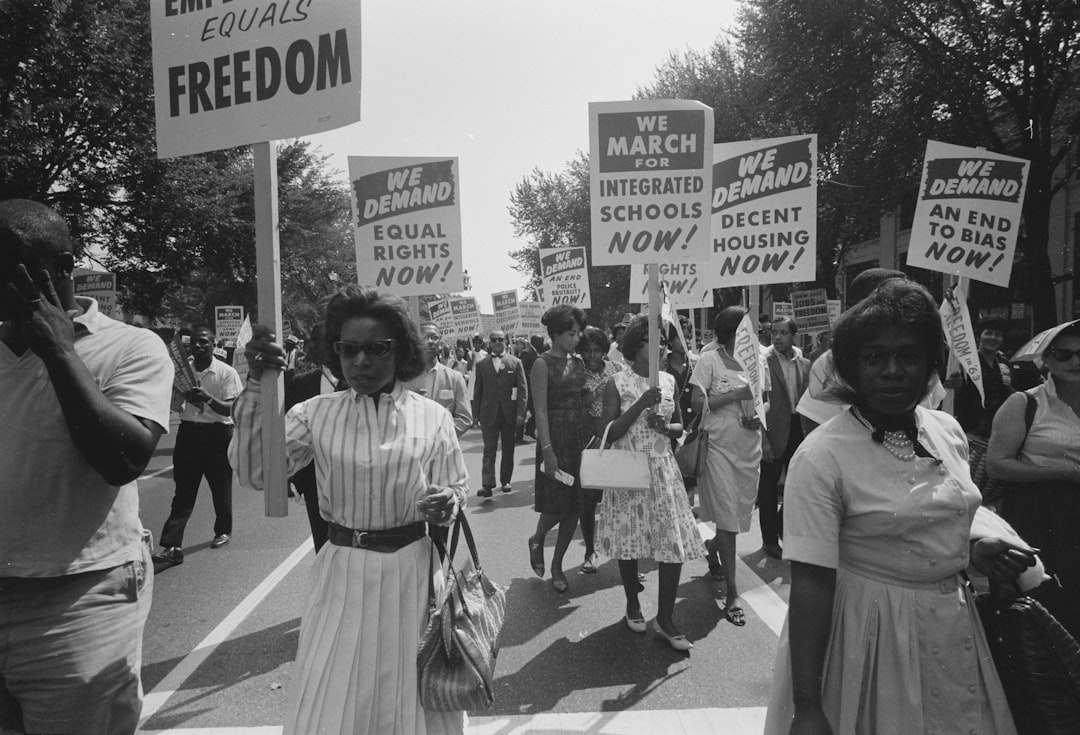
Perhaps the most breathtaking display of unity occurred on August 28, 1963, at the March on Washington for Jobs and Freedom. Organized in just a few short months by the brilliant strategist Bayard Rustin, this peaceful gathering brought approximately 250,000 people of all backgrounds to the nation's capital.
Standing before the Lincoln Memorial, Dr. King delivered his immortal "I Have a Dream" speech, painting a picture of an America where children would be judged by the content of their character rather than the color of their skin.
Two years later, the focus moved to Selma, Alabama, where people were struggling simply to register to vote. On March 7, 1965—a day that would become known as "Bloody Sunday"—about 600 peaceful marchers led by a young John Lewis were met with violence on the Edmund Pettus Bridge. But they did not give up. They returned, growing in numbers and spirit, until they successfully completed their march to Montgomery on March 21, protected by federalized troops.
To see how these two historic events compared, let us look at this simple breakdown:
| Feature | The Montgomery Bus Boycott (1955-1956) | The March on Washington (1963) |
|---|---|---|
| Primary Goal | Desegregate public transportation | Advocate for civil rights and economic equality |
| Duration / Date | 381 Days | August 28, 1963 (1 Day) |
| Key Methods | Economic boycott, community carpools | Mass peaceful assembly, speeches, music |
| Attendance | Local community-wide (~40,000 people) | Nationwide (~250,000 people) |
| National Impact | Propelled Dr. King to national leadership | Helped secure the Civil Rights Act of 1964 |
How Did These Civil Rights Movement Facts Shape Education?
Every parent wants their child to have a bright, hopeful future, and that starts with a good education. For decades, school segregation kept children apart. But in 1954, the Supreme Court handed down a historic, unanimous decision in Brown v. Board of Education, ruling that segregated schools were inherently unequal and unconstitutional.
Implementing this decision required immense courage from very young citizens. In 1957, nine brave African American students—the Little Rock Nine—integrated Central High School in Arkansas, escorted by federal troops sent by President Eisenhower to ensure their safety.
A few years later, in New Orleans, a tiny six-year-old girl named Ruby Bridges walked past angry crowds into William Frantz Elementary School every day, carrying her books and a quiet smile. Her story of gentle bravery continues to inspire families today; you can read more about her journey in Ruby Bridges Courage.
Landmark Laws That United a Nation
The peaceful marches, the quiet prayers, and the steady courage of millions eventually moved the hearts of lawmakers in Washington, leading to some of the most significant legislation in American history.
The Civil Rights Act of 1964 and Voting Rights Act of 1965
Signed into law by President Lyndon B. Johnson on July 2, 1964, the Civil Rights Act of 1964 was a magnificent milestone. It outlawed discrimination in public places, integrated schools and public facilities, and made employment discrimination illegal. The bill was passed with beautiful bipartisan support, overcoming a lengthy Senate filibuster with a final vote of 73 to 27.
Following closely behind was the Voting Rights Act of 1965, signed on August 6, 1965. This essential law banned literacy tests and other unfair barriers that had kept Black citizens from voting. The impact was immediate and profound, allowing millions of Americans to fully participate in their democracy.
Finally, the Fair Housing Act of 1968 was signed on April 11, 1968, prohibiting discrimination in housing and ensuring that everyone had a fair chance to buy or rent a home in the neighborhood of their dreams.
Preserving Civil Rights Movement Facts for Future Generations
The legacy of the Civil Rights Movement is not just found in history textbooks; it lives on in our families and communities. The lessons of resilience, kindness, and peaceful unity are precious gifts that we can pass down to our children and grandchildren.
At Patriot Dreams, we believe that every family’s story is a vital thread in the great American tapestry. Through our interactive map and unique audio storytelling platform, we help families preserve their own legacies of perseverance and hope, ensuring that the everyday heroes in our lives are never forgotten. By exploring the Civil Rights Movement through stories, we keep the spirit of unity alive for generations to come.
Frequently Asked Questions
What started the Civil Rights Movement?
While the struggle for equality had been going on for generations, the modern Civil Rights Movement was sparked in the mid-1950s by the landmark Brown v. Board of Education Supreme Court decision in 1954, followed closely by Rosa Parks' quiet act of courage and the Montgomery Bus Boycott in 1955.
What were the major achievements of the movement?
The movement achieved historic legal victories that transformed American society, including the desegregation of public schools and accommodations, the Civil Rights Act of 1964, the Voting Rights Act of 1965, and the Fair Housing Act of 1968.
How did nonviolent resistance work in practice?
Nonviolent resistance relied on peaceful methods like boycotts, sit-ins, educational workshops, and orderly marches. By responding to hostility with dignity and love, activists won the moral support of the nation and demonstrated that peace is the most powerful force for lasting change.
Conclusion
The history of the Civil Rights Movement reminds us that progress is made when ordinary people choose kindness, courage, and unity over division. It is a story that belongs to all of us, showing that we can build a brighter, more welcoming world when we walk together.
Here at Patriot Dreams, we invite you to explore these beautiful chapters of American history and preserve your own family’s stories of resilience. Let us keep sharing these gentle lessons of hope, remembering that every quiet act of courage helps shape the legacy of our great nation.

Join the Patriot Dreams Community
Download the app today and start your journey through American history and personal legacy.

Explore Our Latest Insights
Dive into stories that shape our American legacy.