"Sergeant Molly": The Woman Who Manned the Cannons at Monmouth

The Story of a Revolutionary Heroine
Molly Pitcher is one of the most celebrated figures of the American Revolution, a woman whose bravery at the Battle of Monmouth has inspired generations. But who was she really, and did she even exist?
Quick Facts About Molly Pitcher:
- Most Likely Identity: Mary Ludwig Hays McCauley (born 1754, died 1832)
- Famous For: Carrying water to soldiers and taking over a cannon at the Battle of Monmouth on June 28, 1778
- Recognition: Received a $40 annual pension from Pennsylvania in 1822 for her wartime service
- Historical Reality: Likely a composite figure representing multiple brave women who served during the Revolution
- Other Candidates: Margaret Corbin ("Captain Molly") and Deborah Sampson also contributed to the legend
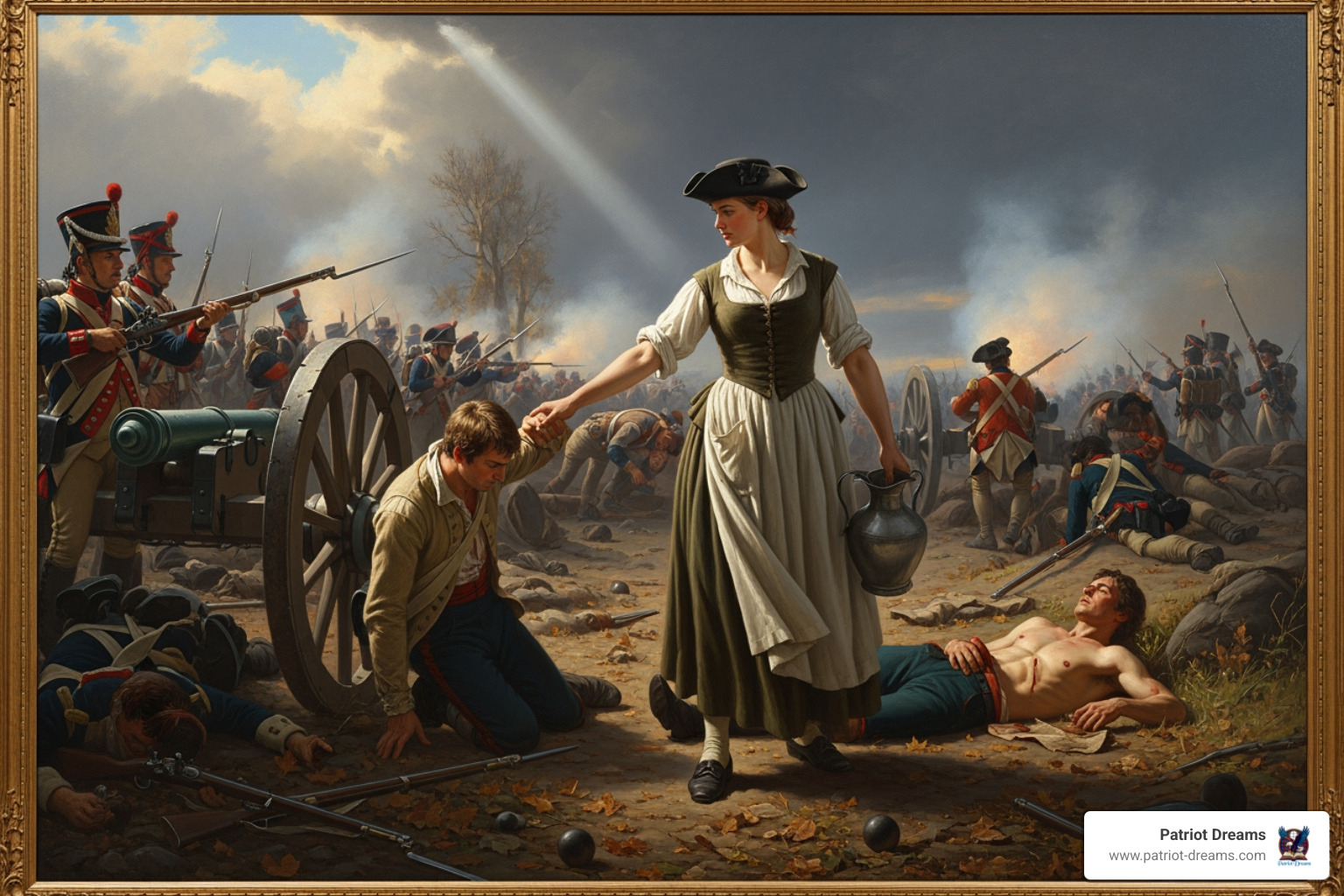
The legend tells us that on a sweltering June day in 1778, when temperatures neared 100 degrees, a woman dashed back and forth across the battlefield carrying pitchers of water to cool cannons and quench soldiers' thirst. When her husband collapsed at his cannon, she bravely stepped in to take his place, continuing to fire at the British throughout the battle.
It's a story that warms the heart and reminds us of the quiet heroism that built our nation. But like many beloved tales from our past, the truth is both simpler and more complex than the legend suggests.
Molly Pitcher represents something precious in American history: the countless women who served alongside the Continental Army as camp followers, nurses, and sometimes even soldiers. These women cooked, cleaned, tended the wounded, and when called upon, stepped into the line of fire. Their contributions were essential to the war effort, yet their names were rarely recorded in official documents.
Today, historians believe that "Molly Pitcher" was likely not one woman, but a symbol of many. The name itself may have been a common nickname for women who carried water pitchers on the battlefield. Yet one woman, Mary Ludwig Hays, stands out as the most probable inspiration for the legend we know today.
Her story—and the stories of women like Margaret Corbin and Deborah Sampson—remind us that heroism isn't always found in grand gestures or famous names. Sometimes it's found in a woman doing what needs to be done, even when it means stepping into danger.
The Woman Behind the Nickname: Who Was Molly Pitcher?
When we think of Molly Pitcher, we often picture a singular, courageous woman. However, the identity of this Revolutionary War icon is a fascinating mix woven from historical fact and enduring legend. Many historians believe that "Molly Pitcher" is a composite character, an embodiment of the bravery displayed by numerous women during the fight for American independence. Yet, among the various possibilities, one woman's story shines brightest as the most widely accepted identity behind the legend: Mary Ludwig Hays McCauley.
Mary Ludwig Hays was born in 1754, likely in the area near Trenton, New Jersey. She spent much of her life in Carlisle, Pennsylvania. We know that she married William Hays in her early twenties, around 1769. Historical accounts paint a vivid picture of Mary: she was described as a young woman, perhaps only twenty-two years old during the Battle of Monmouth, who was illiterate, pregnant, and possessed a spirited, no-nonsense demeanor. She was known to smoke and chew tobacco and, as one account humorously noted, could swear "as well as any of the male soldiers." These details give us a glimpse into a strong, resilient woman, perfectly suited to the harsh realities of army life.
The nickname "Molly Pitcher" itself likely originated from the common practice of women carrying water pitchers to soldiers on the battlefield. "Molly" was a familiar nickname for Mary, and "Pitcher" aptly described her vital task. This simple act of carrying water, often under fire, was a lifeline for weary and parched soldiers, and it became a symbol of the invaluable support women provided. As we dig deeper into her story, it becomes clear why Mary Ludwig Hays is so strongly associated with this legendary name. For those curious to learn more about the fascinating quest to uncover her true identity, we recommend exploring further into the search for her identity.
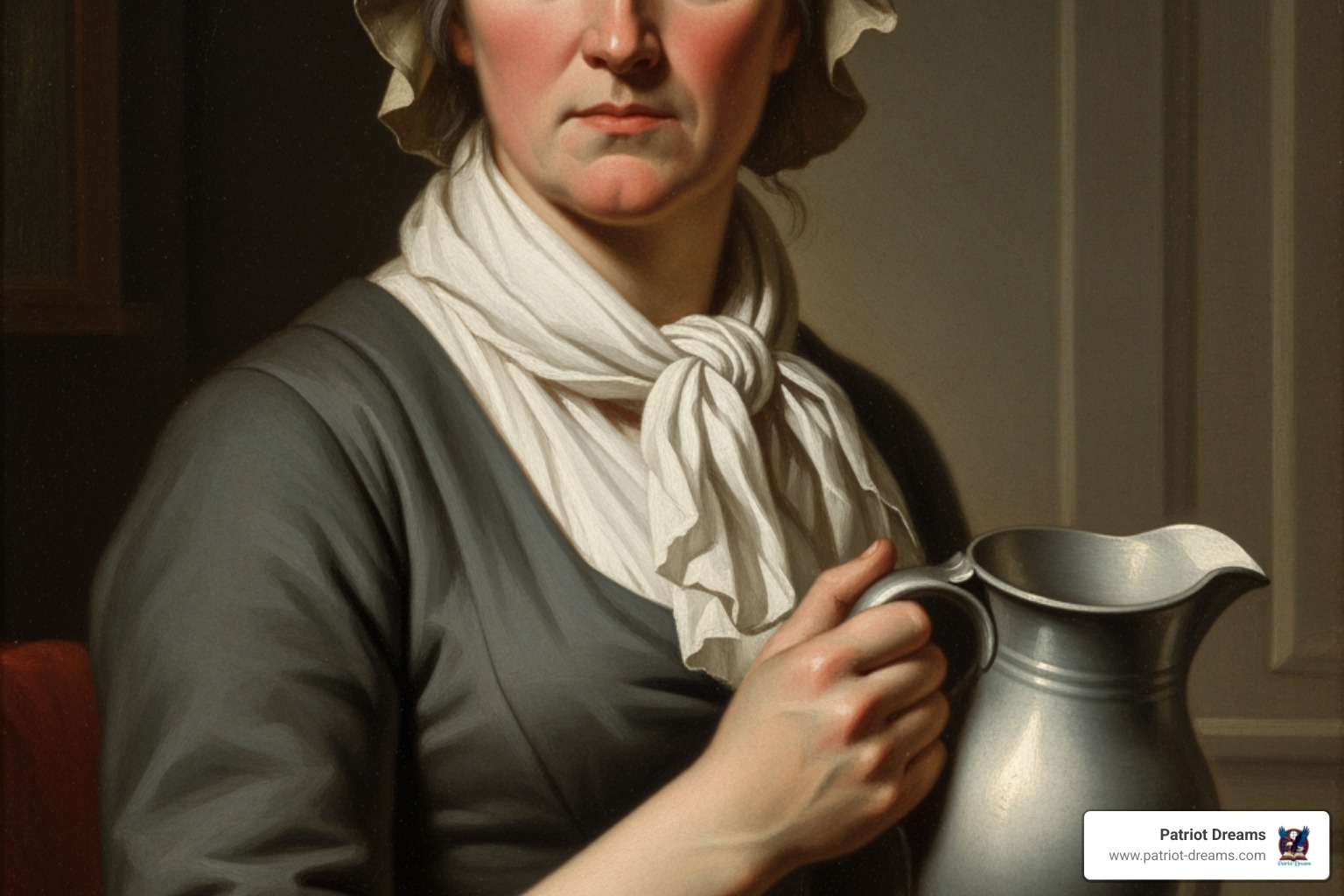
Mary Ludwig Hays: The Real Molly Pitcher at Monmouth
The heart of the Molly Pitcher legend lies in the scorching heat of the Battle of Monmouth. This pivotal engagement of the American Revolutionary War took place on June 28, 1778, in Monmouth, New Jersey. It was an exceptionally brutal day, with temperatures soaring to nearly 100 degrees Fahrenheit. The intense heat, combined with the heavy fighting, made hydration and cooling crucial for the Continental Army soldiers.
It was amidst this chaos and extreme discomfort that Mary Ludwig Hays played her most famous role. Like many wives of soldiers, she was a camp follower, accompanying her husband, William Hays, who was an artilleryman in the 4th Pennsylvania Artillery. Her primary duty that day was to bring water from a nearby spring or well to the soldiers and their cannons. The water was vital not only for quenching the soldiers' thirst but also for cooling down the overheated cannons, which could become dangerously hot from repeated firing. She moved back and forth, pitcher in hand, a constant presence of care and courage on the battlefield.
Then came the moment that etched her into legend. Her husband, William Hays, collapsed from heat exhaustion or a wound, unable to continue his duty at the cannon. Without hesitation, Mary stepped forward. She dropped her water pitcher and, with remarkable resolve, took her husband's place in the gun crew. She swabbed the cannon, loaded it, and helped fire it, continuing the fight against the British.
A famous anecdote, recounted by eyewitness Joseph Plumb Martin, tells of a cannonball fired by the British that passed directly between her legs, tearing away her petticoat. Mary, unfazed, reportedly remarked with a laugh that it was lucky it didn't pass higher. Such a story, whether entirely factual or embellished by memory, speaks volumes about her incredible composure and determination under fire. General George Washington himself is said to have commended her for her bravery, possibly even bestowing upon her the honorific "Sergeant Molly" for her actions. This act of stepping into the breach, of caring for her comrades and then fighting alongside them, is what truly solidified Mary Ludwig Hays's place as the embodiment of Molly Pitcher.
Other Heroines Who Inspired the Legend
While Mary Ludwig Hays is the most prominent figure associated with Molly Pitcher, it's important to remember the theory that Molly Pitcher is a composite character. This idea acknowledges that many brave women performed extraordinary acts of heroism during the American Revolution, and their collective courage may have contributed to the enduring legend. Two other remarkable women, Margaret Corbin and Deborah Sampson, are often cited as potential inspirations.
Margaret Corbin, often referred to as "Captain Molly," displayed incredible valor even before the Battle of Monmouth. In November 1776, during the Battle of Fort Washington in New York, she accompanied her husband, John Corbin, who was an artilleryman. When he was killed at his cannon, Margaret immediately stepped in, taking over his position and continuing to fire the weapon until she was severely wounded herself, losing the use of her left arm. Her bravery was so undeniable that in 1779, the state of Pennsylvania awarded her an annual pension of $50 for her heroism in battle, making her the first woman in the United States to receive a military pension. Her determination and direct involvement in combat certainly resonate with the spirit of Molly Pitcher.
Another inspiring figure is Deborah Sampson. Unlike Mary Hays or Margaret Corbin, Deborah took a different, but equally courageous, path. She disguised herself as a man, adopting the name Robert Shurtleff, and enlisted in the Continental Army in 1782. She served for over a year, participating in combat and sustaining wounds, all while maintaining her disguise. Her fellow soldiers even affectionately nicknamed her "Molly," highlighting the commonality of the name for women who served. Deborah's story of dedicated service and direct combat participation demonstrates the incredible lengths some women went to contribute to the cause of independence. These American Pioneer Stories are vital to understanding the full scope of heroism during the Revolutionary War, and we can explore more about them in American Pioneer Stories.
A Symbol of Service: Women in the Continental Army
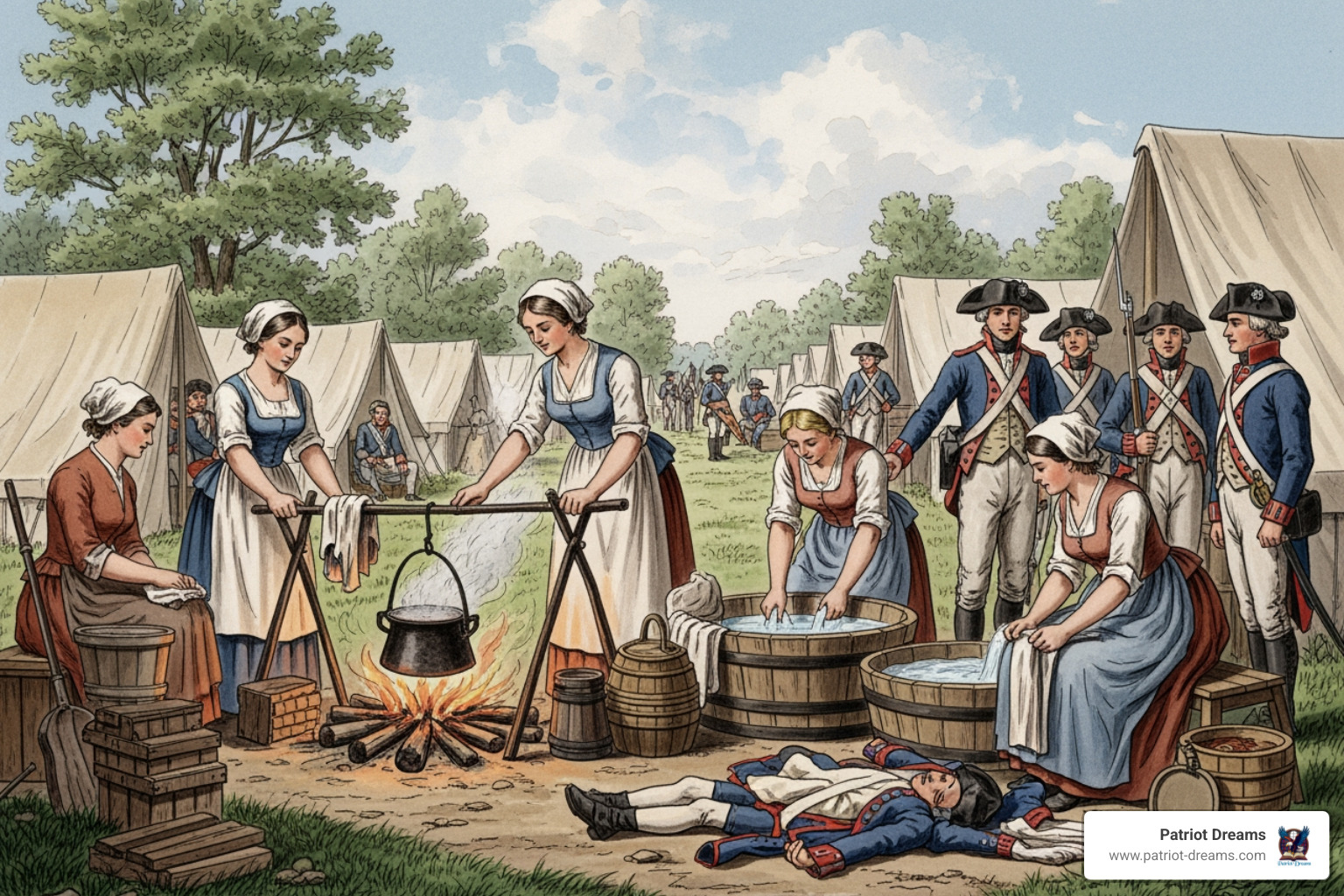
The story of Molly Pitcher is not just about individual acts of bravery; it's a powerful symbol of the broader, often unsung, contributions of women to the American Revolutionary War. These women, known as "camp followers," were an indispensable part of the Continental Army. They weren't official soldiers, but their presence was essential for the army's survival and morale.
Imagine the busy, often chaotic, life of an army camp. It was here that women performed crucial, albeit often overlooked, support roles. They were the backbone of daily life, undertaking tasks that directly impacted the soldiers' well-being and the army's functionality. Their duties included cooking meals over open fires, washing mountains of laundry, mending uniforms, and, perhaps most critically, nursing the sick and wounded. In an era before organized military hospitals, these women often served as the primary caregivers, offering comfort and practical aid to suffering soldiers.
What motivated these women to endure the hardships of camp life? Their reasons were often a blend of necessity and devotion. Many followed their husbands, unwilling to be separated or left alone in dangerous times. Others had their homes destroyed or were displaced by the conflict, leaving them with few options but to seek refuge and sustenance with the army. For some, it was simply a profound sense of patriotism and a desire to contribute to the cause in any way they could. Regardless of their individual motivations, their presence was a constant source of comfort and stability, boosting the morale of the weary soldiers. They were, in essence, the unsung heroes who kept the army fed, clothed, and cared for. Their contributions were so vital that even George Washington's orders stipulated a proportion of women in camps, though it was often difficult to maintain. To truly appreciate the depth of their service, it's worth exploring the roles women played in the Revolution.
The Lasting Legacy of Molly Pitcher
After the smoke of battle cleared and independence was won, the life of Mary Ludwig Hays McCauley, the woman most closely identified with Molly Pitcher, continued, though not without its struggles. Following the war, her first husband, William Hays, passed away around 1786. She later married John McCauley, but this second union proved to be financially ruinous, as her husband reportedly mismanaged her inheritance and eventually disappeared after 1807. Despite these personal hardships, Mary lived out her days in Carlisle, Pennsylvania, the town she called home for much of her life.
Her wartime service, however, was not forgotten. In 1822, the state of Pennsylvania formally recognized her contributions, awarding Mary Hays McCauley an annual pension of $40 for the "services she rendered during the war." This was a significant acknowledgment, especially for a woman of her time, and stands as tangible evidence of her direct involvement and recognized bravery. She lived to be 78 years old, passing away on January 22, 1832. Her grave in Carlisle, Pennsylvania, is marked by a monument, erected in 1918, that proudly proclaims her as Molly Pitcher.
The legend of Molly Pitcher has been commemorated in numerous ways, ensuring her story continues to inspire. In 1928, the U.S. Post Office Department honored her with a special 'overprint' stamp, with the words 'MOLLY PITCHER' printed on 10 million of the regular issue Washington 2¢ stamps, marking the 150th anniversary of the Battle of Monmouth. Her name graces a stretch of US Route 11 in Pennsylvania, known as the "Molly Pitcher Highway," and a Liberty ship during World War II was named the SS Molly Pitcher.
Beyond these, her name is associated with various establishments and events across the United States. We see a beautiful Molly Pitcher Inn in Red Bank, New Jersey, a Molly Pitcher Service Area on the New Jersey Turnpike, and even the Molly Pitcher Brewing Company in Carlisle, PA, near where she lived. The U.S. Army's Field Artillery and Air Defense Artillery branches have an honorary society named after her, and Fort Bragg hosts an annual 'Molly Pitcher Day' event. These commemorations serve as heartwarming reminders of her enduring spirit and the quiet strength of women who shaped our nation.
Frequently Asked Questions about Molly Pitcher
We understand that stories like Molly Pitcher's can spark many questions, especially when separating legend from historical fact. Here are some of the most common inquiries we receive:
Was Molly Pitcher a real person?
Yes, in a very meaningful way. While the name "Molly Pitcher" has become a powerful symbol representing the courage of many women in the American Revolution, the legend is most closely associated with a real woman named Mary Ludwig Hays McCauley. Her documented actions at the Battle of Monmouth and subsequent state pension provide strong historical evidence for her role as the primary inspiration for the Molly Pitcher legend.
What is Molly Pitcher most famous for?
Molly Pitcher is most famous for her heroic actions at the Battle of Monmouth on June 28, 1778. During this sweltering battle, she tirelessly carried pitchers of water to parched soldiers and to cool overheated cannons. Her most iconic act was when her husband, an artilleryman, collapsed, and she bravely stepped in to take his place at the cannon, continuing to fire at the British.
Why is the story of Molly Pitcher important?
The story of Molly Pitcher is incredibly important because it illuminates the vital, and often overlooked, contributions of women to the American Revolution. She represents the thousands of camp followers, nurses, and courageous individuals who supported the Continental Army, performing essential tasks and sometimes even fighting on the front lines. Her story stands as a powerful testament to the resilience, determination, and quiet heroism that helped forge our nation.
The Enduring Spirit of American Heroism
The legend of Molly Pitcher, whether we view her as Mary Ludwig Hays or as a collective symbol, reminds us of a timeless truth: heroism often emerges from ordinary people doing extraordinary things in challenging times. Her story embodies the spirit of resilience, the strength of community, and the profound impact that individual acts of kindness and courage can have on the course of history. It's a gentle reminder that even in the midst of conflict, the human spirit can shine brightly, caring for others and stepping up when duty calls.
At Patriot Dreams, we believe that these warm, nostalgic, and caring stories about America are what truly inspire us. They connect us to our past, reminding us of the values of perseverance, unity, and everyday heroism that continue to define our nation. We are dedicated to bringing these stories to life, helping you feel connected and proud of our shared heritage. You can find more inspiring tales of the people who shaped our nation among our Historical American Figures and by exploring America: 250 Years in the Making. Let's continue to share these precious narratives, ensuring that the enduring spirit of American heroism lives on for generations to come.

Join the Patriot Dreams Community
Download the app today and start your journey through American history and personal legacy.

Explore Our Latest Insights
Dive into stories that shape our American legacy.