The Ultimate Guide to America's Most Iconic Landmarks

What Is Route 66? America's Most Beloved Highway at a Glance
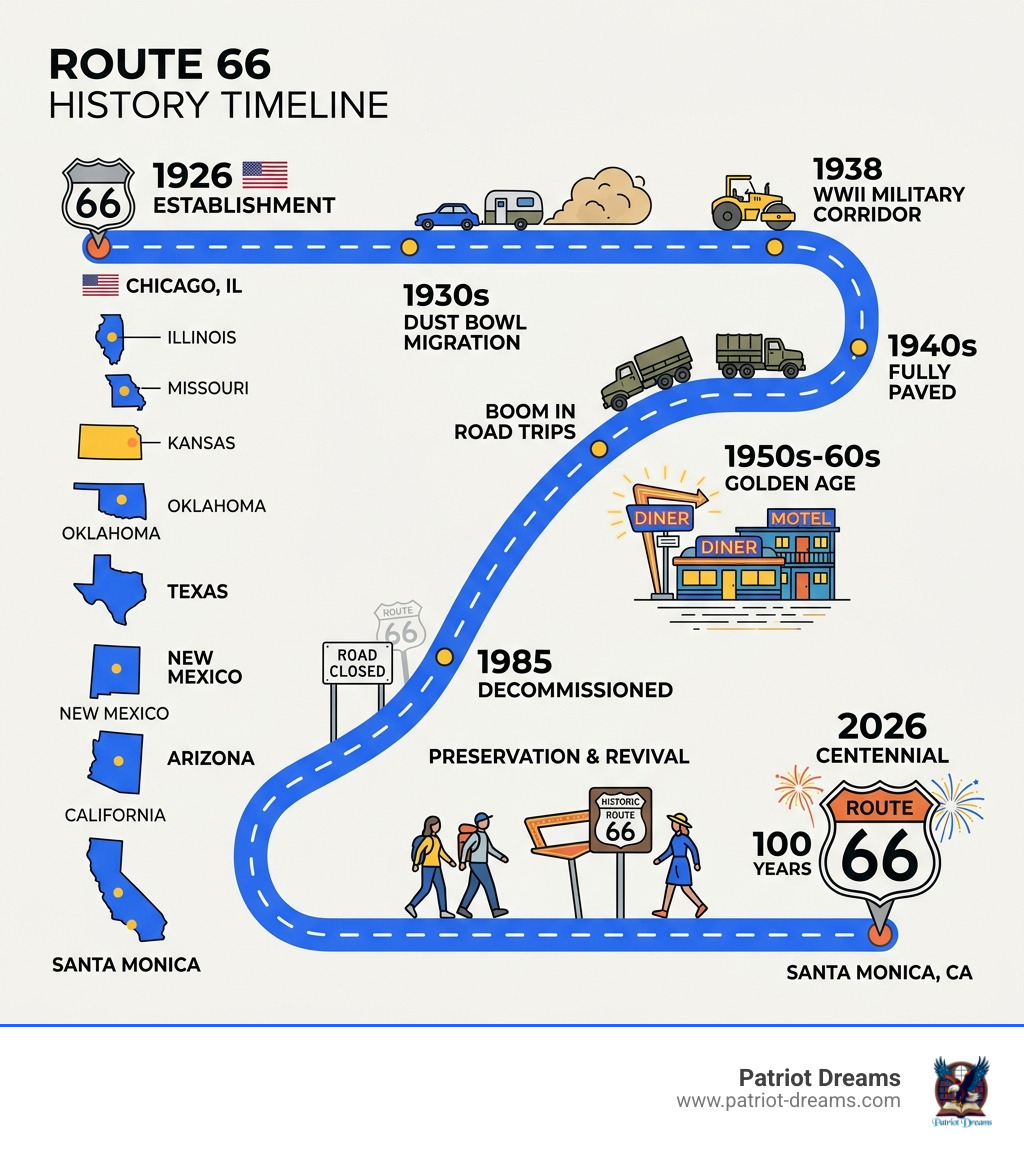
Route 66 history is the story of a 2,448-mile road that connected Chicago, Illinois to Santa Monica, California — and connected generations of Americans to each other.
Here are the key facts, fast:
- Established: November 11, 1926
- Decommissioned: June 26, 1985
- Total length: 2,448 miles (3,940 km)
- States crossed: Illinois, Missouri, Kansas, Oklahoma, Texas, New Mexico, Arizona, and California
- Nicknames: The Mother Road, Main Street of America, Will Rogers Highway
- First fully paved U.S. highway: 1938
- Estimated vehicles (1926–1985): 200 million
- Centennial anniversary: 2026
There is something about Route 66 that stays with you.
Maybe it's the image of a neon sign glowing warm against a desert sky. Maybe it's the thought of a family — packed into a car, full of hope — heading west toward something better. Maybe it's just the feeling that a road could mean so much more than getting from one place to another.
For nearly a century, Route 66 has been exactly that. It was a lifeline for Dust Bowl families in the 1930s. A military corridor during World War World II. A ribbon of freedom for post-war families discovering America one roadside diner at a time. As John Steinbeck wrote in The Grapes of Wrath, it was simply "the Mother Road" — and that name has never stopped feeling true.
In 2026, Route 66 turns 100 years old. That's one hundred years of stories, of communities, of small-town kindness and wide-open skies.
This guide covers the full journey — from the visionaries who built it, to the families who traveled it, to the preservationists keeping its spirit alive today.
Basic Route 66 history terms:
- Oregon Trail stories
- California Gold Rush
- American Revolution stories
The Birth of Route 66 History: A Path of Hope and Vision
The story of the "Main Street of America" didn't begin with a grand government decree, but with the grit and foresight of a few dedicated neighbors who believed in the power of connection. Before 1926, the American West was a patchwork of dirt trails and disconnected wagon roads. Traveling across the country wasn't a "road trip"—it was an expedition.
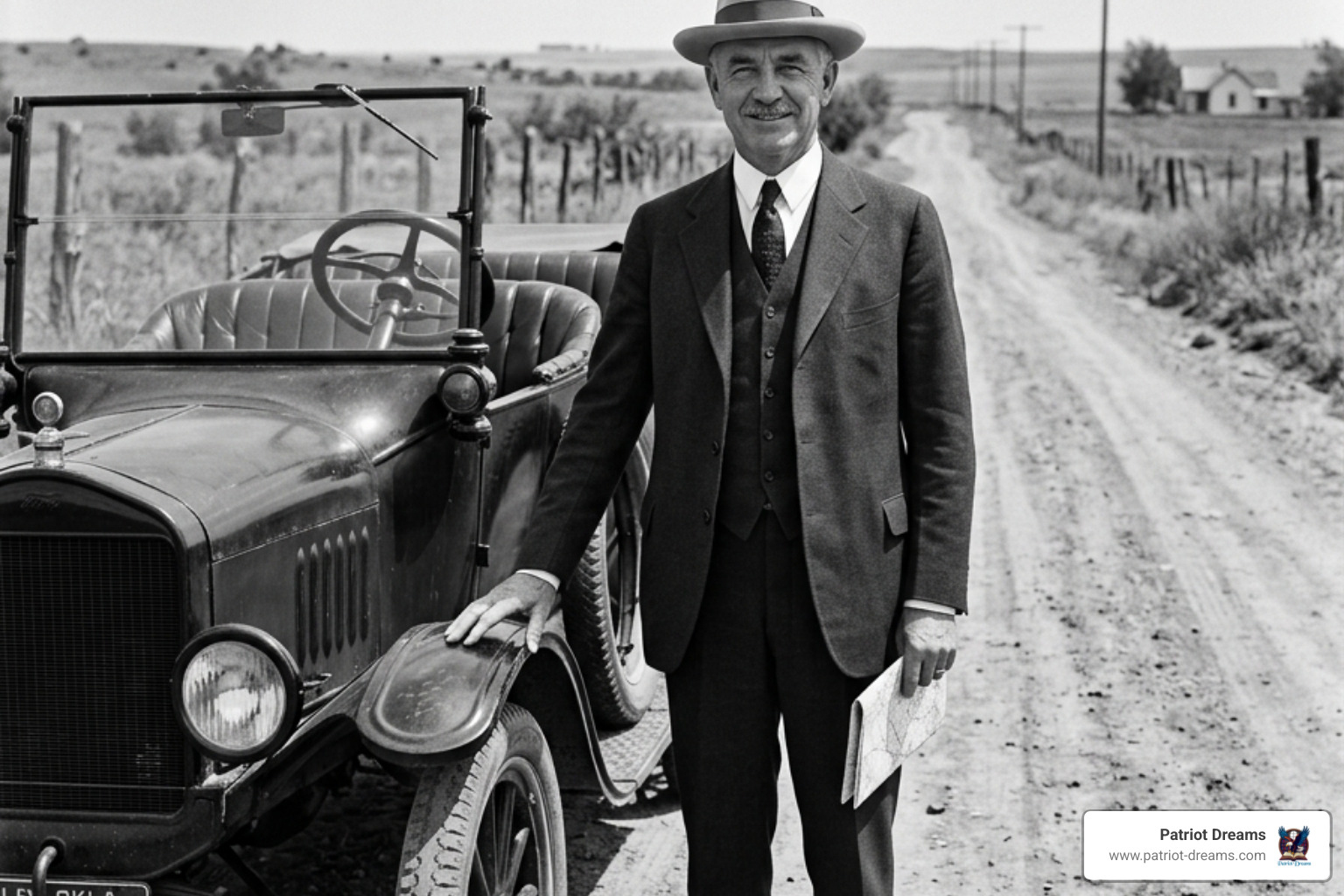
In the early 1920s, two men emerged with a vision for a coordinated highway system. Cyrus Avery of Tulsa, Oklahoma, and John Woodruff of Springfield, Missouri, began lobbying for a route that would link the urban Midwest with the sun-drenched West Coast. They didn't just want a road; they wanted a lifeline for rural communities.
In 1926, the Bureau of Public Roads launched the nation’s first Federal highway system. While other routes followed straight lines, Route 66 was unique because of its diagonal path. By cutting across the heart of the country, it linked hundreds of isolated rural towns to major metropolitan centers. You can learn more about these early days in our look at The First Route 66 Road Trip: How America Learned to Wander.
According to the Route 66 Overview (U.S. National Park Service), this strategic path allowed farmers to transport their grain and produce more efficiently, ensuring that the road was an economic engine from its very first mile.
The Visionaries Behind the Main Street of America
Cyrus Avery, often called the "Father of Route 66," was a realtor and coal company owner who understood that for a road to succeed, it needed a "brand." He helped form the U.S. Highway 66 Association to promote the route as the "shortest, best and most scenic route from Chicago through St. Louis to Los Angeles."
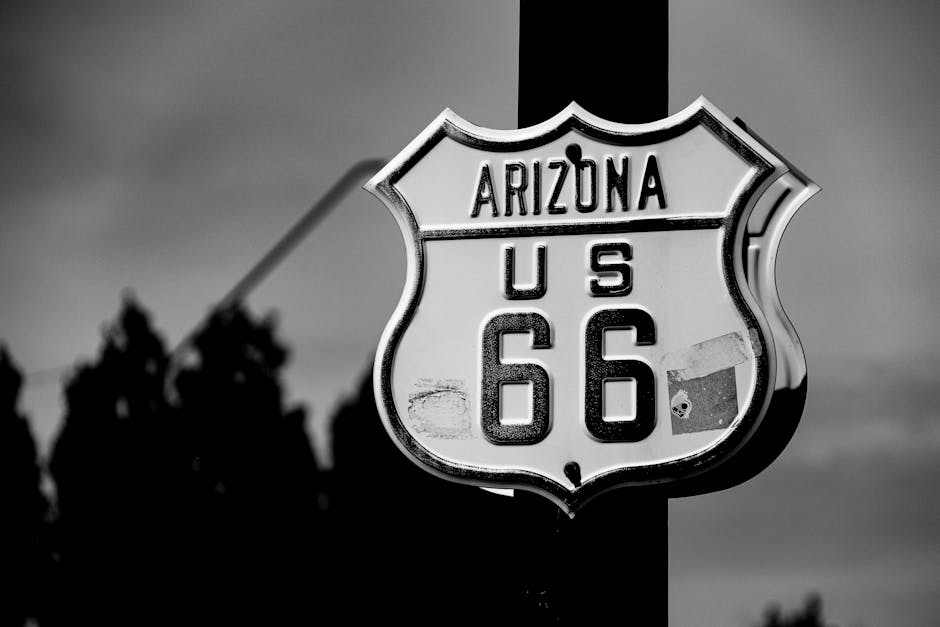
There was even a bit of a friendly scuffle over the number. Originally, the planners wanted the number "60," but after a dispute with other state representatives, Avery settled on "66" because he liked the way the double digits sounded and looked on a sign. By 1927, the first iconic shields were being erected.
To prove the road's worth, the Association organized the famous "Bunion Derby" in 1928—a massive footrace from Los Angeles to New York City. A Cherokee runner from Oklahoma named Andy Hartley Payne won the grueling race, bringing national attention to the highway that would soon become a legend.
A Lifeline Through Hardship: The Dust Bowl and World War II
As the Great Depression gripped the nation in the 1930s, Route 66 history took on a more somber, yet deeply resilient, tone. When the catastrophic Dust Bowl storms ravaged the plains of Oklahoma, Kansas, and Texas, thousands of families were forced to leave their homes.

For these "Okies" and other migrants, Route 66 was the "Path of Hope." John Steinbeck immortalized this journey in his classic novel, The Grapes of Wrath, famously dubbing it the "Mother Road." He described it as a flight from the dust and the heat toward the promised land of California.
During this era, the road itself became a source of work. Through New Deal programs like the Civilian Conservation Corps (CCC) and the Works Progress Administration (WPA), thousands of men were employed to pave the highway. By 1938, Route 66 achieved a major milestone: it became the first highway in the United States to be completely paved from end to end.
Resilience and Service in Route 66 History
When World War II began, the highway's role shifted once again. It was no longer just a path for migrants; it became a vital military corridor. Because of its location along the 35th parallel and its relatively mild weather, the government used Route 66 to move troops, equipment, and supplies across the country.
The Route 66: The Iconic Highway's Rise and Decline - History.com article notes that the road helped facilitate a massive migration of workers to defense plants in California. This period solidified the highway's importance to national security and geographic cohesion, proving that a single road could hold the country together during its most trying times.
The Golden Age of the Family Road Trip
After the war, a new kind of energy hit the pavement. Soldiers came home, families grew, and the American middle class found itself with something new: a car in the garage and a little bit of vacation time.
By 1955, there were over 52 million cars registered in the U.S. This was the era of the great American road trip. Route 66 was no longer just a way to survive; it was a way to celebrate. This was the time of Bobby Troup’s famous song, "Get Your Kicks on Route 66," famously performed by Nat King Cole. The road became a symbol of freedom, adventure, and the "open road."
Small "mom-and-pop" businesses flourished. Every few miles, travelers could find a unique motor court, a quirky diner, or a gas station with a friendly face. These businesses weren't just stops; they were the heart of the community.
| Feature | Historic Route 66 Experience | Modern Interstate Travel |
|---|---|---|
| Speed | Slow and steady, through town centers | Fast and efficient, bypassing towns |
| Scenery | Main streets, neon signs, local kitsch | Sound barriers and exit signs |
| Dining | Homemade pie and local diners | Standardized fast-food chains |
| Connection | Meeting the locals and shop owners | Minimal interaction with surroundings |
Iconic Landmarks in Route 66 History
Part of the magic of Route 66 history is the "roadside attraction." Business owners realized they needed something special to get drivers to pull over. This led to some of the most iconic landmarks in American culture:
- The Wigwam Motels: Located in Holbrook, Arizona, and San Bernardino, California, where you could literally "sleep in a teepee."
- The Blue Whale of Catoosa: A massive, friendly waterfront structure in Oklahoma built as an anniversary gift.
- Cadillac Ranch: A public art installation in Texas featuring ten half-buried Cadillacs.
- The Big Texan Steak Ranch: Famous for its 72-ounce steak challenge—if you eat it in an hour, it's free!
- Natural Wonders: The road provided easy access to the Painted Desert, the Grand Canyon, and the massive Meteor Crater in Arizona.
From Decommissioning to a Century of Celebration
As much as we loved the Mother Road, our need for speed eventually led to its decline. In 1956, President Dwight D. Eisenhower signed the Federal-Aid Highway Act, which began the construction of the Interstate Highway System. Eisenhower had been impressed by the German Autobahn and wanted a faster, more efficient way to move the military and citizens.
One by one, the segments of Route 66 were bypassed by five new interstates: I-55, I-44, I-40, I-15, and I-10. The interstates were faster, but they lacked the soul of the old road. They didn't go through the towns; they went around them.
The final blow came in October 1984, when the last stretch of original Route 66 was bypassed in Williams, Arizona. On June 26, 1985, the highway was officially decommissioned. The iconic shields were taken down, and for a while, it seemed the road might fade into history.
Preserving the Spirit of Route 66 History
But Americans are a nostalgic lot, and we don't let go of our legends easily. Almost as soon as the road was decommissioned, grassroots efforts began to save it. Organizations like the National Historic Route 66 Federation and the U.S. Route 66 - Wikipedia community lobbied for its protection.
In 1990, Congress passed the Route 66 Study Act, followed by the Route 66 Corridor Preservation Program. This provided the technical and financial support needed to restore old neon signs, preserve historic motels, and keep the "Main Street" spirit alive.
Today, Route 66 is a "living museum." It attracts thousands of international tourists every year who want to see the "real America." As we approach the 2026 Centennial, the road is more popular than ever. It reminds us that even in a world, there is value in taking the long way home. You can explore why this nostalgia is so powerful in our article Why Route 66 is More Than a Road: The Nostalgia and Myth of America’s Main Street.
Frequently Asked Questions about the Mother Road
Where are the official endpoints of Route 66?
The road traditionally begins at East Adams Street in Chicago, Illinois, and ends at the Santa Monica Pier in California. It stretches roughly 2,448 miles, creating a grand East-West connection that traverses two-thirds of the North American continent.
Why was Route 66 officially decommissioned?
It was decommissioned because it was no longer considered necessary for the national highway system. The new Interstate Highway System (specifically I-40, I-55, and others) provided four-lane, high-speed travel that bypassed the narrow, often dangerous "two-lane" sections of the old 66. By 1985, the government felt the interstates had completely replaced its function.
What states does the historic route traverse?
Route 66 passes through eight states:
- Illinois (Starting in Chicago)
- Missouri (Home of the first drive-through)
- Kansas (Only 13 miles, but full of character!)
- Oklahoma (The birthplace of the route)
- Texas (The midpoint and Cadillac Ranch)
- New Mexico (The stunning high desert)
- Arizona (The longest continuous stretches)
- California (The final destination at the Pacific)
Conclusion: Your Story on the Open Road
Route 66 is more than just asphalt and old signs. It is a testament to American resilience, a gallery of our quirky creativity, and a reminder of the kindness found in small towns across the heartland. It’s a road that has seen us at our most desperate during the Dust Bowl and at our most joyful during the post-war boom.
At Patriot Dreams, we believe that every mile of that road holds a story—and many of those stories belong to your family. Whether your grandfather drove a truck during the war or your parents took you on a cross-country vacation in a station wagon, those memories are part of our shared American heritage.
Our audio storytelling platform and interactive maps are designed to bring these histories to life. We invite you to explore the landmarks, listen to the voices of the past, and perhaps even record your own family’s legacy for future generations.
The road is still there, waiting for you. It might be a little quieter now, but if you listen closely, you can still hear the hum of 200 million vehicles and the echoes of a century of dreams.
Download the Patriot Dreams App and start your journey today. Let's keep the spirit of the Mother Road alive, together.

Join the Patriot Dreams Community
Download the app today and start your journey through American history and personal legacy.

Explore Our Latest Insights
Dive into stories that shape our American legacy.