Scaling the Cliffs of Hell: The D-Day Heroism of the 2nd Ranger Battalion

Ordinary Men, Extraordinary Courage
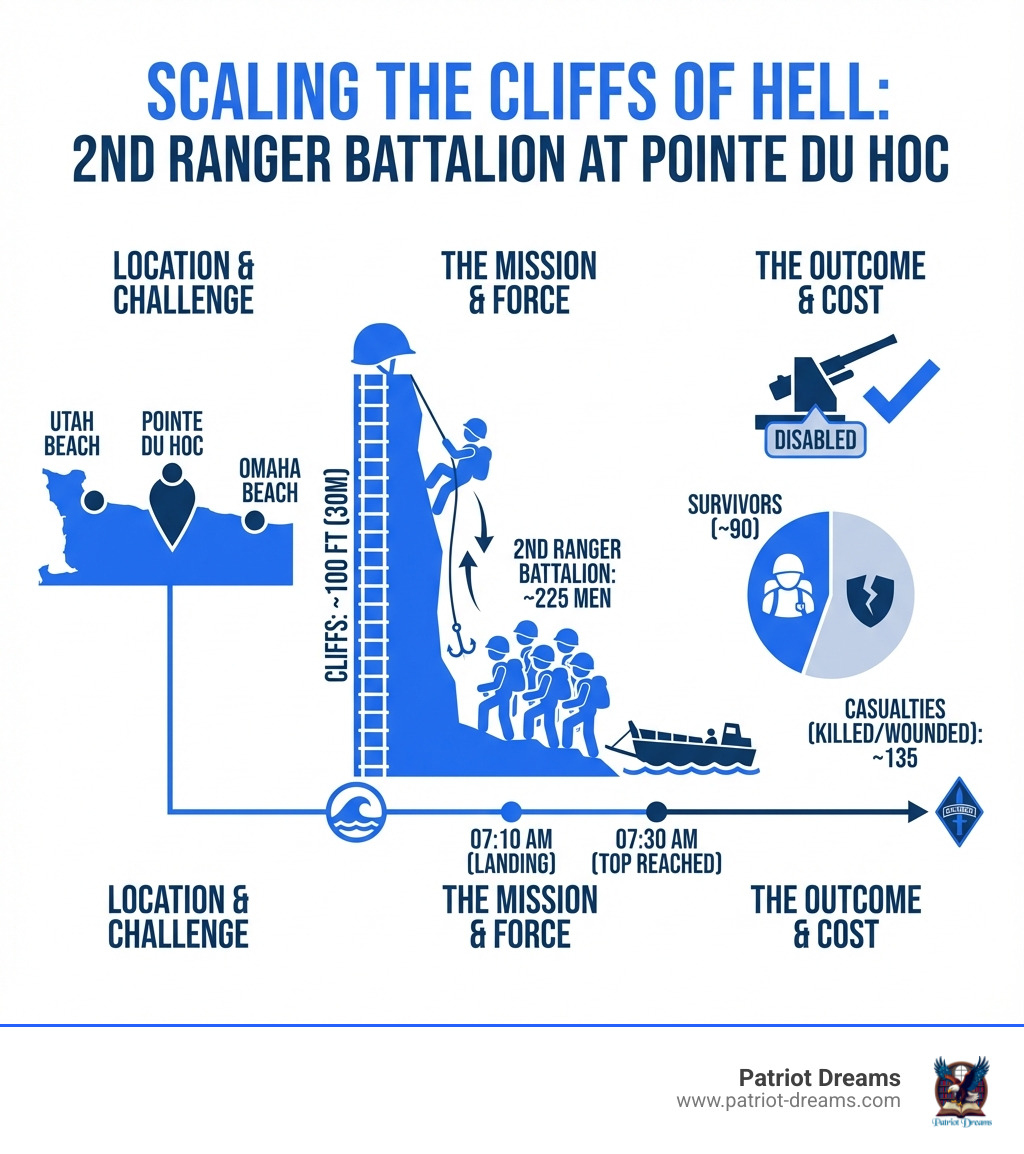
Scaling the Cliffs of Hell: The D-Day Heroism of the 2nd Ranger Battalion tells the story of 225 American soldiers who faced one of the most dangerous missions in military history. On June 6, 1944, these brave men climbed 100-foot cliffs at Pointe du Hoc under heavy enemy fire to destroy German guns threatening the D-Day landings.
Quick Facts About the Pointe du Hoc Mission:
- The Mission: Climb sheer cliffs and destroy six powerful German cannons
- The Challenge: 100-foot cliffs, waterlogged ropes, equipment failures, and fierce enemy fire
- The Cost: 70% casualties — 77 killed, 152 wounded, 38 missing
- The Result: First Allied unit to complete their D-Day objective, protecting thousands of soldiers on the beaches below
- The Legacy: Presidential Unit Citation and eternal recognition as "The Boys of Pointe du Hoc"
These weren't professional soldiers born to war. They were ordinary Americans — farmers, factory workers, shop clerks — who answered their country's call. Many commanders thought the mission was impossible. One Navy officer said, "Three old women with brooms could keep the Rangers from climbing those cliffs."
But Lt. Col. James Earl Rudder and his 2nd Ranger Battalion didn't see it that way. They saw neighbors and brothers on the beaches below who needed protecting. They saw families back home counting on them. They saw a chance to do something that mattered.
The cliffs at Pointe du Hoc stood between Utah and Omaha Beaches like a fortress on the sea. The German guns positioned there could rain destruction on the landing forces, turning the beaches into killing fields. If the Rangers failed, thousands of American soldiers might never make it off those beaches alive.
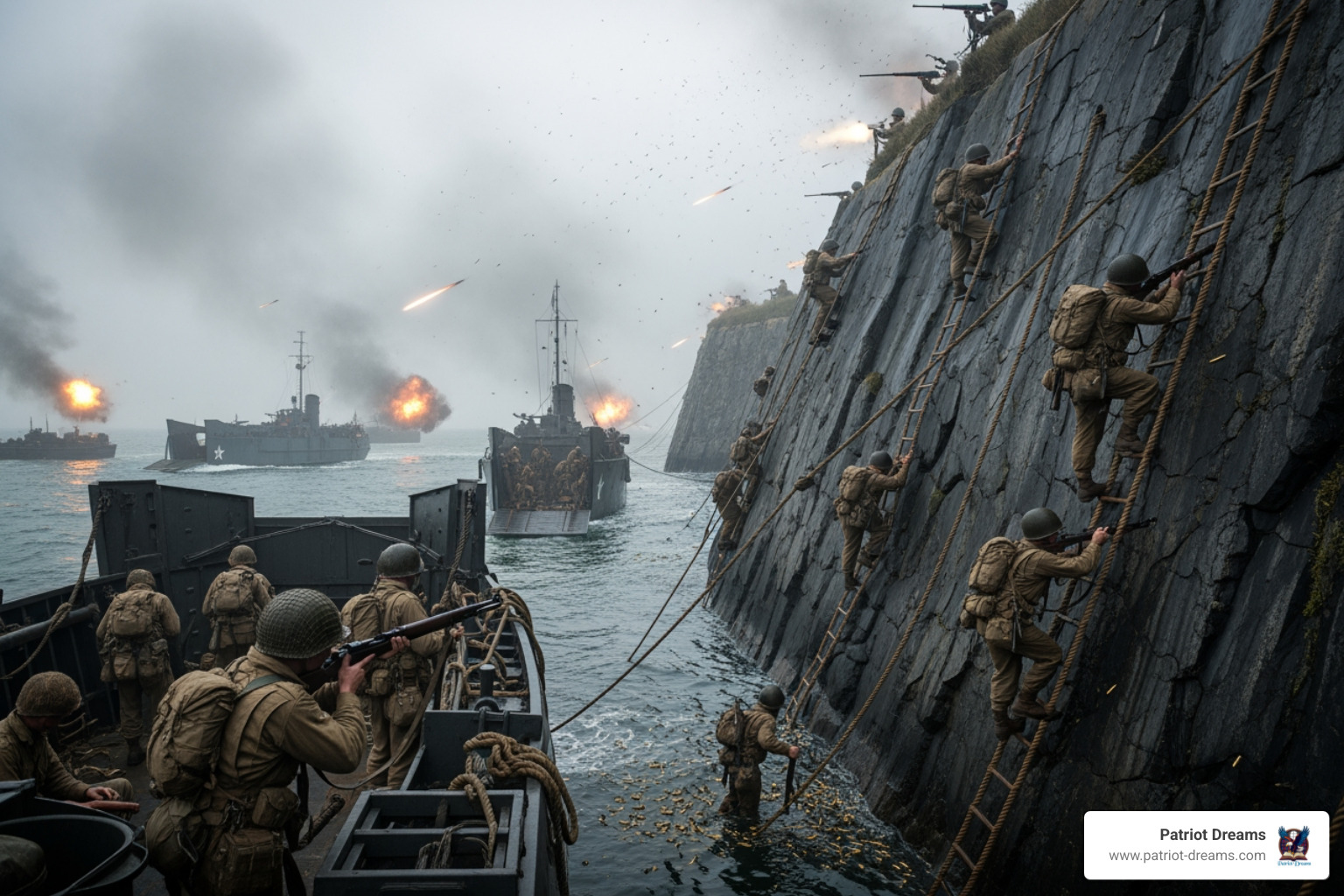
So they climbed. Through machine-gun fire and grenades. With ropes that wouldn't hold and ladders that fell short. They climbed because that's what Americans do when the impossible needs doing.
A Fortress on the Sea: Why Pointe du Hoc Mattered
Imagine standing on the shores of Normandy, watching thousands of Allied ships approach, knowing that powerful German guns could release a storm of steel upon them at any moment. That was the grim reality facing the D-Day planners. Pointe du Hoc, a promontory with rocky cliffs 85 to 100 feet high, was a critical piece of the formidable German Atlantic Wall. It housed a battery of six 155mm howitzers, capable of firing shells up to 25,000 yards (about 10 miles) in any direction. These guns posed an existential threat to the Allied landings on both Utah and Omaha Beaches. Their strategic importance was immense; neutralizing them was paramount for the success of Operation Overlord, the broader D-Day invasion plan.
The mission to scale these cliffs and destroy the guns was deemed so dangerous that it was perceived as a suicide mission by many. Yet, the Rangers, these incredible American Pioneer Stories, understood the gravity of their task. The safety of thousands of their comrades, the very fate of the invasion, rested on their ability to overcome what seemed impossible. Their courage echoes the defiance of figures like General Jonathan Wainwright: The Hero of Bataan's Defiance, who faced overwhelming odds with unwavering resolve.
The German Defenses
The German defensive setup at Pointe du Hoc was designed to be virtually impregnable from the sea. It was a testament to the Atlantic Wall, a vast network of fortifications stretching along the European coast. The battery itself was located on a tableland ending in sheer cliffs, providing a natural defensive advantage.
The fortifications included thick concrete bunkers and well-placed machine-gun nests, ready to pour fire down on any approaching force. The German garrison was primarily manned by elements of the 832nd Army Coastal Battery, supported by approximately 200 artillerymen and infantrymen from the 716th Infantry Division. Many of these defenders were non-German soldiers, adding a complex layer to the human element of the battle.
However, prior Allied bombing raids had a surprising effect. While the bombing aimed to destroy the gun emplacements, it actually caused the Germans to move the six 155mm guns from their exposed concrete pits. They were camouflaged with netting and moved about 1000 yards inland to an apple orchard, making them less vulnerable and harder to detect from the air. This meant that while the Rangers were tasked with destroying guns in specific emplacements, the actual threat had shifted, adding an unexpected layer of challenge to their mission. Two casemates also remained unfinished by the time of the invasion, a consequence of the earlier bombardments. Despite these shifts, the German defensive positions on the cliffs themselves remained formidable, bristling with machine guns and well-prepared to repel an assault.
The Rangers’ Brave Plan
Commanding this audacious mission was Lt. Col. James Earl Rudder. His 2nd Ranger Battalion was composed of volunteers from across America, men who had undergone grueling special training inspired by the British Commandos. This training, often conducted under British Commando supervision, was exceptionally rigorous, preparing them for coastal raids and amphibious assaults. The mission rehearsal took place at the Isle of Wight, simulating the daunting task ahead.
To tackle the sheer 100-foot cliffs, the Rangers came equipped with creative and specialized tools. Their arsenal included rocket-fired ropes designed to snag the cliff tops, rope ladders for climbing, and even 112-foot extension ladders borrowed from the London Fire Brigade. Each of these tubular steel sections weighed four pounds, making the ladders heavy and cumbersome, especially when wet.
Beyond the climbing gear, each Ranger was a self-contained fighting unit. They carried a chocolate D-bar for rations, two grenades, and an M1 Garand rifle. Each company was also equipped with four Browning Automatic Rifles (BAR), two light mortars, and ten thermite grenades — crucial for destroying the heavy guns. Two supply boats followed, laden with packs, extra rations, ammunition, two 81mm mortars, explosives, and hauling equipment. This meticulous, albeit daring, planning was necessary for a mission that many considered 'crazy' or 'madman-like.' They were preparing for the impossible, and they knew it.
“Rangers, Lead the Way!”: The Climb Begins
The morning of June 6, 1944, dawned with a chaotic symphony of war. For the 2nd Ranger Battalion, the climb began with a series of unfortunate events. They had planned to land at the base of the cliffs at 06:00 hours, but a navigational error, possibly due to a new radar system failing, caused them to land nearly an hour late, around 07:10 am. This significant delay meant they lost the critical element of surprise.
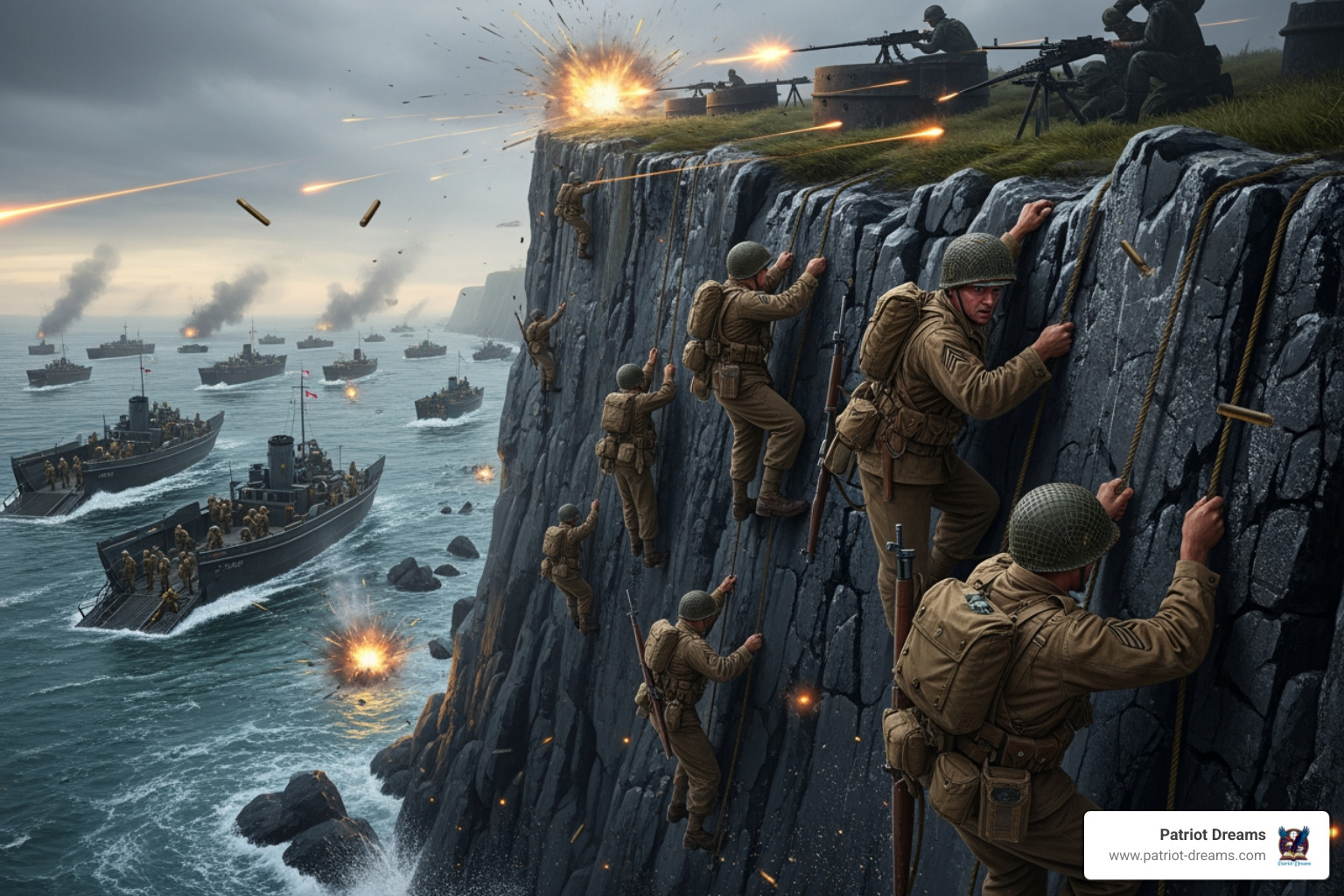
As their landing craft approached, they faced fierce resistance. German machine guns and small arms fire rained down from above. The waters were rough, and the Rangers suffered losses even before reaching shore; one LCA (Landing Craft, Assault) was swamped, and another LCA and a DUKW were lost. By 7:30 am, the battalion had already lost more than 20 Rangers killed or wounded. The ropes, soaked and heavy from the rough sea, became incredibly difficult to manage. Some of the 112-foot extension ladders proved too short for the highest points of the cliffs, forcing the Rangers to improvise with struggling hooks. Despite the early morning chaos and the devastating loss of life and equipment, the Rangers pressed on, fueled by an unwavering sense of hope and duty.
Overcoming Chaos and Fire
The specific challenges and dangers faced by the Rangers during the cliff assault were immense. Beyond the sheer height of the 100-foot cliffs, they contended with heavy machine-gun fire, grenades, and even German soldiers attempting to cut their rope ladders. The ropes, already waterlogged and heavy, became slippery and difficult to grip. The delays meant the naval bombardment, intended to soften the defenses, had largely ceased, leaving the German defenders more alert.
Yet, the Rangers, true to their spirit, found ways to overcome these obstacles. When ladders fell short, they used struggling hooks. When bomb craters from previous Allied shelling created natural crevices, they used them for cover and as pathways up the cliff face. Destroyer support from the USS Satterlee and HMS Talybont provided crucial direct fire to suppress enemy positions. It took most men 15 to 20 minutes to scale the cliff, an eternity under such intense fire. Acts of courage, both big and small, became commonplace. The American spirit, characterized by resilience and ingenuity, shone through every desperate climb and every heroic push forward. Their story is a powerful testament to the enduring resolve of Historical American Figures who faced adversity head-on.
The Personal Cost of the Climb
The climb exacted a terrible personal cost. James E. Fulton, a Staff Sergeant in F Company, 2nd Ranger Battalion, was just 20 years old when he landed in Normandy. He joined the US Army at 17 and embodied the spirit of these young volunteers. He recalled the "crazy, funny stuff" that helped him cope and the feeling that "We were young, stupid and full of shit. Everybody was pretty wound up."
Corporal Lou Lisko vividly remembered the horror of seeing a fellow Ranger hit, blood spewing, a stark reminder of the mission's brutal reality. Private First Class Raymond A. Cole was killed shortly after reaching the top of the cliff, a tragic loss at the very moment of partial triumph. Fulton himself, after surviving the initial assault, was wounded by a German mortar on June 8th, suffering shrapnel in his tongue and throat. He would eventually receive three Purple Hearts for his sacrifices.
These men, these friends and neighbors, paid the price of freedom with their blood and their lives. By 7:30 am, the battalion had already lost more than 20 Rangers killed or wounded. After two days of relentless fighting, less than half of the original force of slightly more than 200 Rangers remained standing. Casualties for the Pointe du Hoc assault bordered on 70 percent, with 77 killed, 152 wounded, and 38 missing. Each statistic represents a personal story, a family forever changed, a hero who gave everything.
Scaling the Cliffs of Hell: The D-Day Heroism of the 2nd Ranger Battalion
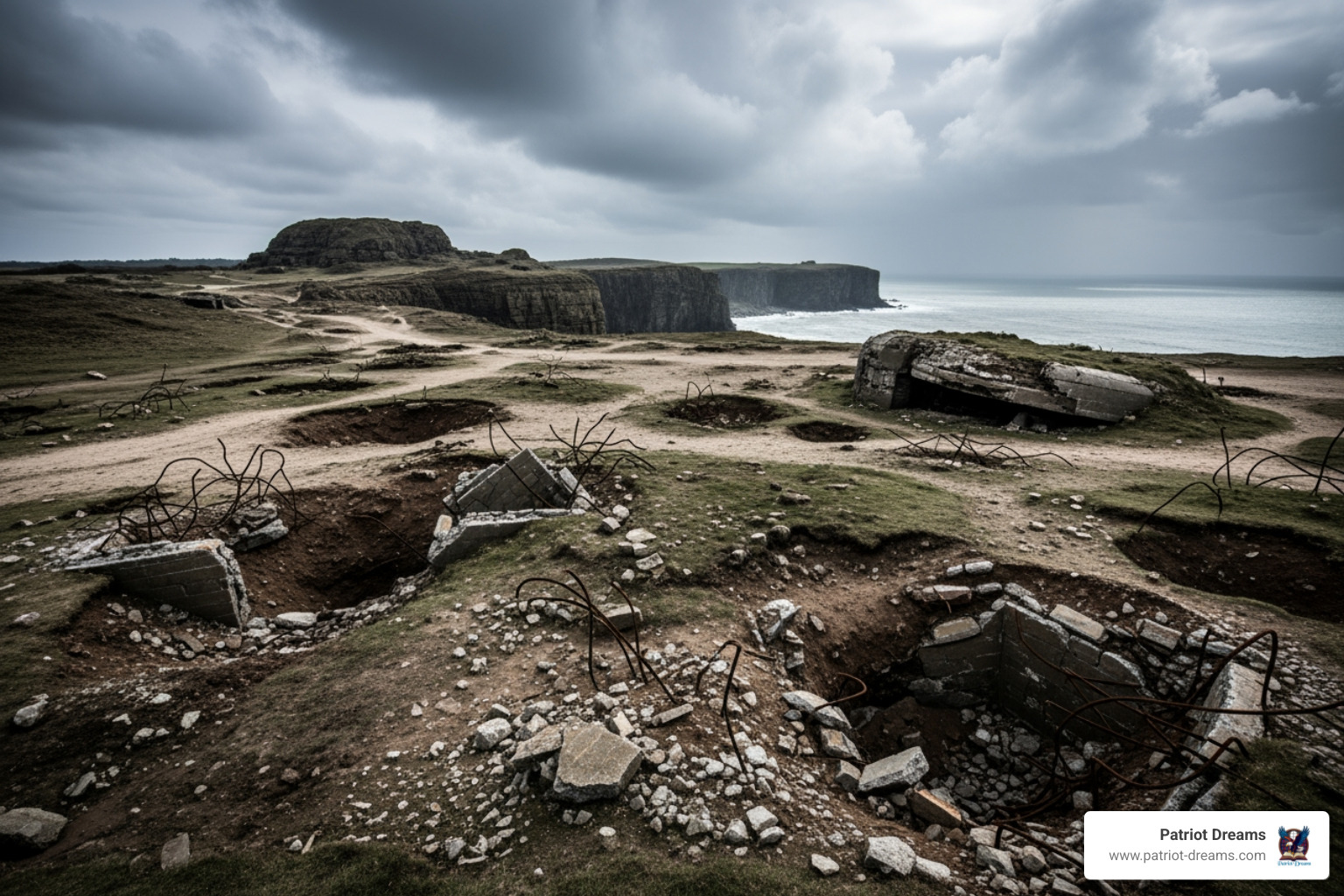
After an arduous and costly ascent, the Rangers finally reached the top of the cliffs. The landscape was utterly battered from previous bombardments. However, a startling find awaited them: the main gun emplacements were empty. The formidable 155mm cannons they had risked everything to destroy were not there. This moment of truth could have been devastating, potentially rendering their incredible sacrifice in vain.
But the Rangers were not easily deterred. Under the command of Lt. Col. Rudder, they immediately fanned out in a frantic search for the missing guns. This is where Sergeant Leonard Lomell, a true hero of the mission, led a small patrol inland. Following tracks and intuition, Lomell and his men found the six massive artillery pieces hidden in an apple orchard, some distance from their original positions. The Germans had moved them to avoid Allied bombing, camouflaged and ready to fire on the beaches.
Disabling the Threat
The finding of the hidden guns was a critical turning point. Without hesitation, Sergeant Lomell and his patrol sprang into action. Using thermite grenades, designed specifically for destroying heavy equipment, they disabled the breach mechanisms of the cannons. Some accounts also mention the use of chemical agents and even hand grenades to render the guns inoperable. This act, carried out under constant threat of discovery, ensured that the guns could not be turned on the vulnerable Allied forces on Utah and Omaha Beaches.
With the guns neutralized, the Rangers had achieved their primary objective. They sent word back: "Located and destroyed." This made the 2nd Ranger Battalion the first Allied unit to complete its D-Day objective, a monumental achievement that secured a vital flank for the broader invasion. Their success, against all odds, directly contributed to the overall success of D-Day by removing a significant threat to the landing forces.
Holding the Line
Even with the guns disabled, the Rangers' mission was far from over. They were isolated and surrounded, having successfully taken the high ground but now needing to hold it against inevitable German counterattacks. For two harrowing days, the Rangers fought fiercely, enduring relentless assaults from the German 716th Infantry Division. They were often outnumbered and low on ammunition, forcing them to use captured German weapons to defend their positions.
The casualties mounted quickly. Of the 225 Rangers who landed, only 90 were still able to bear arms after two days of relentless fighting. By June 8th, Lt. Col. Rudder had only 75 men left who could fight. In the chaos, 20 Rangers were even captured during night attacks. This brutal defense, highlighted in accounts like The Pointe du Hoc Rangers: a Madman's D-Day Mission, showcases the sheer grit and determination of these men. They held their ground, preventing the Germans from retaking the strategic position and re-establishing observation over the beaches. Their unwavering stand, despite heavy losses, was a crucial part of the broader D-Day invasion plan, buying precious time and preventing further disaster on the beaches.
The Legacy of the “Boys of Pointe du Hoc”
The relief for the beleaguered Rangers finally arrived on June 8th, two days after their initial landing. They were relieved by elements of the 5th Ranger Battalion and later by the 29th Infantry Division. The cost of victory was immense, but their sacrifice was not in vain. For their extraordinary heroism and unparalleled courage, the 2nd Ranger Battalion was awarded the Presidential Unit Citation, one of the highest military honors a unit can receive.
Pointe du Hoc today stands as a powerful symbol of courage and sacrifice, a place of pilgrimage for those who wish to remember the incredible deeds of these American heroes. Its legacy was beautifully captured by President Ronald Reagan in his iconic 1984 speech commemorating the 40th anniversary of D-Day. Standing on those very cliffs, Reagan addressed the surviving Rangers, famously saying, "These are the boys of Pointe du Hoc. These are the men who took the cliffs. These are the champions who helped free a continent. These are the heroes who helped end a war." His words ensured that the story of the 2nd Ranger Battalion would forever be etched into the annals of American history and memory.
Personal Stories of Sacrifice and Survival
Amidst the grand narratives of courage and strategic importance, it's the personal stories that truly touch our hearts. James E. Fulton, the Staff Sergeant from F Company, provides a poignant example of the bonds forged in the crucible of war. He recounts an instance of milking a cow on D-Day, not for himself, but for a wounded comrade who couldn't eat his rations. "I was probably the only soldier to milk a cow on D-Day," he chuckled, a moment of humanity amidst the horror. These small acts of kindness, the selfless devotion to one another, highlight the true spirit of brotherhood that defined these men.
Fulton's journey of sacrifice continued, earning him three Purple Hearts. Yet, despite the physical and emotional scars, his reflections reveal a profound sense of duty. When asked about his experiences, he stated, "It makes you wonder what in the hell it was all about." But then, with a resolute spirit that defines true heroism, he added, "Hell yes, I’d do it again." This sentiment captures the essence of these ordinary Americans who became extraordinary heroes, ready to face the "Cliffs of Hell" once more for their country and their comrades.
Frequently Asked Questions about the Pointe du Hoc Assault
Why was the Pointe du Hoc mission so important for D-Day?
The six German 155mm cannons at Pointe du Hoc posed a direct threat to the Allied landing forces on both Utah and Omaha Beaches. These long-range guns could have rained destruction on the ships and troops, causing immense casualties and potentially crippling the entire D-Day invasion. Neutralizing this battery was a critical objective, vital for protecting the thousands of soldiers and ensuring the success of the Allied landings.
Did the Rangers find and destroy the guns?
Yes, they did. While the main gun emplacements on the cliffs were found empty, a patrol led by Sergeant Leonard Lomell heroically located the six 155mm guns hidden in an apple orchard about a thousand yards inland. Using thermite grenades, they effectively disabled the weapons, rendering them useless and completing their primary mission.
What made the Rangers’ climb so difficult?
The Rangers faced an array of daunting challenges. They had to scale sheer 100-foot cliffs under intense enemy machine-gun fire and grenade attacks. Equipment failures were common, with ropes becoming waterlogged and heavy, and some extension ladders proving too short. A navigational error caused them to land nearly an hour late, losing the element of surprise and facing a more alert enemy. The combination of formidable natural defenses, heavy enemy resistance, and equipment issues made it one of the most perilous missions of D-Day.
A Story of American Courage for the Ages
The story of the 2nd Ranger Battalion at Pointe du Hoc is more than just a military account; it's a profound narrative about ordinary people rising to extraordinary challenges. It speaks to the core values of courage, resilience, and unwavering dedication to one another and to a greater cause. These Rangers, these "Boys of Pointe du Hoc," remind us that even in the face of seemingly impossible obstacles, the human spirit, especially the American spirit, can achieve the impossible.
Their legacy is a guide of hope and unity, inspiring us to remember the sacrifices made for the freedoms we cherish. At Patriot Dreams, we believe in preserving these heartwarming stories of American heroism, ensuring they continue to uplift and connect us across generations. We invite you to find more inspiring tales of perseverance and community in our collection, America: 250 Years in the Making.

Join the Patriot Dreams Community
Download the app today and start your journey through American history and personal legacy.

Explore Our Latest Insights
Dive into stories that shape our American legacy.