The 39 Men Who Risked Everything to Sign the US Constitution

Who Signed the U.S. Constitution?
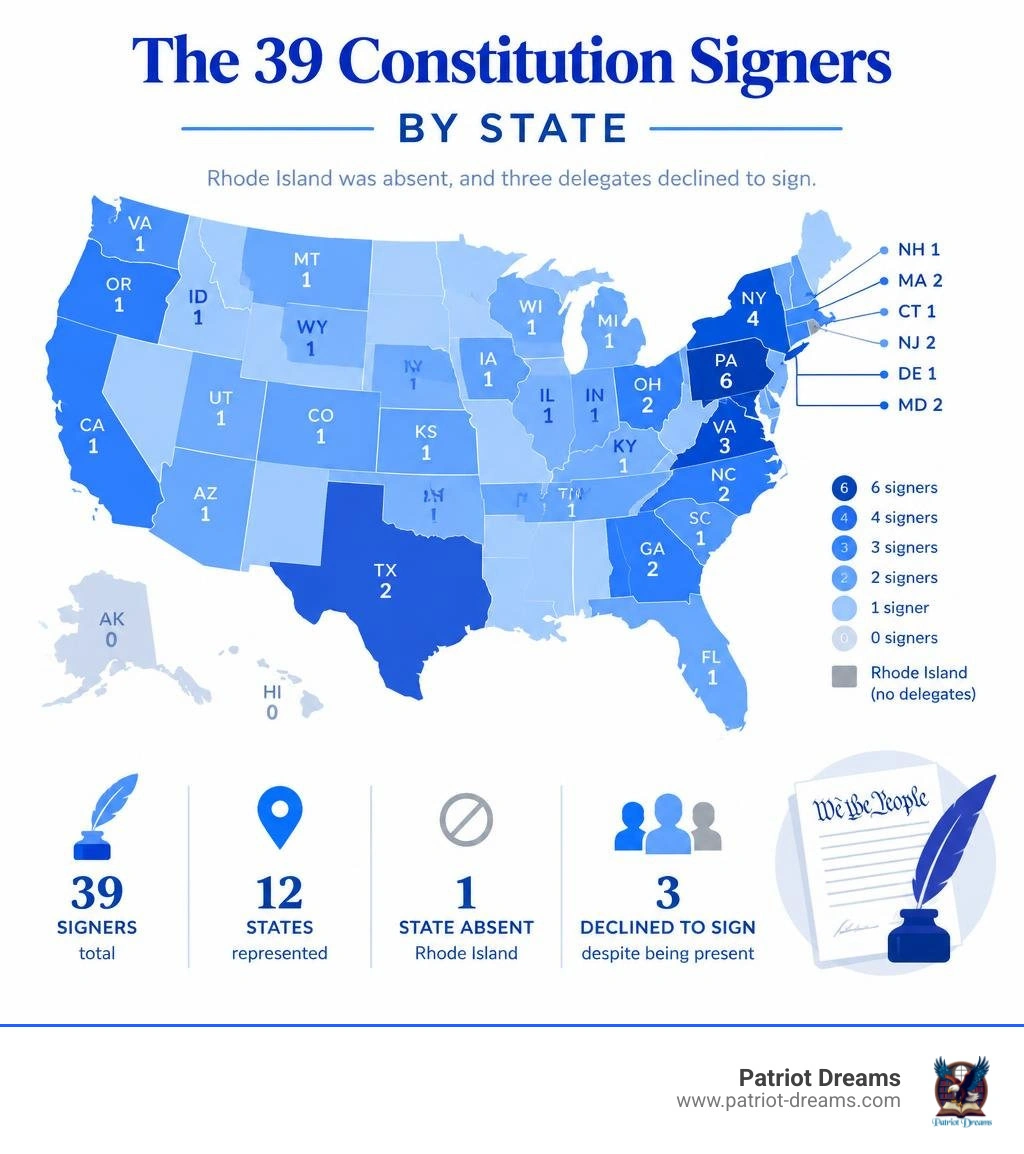
Thirty-nine delegates signed the U.S. Constitution in Philadelphia on September 17, 1787. They represented 12 states and included George Washington of Virginia, Benjamin Franklin of Pennsylvania, and Alexander Hamilton of New York. Rhode Island sent no delegates.
The signatures came after months of debate. Three delegates who were there at the end chose not to sign, and the document still had to win approval from the states. We're Kyle and Emily, and we'll start with every signer's name and state, then look at the people and choices behind them.
Must-know signers of the constitution terms:
- Declaration Signers
- how many delegates signed the declaration of independence
- list the signers of the declaration of independence
Complete State-by-State Guide to the Signers of the Constitution
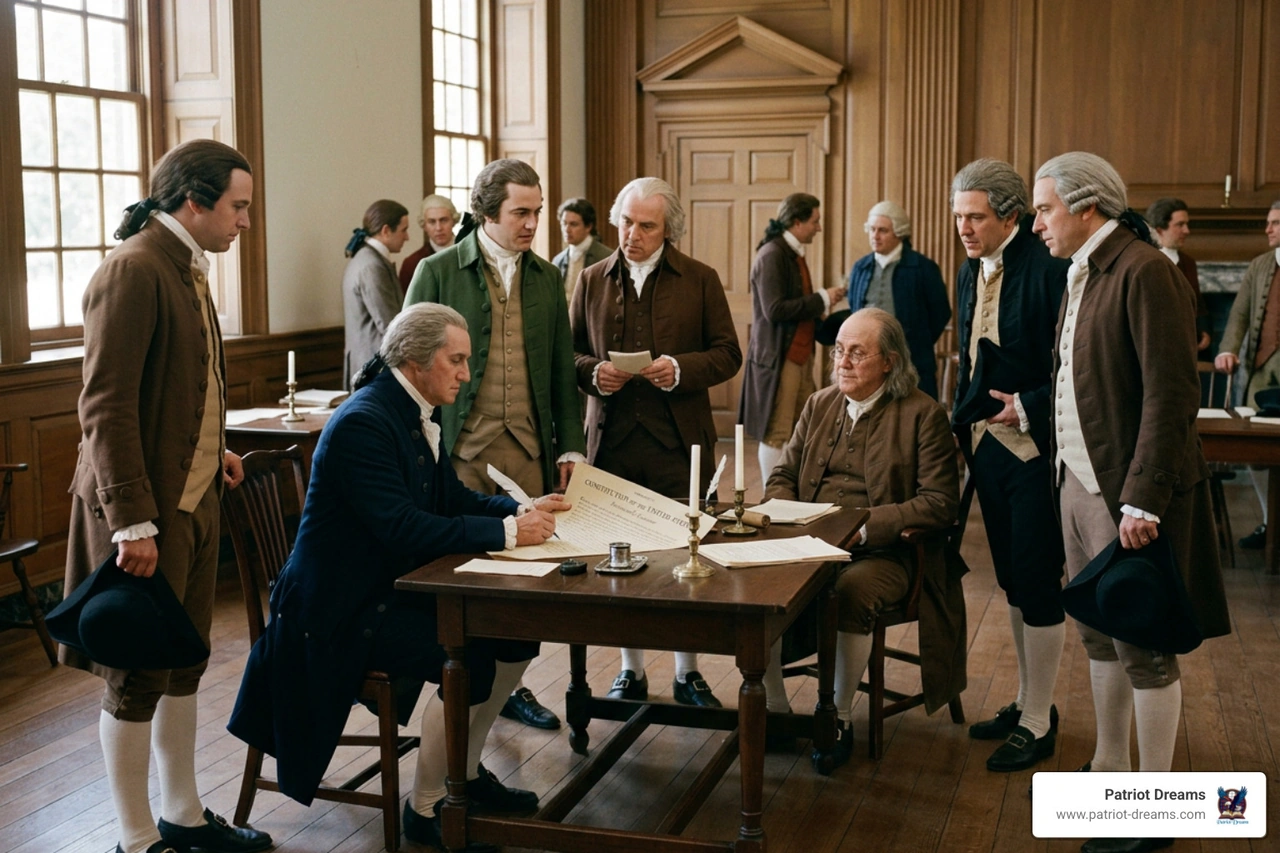
When the parchment was engrossed by assistant clerk Jacob Shallus, the signatures were arranged geographically from north to south. Presiding over the entire room was George Washington: The General Who Became America's First President, whose signature stands front and center as President of the Convention. Alongside the delegates, Convention Secretary William Jackson signed to attest the validity of the parchment.
Official archival records, including the Signers of the United States Constitution historical records, document the thirty-nine men representing twelve states.
New England and Middle Atlantic Delegations
The journey through the delegations begins in northern New England and moves southward through the bustling commercial hubs of the Middle Atlantic:
- New Hampshire:
- John Langdon: A wealthy merchant who generously paid the travel expenses for himself and his fellow delegate so New Hampshire could take part.
- Nicholas Gilman: A dedicated public servant who served in the Continental Army and managed crucial administrative affairs.
- Massachusetts:
- Nathaniel Gorham: A seasoned merchant and former President of the Confederation Congress who frequently chaired the Committee of the Whole.
- Rufus King: A gifted orator and attorney who championed a strong central government.
- Connecticut:
- William Samuel Johnson: A respected scholar and president of Columbia College who chaired the Committee of Style.
- Roger Sherman: A master statesman who introduced the pivotal Great Compromise.
- New York:
- Alexander Hamilton: The sole signatory for New York after his fellow delegates departed early over states' rights concerns.
- New Jersey:
- William Livingston: The long-serving governor of New Jersey who brought steady executive leadership.
- David Brearley: A chief justice of New Jersey’s Supreme Court dedicated to judicial integrity.
- William Paterson: The author of the New Jersey Plan, ensuring smaller states retained fair representation.
- Jonathan Dayton: An ambitious Continental Army veteran and the youngest person to sign.
- Pennsylvania:
- Benjamin Franklin: The revered inventor, diplomat, and philosopher whose wit and warmth held the delegates together.
- Thomas Mifflin: A general during the Revolutionary War and skilled administrator.
- Robert Morris: Known as the "Financier of the Revolution," who helped fund America's fight for liberty.
- George Clymer: A quiet merchant dedicated to sound commercial policies.
- Thomas Fitzsimons: An Irish-born merchant and philanthropist who advised on international trade.
- Jared Ingersoll: A brilliant lawyer who helped navigate complex statutory debates.
- James Wilson: A legal scholar who played a foundational role in structuring the executive and judicial branches.
- Gouverneur Morris: The brilliant stylist credited with drafting the actual words of the Constitution, including its famous preamble.
Southern Delegations and Key Signatories
Moving south of the Mason-Dixon line, the remaining delegations balanced agricultural traditions with national unity. Detailed entries in the National Constitution Center delegate biographies illustrate their varied contributions:
- Delaware:
- George Read: A meticulous legal mind who also cast a proxy vote for his ailing colleague.
- Gunning Bedford Jr.: A fiery defender of small-state sovereignty.
- John Dickinson: The famous "Penman of the Revolution." Due to a sudden illness, he authorized George Read to sign his name by proxy.
- Richard Bassett: An attorney, planter, and later a dedicated Methodist preacher.
- Jacob Broom: A hardworking surveyor and businessman who consistently supported a practical federal structure.
- Maryland:
- James McHenry: An Irish-born physician who served as an aide to General Washington.
- Daniel of St. Thomas Jenifer: A genial veteran of colonial administration who brought good humor to heated debates.
- Daniel Carroll: A wealthy planter who helped bridge religious and civic communities in Maryland.
- Virginia:
- John Blair: A revered Virginia judge known for his calm temperament and judicial wisdom.
- James Madison and the Constitution: Often hailed as the "Father of the Constitution" for drafting the Virginia Plan and keeping detailed notes of the debates.
- North Carolina:
- William Blount: A frontier land speculator and public official.
- Richard Dobbs Spaight: A young legislator committed to developing infrastructure and trade.
- Hugh Williamson: A physician, mathematician, and natural philosopher who served on key economic committees.
- South Carolina:
- John Rutledge: A seasoned jurist who led the Committee of Detail, producing the first complete draft of the document. The signing took place on his 48th birthday.
- Charles Cotesworth Pinckney: A decorated Revolutionary officer and diplomat who advocated for commercial interests.
- Charles Pinckney: A cousin of Charles Cotesworth, who contributed energetic proposals on legislative design.
- Pierce Butler: An Irish-born planter who vigorously represented southern agricultural policies.
- Georgia:
- William Few: A frontier lawyer and soldier who supported military and federal protections for developing territories.
- Abraham Baldwin: A Yale-educated minister and scholar who broke key ties to keep the convention unified.
Backgrounds, Occupations, and Demographics of the Signers of the Constitution
The delegates in Philadelphia represented a cross-section of early American leadership, from scholars and physicians to merchants and planters.
| Signer | State | Age in 1787 | Primary Occupation | Continental Military Service | Birthplace |
|---|---|---|---|---|---|
| Benjamin Franklin | PA | 81 | Printer / Scientist / Diplomat | No | Boston, MA |
| Jonathan Dayton | NJ | 26 | Lawyer / Politician | Yes (Captain) | Elizabethtown, NJ |
| George Washington | VA | 55 | Planter / Surveyor | Yes (Commander-in-Chief) | Westmoreland Co., VA |
| James Madison | VA | 36 | Planter / Statesman | Yes (Col. Militia) | Port Conway, VA |
| Alexander Hamilton | NY | 30 | Lawyer / Statesman | Yes (Lt. Colonel) | Nevis, West Indies |
| Roger Sherman | CT | 66 | Lawyer / Cobbler / Merchant | No | Newton, MA |
| Robert Morris | PA | 53 | Merchant / Financier | No | Lancashire, England |
| James Wilson | PA | 45 | Lawyer / Jurist | Yes (Col. Militia) | Fife, Scotland |
| Pierce Butler | SC | 43 | Planter / Soldier | No (British/Militia) | County Carlow, Ireland |
| James McHenry | MD | 33 | Physician / Statesman | Yes (Surgeon/Major) | County Antrim, Ireland |
| William Paterson | NJ | 41 | Lawyer / Jurist | No | County Antrim, Ireland |
| Thomas Fitzsimons | PA | 46 | Merchant / Banker | Yes (Captain Militia) | Ireland |
As commemorated in the National Archives Faulkner Constitution Mural guide, the signers brought practical experience from every corner of the young republic.
Demographics and Daily Occupations of the Signers of the Constitution
The delegates ranged widely in age and life experience. Benjamin Franklin was the eldest at 81, while New Jersey’s Jonathan Dayton was just 26. The average age was around 42.

Over half of the delegates held legal careers, serving as judges, attorneys, or legal apprentices. Others brought agricultural wisdom from family farms, while merchants understood maritime trade and currency instability. Learn more about their stories in All About Benjamin Franklin: Inventor, Diplomat, and Founding Father and explore the broader circle of Who Are the Founding Fathers of the USA?.
Seven of the 39 signers were born outside the thirteen colonies:
- Ireland: Pierce Butler, Thomas Fitzsimons, James McHenry, William Paterson
- England: Robert Morris
- Scotland: James Wilson
- West Indies: Alexander Hamilton
Key Differences: Signers of the Constitution vs. Declaration Signers
It is easy to confuse the signing of the Declaration of Independence in 1776 with the Constitutional Convention in 1787. In 1776, 56 men risked everything to announce separation from Great Britain. In 1787, 39 men met to build a stable, lasting framework of law.
Only six remarkable patriots signed both founding charters:
- Benjamin Franklin
- Roger Sherman
- James Wilson
- Robert Morris
- George Clymer
- George Read
Roger Sherman achieved a unique distinction: he is the only person to sign all four foundational state papers—the Continental Association (1774), the Declaration of Independence (1776), the Articles of Confederation (1777), and the Constitution (1787). Explore these connections further in our look at the Founding Fathers of the United States.
The Dissenters, Absentees, and Franklin’s Persuasive Closing Plea
Of the 55 delegates who took part in Philadelphia, only 41 were present on the final morning of September 17, 1787. Several leading figures missed the convention entirely. Thomas Jefferson was in Paris serving as minister to France, John Adams was minister in London, and Patrick Henry chose not to attend, famously expressing skepticism about strengthening the central government.
The Three Delegates Who Refused to Sign
Three delegates present on the final day declined to sign the completed document:
- George Mason (Virginia): Refused to sign because the draft lacked an explicit declaration of individual liberties. His firm stand helped catalyze the later adoption of the Bill of Rights.
- Elbridge Gerry (Massachusetts): Feared the central government had been granted too much power over state trade and domestic militias.
- Edmund Randolph (Virginia): Introduced the Virginia Plan at the start of the summer, but worried the final text leaned too far toward consolidation and advocated for a second general convention.
Discover how their principled dissent influenced our national blueprint in The US Constitution & Bill of Rights Explained Simply.
Why Rhode Island Boycotted the Convention
Rhode Island stood out by refusing to send any delegates to Philadelphia. Its leaders worried that a stronger national government would restrict their local paper currency policies and import taxes. Under the Articles of Confederation, amendments required unanimous approval, giving Rhode Island an effective veto. By remaining absent, its legislature hoped to protect its local autonomy.
Benjamin Franklin and the 'Rising Sun' Speech
On the final morning, 81-year-old Benjamin Franklin addressed the room. Too frail to stand for long, he asked fellow Pennsylvania delegate James Wilson to read his speech.
Franklin acknowledged human fallibility, observing that as he grew older, he doubted his own infallibility more and more. He urged every member who still had reservations to join in signing:
"I consent, Sir, to this Constitution because I expect no better, and because I am not sure, that it is not the best."
As the final signatures were inscribed, Franklin looked at the half-sun carving on the back of George Washington's chair. He remarked that artists often found it hard to distinguish a rising sun from a setting one. Now, with the document completed, he felt confident the sun was rising upon the American republic.
The Clever Signing Formula, Personal Risks, and Path to Ratification
Getting delegates to put quill to parchment required diplomatic creativity. The debates of the summer, explored in our overview of Constitutional Convention History, culminated in a carefully phrased conclusion.
The Attestation Clause and Gouverneur Morris's Diplomatic Formula
To encourage reluctant delegates to sign, Gouverneur Morris crafted the closing attestation clause:
"Done in Convention by the Unanimous Consent of the States present the Seventeenth Day of September in the Year of our Lord one thousand seven hundred and Eighty seven..."
This wording meant signers were witnessing the consent of the states present, rather than declaring personal agreement with every individual clause.
Personal Risks, Political Sacrifices, and the Ratification Campaign
Signing the Constitution carried real political and personal stakes. Delegates exposed themselves to public criticism from neighbors who worried about federal overreach.
After signing, the document went to the Confederation Congress and then to state ratifying conventions. Delaware became the first state to ratify on December 7, 1787, while New Hampshire secured the required nine-state threshold on June 21, 1788.
Debunking Common Myths About the Constitutional Signing
- Myth 1: The Constitution became law the moment it was signed.
Fact: Signing the document did not enact it. It served as a proposal sent to state conventions for formal ratification under Article VII. - Myth 2: Forty delegates signed the document.
Fact: Thirty-nine delegates signed. The 40th name on the parchment belongs to Convention Secretary William Jackson, who signed to attest the signatures. - Myth 3: John Dickinson was in the room when his name was signed.
Fact: Dickinson was confined to bed with a severe headache and authorized George Read to sign on his behalf. - Myth 4: Thomas Jefferson wrote the Constitution.
Fact: Jefferson drafted the Declaration of Independence in 1776, but was in France throughout the 1787 Constitutional Convention.
Frequently Asked Questions About the Signers of the Constitution
Who was the oldest and youngest signer of the Constitution?
Benjamin Franklin of Pennsylvania was the oldest signer at 81 years old. Jonathan Dayton of New Jersey was the youngest signer at 26 years old.
Which six men signed both the Declaration of Independence and the Constitution?
Benjamin Franklin, Roger Sherman, James Wilson, Robert Morris, George Clymer, and George Read signed both landmark documents.
Why did Edmund Randolph, George Mason, and Elbridge Gerry refuse to sign?
They were concerned about the lack of an explicit Bill of Rights and worried that the new federal government held too much centralized authority over state institutions.
Conclusion
When we reflect on that warm September afternoon in Philadelphia, we see neighbors from different backgrounds working through hard disagreements to build something lasting. The 39 delegates who signed the Constitution showed that people can sit down together, listen with patience, and find common ground for the common good.
Every year on September 17, Constitution Day reminds us of the power of unity and thoughtful compromise. At Patriot Dreams, we love sharing the human stories behind these pivotal moments in American history. We invite you to explore our interactive maps and discover the remarkable lives of the signers of the Declaration of Independence and the men who helped shape our nation.

Join the Patriot Dreams Community
Download the app today and start your journey through American history and personal legacy.

Explore Our Latest Insights
Dive into stories that shape our American legacy.