The Story of Chief Joseph's Final Stand

One Man's Final Stand: The Story of the Chief Joseph Surrender
The Chief Joseph surrender is one of the most moving moments in American history — a story of love for home, quiet strength, and a leader who never stopped caring for his people.
Here is a quick overview of the key facts:
- Who: Chief Joseph (Hin-mah-too-yah-lat-kekt), leader of the Wallowa band of the Nez Perce
- When: October 5, 1877
- Where: Bear Paw Mountains, Montana Territory — just 40 miles from the Canadian border
- Why: Exhausted and outnumbered, with children freezing, leaders dead, and people starving after a 1,170-mile retreat
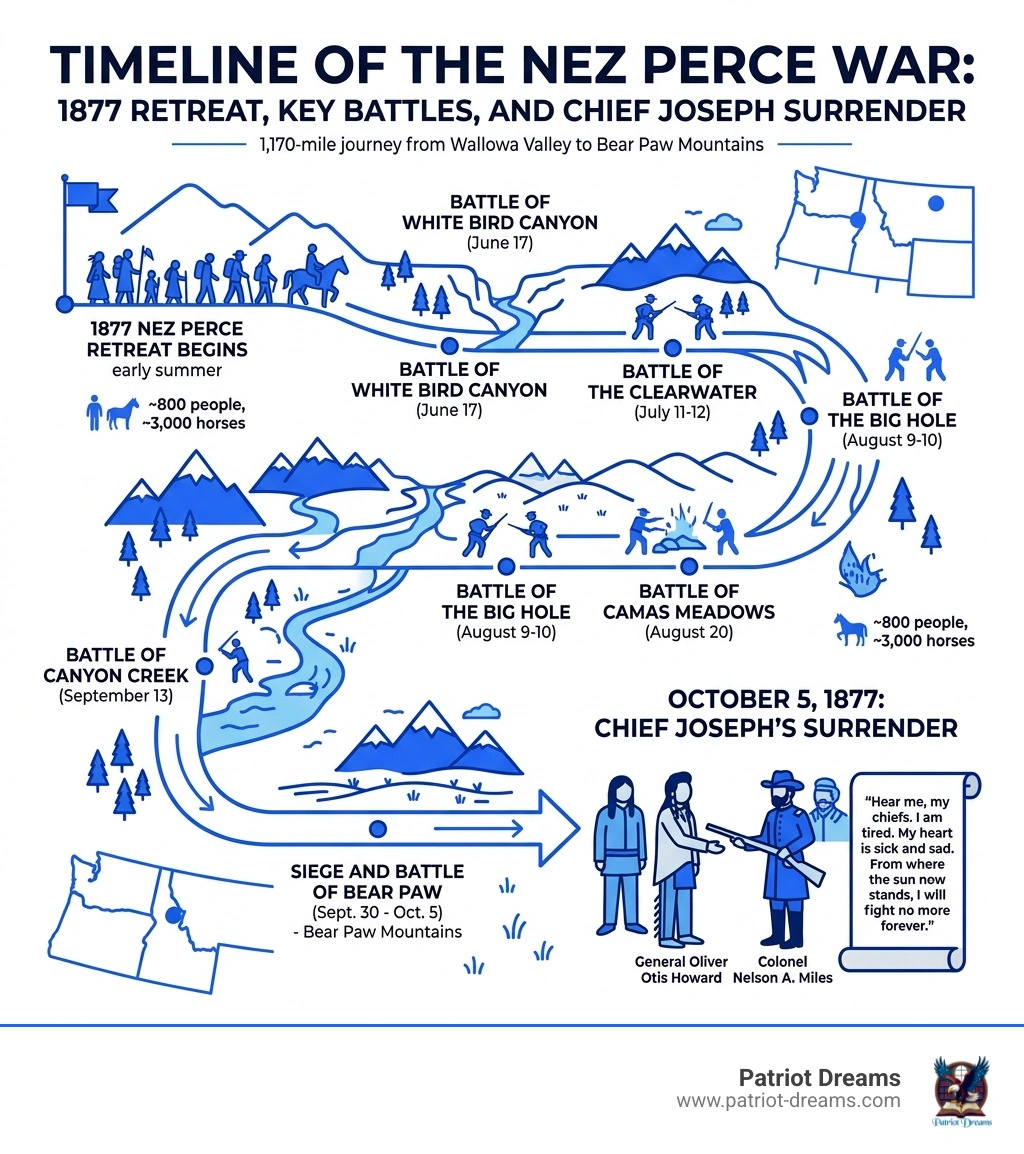
- Famous words: "Hear me, my chiefs. I am tired. My heart is sick and sad. From where the sun now stands, I will fight no more forever."
- What followed: Broken promises, forced exile to Kansas and Oklahoma, and decades of advocacy for his people
Chief Joseph did not surrender because he gave up on his people. He surrendered because of them.
For over three months, he helped lead roughly 800 men, women, and children — along with nearly 3,000 horses — across mountains, rivers, and open plains. They outmaneuvering more than 2,000 U.S. soldiers across four states. They fought with courage. They treated prisoners with kindness. They even purchased supplies rather than taking them by force.
And then, just two days' ride from safety in Canada, it ended.
This is the story of what happened — and why it still matters.
Relevant articles related to Chief Joseph surrender:
The Heart of the Wallowa: A Legacy of Peace and Promises
To understand why the Chief Joseph surrender was so heartbreaking, we have to look back at the beautiful Wallowa Valley in Oregon. This was the home of the Nez Perce (who called themselves the Niimíipuu). For generations, they lived in harmony with the land, breeding the famous Appaloosa horses and maintaining a peaceful relationship with white explorers. In fact, back in 1805, the Nez Perce famously aided the starving Lewis and Clark expedition, providing them with food and horses.
However, as more settlers arrived on the Oregon Trail Stories path, the U.S. government began pushing for land cessions. Chief Joseph's father, known as Old Joseph, had been one of the first Nez Perce to convert to Christianity and had initially sought peace with the settlers. But when the "Thief Treaty" of 1863 was proposed, everything changed.
This treaty was signed by only a portion of the Nez Perce chiefs — those whose lands were not being taken. Old Joseph and several other bands refused to sign. They were called the "non-treaty" Nez Perce. Old Joseph famously told his son, "Always remember your country. Do not give it away." He even marked the boundaries of their land with poles to show exactly where their home was.
| Feature | 1855 Walla Walla Treaty | 1863 "Thief Treaty" |
|---|---|---|
| Total Land Allotted | 7.7 Million Acres | 760,000 Acres |
| Percentage of Land Lost | N/A | Approximately 90% |
| Status of Wallowa Valley | Retained by Nez Perce | Taken by U.S. Government |
| Signatories | General Tribal Consensus | Only "Treaty" Bands |
When Old Joseph died in 1871, he left his son with a heavy responsibility. As we look at the history from our perspective in April 2026, we can see the impossible choice Joseph faced: stay and watch his people be forced onto a tiny reservation in Idaho, or fight for the land his father told him never to sell.
The Long Journey Home: A 1,100-Mile Test of Resilience
The conflict finally reached a breaking point in 1877. After a series of violent incidents sparked by young warriors who were angry over the loss of their land and the mistreatment of their people, the U.S. Army was sent to force the Nez Perce onto the Lapwai reservation.
Chief Joseph, who was primarily a camp leader and diplomat rather than a "war chief," realized that his people could not win a direct war against the U.S. military. Instead, he and other leaders like Looking Glass and Lean Elk decided to lead their people on an epic retreat toward Canada, hoping to find asylum with Sitting Bull.
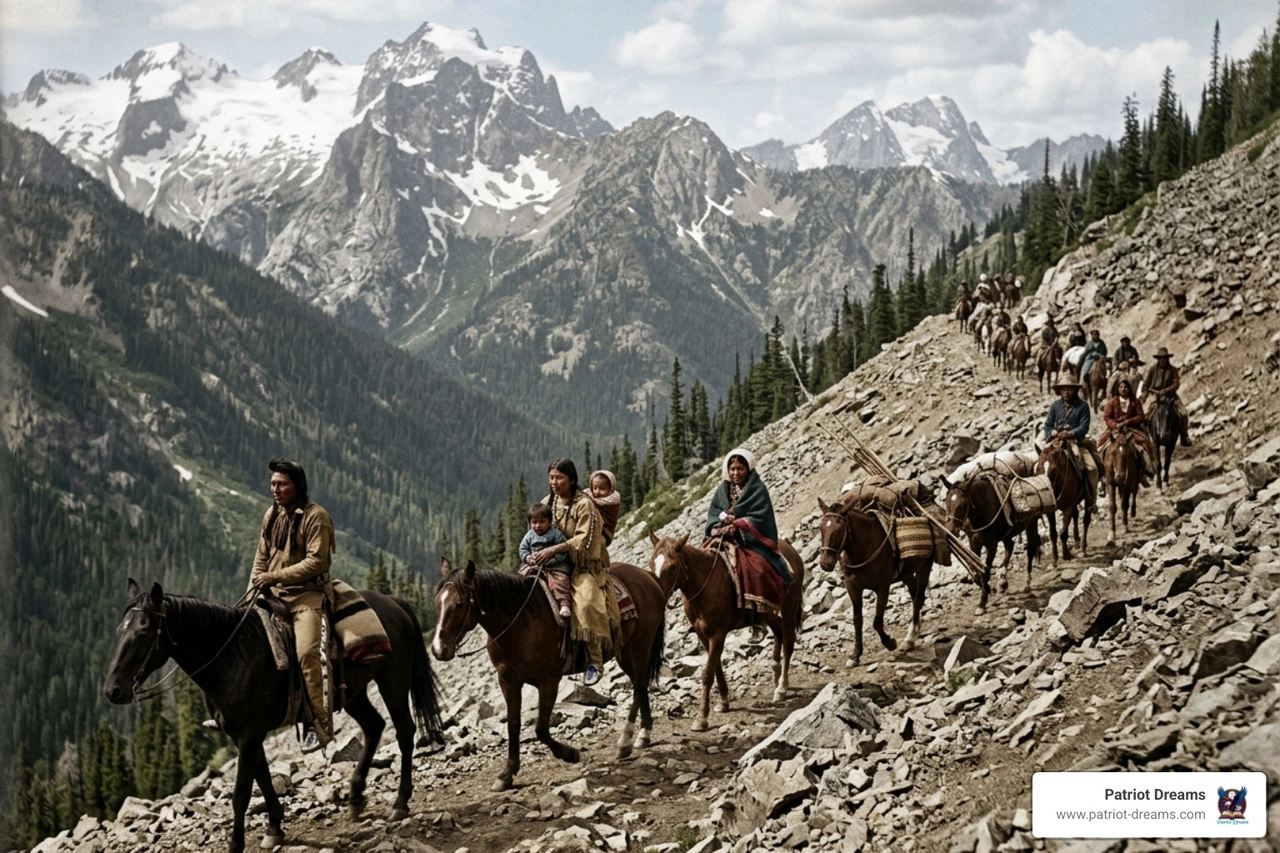
This wasn't just a military unit moving through the wilderness. It was a whole community. We’re talking about:
- Roughly 800 people, including elders, women, and nursing infants.
- Approximately 3,000 horses and pack animals.
- A journey of 1,170 miles (some estimates say up to 1,600 miles) through Oregon, Washington, Idaho, Wyoming, and Montana.
Along the way, they fought 13 separate battles and skirmishes against the U.S. Army. In the Battle of White Bird Canyon, the Nez Perce dealt a stunning defeat to the cavalry, losing only three men while 34 soldiers fell. You can read more about the military specifics in The Nez Perce War of 1877 | Article. Despite being pursued by over 2,000 soldiers, the Nez Perce continued to move with incredible speed and tactical brilliance.
The Strategic Brilliance of the Chief Joseph Surrender Path
The world watched in amazement as the Nez Perce outmaneuvered General Oliver Otis Howard. The press nicknamed Chief Joseph "The Red Napoleon" because of the tactical genius shown during the retreat. However, modern historians note that while Joseph was a brilliant spokesperson and logistical leader, the military strategy was often a collective effort among several chiefs.
What truly set this retreat apart was the humanity shown by the Nez Perce. Unlike many conflicts of the era, the Nez Perce:
- Treated wounded prisoners with kindness.
- Refused to scalp or mutilate the dead.
- Purchased supplies from local settlers and stores using gold or currency instead of stealing them.
This honorable behavior earned them the respect of many soldiers and citizens alike. They were traveling through the same rugged terrain that the Mountain Men Frontier Tales often describe, but they were doing it with an entire village in tow. They even crossed through the newly established Yellowstone National Park, surprising early tourists along the way!
The Moment of Chief Joseph Surrender: Words That Echoed Through Time
By the time the Nez Perce reached the Bear Paw Mountains in Montana, they were exhausted. They believed they had finally outrun General Howard and were only 40 miles from the Canadian border. They stopped to rest and hunt buffalo, not realizing that Colonel Nelson A. Miles was approaching from a different direction to intercept them.
On September 30, 1877, the final battle began. For five days, the Nez Perce held their ground in freezing temperatures and driving snow. But the cost was too high. Many of the great leaders, including Joseph’s brother Ollokot and the brave Chief Looking Glass, were killed.
On October 5, 1877, Chief Joseph made the heart-wrenching decision to end the fighting. He rode out to meet General Miles and General Howard (who had finally caught up).
His Chief Joseph: Surrender Speech (transcript) is considered one of the most eloquent and tragic pieces of oratory in American history. He spoke of the "little children freezing to death" and his "sick and sad" heart. When he uttered the words, "From where the sun now stands, I will fight no more forever," he wasn't just ending a war; he was trying to save the remnants of his family.
The Broken Promises Following the Chief Joseph Surrender
When the Chief Joseph surrender took place, it was under specific terms. General Miles had promised Joseph that the Nez Perce would be allowed to return to their reservation in Idaho. Joseph believed him. He had been a man of his word throughout the entire war, and he expected the same from the U.S. government.
Unfortunately, General William Tecumseh Sherman overruled those terms. Instead of going home to the Pacific Northwest, the 418 survivors were loaded onto unheated rail cars and sent to Fort Leavenworth, Kansas, and later to "Indian Territory" in Oklahoma.
The conditions were horrific. The Nez Perce were accustomed to the cool, high-altitude air of the mountains, not the humid, swampy heat of Oklahoma. Within a few years, more than a quarter of the tribe had died from malaria and other diseases. This period of their history is a somber echo of the Cherokee Trail Of Tears Stories that happened decades earlier.
A Leader’s Love: Advocacy and Resilience After the Conflict
Chief Joseph never stopped fighting for his people, but he traded his rifle for the power of the spoken word. In 1879, he traveled to Washington D.C. to address a crowded theater of diplomats and politicians, including President Rutherford B. Hayes.
He said, "Whenever the white man treats the Indian as they treat each other, then we shall have no more wars. We shall all be alike—brothers of one father and mother, with one sky above us and one country around us." His Chief Joseph’s Guiding Principle was always equality and the right to live on the land of his ancestors.
Eventually, his advocacy paid off — partially. In 1885, the Nez Perce were allowed to return to the Pacific Northwest. However, Joseph and about 150 others were not allowed to go back to the Wallowa Valley. Instead, they were sent to the Colville Reservation in Washington State.
Joseph spent the rest of his life visiting the Wallowa whenever he was permitted, though he was often met with hostility from the settlers who now lived there. He passed away in 1904. His doctor famously noted that the great chief had died not of old age, but of "a broken heart."
Frequently Asked Questions about the Nez Perce
Why did Chief Joseph surrender?
The Chief Joseph surrender happened because the survival of the tribe was at stake. By October 1877, the Nez Perce were trapped in a siege during a Montana winter. They had no blankets, very little food, and their most experienced military leaders had been killed. Chief Joseph saw his people, especially the children and the elderly, suffering from the cold and starvation, and he chose their lives over continued resistance.
What was the famous quote from the surrender?
The most famous part of his speech is: "Hear me, my chiefs! I am tired. My heart is sick and sad. From where the sun now stands, I will fight no more forever." This statement has become a symbol of the end of the "Indian Wars" and the tragic dignity of Native American resistance.
What happened to the Nez Perce after 1877?
After the Chief Joseph surrender, the tribe was forcibly relocated to Kansas and then Oklahoma. They suffered greatly from disease and grief. In 1885, they were finally allowed to return to the Northwest, but they were split between the Lapwai reservation in Idaho and the Colville reservation in Washington. Today, the Nez Perce Tribe is a vibrant community that continues to preserve its language, culture, and the legacy of Chief Joseph.
Conclusion: Carrying the Spirit of the Nez Perce Forward
At Patriot Dreams, we believe that stories like the Chief Joseph surrender are the threads that weave the fabric of our national identity. Chief Joseph’s story isn't just one of defeat; it’s a story of incredible resilience, deep family love, and the enduring hope for a better tomorrow.
When we listen to these American Pioneer Stories, we are reminded that heroism comes in many forms. Sometimes it’s the courage to fight, but often, it’s the courage to stop fighting so that others may live. Chief Joseph’s life teaches us about the importance of keeping our word and the value of our shared humanity.
As we explore The Frontier Myth Today What The Old West Tells Us About Modern America, we see that the spirit of the Nez Perce lives on in every person who stands up for their community and advocates for justice with kindness.
We invite you to Explore more Historical American Figures and discover the personal legacies that shaped our country. By remembering Chief Joseph, we honor a man who truly meant it when he quit—not because he was weak, but because his love for his people was the strongest force of all.

Join the Patriot Dreams Community
Download the app today and start your journey through American history and personal legacy.

Explore Our Latest Insights
Dive into stories that shape our American legacy.