Why Teddy Roosevelt Adventure Tales Still Warm Our Hearts


The Strenuous Life: Why We Love Teddy Roosevelt Adventure Tales
#
Teddy Roosevelt adventure tales are some of the most inspiring stories in all of American history — full of grit, heart, and a deep love for the natural world. Whether he was charging up San Juan Hill, chasing boat thieves across a frozen river, or mapping an uncharted stretch of the Amazon, Roosevelt lived life with a spirit that still speaks to us today, more than a century later.
Here is a quick look at the most beloved Roosevelt adventures:
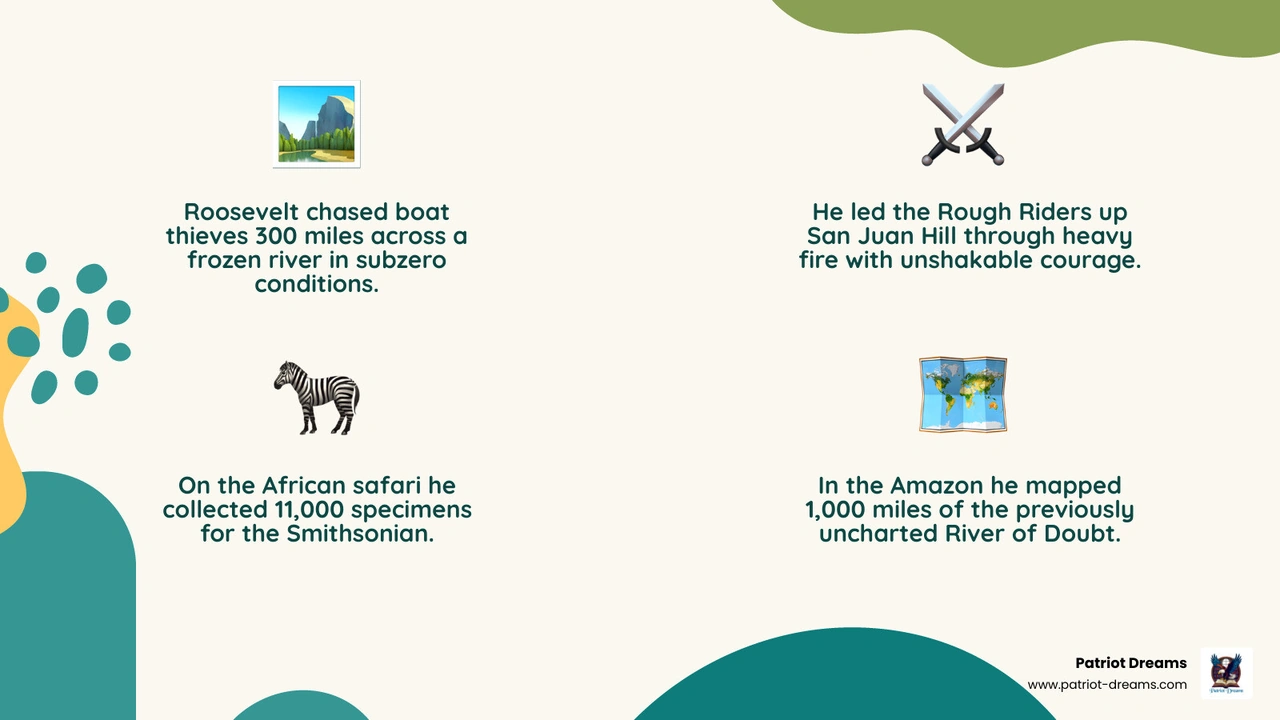
- The Badlands Pursuit — Roosevelt chased boat thieves 300 miles down the icy Little Missouri River in freezing temperatures, then personally walked them to justice.
- San Juan Hill — Leading the Rough Riders up a heavily defended hill in Cuba, Roosevelt inspired his men through sheer personal courage.
- The African Expedition (1909-1910) — Roosevelt and his son Kermit traveled to Africa and collected over 11,000 specimens for the Smithsonian Institution.
- The River of Doubt (1913-1914) — Father and son battled malaria, starvation, and deadly rapids to map nearly 1,000 miles of uncharted Amazon river.
What makes these stories so special is not just the action. It is the why behind them. Roosevelt believed deeply in what he called "the strenuous life" — the idea that a life of challenge, purpose, and effort is a life well lived. That message feels just as true in May 2026 as it did in his time.
These are stories about a real person — a father, a son, a neighbor, a leader — who chose courage over comfort, again and again.
When we think of Theodore Roosevelt today, we often picture the rough-and-tumble outdoorsman, but his journey to becoming that icon was a quiet, steady act of bravery. As a young boy in New York City, "Teedie" was incredibly frail, suffering from debilitating asthma that often left him gasping for breath. Instead of letting his physical limitations define him, he took his father’s advice to "make his body."
Through sheer personal determination, he transformed himself. He spent hours in the gym and even more time in the great outdoors. This early struggle shaped his entire philosophy: the "strenuous life." He believed that we find our best selves when we choose the hard path over the easy one. This wasn't about being "tough" for the sake of it; it was about building moral courage and the strength to help others.
You can learn more about this remarkable transformation in our article, Teddy Roosevelt: The Fearless Leader Every Young American Should Know. His life reminds us that no matter where we start, we have the power to grow, to learn, and to lead with kindness and vigor.
Timeless Lessons from Teddy Roosevelt Adventure Tales
What is it about a century-old story that still warms our hearts in May 2026? It’s the neighborly values Roosevelt carried with him into the wild. Even in his most dangerous moments, he remained a student of nature and a man of his word.
In the classic American Boys' Life of Theodore Roosevelt, we see a man who treated every everyday heroism as a duty. Whether he was helping a newsboy in distress or leading a nation, he believed that perseverance and family bonds were the true North Star. His adventures weren't just about the "kill" or the "glory"; they were about the appreciation of the world around us. He taught us that the same courage it takes to climb a mountain is the courage we use to stand up for what is right in our own neighborhoods.
A Legacy of Resilience: From the Badlands to San Juan Hill
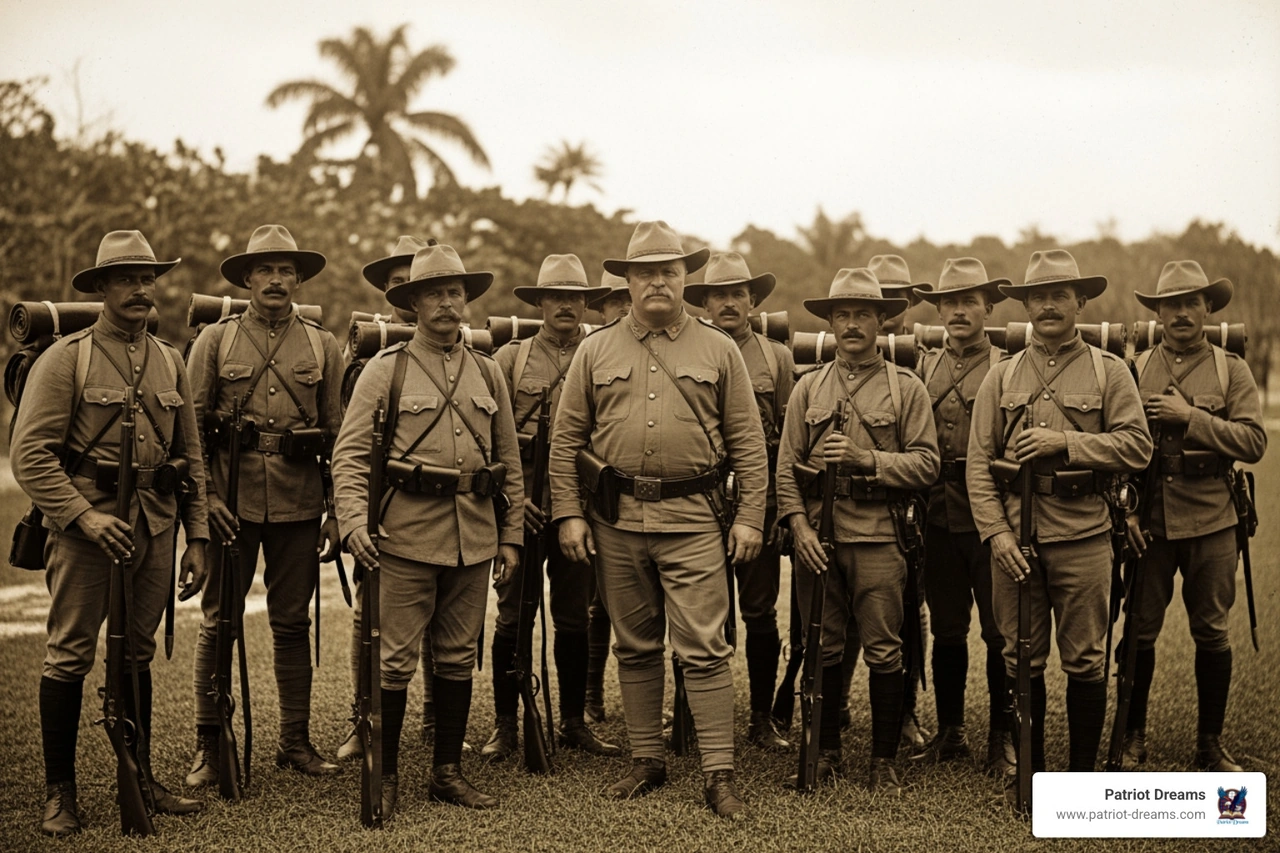
One of the most famous Teddy Roosevelt adventure tales took place right here in the American West. While ranching at Elkhorn Ranch, Roosevelt discovered that three thieves had stolen his boat. Most people would have let it go—after all, the boat was replaceable, and the river was choked with dangerous ice.
But Roosevelt, acting as a deputy sheriff, felt a moral obligation to uphold the law. He and two companions built another boat and pursued the thieves for three days down the Little Missouri River. Even as temperatures dipped to zero degrees Fahrenheit, Roosevelt didn't waver. When they finally caught the thieves, he didn't resort to frontier "vigilante" justice. Instead, he stayed awake for forty hours straight, reading Tolstoy’s Anna Karenina to pass the time while guarding the prisoners, eventually walking them 300 miles to a proper trial. You can read the full, gripping account of this pursuit at Roosevelt Pursues the Boat Thieves.
This same spirit followed him to Cuba during the Spanish-American War. As the leader of the "Rough Riders"—an eclectic mix of cowboys, Ivy League athletes, and Native Americans—Roosevelt displayed incredible bravery. During the famous charge up San Juan Hill, he rode his horse, Little Texas, right into the thick of the action. Despite a 37% casualty rate among his regiment, his leadership and the support of the brave Buffalo Soldiers secured a historic victory. To dive deeper into the tactics and heroism of that day, check out Teddy Roosevelt's Rough Ride.
The Smithsonian-Roosevelt Expedition: A Scientific Gift to the World
After leaving the White House in 1909, Roosevelt didn't head for a quiet retirement. Instead, he headed for Africa. This wasn't just a hunting trip; it was a massive scientific undertaking for the Smithsonian Institution.
Accompanied by his son Kermit and a team of expert naturalists, Roosevelt collected over 11,000 specimens, ranging from large mammals to tiny insects. These specimens were a gift to the American people and are still used by scientists today to understand historical biodiversity.
One of the most charming details of this trip was Roosevelt’s "Pigskin Library." He carried 46 volumes of classic literature, all bound in durable pigskin leather so he could read them in the dusty African heat. He believed that a sharp mind was just as important as a sharp eye. His reflections on this journey were captured in his bestseller African Game Trails, and you can find more historical context in Roosevelt's Marvelous Exploits in the Wilds of Africa. Through this expedition, Roosevelt proved that exploration and conservation go hand in hand.
The River of Doubt: A Father and Son’s Ultimate Test
Perhaps the most harrowing of all Teddy Roosevelt adventure tales is his 1913-1914 journey into the Amazon. Following a difficult political defeat in 1912, Roosevelt sought a challenge that would test his very soul. Alongside the legendary Brazilian explorer Cândido Rondon and his son Kermit, he set out to map the Rio da Dúvida—the River of Doubt.
The expedition faced unimaginable hardships:
- Dangerous Rapids: The team had to portage heavy dugout canoes through miles of dense jungle to avoid deadly waterfalls.
- Malaria and Infection: Roosevelt suffered from a 105-degree fever and a severe leg infection that brought him to the brink of death.
- Loss of Life: Three men died during the journey—one by drowning, one by murder within the ranks, and one by being left behind after the crime.
Despite the darkness of the journey, the bond between father and son shone through. Kermit worked tirelessly to keep his father alive, and Roosevelt, even in his delirium, urged his men to leave him behind so they might save themselves (they refused, of course!).
They successfully mapped nearly 1,000 miles of the river, which was later renamed the Rio Roosevelt in his honor. This incredible feat of exploration changed the map of the Western Hemisphere forever. For a detailed look at this "darkest journey," we highly recommend Candice Millard’s book, The River of Doubt: Theodore Roosevelt's Darkest Journey.
Frequently Asked Questions about Teddy Roosevelt Adventure Tales
What motivated Theodore Roosevelt to explore the Amazon after his presidency?
After the 1912 election, Roosevelt felt a restless need for a new "strenuous" challenge. His scientific curiosity was piqued by the chance to map an uncharted river, and he wanted to prove that his spirit was as strong as ever, regardless of political setbacks.
How many specimens did Roosevelt collect for the Smithsonian?
During the Smithsonian-Roosevelt Expedition to Africa (1909-1910), the team collected over 11,000 specimens. This included everything from lions and elephants to plants and small rodents, providing a massive boost to the National Museum’s natural history collections.
What role did Kermit Roosevelt play in his father's expeditions?
Kermit was his father’s right-hand man. In Africa, he was a skilled hunter and companion. In the Amazon, he served as the official photographer and was instrumental in saving his father’s life during their battle with malaria and the treacherous rapids of the River of Doubt.
Conclusion
Theodore Roosevelt’s life was a testament to the idea that our stories—and our heritage—are worth preserving. At Patriot Dreams, we believe that these tales of resilience and heart are the threads that weave us together as Americans. By looking back at the "strenuous life" of our 26th president, we find the inspiration to face our own challenges with a smile and a helping hand.
Whether you are sharing these stories with your grandchildren or listening to them on a long drive, the spirit of adventure lives in all of us. If you’d like to explore more about TR's early years, don't forget to visit Teddy Roosevelt: The Fearless Leader Every Young American Should Know.
Let’s keep these stories alive, together. Because a legacy of courage is the greatest gift we can pass down to the next generation.

Join the Patriot Dreams Community
Download the app today and start your journey through American history and personal legacy.

Explore Our Latest Insights
Dive into stories that shape our American legacy.