
The Ultimate Guide to Women in Revolution
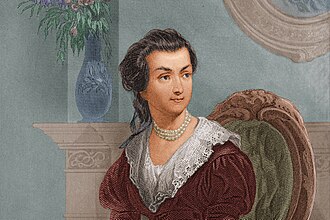

The Untold Story of Women in Revolution
Women in Revolution didn't just watch history unfold — they shaped it.
From spinning yarn by firelight to marching through the streets of Paris, women were at the heart of some of history's greatest turning points. Their stories are ones of quiet courage, fierce determination, and deep love for family and community.
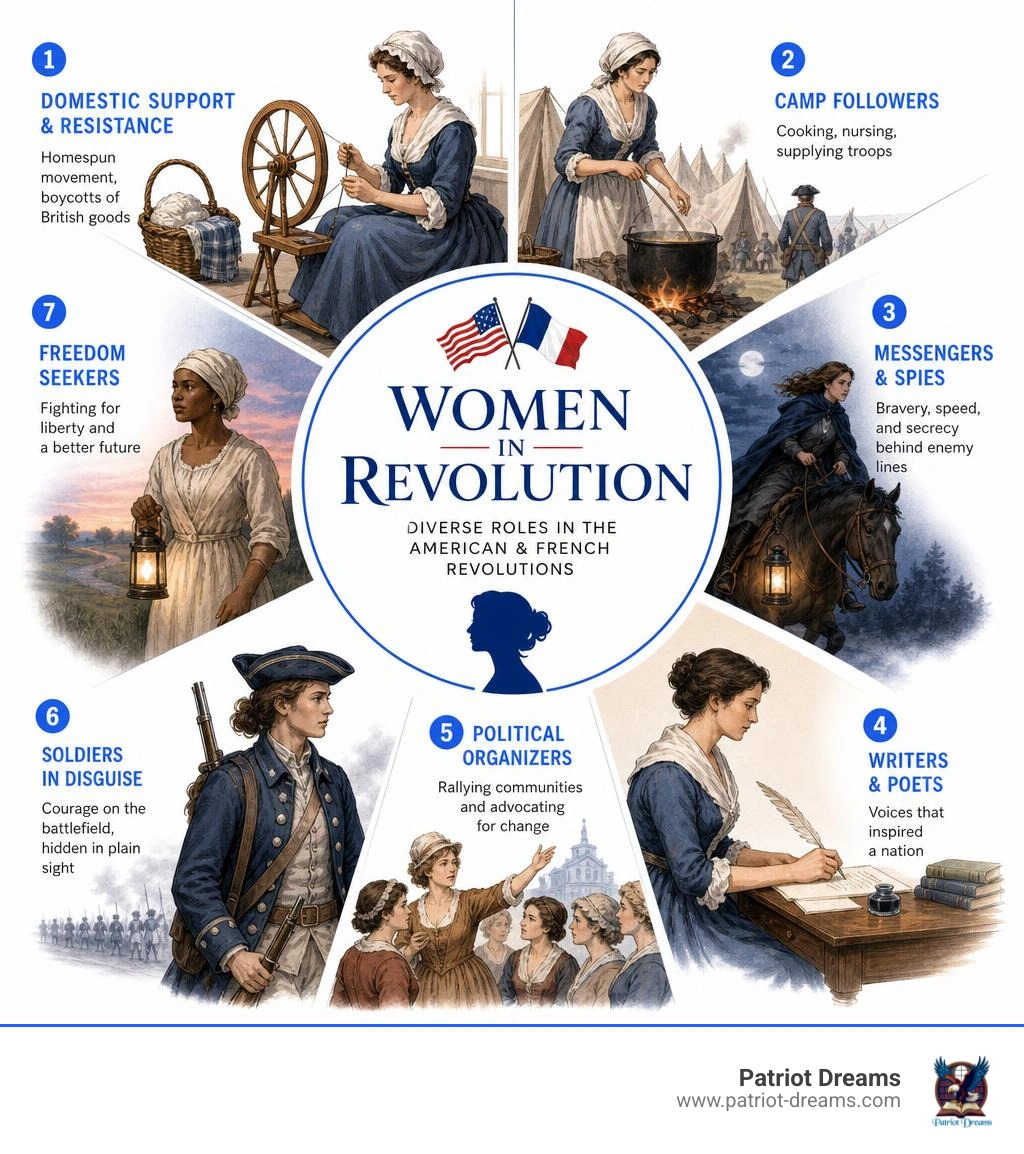
Here's a quick look at the key roles women played:
RoleExamplesDomestic support & resistanceHomespun movement, boycotts of British goodsCamp followersCooking, nursing, supplying troopsMessengers & spiesSybil Ludington, Emily GeigerWriters & poetsAbigail Adams, Phillis Wheatley, Mercy Otis WarrenPolitical organizersSociety of Revolutionary Republican WomenSoldiers in disguiseDeborah SampsonFreedom seekersElizabeth Freeman, enslaved women under Dunmore's Proclamation
These weren't just supporting roles. They were essential ones.
In 1780 alone, women's organizations raised over $300,000 for the Continental Army. Thousands more marched alongside soldiers, kept farms running, and raised families — all while holding the Revolution together from the inside.
And yet, for generations, many of these stories were left out of the history books.
This guide is here to change that. We'll walk through the lives of remarkable women — from colonial America to France — whose bravery helped build the world we live in today. Think of it as a visit to a part of history that's always been there, waiting for you to find it.
Similar topics to Women in Revolution:
Breaking the Mold: Traditional Expectations vs. Revolutionary Realities
In the 18th century, society held very specific ideas about a woman's place. The "ideal" woman was expected to remain strictly within the domestic sphere—managing the household, raising children, and staying completely out of the messy worlds of politics and war. But when the fires of revolution began to burn, these traditional boundaries gently but firmly fell away.
Women quickly realized that their everyday household choices could become powerful acts of political resistance. Through the homespun movement, patriotic women protested British taxation by refusing to buy imported textiles. Instead, they spent long hours spinning their own yarn and weaving cloth to clothe their families and the struggling Continental Army. They organized widespread boycotts of British goods, turning the simple act of refusing a cup of imported tea into a courageous political statement.
When the war arrived on their doorsteps, many women took even more direct action. Between 1776 and 1779, women organized and led over 30 food raids, ensuring that local merchants did not hoard essential supplies or price-gouge families during hard times.
For many, supporting the war meant traveling with the troops. Women made up approximately 3% of the camp populations in the Continental Army. These "camp followers"—numbering up to 20,000 women over the course of the war—provided crucial medical aid, cooked meals, washed uniforms, and kept the spirits of the weary soldiers alive.
To explore this shift from domestic life to the front lines, let us look at how these roles compared:
Traditional Domestic ExpectationsRevolutionary Realities & ContributionsStaying out of political debatesOrganizing boycotts and raising over $300,000 for the war effortPurchasing imported household goodsSpinning homespun cloth and leading food raids to protest shortagesRemaining safely at homeMarching with the army as camp followers, nurses, and cooksLeaving military action to menServing as couriers, spies, and even picking up weapons in battle
Some extraordinary women stepped directly onto the battlefield. We see this in the legendary stories of Molly Pitcher—women like Margaret Corbin and Mary Ludwig Hays, who carried water to thirsty soldiers under fire and courageously took over firing their husbands' cannons when the men fell. We see it in the incredible journey of Sybil Ludington Ride, a brave sixteen-year-old who rode 40 miles through a dark, rainy night—twice as far as Paul Revere—to muster local militia forces. And we see it in the quiet artistry of the Betsy Ross Flag, which showed how a simple seamstress's craft could become an enduring symbol of a new nation's hope.
To learn more about these incredible transitions, you can read about Women in the American Revolution | American Battlefield Trust .
Diverse Paths to Freedom: Indigenous and African American Women
The promise of liberty and natural rights sounded beautiful to everyone, but the path to achieving that freedom looked very different depending on who you were. For Indigenous and African American women, the American Revolution brought unique challenges, difficult choices, and a constant struggle to protect their families.
For enslaved African American women, the war became a complex landscape of risk and hope. In 1775, the British colonial governor of Virginia issued Dunmore's Proclamation, which offered freedom to any enslaved person willing to leave their rebel masters and join the British forces. Approximately one-third of all the brave individuals who responded to this proclamation and fled to British camps were women. They sought a better life for themselves and their children, even though the journey was filled with danger.
Escaping was never easy. During the colonial era, roughly one-eighth of all runaway slaves were women. This lower percentage compared to men was not due to a lack of desire for freedom, but rather the deep bond of family; women were far more likely to have young children to care for, making escape attempts incredibly difficult.
Others chose to fight for their freedom through the legal system. In 1781, a courageous enslaved woman named Elizabeth Freeman (often called Mum Bett) used the newly written Massachusetts Bill of Rights—which declared all people born free and equal—to file a freedom lawsuit. She won her case, helping to pave the way for the end of slavery in Massachusetts.
Yet, the struggle was long. Even as free Black communities began to grow—leading to a massive post-war migration to Northern cities where, by 1806, free Black women outnumbered men four to three in New York City—systemic barriers remained. In 1810, there were still 27,000 people living in slavery in the Northern states, showing how slowly the wheels of justice turned.
For Indigenous women, the war brought a different kind of upheaval. Among the Iroquois, women had traditionally held immense political and agricultural power, choosing chiefs and managing the cultivation of crops. The war fractured the Iroquois Confederacy and devastated their homelands. Following the war, the new United States government pushed policies designed to "civilize" Native communities, which meant forcing traditional gender roles to reverse—encouraging men to farm and pushing women into domestic spinning and weaving, contrary to their ancestral ways.
Meanwhile, other tribes sought to build peaceful bridges. Sally New River, a respected Catawba woman, acted as a goodwill ambassador, offering hospitality and helping her people maintain their land and cultural identity during a time of immense pressure.
The spirit of these women echoes through the generations. Their quiet strength laid the foundation for future leaders, reminding us of the powerful words found in the Sojourner Truth Speech, the guiding legacy in The True Story of Sacagawea Guide Interpreter and American Icon, and the inspiring perseverance detailed in Rising from the Shadows: How Cathay Williams and African American Soldiers Inspired New Hope During the Civil War.
The Spark of Liberty: How Revolutionary Ideals Ignited Early Feminism
The language of the American Revolution was filled with beautiful, soaring ideals. Words like liberty, equality, and unalienable natural rights were spoken in town squares and written in pamphlets. While the male leaders of the revolution were focused on breaking away from British rule, women were listening closely to these concepts and asking a very natural question: Don't these rights belong to us, too?
This spark of liberty ignited the very earliest whispers of modern feminist thought. Women began to argue that if a government's authority comes from the consent of the governed, then women—who made up half the population—should have a voice in that government. They began to challenge the idea that they should be subject to laws they had no part in making.
To explore these early expressions of political dignity, you can read The Ladies of the Revolution - The White House .
Notable American Women in Revolution
Several remarkable women used their unique talents, education, and positions to gently but firmly push the boundaries of what women could achieve in this new era:
- Abigail Adams: While her husband, John, was away helping to draft the laws of the new nation, Abigail managed their family farm, handled their finances, and wrote letters filled with sharp political insights. In her most famous letter, she warned him to "Remember the Ladies" and cautioned that "all men would be tyrants if they could," hinting that women would not hold themselves bound by laws in which they had no voice.
- Martha Washington: Showing immense personal strength, Martha spent every single brutal winter of the war at the front lines with her husband, George. She mended socks, organized social gatherings to boost morale, and helped raise vital funds for the soldiers, setting a warm precedent for what it meant to serve the community.
- Mercy Otis Warren: Known as the "Conscience of the Revolution," Mercy was a brilliant intellectual who wrote satirical plays mocking British officials. She was the third American woman to publish a book of poems using her real name and wrote a comprehensive, three-volume history of the American Revolution. She was also a passionate voice against slavery, warning that it could "banish a sense of general liberty."
- Phillis Wheatley: Kidnapped from West Africa at age seven and enslaved in Boston, Phillis possessed a brilliant mind. In 1773, she became the first African American woman and only the third American woman to publish a book of poems. She had to defend her authorship in court because many doubted a Black woman could write such beautiful verse. Her poetry, which she even shared with George Washington, stood as a living testament to the intellectual equality of all people.
To discover more about these and other incredible figures, check out 9 Women You May Not Know Who Shaped the American Revolution .
The Heartbeat of the Streets: Working-Class Women in Revolution
While the American Revolution was often shaped by organized boycotts and legislative debates, the French Revolution was fueled by the raw energy of the streets. At the very center of this storm were the working-class women of Paris—often called sansculotte women.
These women were the heartbeat of their neighborhoods. When bad weather and economic instability caused the price of bread to skyrocket, it was the mothers and market women who felt the pain first. They could not feed their children, and so they took to the streets.
In October 1789, thousands of these women marched twelve miles through the rain from Paris to the Palace of Versailles. Armed with pikes and knives, they demanded bread and forced King Louis XVI and his family to return with them to Paris. This historic march showed that the poorest women in society possessed the power to alter the course of a nation.
The Society of Republican Revolutionary Women
As the French Revolution grew more radical, working-class women realized they needed more than just bread—they needed a political voice. On May 10, 1793, two passionate activists, Claire Lacombe and Pauline Léon , founded the Society of Revolutionary Republican Women .
This was the first all-female political club in France, representing the extreme left wing of the revolution. Unlike aristocratic women who wrote polite petitions, these working-class women took their rights by direct action. They wore the red liberty caps (bonnets rouges), carried weapons, and stood guard in the galleries of the National Convention to support radical policies and keep a watchful eye on politicians.
Léon had previously petitioned the National Assembly for the right of women to bear arms and form an all-female militia, while Lacombe was celebrated as the "Heroine of August Tenth" after being shot through the arm while leading an assault on the Tuileries Palace. Together, they demanded strict price controls on food and pushed for women to be fully integrated into the political life of the Republic.
To understand how these brave women connected their class struggles with their gender, you can read this insightful analysis: Hal Draper/Anne Lipow: Women and Class (1-2. The Society of Revolutionary Women of 1793) .
The Jacobin Backlash and the Reign of Terror
For a brief moment, the radical Jacobin leaders welcomed the support of these fierce women. But as the Reign of Terror took hold, the male politicians in power grew deeply uneasy. They feared the independent organizing power of the sansculotte women on their left flank.
In the autumn of 1793, a violent dispute broke out in the Paris markets. Members of the Society tried to force local market women to wear the tricolor cockade and the red liberty cap. The market women, who were more concerned with daily survival than radical symbols, resisted.
The Jacobin leadership used this confrontation as a convenient excuse to silence women's political voices entirely. On October 30, 1793, the National Convention officially banned all women's political clubs and assemblies. They argued that women were too emotional for politics and belonged at home, caring for their families.
The consequences were devastating. Activists like Claire Lacombe were arrested and spent long periods in prison, and the brief window of political equality slammed shut. To read more about this difficult chapter, explore Claire Lacombe - France: Women in the Revolution - Research Guides at Library of Congress .
A Legacy of Hope: From Revolutionary Sparks to the Suffrage Movement
Though the doors were often closed by the men in power, the sparks of hope could not be extinguished. The ideas of natural rights and equality traveled across oceans and down through decades, quietly passing from mother to daughter like a cherished family heirloom.
When American women gathered in Seneca Falls, New York, in 1848 for the first women's rights convention, they did not look for a new language. Instead, they reached back to the American Revolution. They drafted the Declaration of Sentiments, deliberately mirroring the Declaration of Independence. They wrote that "all men and women are created equal," using the very same ideals to launch the long campaign for the Nineteenth Amendment, which finally secured the right to vote in 1920.
This beautiful thread of perseverance connects the era to so many other inspiring women throughout our history. We see it in the ingenious spirit of inventors like those in From Paper Bags to Possibility: Margaret E. Knight and Women Inventors in America. We feel it in the healing hands of Clara Barton Nurse, the compassionate leadership in Eleanor Roosevelt Achievements, and the quiet, immovable strength of Rosa Parks Story and Ruby Bridges Courage.
It is the very same courage that guided Harriet Tubman along the Underground Railroad, inspired the investigative truth-telling in Nellie Bly Journalist, and fueled the daring exploits of Virginia Hall The Limping Lady Who Outwitted the Nazis.
The Legacy of Brave Women in Revolution
For far too long, traditional history books focused only on the names of generals and politicians, leaving the quiet, everyday heroism of women in the shadows. But history is not just made on battlefields; it is made around kitchen tables, in family letters, and in the quiet sacrifices of mothers and sisters.
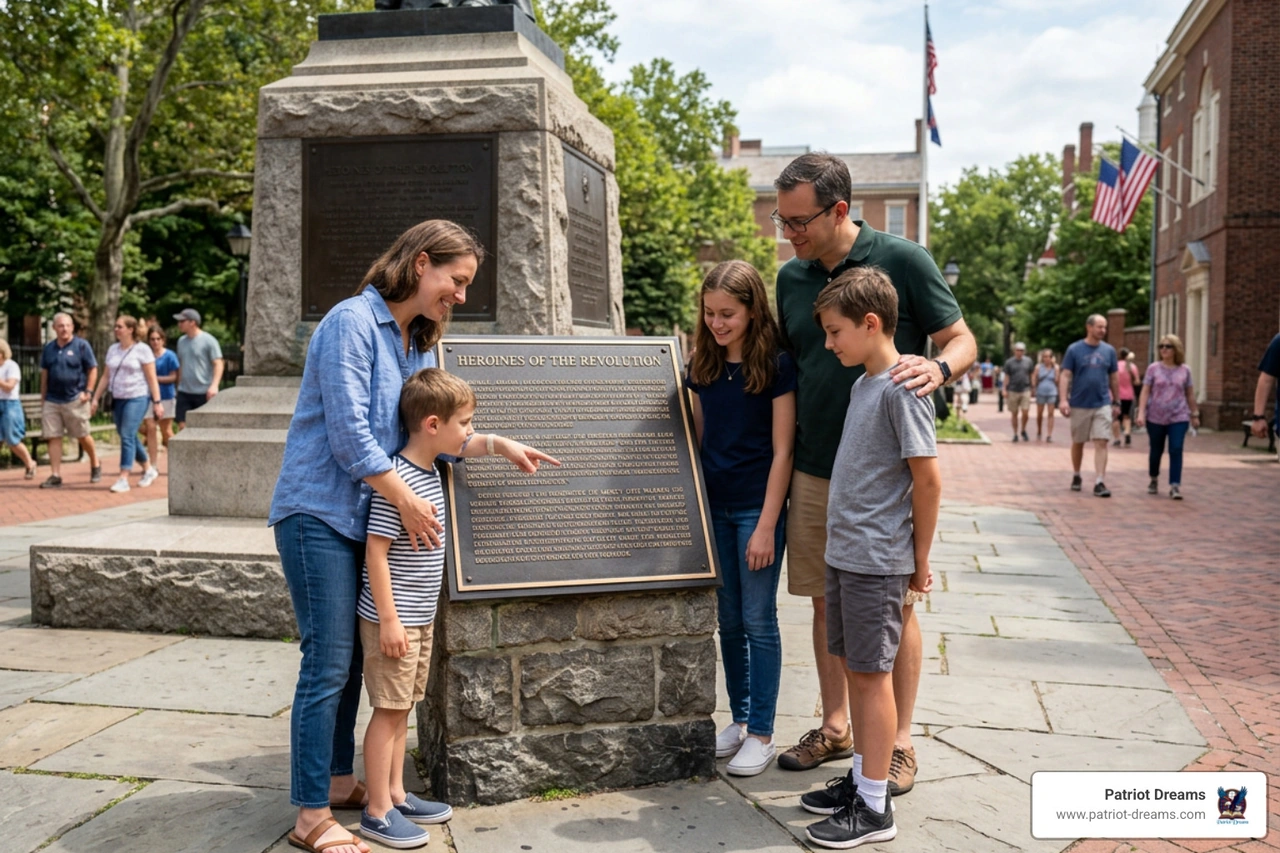
When we take the time to remember these unsung heroines, we are doing more than just studying the past—we are preserving our own family legacies. Every family has its own stories of quiet strength and perseverance, waiting to be listened to and passed down to the next generation.
To see how these patterns of female courage and community organizing have shaped other global struggles, you might find this study fascinating: Women and the Cuban Insurrection How Gender Shaped Castro's Victory .
Frequently Asked Questions
What roles did women play in the American Revolution?
Women supported the American Revolution in a wide variety of ways. On the home front, they organized boycotts of British goods and spun their own "homespun" cloth to clothe the army. Many traveled with the troops as camp followers, working as nurses, cooks, and seamstresses. Others served as vital couriers, spies, and occasionally disguised themselves as men to serve as soldiers on the battlefield.
Who was Claire Lacombe and what did she do?
Claire Lacombe was a French actress who became a radical and women's rights activist. She co-founded the Society of Revolutionary Republican Women in 1793, advocating for working-class women's political rights and food price controls. She was famously wounded while participating in the storming of the Tuileries Palace, earning her the nickname "Heroine of August Tenth."
How did the American Revolution influence the women's suffrage movement?
The American Revolution popularized the ideals of natural rights, liberty, and equality. Decades later, early suffragists used these exact same principles to argue for women's right to vote. At the Seneca Falls Convention of 1848, they modeled their famous "Declaration of Sentiments" directly after the Declaration of Independence to demand equal rights.
Conclusion
Every story of courage, family, and resilience is a thread in the beautiful fabric of our shared history. Here at Patriot Dreams, we believe these personal, heartfelt stories are the true heartbeat of America.
Our interactive digital history platform brings these incredible voices to life. Through our unique listening modes and interactive map, you can explore the very places where these brave women made history, while preserving your own family's legacy for generations to come.
We invite you to join our warm community of history lovers, storytellers, and families. Come share your own stories and explore our nation's rich heritage at the Patriot Dreams Creator Hub.

Join the Patriot Dreams Community
Download the app today and start your journey through American history and personal legacy.

Explore Our Latest Insights
Dive into stories that shape our American legacy.