The Ultimate Guide to Theodore Roosevelt

The Story of Theodore Roosevelt: America's Roughrider President
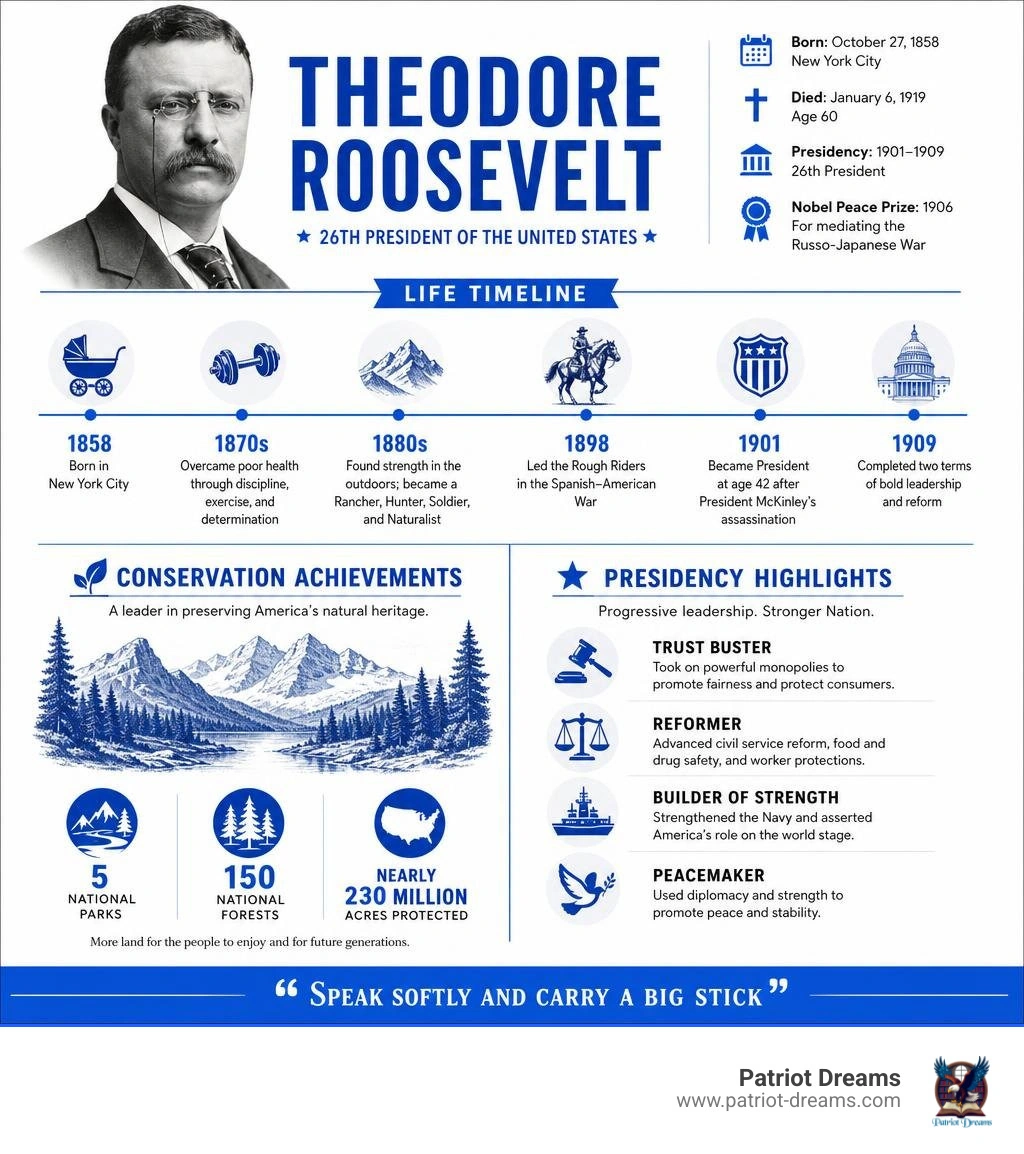
Theodore Roosevelt was the 26th President of the United States — and one of the most remarkable human beings ever to hold that office.
Here are the essential facts at a glance:
- Born: October 27, 1858, in New York City
- Died: January 6, 1919, at age 60
- Presidency: 1901–1909 (26th President)
- Youngest president: Took office at age 42 after President McKinley's assassination
- Nickname: "The Trust Buster" (though he personally preferred "Colonel Roosevelt")
- Nobel Peace Prize: 1906, for mediating the Russo-Japanese War — the first non-European recipient
- Conservation legacy: Protected nearly 230 million acres, including 5 national parks and 150 national forests
- Famous motto: "Speak softly and carry a big stick"
But the numbers only tell part of the story.
What makes Roosevelt truly special is the human story behind those achievements. He was a sickly, asthmatic boy from New York City who was told his body might never match his brilliant mind. He faced heartbreak so devastating that he fled to the wild Badlands of North Dakota — and came back a changed man. A stronger man. A leader.
Roosevelt once said something that still echoes today. He urged every person to step into what he called "the arena" — to dare greatly, to try, to struggle, and to keep going even when things get hard. That spirit of quiet courage and wholehearted effort is at the heart of everything he stood for.
At Patriot Dreams, we believe that kind of story deserves to be told warmly, honestly, and in a way the whole family can appreciate together.
The Strenuous Life: How Theodore Roosevelt Overcame Adversity

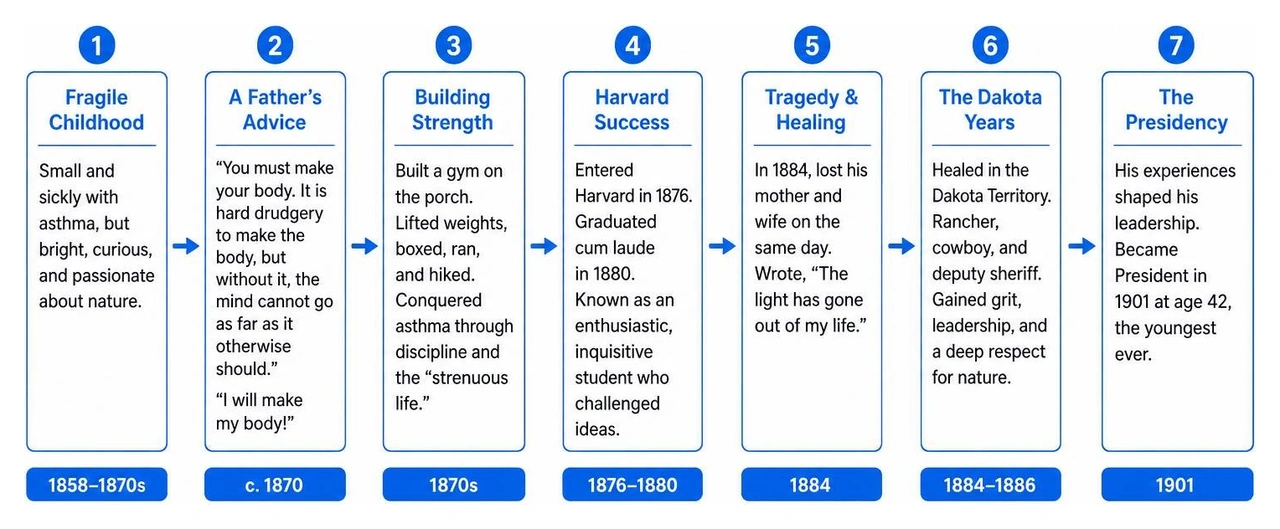
Long before he was a president, a soldier, or a global statesman, Theodore Roosevelt was simply a little boy named "Teedie" who struggled to breathe. Born into a loving and wealthy family in New York City on October 27, 1858, young Theodore suffered from severe, life-threatening asthma. In the 19th century, there were no inhalers or modern treatments; his family could only comfort him through long, agonizing nights. His father, Theodore Sr., would sometimes wrap the gasping boy in blankets and take him on carriage rides through the midnight air, hoping the cool breeze would open his lungs.
Despite his physical frailty, young Theodore possessed an incredibly bright, curious mind. He loved the natural world, even creating the "Roosevelt Museum of Natural History" in his bedroom at just seven years old, starting with a seal's head he obtained from a local market.
Recognizing his son's brilliant intellect but fragile frame, his father gave him a piece of advice that would change his life forever:
"Theodore, you have the mind but you have not the body. You must make your body. It is hard drudgery to make the body, but without it, the mind cannot go as far as it otherwise should."
The young boy looked at his father and replied, "I will make my body!"
The family built a gymnasium on their outdoor porch, and Theodore began a lifelong commitment to what he called "the strenuous life." He lifted weights, boxed, ran, and hiked. He learned to channel his energy into physical strength, gradually conquering the asthma that had confined him for so long.
This relentless drive followed him to Harvard College, where he entered in 1876. He graduated cum laude in 1880, known by classmates as an exceptionally enthusiastic, inquisitive student who was never afraid to ask questions or challenge ideas. To learn more about these early formative years, you can explore the Theodore Roosevelt Biography (U.S. National Park Service) , which details how his early struggles built the foundation of his legendary character.
Healing in the Badlands: The Dakota Territory and the Making of a Leader

Sometimes, the greatest leaders are forged in the fires of personal tragedy. For Theodore Roosevelt, that fire burned hottest in 1884.
Within the span of just a few hours on February 14, 1884—Valentine's Day—Theodore lost both his mother, Martha, and his beloved first wife, Alice Hathaway Lee, who had just given birth to their daughter, Alice. In his diary, he drew a heavy black "X" and wrote the heartbreaking words: "The light has gone out of my life."
Grief-stricken and seeking solace, Roosevelt left his baby daughter in the care of his sister and boarded a train heading west to the rugged Badlands of the Dakota Territory. He sought a quiet place to heal, away from the painful reminders of New York.
In Medora, North Dakota, Roosevelt invested in cattle ranching and established the Elkhorn Ranch along the Little Missouri River. The local cowboys initially doubted this near-sighted "four-eyes" from New York, but Roosevelt quickly earned their respect. He rode for days in the freezing rain, worked the grueling spring roundups, and even served as a deputy sheriff. In one famous incident, he spent days tracking down three thieves who had stolen his river boat, capturing them and marching them for thirty-six hours through the freezing wilderness to face justice.
It was in this beautiful, untamed landscape that Roosevelt healed. He credited his time in North Dakota with making him the man—and the president—he eventually became. He once remarked:
"I have always said I would not have been President had it not been for my experience during the years in North Dakota."
This deep connection to the frontier also planted the seeds of his passionate commitment to conservation. He saw how overgrazing and unregulated hunting could devastate a landscape, and he vowed to protect America's natural heritage. You can read some of these thrilling frontier stories in our collection of Teddy Roosevelt Adventure Tales.
Transforming the Nation: The Presidency of Theodore Roosevelt
When President William McKinley was tragically assassinated in September 1901, Vice President Theodore Roosevelt was thrust into the presidency. At just 42 years old, he became the youngest person ever to hold the nation's highest office.
Roosevelt brought a vibrant, unprecedented energy to the White House. He believed that the president should act as a "steward of the people," actively working to improve the lives of everyday citizens. He introduced the "Square Deal," a domestic policy centered on three basic ideas:
- Conservation of natural resources
- Control of corporations (earning his reputation as the "Trust Buster" by bringing 44 antitrust suits under the Sherman Act)
- Consumer protection (signing the Pure Food and Drug Act of 1906)
On the global stage, Roosevelt expanded America's influence with his trademark foreign policy philosophy: "Speak softly and carry a big stick." He championed the construction of the Panama Canal, sent the "Great White Fleet" on a world tour to showcase American naval strength, and brokered the peace treaty that ended the Russo-Japanese War, earning him the Nobel Peace Prize in 1906.
To understand the full scope of his political career and legacy, you can read the comprehensive Theodore Roosevelt - Wikipedia page.
Below is a comparison of his landmark domestic and foreign policy achievements:
| Policy Area | Key Initiatives & Achievements | Impact on America |
|---|---|---|
| Domestic (The Square Deal) | • Hepburn Act (railroad regulation) • Pure Food and Drug Act of 1906 • 44 antitrust lawsuits against monopolies | Protected consumers, promoted fair business competition, and established federal oversight of food and medicine safety. |
| Foreign Policy | • Construction of the Panama Canal • Mediated the Russo-Japanese War • Sent the Great White Fleet around the world | Positioned the United States as a major global power and promoted international diplomacy. |
| Conservation | • Created the U.S. Forest Service • Established 150 national forests and 5 national parks • Protected 230 million acres of public land | Saved America's wild spaces from destruction, ensuring they would remain open for generations to enjoy. |
A Modern Sanctuary: The Theodore Roosevelt Presidential Library in Medora
In the summer of 2026, a long-held dream finally became a reality. The Theodore Roosevelt Presidential Library officially opened its doors to the public in Medora, North Dakota—the very place that healed Roosevelt's broken heart so many decades ago.
This is not a traditional, dusty archive. Located on the edge of the breathtaking Theodore Roosevelt National Park, the library's architecture is designed to blend seamlessly into the prairie landscape. Featuring a grass-covered roof, walking paths, and sustainably sourced local materials, it is difficult to tell where the natural hills end and the building begins.
The grand opening in 2026 was a historic celebration of Roosevelt's enduring legacy, drawing visitors from all over the world and receiving widespread media coverage, including a featured segment on CBS Sunday Morning. This beautiful sanctuary serves as a living tribute to the landscape that forged a president. To plan a visit or support their mission, check out the official Theodore Roosevelt Presidential Library | Theodore Roosevelt ... .
Stepping into the Arena: Interactive Exhibits Featuring Theodore Roosevelt
The library invites visitors to "Get in the Arena" through a series of deeply moving, interactive exhibits. Rather than simply looking at artifacts behind glass, guests are invited to participate in the stories.
One of the library’s most remarkable features is the Campfire AI guide. Because Roosevelt loved to tell his best stories around a crackling campfire, the library designed an interactive experience that brings together his letters, speeches, and photographs from 18 different cultural and historical institutions. Visitors can gather around a digital hearth and listen as the collections come together to paint a vivid picture of his life, leadership, and unwavering commitment to active citizenship.
Connecting with History: The AI Archive Featuring Theodore Roosevelt
For those who want to dive even deeper, the library features an innovative AI archive that allows for real-time conversation. Using advanced digital preservation technology, visitors can ask questions and receive answers in Roosevelt's own voice, drawn directly from his 150,000 letters and 35 published books.
Beyond the physical building in Medora, the library extends its reach globally through resources like the Good Citizen Podcast, an online store filled with educational keepsakes, and exclusive founding membership opportunities that help preserve this vital history for future generations.
Frequently Asked Questions about Theodore Roosevelt
Why was Theodore Roosevelt called the "Trust Buster"?
During the late 19th and early 20th centuries, massive corporate monopolies (known as "trusts") controlled major American industries, including railroads, oil, and beef. This eliminated competition and hurt everyday workers. Under the Sherman Antitrust Act, Theodore Roosevelt initiated 44 antitrust lawsuits to break up bad trusts, earning him the nickname "Trust Buster." He believed that the government had a duty to ensure a level playing field for everyone.
How did Theodore Roosevelt contribute to environmental conservation?
Roosevelt is often considered America's "Conservationist President." During his time in office, he used his executive power to place approximately 230 million acres of public land under federal protection. He established:
- 150 national forests
- 51 federal bird reserves
- 18 national monuments (including the Grand Canyon)
- 5 national parks
- 4 national game preserves
When did the Theodore Roosevelt Presidential Library open to the public?
The Theodore Roosevelt Presidential Library officially celebrated its grand opening in 2026, marking 107 years since Roosevelt's passing in 1919. Located in the beautiful Badlands of Medora, North Dakota, the library stands as a modern monument to his life, his love of nature, and his enduring lessons on leadership and citizenship.
Conclusion
The story of Theodore Roosevelt reminds us that we are all capable of overcoming life's hardest trials. Whether we are facing personal loss, physical limitations, or the everyday challenges of raising a family, Roosevelt’s life teaches us to step into the arena with courage, kindness, and a resilient spirit.
At Patriot Dreams, we love sharing these beautiful, unifying stories of American heritage. Our interactive map and audio storytelling platform are designed to help families discover the rich history of our country while preserving their own cherished family legacies.
We invite you to share this inspiring history with the young people in your life by reading Teddy Roosevelt The Fearless Leader Every Young American Should Know. Together, let's keep the spirit of the strenuous life alive in our homes and communities, daring greatly and caring deeply for one another.
Join the Patriot Dreams Community
Download the app today and start your journey through American history and personal legacy.

Explore Our Latest Insights
Dive into stories that shape our American legacy.