In Depth Guide to The Life of George Eastman

The Life of George Eastman: From Humble Beginnings to American Icon
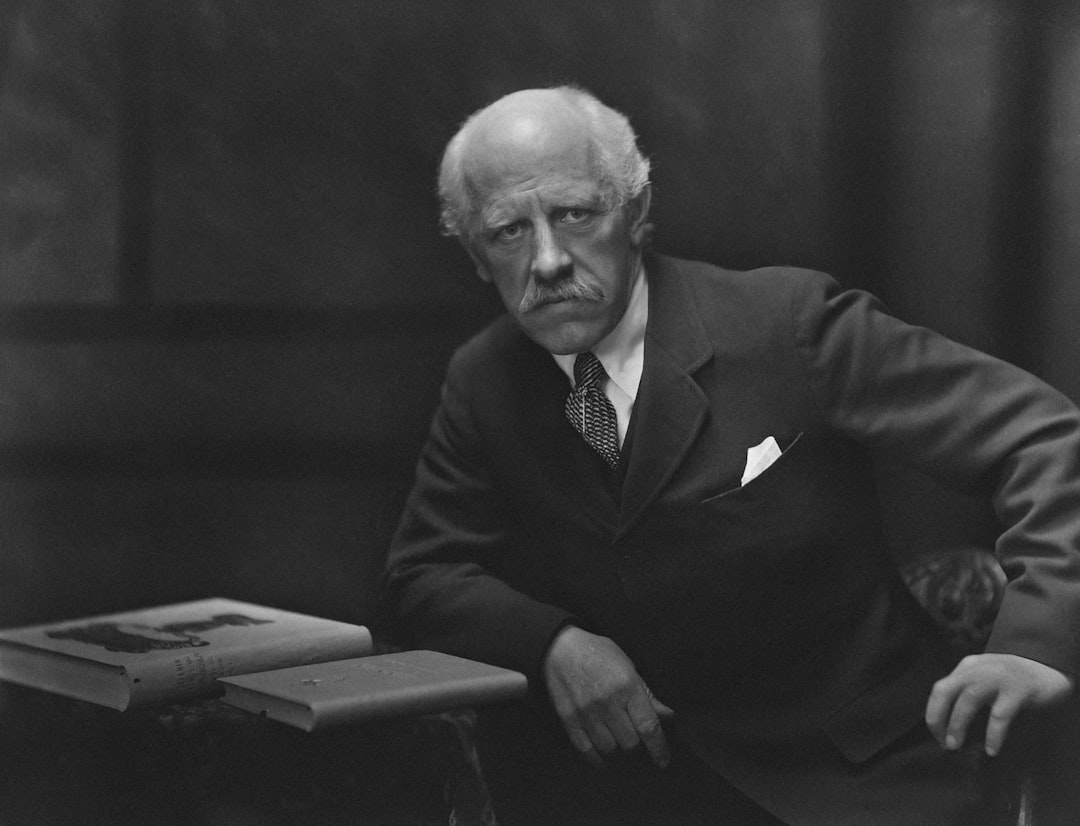
The life of George Eastman is one of the most inspiring stories in American history — a tale of grit, curiosity, and a deep desire to make the world a little better for everyone around him.
Here is a quick overview of who George Eastman was:
- Born: July 12, 1854, in Waterville, New York
- Died: March 14, 1932, in Rochester, New York, aged 77
- Known for: Founding Eastman Kodak Company and making photography accessible to everyday people
- Key invention: Roll film and the Kodak camera (1888)
- Famous slogan: "You press the button, we do the rest"
- Philanthropist: Donated more than $100 million to education, arts, and health causes during his lifetime
- Legacy: Transformed photography from a complicated professional trade into a beloved everyday hobby
George Eastman grew up in a family that knew hardship well. He left school at 14 to help support his widowed mother. He worked humble jobs — as an insurance clerk, then a bank teller — but his mind was always reaching for something more.
Then one day, a colleague suggested he bring a camera on a trip. That small moment changed everything. Not just for Eastman, but for the world.
He spent years experimenting with photographic chemicals in his mother's kitchen, sleeping on the floor when exhaustion took over. Step by step, he turned those late nights into inventions that gave ordinary families the ability to capture their memories forever.
That is the kind of American story that stays with you.
Humble Beginnings and the Spark of Innovation

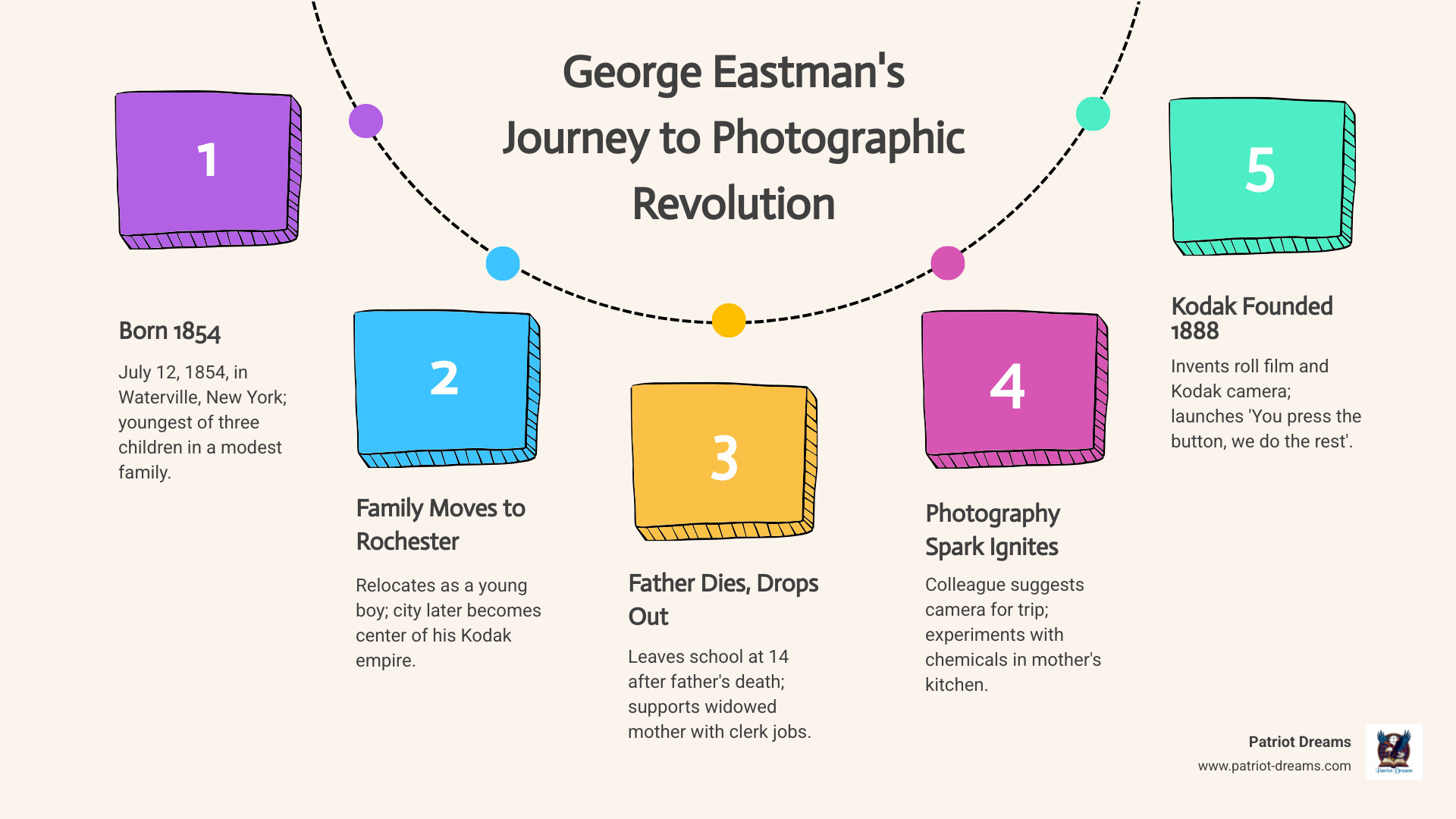
Every great journey has a beginning, and for George Eastman, that beginning was rooted in the small village of Waterville, New York. Born in 1854, George was the youngest of three children. When he was just a young boy, his family moved to Rochester, a city that would eventually become synonymous with his name.
Tragedy struck early when George's father passed away, leaving the family in a precarious financial position. To make ends meet, his mother, Maria, took in boarders. Seeing his mother work so hard deeply affected George; he vowed to repay her sacrifices and provide her with the comfort she deserved. This sense of responsibility led him to drop out of school at the age of 14 to enter the workforce.
His first jobs were humble. He started as a junior clerk in an insurance office, earning a meager $3 a week. Later, he secured a position as a bank teller, where his salary eventually tripled. Despite his lack of formal higher education, George possessed a keen mind for American Innovation History and a relentless work ethic. He spent his days at the bank and his nights teaching himself the complexities of business and science.
The "Pack-Horse" Challenge
In 1877, when George was 23, he planned a vacation to Santo Domingo. A colleague suggested he document the trip with a camera. While George never actually made it to Santo Domingo, the suggestion sparked an obsession. At that time, photography was anything but "point and shoot."
A photographer had to carry a "pack-horse load" of equipment: a camera the size of a microwave, a heavy tripod, large glass plates, a darkroom tent, and jugs of volatile chemicals. The "wet-plate" process required the plate to be coated, exposed, and developed before the liquid chemicals dried. It was messy, cumbersome, and exhausting. George looked at this mountain of gear and thought, "There has to be a better way."
He transformed his mother’s kitchen into a laboratory. For three years, he experimented with gelatin emulsions, often working until he fell asleep on the floor from sheer exhaustion. He wasn't just looking for a hobby; he was looking to simplify a craft for the world.
The Invention of the Dry-Plate Machine
By 1880, George’s kitchen experiments bore fruit. He developed a dry-plate process where the plates could be prepared in advance and developed at leisure. But George didn't stop at the chemistry; he used his mechanical intuition to invent and patent a dry-plate coating machine. This allowed for the mass production of photographic plates, moving photography from a boutique craft toward an industrial scale.
Recognizing the potential, a local businessman named Henry Strong invested in George’s vision. Together, they formed the Eastman Dry Plate Company in 1881. Even in these early stages, George showed the integrity that would define The Life of George Eastman. When a batch of plates failed in the hands of customers, he recalled them all and replaced them at his own expense, nearly bankrupting his young company to protect its reputation. You can read more about his early journey at the George Eastman Museum.
The Life of George Eastman: Revolutionizing the World of Images

As we look back at our history, we see how certain inventions change the way we see ourselves. George Eastman didn't just want to sell plates; he wanted to make photography as easy as breathing. He realized that glass plates were heavy and fragile, so he began searching for a flexible substitute.
This search led to the development of roll film. By moving from glass to paper, and eventually to transparent celluloid, Eastman paved the way for something truly magical: the motion picture. His flexible film was the very foundation that allowed pioneers like Thomas Edison to bring stories to life on the silver screen. This intersection of technology and storytelling is a vital part of When Film Becomes History How Movies Shape Our View Of America.
The Life of George Eastman and the Birth of the Kodak Camera
In 1888, the world changed with the launch of the first Kodak camera. It was a simple brown box, but inside was a revolution. Priced at $25, it came pre-loaded with a roll of film capable of 100 exposures.
The genius was in the business model. Eastman coined the famous slogan: "You press the button, we do the rest." Once the 100 pictures were taken, the owner mailed the entire camera back to Rochester. For $10, the company would develop the prints, reload the camera with fresh film, and mail it back. For the first time, you didn't need to be a scientist to capture a family picnic or a child's first steps. The "snapshot" was born.
The Brownie Camera and the Democratization of Art
If the 1888 Kodak was the spark, the Brownie camera was the wildfire. Released in 1900, the Brownie was made of reinforced cardboard and sold for just $1. It was marketed directly to children, turning photography into a universal language.
The "Kodak Girl" became a cultural icon — a symbol of a new, mobile, and independent generation. Photography was no longer a luxury for the wealthy; it was a tool for every American to tell their own story. This democratization of art is a beautiful chapter in the American Experience.
The Life of George Eastman: A Legacy of Giving
George Eastman once said, "The progress of the world depends almost entirely upon education." As his wealth grew, so did his desire to share it. During his lifetime, he gave away more than $100 million — which would be over $2 billion in today's money.
He was a man who preferred the shadows to the spotlight. For years, he made massive donations to MIT under the pseudonym "Mr. Smith," enjoying the newspaper speculation about who the mystery donor might be. In his home city, he founded the Eastman School of Music and the University of Rochester’s medical and dental schools. He also extended his kindness to the South, providing significant support to Historically Black Colleges and Universities (HBCUs), believing that everyone deserved the chance to learn and grow.
A Visionary Approach to Business and People
At Patriot Dreams, we often talk about the importance of community and how we treat our neighbors. George Eastman lived these values in his business. He believed that the success of a company wasn't just in its patents, but in the "goodwill" of its workers.
By 1915, Kodak was the largest employer in Rochester, with over 8,000 people. Eastman was decades ahead of his time in how he treated them. He didn't just want employees; he wanted partners in his American Innovation History.
Pioneering Employee Welfare
In 1912, Eastman established a "wage dividend," a profit-sharing program that ensured when the company did well, the workers did well too. He gave away millions of dollars of his own stock to his employees and established retirement funds and disability benefits. He created safety committees and a medical department long before such things were required by law. He knew that a happy, secure worker was a loyal one, and this philosophy created a sense of "Kodak family" that lasted for generations.
Scientific Research and Global Expansion
Eastman was also a pioneer in industrial research. He established one of the first dedicated chemical research laboratories in the U.S., ensuring that Kodak stayed at the cutting edge of technology.
During World War I, this commitment to science served the nation. Kodak developed unbreakable glass for gas masks and specialized cameras for aerial photography. By the 1920s, Kodak was a global powerhouse, supplying film stock to the entire international movie industry.
| Feature | Professional Wet-Plate (1870s) | Kodak System (1888) |
|---|---|---|
| Portability | Requires a wagon or pack-horse | Handheld box |
| Complexity | Must mix chemicals on-site | Just press a button |
| Weight | 50+ lbs of gear | Less than 2 lbs |
| Developing | Instant, messy tent work | Done by factory experts |
| Accessibility | Highly trained professionals | Anyone, including children |
Personal Passions and the Final Chapter
Despite his immense success, George Eastman was a private, often lonely man. He never married, once remarking that he was "too poor" when he was young and "too busy" when he was older. He lived with his mother until her death, a loss that devastated him.
He found solace in music, often starting his mornings with a private organ recital in his magnificent Rochester home. He was an avid traveler and cyclist, and in his later years, he even went on African safaris. He loved the outdoors and took great pride in the lush gardens of his estate.
The Heart of a Neighbor in Rochester
Eastman was the ultimate citizen of Rochester. He helped found the Chamber of Commerce and worked tirelessly to make his city "the best place on earth to live." He was a complex man, of course. He advocated for a 13-month calendar (which Kodak actually used until 1989!) and held some paternalistic views common to his era, including support for eugenics. Yet, his overarching drive was always toward improvement and progress. You can see how this era of industry is captured in The Industrial Ages In Hollywood.
In the late 1920s, George began to suffer from a painful and progressive spinal disease that made it difficult for him to stay active. For a man who loved to move and do, this was a heavy burden. On March 14, 1932, at the age of 77, he settled his affairs, wrote a short note, and ended his life. His note read simply: "To my friends: my work is done. Why wait?"
Frequently Asked Questions about George Eastman
Why did George Eastman choose the name "Kodak"?
George wanted a name that was short, vigorous, and couldn't be misspelled. He was particularly fond of the letter "K," which he felt was "a strong, incisive sort of letter." He played with combinations until he landed on "Kodak"—a word that meant nothing but would soon mean everything to photography.
What was George Eastman's impact on the movie industry?
Massive! Without Eastman’s invention of flexible transparent film, the motion picture industry as we know it wouldn't have started when it did. He was the primary supplier of film to Thomas Edison and the early Hollywood studios, literally providing the "canvas" upon which the history of cinema was painted.
How much of his fortune did George Eastman give away?
He gave away more than $100 million during his life. His philosophy was to "do your giving while you are alive" so you can see the good it does. His estate continued this legacy, leaving the bulk of his remaining fortune to the University of Rochester.
Conclusion
The life of George Eastman reminds us that the American Dream is often built in the quiet hours of the night, fueled by a desire to help our neighbors. George didn't just invent a camera; he gave us a way to hold onto our most precious memories. He showed us that a business can be successful while still being kind to its workers, and that true wealth is measured by what we give away.
At Patriot Dreams, we believe every family has a story worth capturing, just like the ones George Eastman helped us save through his lenses. His perseverance and kindness are a part of our shared American heritage that we are so proud to celebrate. We invite you to explore more stories of American Historical Figures and discover the threads that connect us all.
Read Time: 10 mins

Join the Patriot Dreams Community
Download the app today and start your journey through American history and personal legacy.

Explore Our Latest Insights
Dive into stories that shape our American legacy.