No Trespassing: The Definition of Monroe Doctrine Explained

What Is the Definition of Monroe Doctrine? A Simple Answer First
The definition of Monroe Doctrine is this: a foundational U.S. foreign policy statement, first delivered on December 2, 1823, declaring that the Americas were no longer open to European colonization — and that any attempt by European powers to interfere in the Western Hemisphere would be considered a threat to American peace and security.
Here is a quick summary before we dive deeper:
Core IdeaWhat It MeansNo new colonizationEuropean powers could not claim new territory in the AmericasNo interferenceEurope could not interfere with independent nations in the Western HemisphereSeparate spheresThe Americas and Europe were to stay out of each other's political affairsU.S. security warningAny European meddling would be seen as an unfriendly act toward the United States
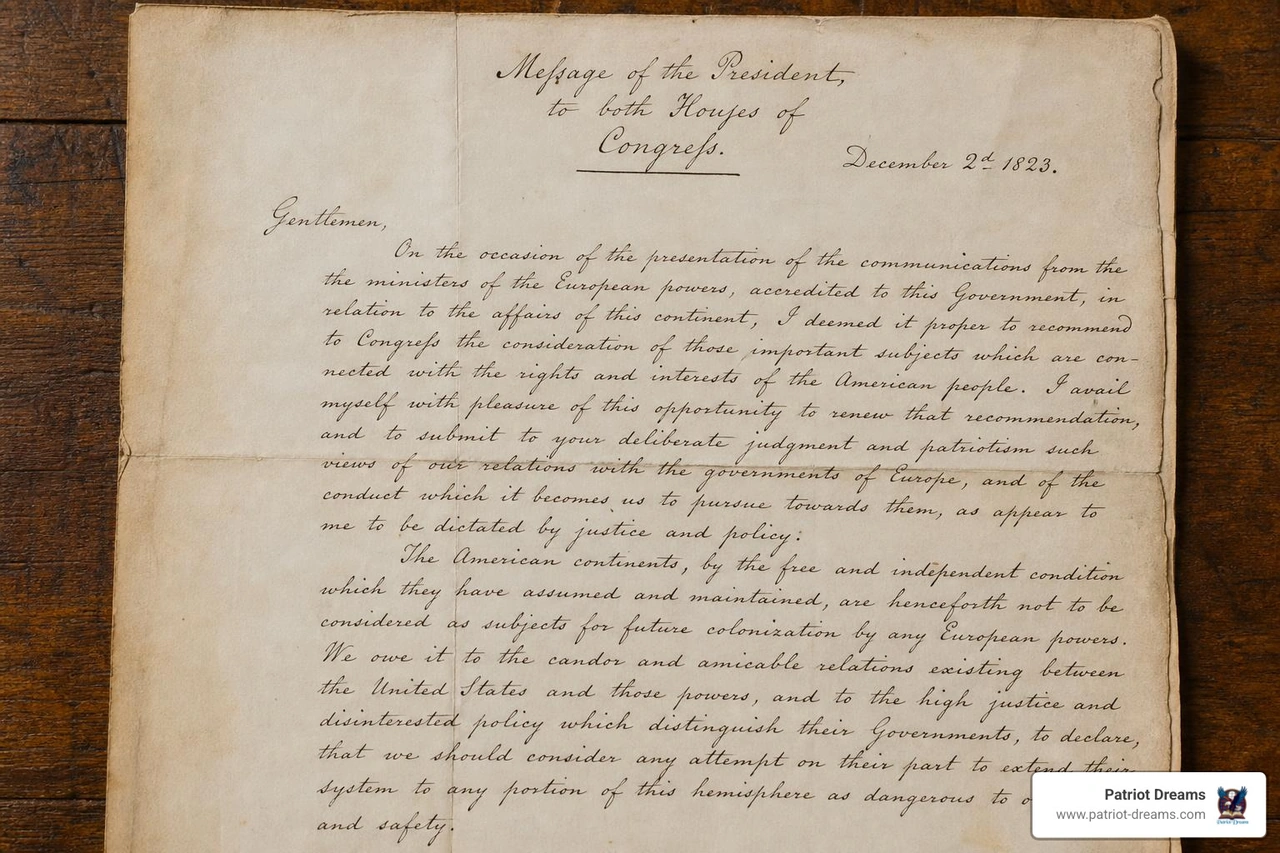
President James Monroe did not deliver this as a grand, standalone proclamation. He tucked it quietly into his seventh annual message to Congress — what we might think of today as a routine State of the Union address. And yet, those few paragraphs became one of the most enduring promises America ever made.
Think of it like a neighbor gently but firmly placing a "No Trespassing" sign at the edge of the yard — not out of hostility, but out of a deep desire to keep the community safe.
Over the next two centuries, that quiet promise grew into something much larger. It shaped wars, prevented crises, sparked debates, and defined what it means for America to be a guardian of the Western Hemisphere.
Let's walk through it together — from its warm and hopeful beginnings to its complex modern legacy.
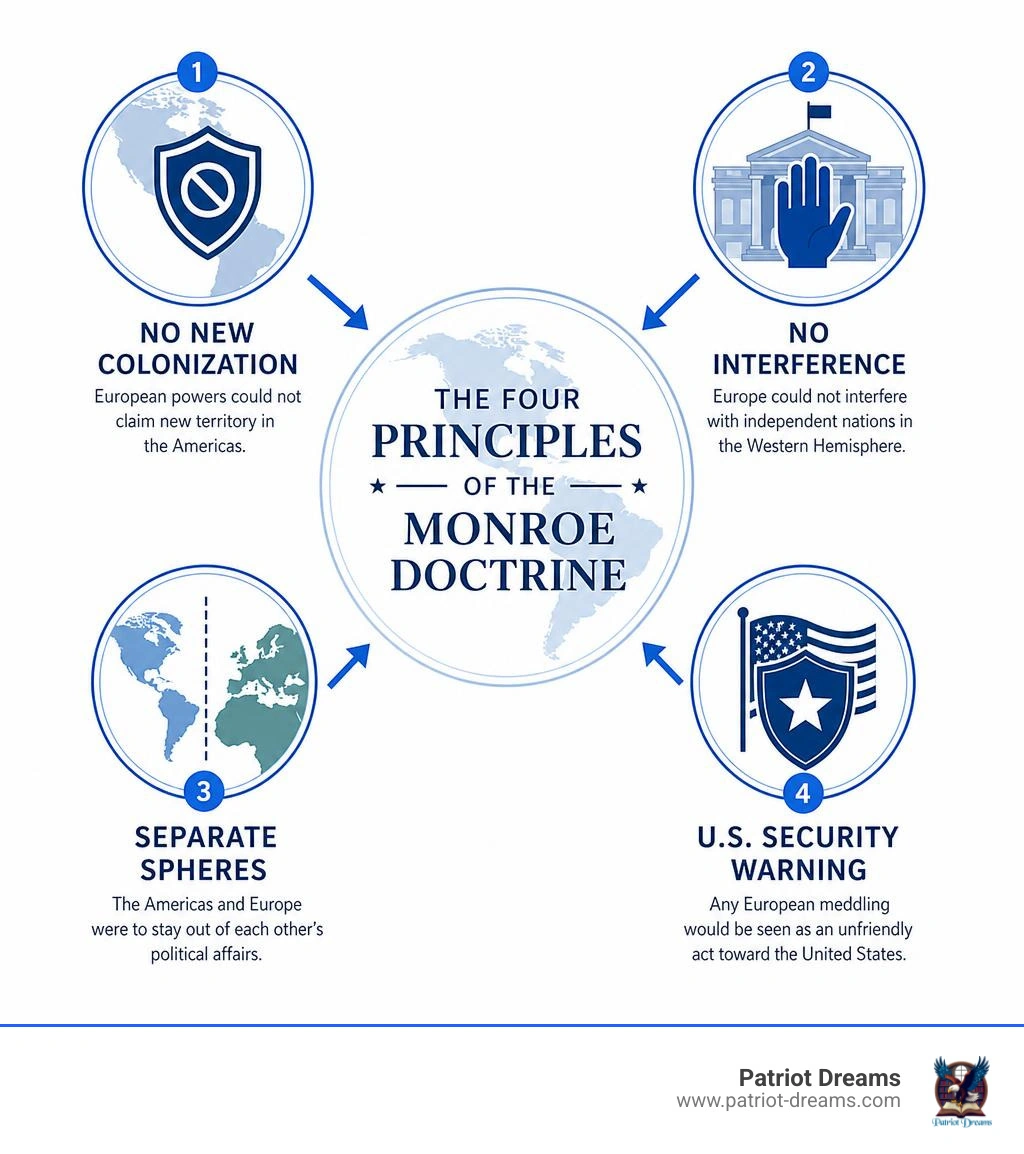
The Core Definition of Monroe Doctrine and Its Four Principles

When we look back at the winter of 1823, we see a young nation trying to find its footing on the global stage. President James Monroe, working alongside his brilliant Secretary of State, John Quincy Adams, wanted to outline a foreign policy that would protect the hard-won independence of the United States and its newly free neighbors in Latin America.
This historic policy was preserved for future generations, and you can view the transcript of the original text through the Monroe Doctrine (1823) | National Archives. To truly understand the definition of Monroe Doctrine, we have to break it down into the four core principles that Monroe outlined in his address to Congress. These principles established a framework of mutual respect and separate spheres of influence between the Old World and the New World. For a deeper look at Monroe's presidency, you can also explore our guide on the James Monroe Doctrine.
Principle 1: Staying Out of European Conflicts
The first principle was a promise of peace and neutrality. The United States pledged that it would not meddle in the internal affairs, wars, or political struggles of European nations. We believed that Europe had its own set of interests, and we had ours. By promising to stay out of their backyard, we hoped to encourage them to stay out of ours. It was a commitment to peaceful coexistence.
Principle 2: Respecting Existing Colonies
America did not want to start unnecessary fights. The second principle made it clear that the United States would not interfere with or disturb existing European colonies already established in the Western Hemisphere. If a European power already owned an island or a territory in the Americas, we respected that boundary. We were not looking to conquer; we were looking to preserve stability.
Principle 3: No New Colonization in the Americas
This was the core "No Trespassing" sign. Monroe declared that the American continents, by virtue of their free and independent condition, were no longer open to future colonization by any European powers. The days of European empires carving up the Americas like pieces of a pie were officially over. The land belonged to the people who lived there.
Principle 4: A Warning Against European Interference
The final principle was a protective shield. Monroe warned that any attempt by European powers to extend their political system to any portion of the Western Hemisphere, or to oppress and control the newly independent Latin American republics, would be viewed as dangerous to our peace and safety. It was a warm, protective hand extended to our southern neighbors, letting them know they were not alone in their quest for freedom.
The Historical Origins and Gentle Beginnings of a National Promise
To understand why this doctrine was written, we have to travel back to a time of great change. In the early 19th century, Latin American nations were bravely rising up, throwing off the yoke of Spanish rule, and declaring their independence. It was a beautiful era of revolution and hope, very much inspired by America’s own struggle for liberty, which our Founding Fathers had championed decades earlier. You can read more about that original spark of freedom in our article on Thomas Jefferson and the Declaration of Independence: How a Nation Found Its Voice.
However, the powerful monarchies of Europe—collectively known as the Holy Alliance—were uneasy. They wanted to restore Spanish colonial rule in South and Central America. At the same time, Russia was expanding its claims down the Pacific coast into the Oregon Territory. The world was changing quickly, and the United States needed a clear voice. For a detailed breakdown of this diplomatic environment, the Monroe Doctrine, 1823 - Office of the Historian offers excellent historical context.
How John Quincy Adams Shaped the Original Definition of Monroe Doctrine
While the doctrine bears President Monroe's name, its chief architect was his Secretary of State, John Quincy Adams.
Great Britain, represented by Foreign Secretary George Canning, had actually approached the United States with an offer. Britain suggested that the two nations issue a joint declaration warning France and Spain to keep their hands off Latin America. It sounded like an easy shortcut to safety.
But John Quincy Adams was a forward-thinking diplomat. He insisted that the United States should make its own unilateral declaration rather than "going as a cockboat in the wake of the British man-of-war." Adams believed that a joint statement would limit America's future growth and make us look weak. By standing on our own two feet and speaking directly to the world, we asserted our identity as a truly sovereign nation dedicated to democratic ideals.
The Role of British Naval Power in the 19th Century
There was just one small problem: in 1823, the United States military was quite small, and our navy was far from a global superpower. On our own, we did not have the military muscle to back up Monroe’s bold words.
For the first several decades of the doctrine's existence, it was actually enforced by the British Royal Navy. Britain wanted to keep Latin American ports open for free trade, and they had no desire to see Spain or France reclaim territory. Under the umbrella of Pax Britannica, the British fleet served as the unspoken muscle behind our "No Trespassing" sign. It is a wonderful historical reminder of how shared interests and quiet cooperation can protect freedom, even when a nation is still growing into its strength.
The Evolution of the Doctrine: From Rhetoric to Foundation
As the decades rolled by, the United States grew. We built cities, expanded westward, and strengthened our institutions. The Monroe Doctrine, which began as a simple statement tucked inside a routine address, gradually transformed into a foundational tenet of American foreign policy.
To understand this evolution, we can trace how the U.S. shifted from a defensive posture to a more active, policing role in the hemisphere. This expansion of federal influence is deeply connected to how we interpret our national powers, a concept you can explore in The US Constitution & Bill of Rights Explained Simply.
EraPrimary StanceKey ObjectiveEnforcement Style1823 (Original)Defensive & RhetoricalProtect newly independent nations; prevent European recolonizationRelied on British naval power; symbolic warningsLate 19th CenturyAssertive & ArbitratingEstablish the U.S. as the dominant diplomatic authority in the hemisphereDiplomatic pressure; active mediation (e.g., Venezuela 1895)Early 20th CenturyInterventionist (Roosevelt Corollary)Maintain order, manage debts, and prevent European military interventionDirect military occupation; "International Police Power"
The Olney Corollary and the Venezuelan Crisis of 1895
In 1895, a border dispute flared up between Venezuela and British Guiana. Great Britain wanted to claim a large portion of disputed land, but Venezuela appealed to the United States for help, invoking the Monroe Doctrine.
U.S. Secretary of State Richard Olney stepped in with a very bold interpretation of the policy. He declared that the United States was "practically sovereign on this continent" and that its word was law in matters concerning the hemisphere. This became known as the Olney Corollary.
While Olney's tone was aggressive, the crisis was ultimately resolved peacefully. The 1899 Paris Arbitration Tribunal ended up awarding Britain almost 90% of the disputed territory, but the event established a major precedent: European powers now recognized that if they had a dispute in the Americas, they had to go through the United States first.
The Roosevelt Corollary and International Police Power
In 1904, President Theodore Roosevelt took the doctrine a step further. Many Latin American nations owed massive debts to European banks. When they fell behind on payments, European nations threatened to send warships to collect the debts by force.
Roosevelt wanted to keep European militaries out of our neighborhood, but he also believed that nations should pay what they owed. His solution was the Roosevelt Corollary: if a nation in the Western Hemisphere showed "chronic wrongdoing" or an inability to maintain order, the United States would step in as an "international police power" to fix the situation before Europe could intervene.
Under this new policy, U.S. forces were sent into Santo Domingo in 1904, Nicaragua in 1911, and Haiti in 1915 to manage customs houses, pay off debts, and restore order. While Roosevelt’s intentions were to protect the hemisphere from European empires, this shift toward direct intervention created long-lasting tension with our Latin American neighbors, who felt that their own sovereignty was being compromised.
Historical Invocations: Protecting the Neighborhood in Times of Crisis
Throughout history, American presidents have reached back to the Monroe Doctrine to guide the nation through moments of extreme tension. Let's look at a few of those critical moments when the policy was put to the test.
- Supporting Mexico (1865): During the American Civil War, France took advantage of our domestic distraction and installed a puppet monarch, Emperor Maximilian, in Mexico. Once our civil conflict ended, the U.S. government invoked the Monroe Doctrine. We sent military forces to the Texas border and diplomatically supported Mexican President Benito Juárez. This pressure helped enable a successful revolt by Mexican patriots, restoring self-governance to our southern neighbor.
- The Venezuelan Debt Crisis (1902–1903): When Britain, Germany, and Italy blockaded Venezuelan ports over unpaid debts, the U.S. used diplomacy and naval maneuvers to push the European powers toward a peaceful arbitration process, reinforcing the idea that European military force had no place in the Americas.
The Cuban Missile Crisis and the 1962 Quarantine
Perhaps the most famous modern application of the doctrine occurred during the Cold War. In October 1962, the United States discovered that the Soviet Union was secretly building nuclear missile sites in Cuba, just 90 miles from Florida.
This was a direct violation of the spirit of the Monroe Doctrine—a hostile foreign superpower establishing a military foothold in our hemisphere. President John F. Kennedy chose a careful, measured path to keep us safe. Instead of a direct invasion, which could have triggered a global nuclear war, he established a naval and air "quarantine" around Cuba to block further Soviet shipments.
After several incredibly tense days, the Soviet Union agreed to withdraw the missiles. It was a powerful demonstration of how the core principles of the Monroe Doctrine could be used to protect our neighborhood in a highly dangerous modern world.
Public Support and the Hemispheric Shield in 1940
As World War II began to engulf Europe, Americans felt a deep, instinctive urge to protect our peaceful corner of the globe. The principles of the Monroe Doctrine were not just diplomatic theories; they were deeply held beliefs shared by everyday citizens.
A public opinion survey conducted in 1940 revealed just how strongly Americans believed in protecting their neighbors:
- 81% of Americans supported defending Canada from foreign invasion.
- 75% supported defending Mexico and Central America.
- 69% supported defending South America.
This poll captures a beautiful truth about the American spirit: when the world is in turmoil, we believe in standing shoulder-to-shoulder with our neighbors to keep our shared home safe and free.
Global Perspectives and the Modern Legacy of the Doctrine
Over its two-hundred-year history, the Monroe Doctrine has been viewed in many different ways. In the United States, it has often been seen as a noble shield protecting the hemisphere from outside tyranny. In Latin America, however, the policy has sometimes been viewed with suspicion—as a tool used by a powerful northern neighbor to justify intervention in their domestic affairs.
Recognizing these complex feelings, American leaders have worked to evolve the policy. In the late 1920s, the Clark Memorandum officially separated the Roosevelt Corollary from the original Monroe Doctrine, stating that the U.S. did not have a blanket right to intervene in Latin American affairs. This paved the way for President Franklin D. Roosevelt's "Good Neighbor Policy," which emphasized mutual respect, cooperation, and joint hemispheric defense rather than unilateral intervention.
To explore the exact words that started it all, you can read the primary source document preserved by the Avalon Project - Monroe Doctrine; December 2 1823.
The Modern Definition of Monroe Doctrine in the 21st Century
In 2013, Secretary of State John Kerry declared to the Organization of American States that "the era of the Monroe Doctrine is over," suggesting that the United States would view Latin American nations as equal partners rather than protectorates.
Yet, history has a way of staying relevant. In recent years, the doctrine has found new life. During the late 2010s, U.S. officials invoked the Monroe Doctrine to warn external powers—specifically Russia and China—against establishing deep military or economic footholds in Venezuela and other parts of the hemisphere. This modern interpretation, sometimes referred to as the "Trump Corollary," reminds us that the fundamental question of the Monroe Doctrine remains active: How do we keep our hemisphere safe, free, and secure from external geopolitical rivalries?
Frequently Asked Questions About the Monroe Doctrine
What is the simplest definition of the Monroe Doctrine?
The simplest definition of Monroe Doctrine is a U.S. policy stating that European powers must stay out of the Western Hemisphere—meaning no new colonization and no interference with independent nations—while the United States promises to stay out of European affairs.
Who actually wrote the Monroe Doctrine?
While the policy was announced by President James Monroe in 1823, it was largely drafted and shaped by his brilliant Secretary of State, John Quincy Adams.
Is the Monroe Doctrine still in effect today?
While it is no longer invoked in the same interventionist way it was during the early 20th century, the core spirit of the Monroe Doctrine—the idea that the Western Hemisphere should remain free from hostile foreign influence—is still a vital part of contemporary American diplomatic strategy.
Conclusion
At its heart, the story of the Monroe Doctrine is a story about home. It is about a young nation that looked out at its neighbors, saw their shared love for liberty, and decided to build a protective fence around our corner of the world. Like any long-standing family policy, it has been tested, rewritten, and debated over the years. But the warm, protective spirit behind it—the desire to live in peace, side-by-side with our neighbors, free from outside interference—remains a beautiful part of our American heritage.
Here at Patriot Dreams, we believe that history is not just a collection of dates and documents. It is a living tapestry of stories, families, and dreams that have shaped the land we love today. Through our interactive map and unique audio storytelling, we bring these incredible moments to life, helping you preserve your own family's legacy while exploring the great milestones of our nation.
We invite you to take a gentle step back in time and Explore the James Monroe Doctrine with Patriot Dreams. Let's discover the stories of our past, together.

Join the Patriot Dreams Community
Download the app today and start your journey through American history and personal legacy.

Explore Our Latest Insights
Dive into stories that shape our American legacy.