Wild West Era 101

The Story of When the Wild West Era Shaped America Forever
When was the Wild West era? Here's the short answer:
| Detail | Date |
|---|---|
| Start of the Wild West era | 1865 (end of the Civil War) |
| End of the Wild West era | 1890–1895 |
| Duration | Approximately 30 years |
| Broader Frontier Era | 1607–1912 |
The Wild West era — that legendary, golden chapter of American life — lasted only about 30 years. Just three decades. And yet, it left a mark on our national spirit that still feels alive today, more than 130 years later.
Think about that for a moment.
In just 30 years, millions of ordinary people crossed vast, open plains. Cowboys drove enormous herds of cattle across hundreds of miles. Families packed everything they owned into wagons and headed toward a horizon they had never seen. They were brave. They were hopeful. And they were building something together.
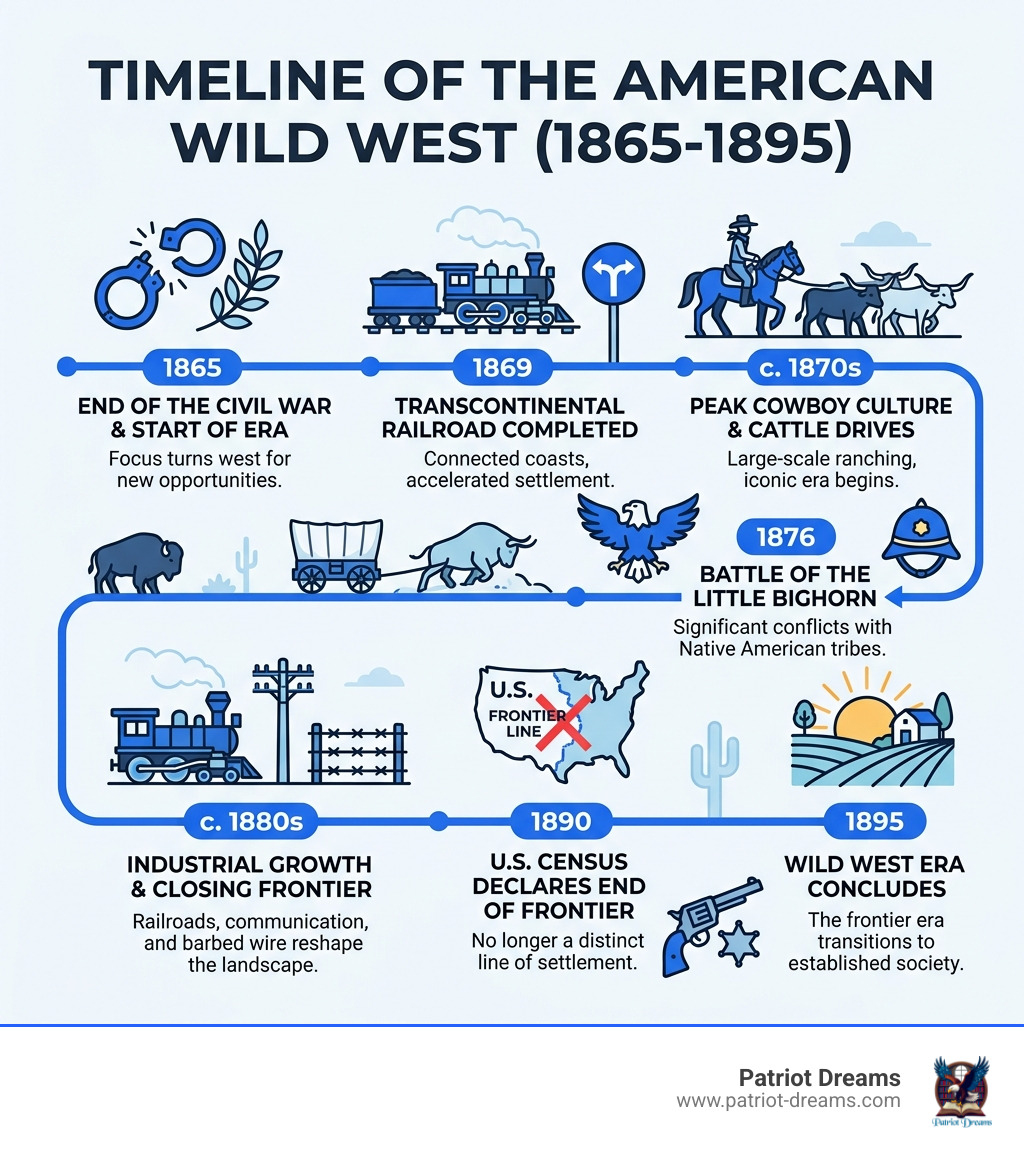
Historians generally place the Wild West era between 1865 and 1895, though some extend it to 1900. It began when the Civil War ended and restless Americans turned their eyes westward. It closed when the U.S. Census Bureau officially declared in 1890 that there was no longer a clear frontier line left to settle.
Thirty years. One remarkable American story.
Easy when was the wild west era word list:
Defining the Timeline: When Was the Wild West Era?
When we talk about the "Old West," we are often talking about a feeling as much as a timeframe. But for those of us who love the history of our beautiful country, it’s helpful to pin down exactly when was the wild west era. While the broader American frontier technically began the moment the first settlers stepped onto the East Coast in 1607, the "Wild West" we see in movies — the one with dusty trails, bustling boomtowns, and lone riders — is a much tighter window.
Most historians agree that the core Wild West era spanned from 1865 to 1895. This 30-year period was a unique "sub-era" of American history. It was a time of rapid change, where the old ways of the wilderness met the new ways of the industrial world.
To help visualize this, let’s look at how this brief period fits into the much longer history of American expansion:
| Period | Dates | Key Characteristics |
|---|---|---|
| Broad Frontier Era | 1607–1912 | From Jamestown to the statehood of Arizona/New Mexico. |
| Early Exploration | 1803–1860 | The Louisiana Purchase and Oregon Trail Stories. |
| The Wild West Era | 1865–1895 | The peak of cowboys, outlaws, and the Transcontinental Railroad. |
| The Closing | 1890–1912 | The transition from territories to settled states. |
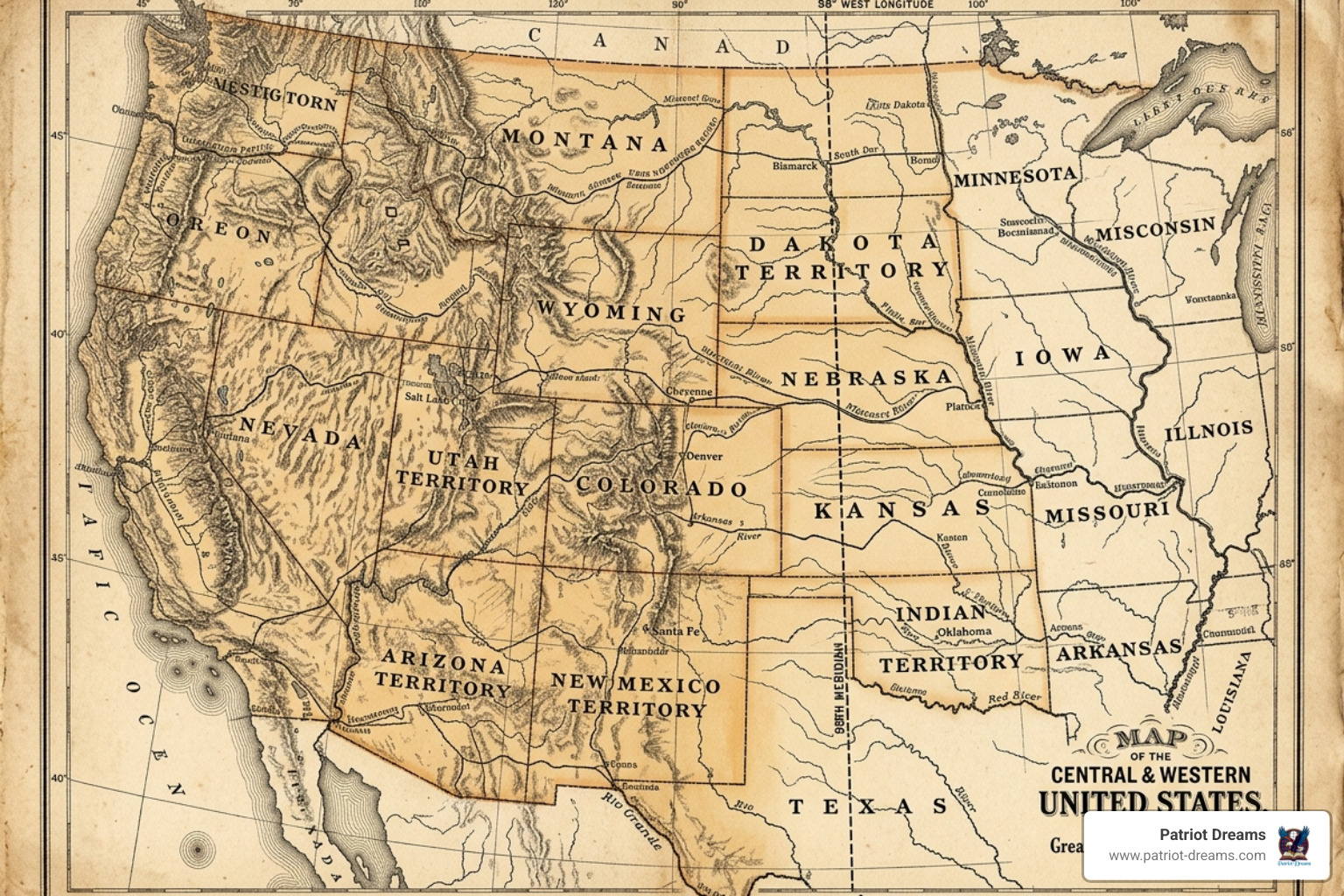
The Timeline of the American Old West shows us that geography played a huge role too. The "West" often started at the 98th meridian — a line that roughly cuts through the Dakotas, Nebraska, Kansas, Oklahoma, and Texas. West of that line, the climate changed, and so did the way of life.
The Spark of 1865 and Post-War Migration
Why did it all start in 1865? When the Civil War finally came to an end, the nation was weary but also filled with a new, restless energy. Thousands of soldiers returned home to find their previous lives forever changed. Some sought a fresh start; others sought fortune.
This led to a massive westward movement. By 1870, nearly 500,000 migrants had moved west, seeking land and opportunity. The Homestead Act of 1862 had already laid the groundwork, offering 160 acres of land to anyone willing to farm it for five years. It was a beautiful invitation to build a home and a future. We see this spirit of perseverance in many American Pioneer Stories, where families faced incredible hardships with a quiet, steady kindness toward one another.
Why the 1890 Census Marked the End of the Frontier
It might seem strange that a government report could "end" an era, but that’s exactly what happened in 1890. Every ten years, the U.S. Census Bureau looks at where people are living. For decades, there had been a clear "frontier line" — a point where the population density dropped below two people per square mile.
In 1890, the Superintendent of the Census made a startling announcement: the unsettled areas were now so broken up by settlements that there was no longer a discernible frontier line. The "Wild" was being filled in. While the spirit of the West lived on, the era of vast, unclaimed wilderness was technically over. This transition is beautifully detailed in The American West, 1865 to 1900 - The Library of Congress , which marks the shift from a frontier to an industrial nation.
The Heartbeat of the Frontier: Cowboys and Cattle Drives
If the railroad was the veins of the West, the cowboy was surely its heartbeat. When we ask when was the wild west era, we are almost always picturing the "Cowboy Era." This specific window was driven by a simple economic reality: Texas had too many cows, and the North had too many hungry people.
After the Civil War, an estimated 5 million longhorn cattle were roaming the Texas plains. In Texas, a cow might be worth only $4. But in the hungry cities of the North, that same cow could fetch $40. To bridge that gap, cowboys had to drive herds hundreds of miles north to railroad terminals in places like Abilene and Dodge City.

A typical cattle drive involved 1,500 to 2,500 head of cattle and a small, dedicated crew. These men lived a life of American Cowboy Ranch Life, which was far less glamorous than the movies suggest. It was hard, dusty, and often lonely work, but it forged a bond of brotherhood that defined the era.
Diversity on the Range: Vaqueros and Black Cowboys
One of the most wonderful things about the real history of the West is how diverse it truly was. The image of the "lone white cowboy" is largely a creation of later Hollywood films. In reality, the frontier was a "crossroads of cultures."
The very first cowboys weren't American at all — they were Mexican vaqueros. These skilled horsemen taught the newcomers everything they knew about roping, riding, and ranching. Even the word "cowboy" is a translation of vaquero. We owe so much of our Western heritage to their expertise.
Furthermore, about 25% of all cowboys were African American. After the Civil War, many former slaves headed west to find a life where their skills mattered more than the color of their skin. One famous example is Bose Ikard, a prominent scout and cowboy who became a legend for his skill and loyalty. You can find more about these incredible individuals in our mountain men frontier tales.
The Economic Engine of the Wild West Era
The Wild West wasn't just about adventure; it was a massive business. The average cowboy earned between $25 and $40 a month — a humble wage for such dangerous work. They were usually paid only when the herd was sold at the end of the trail.
This era also saw the rise of legendary figures who weren't cowboys at all, but pioneers in other ways. For instance, Daniel Boone had blazed trails much earlier, but his spirit of exploration lived on in the men and women who built the boomtowns that supported the cattle industry. These towns were the "economic engines" of the era, providing supplies, entertainment, and a place for weary travelers to rest.
Technological Shifts That Tamed the Wild
As much as we love the image of the horse and wagon, it was technology that truly defined when was the wild west era ended. The very tools that made the West accessible were the ones that eventually "tamed" it.
How the Iron Horse Changed the Landscape
The completion of the First Transcontinental Railroad in 1869 was perhaps the most significant event of the era. Before the "Iron Horse," traveling across the country took months and was filled with peril. Afterward, it took about a week.
The railroad brought people, but it also brought law, order, and industry. It turned remote outposts into bustling "industrial crossroads." While this was wonderful for the growth of the nation, it meant that the "wild" parts of the West were shrinking. The railroad made the long, difficult cattle drives less necessary, as tracks eventually reached deeper into Texas and other ranching territories. For those interested in the physical challenges of this expansion, our stories on mountain pass frontier crossings offer a glimpse into the rugged terrain the tracks had to conquer.
The Impact of Barbed Wire on the Open Range
If the railroad was the "front door" to the West, barbed wire was the "fence." Invented in 1874 by a farmer named Joseph Glidden, barbed wire changed everything.
Before barbed wire, the West was "open range." Cattle could roam freely across vast distances. But as more settlers arrived, they needed a way to protect their crops from wandering herds. Barbed wire was cheap and effective. However, it also ended the era of the free-roaming cowboy.
The "Great Die Up" of 1887 — a catastrophic winter where temperatures dropped to -50 degrees — was the final blow. Because of the new fences, cattle couldn't migrate south to find shelter from the blizzards. An estimated 90% of the cattle on the northern plains died. This tragedy forced ranchers to move toward smaller, fenced-in herds and hay feeding, effectively ending the old way of life.
Interestingly, this era of hard labor also gave us an American fashion icon. In the 1870s, a German immigrant named Levi Strauss created reinforced blue jeans to withstand the rough work of miners and cowboys. It’s a lovely reminder of how the practical needs of the frontier still shape our world today.
The Lasting Legacy and the Cowboy Code
Even though the era was short, its legacy is immortal. We still talk about the "Cowboy Code" — a set of unwritten rules that emphasized honor, resilience, and kindness. A cowboy was expected to be a person of his word, to protect the vulnerable, and to take responsibility for his own life.
Romanticizing the Wild West Era in Literature and Film
The myth-making began almost immediately. Even while the West was still "wild," people in the East were reading "dime novels" that turned outlaws and lawmen into larger-than-life heroes. The Cowboy Era and Why Their Legacy Matters Today | Galaxy Press explains how authors like Louis L'Amour and entertainers like Buffalo Bill Cody helped cement this image in our minds.
Buffalo Bill’s Wild West show, which started in 1883, took the "spectacle" of the West all over the world. It featured sharpshooters like Annie Oakley and simulated battles that thrilled audiences. While these shows weren't always historically accurate, they captured the spirit of the era — the bravery and the sense of possibility.
Lessons of Kindness and Perseverance for Today
At Patriot Dreams, we believe that the true value of the Wild West era isn't just in the shootouts or the gold rushes. It’s in the everyday heroism of the people who lived through it. We see The Frontier Myth Today: What the Old West Tells Us About Modern America as a bridge to our modern lives.
The West teaches us about community strength. When a neighbor’s barn burned down, the community gathered to rebuild it. When a family was struggling on the trail, others shared their meager rations. These acts of quiet kindness are what truly built our country. They remind us that no matter how "wild" the world feels, we can always choose to be gentle and helpful to one another.
Frequently Asked Questions about the Old West
How long did the Wild West era actually last?
The Wild West era lasted approximately 30 years, generally defined as the period between 1865 and 1895. While the frontier itself existed for centuries, this specific window was the peak of the "cowboy" and "outlaw" culture we recognize today.
What was the primary cause of the great cattle drives?
The primary cause was an economic disconnect. There was a massive surplus of cattle in Texas (about 5 million) following the Civil War, while there was a high demand for beef in the Northern states. Cowboys drove the cattle to railroad terminals in Kansas so they could be shipped to Eastern markets.
What officially signaled the end of the era?
Several factors signaled the end:
- The 1890 Census: Declared there was no longer a continuous frontier line.
- Barbed Wire: Ended the "open range" and free grazing.
- The Railroad: Made long-distance cattle drives unnecessary.
- Statehood: As territories like Oklahoma (1907), New Mexico (1912), and Arizona (1912) became states, the "lawless" nature of the territories gave way to formal government.
Conclusion
The story of when was the wild west era is more than just a list of dates on a calendar. It is a story of a few decades where the American spirit was tested and refined. It was a time of immense challenge, but also immense hope.
Though the dusty trails have mostly been replaced by highways, and the "Iron Horse" has evolved into high-speed transit, the values of that era — resilience, honor, and a helping hand for a neighbor — are still part of who we are.
At Patriot Dreams, we are honored to help you preserve these stories. Whether it’s a tale of a distant ancestor who crossed the plains or a legend of a local hero, these memories are the threads that weave our national tapestry together. We invite you to Explore our 250-year American journey and discover how your own family story fits into this grand, beautiful history of ours.
After all, history isn't just about the past. It’s about the stories we tell today to inspire a kinder, braver tomorrow. Thank you for being part of our community.

Join the Patriot Dreams Community
Download the app today and start your journey through American history and personal legacy.

Explore Our Latest Insights
Dive into stories that shape our American legacy.