An Essential Guide to Peter Salem’s Revolutionary Legacy
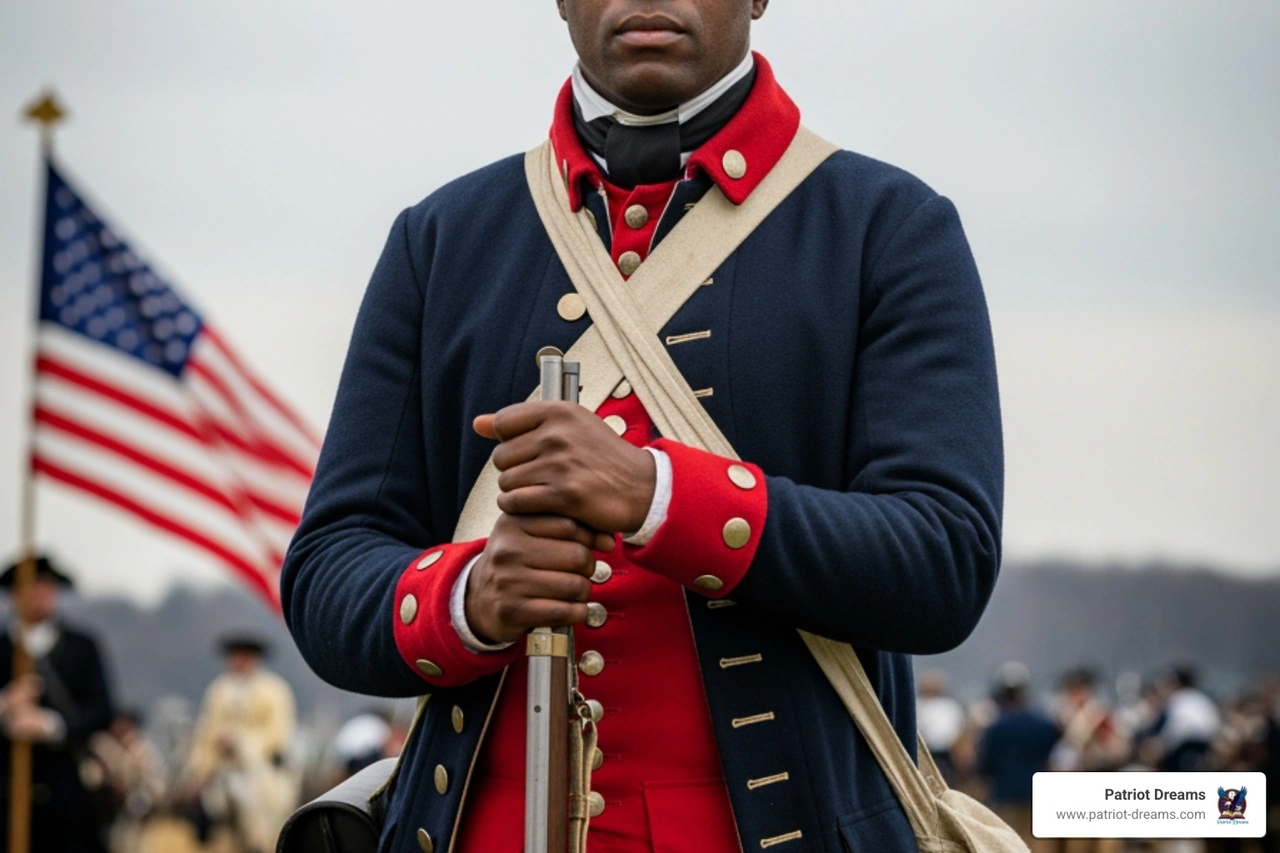

Why At Bunker Hill and Beyond: Peter Salem's Revolutionary War Legacy Still Matters Today
At Bunker Hill and Beyond: Peter Salem's Revolutionary War Legacy is the story of a man who went from being enslaved in colonial Massachusetts to standing on one of the most important battlefields of the American Revolution — and changing the course of that fight with a single shot.
Here is a quick look at who Peter Salem was and why his story matters:
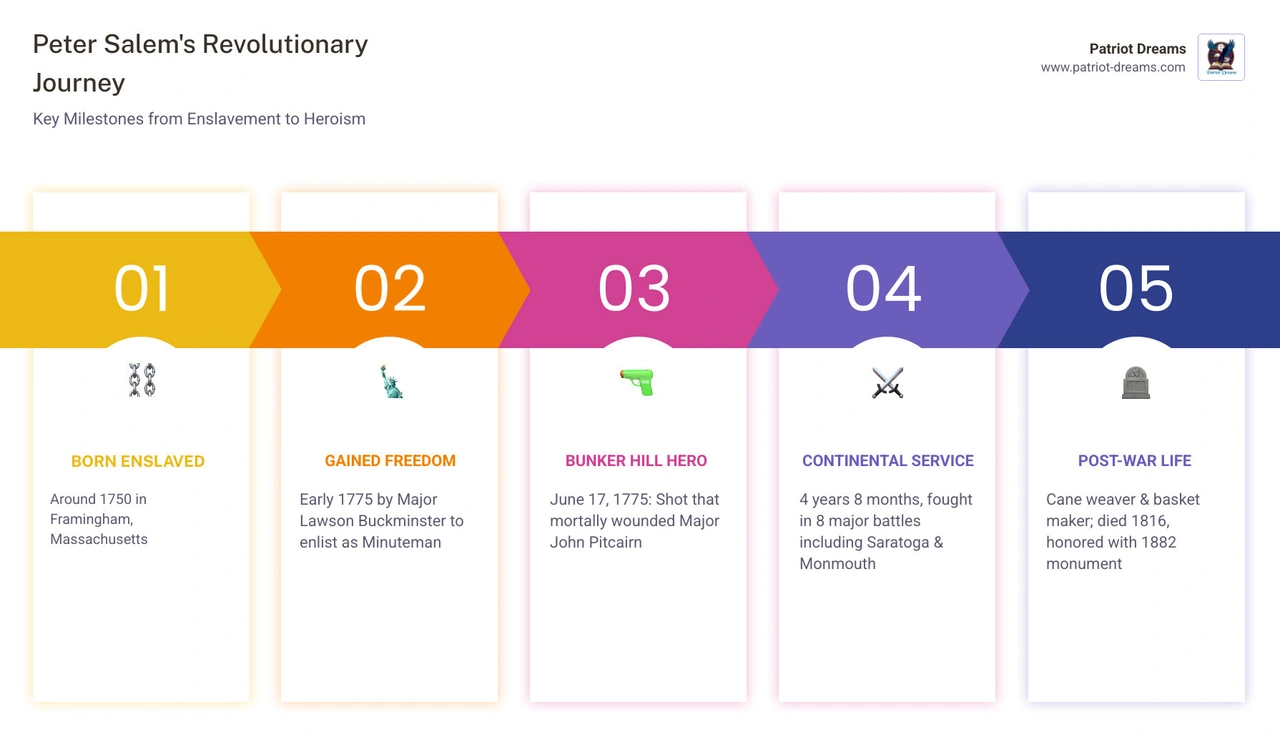
- Born: Around 1750 in Framingham, Massachusetts, into slavery
- Freed: Early 1775, by Major Lawson Buckminster, specifically so he could enlist as a Minuteman
- Most famous moment: Credited with firing the shot that mortally wounded British Major John Pitcairn at the Battle of Bunker Hill, June 17, 1775
- Total service: Four years and eight months in the Continental Army, discharged March 1, 1780
- Battles fought: Lexington & Concord, Bunker Hill, Harlem Heights, Trenton, Saratoga, Monmouth, Stony Point, and White Plains
- Later life: Worked as a cane weaver and basket maker; died in the Framingham poorhouse on August 16, 1816
- Legacy: Honored with a monument in 1882, depicted in a painting now in the U.S. Capitol, and celebrated with his own commemorative day in Framingham
His is a story of remarkable courage — and also of the deep contradictions at the heart of early America. A man who fought for liberty while being denied it. A hero whose later years were marked by poverty, not praise.
But his story does not end in sadness. It ends in something more powerful: memory, recognition, and the quiet but enduring reminder that America's founding belonged to many voices, many hands, and many hearts.
Come with us as we explore the full life of this extraordinary Patriot.
Quick look at At Bunker Hill and Beyond: Peter Salem’s Revolutionary War Legacy:
From Enslavement to Emancipation: Peter Salem’s Early Life
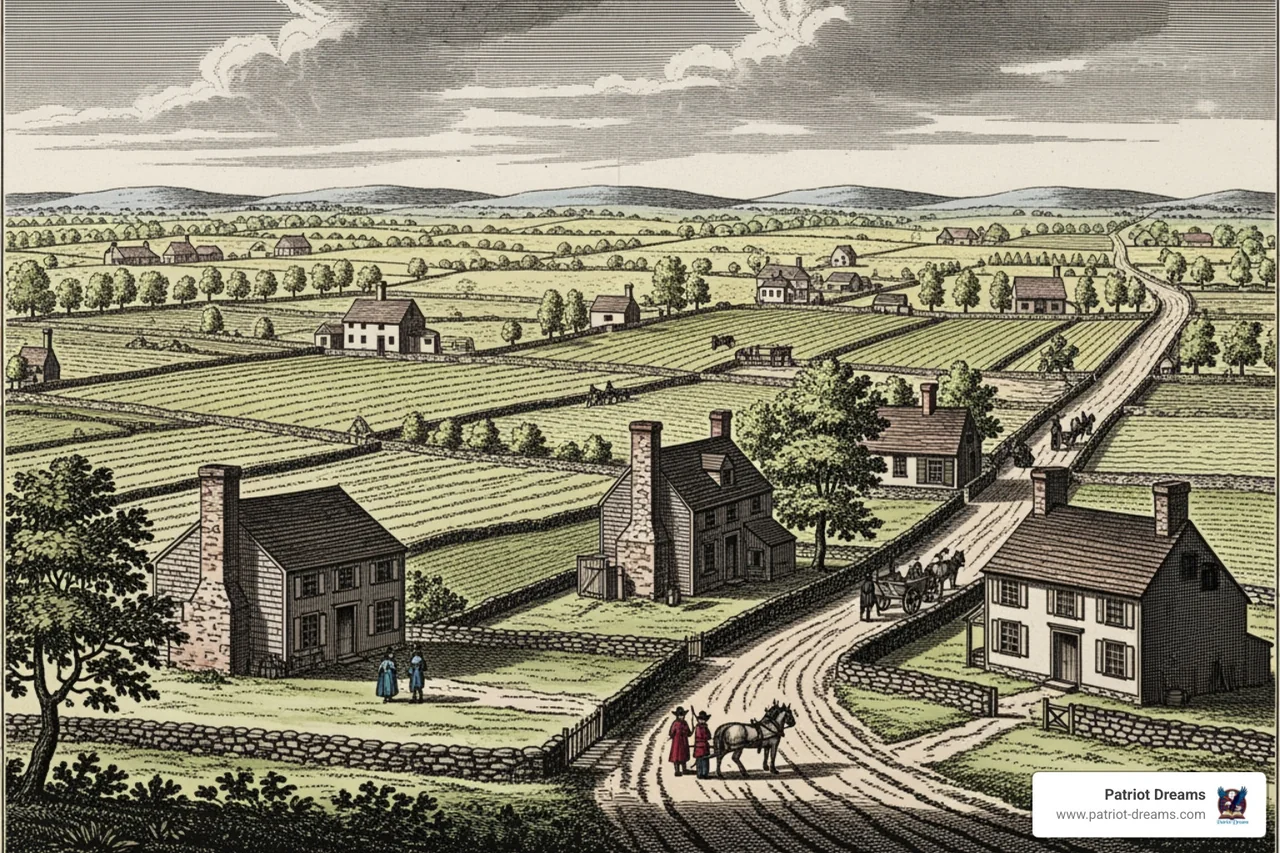
To truly understand the weight of Peter Salem’s contributions, we must start at the very beginning of his journey in Framingham, Massachusetts. Born around 1750, Peter entered a world where the air was thick with talk of "liberty," yet he himself was held in bondage. He was originally enslaved by Jeremiah Belknap, who later sold him to Major Lawson Buckminster.
The name "Salem" itself is a piece of history; it is believed he may have been named after his owner's hometown or perhaps adopted it as a surname later. Regardless of its origin, his identity was soon to be forged not in the fields of a plantation, but on the front lines of a revolution.
As the year 1775 dawned, the tension between the American colonies and the British Crown reached a breaking point. In a move that highlights the complex American Historical Figures Complete Guide, Major Buckminster emancipated Peter Salem in early 1775. This was not a random act of charity; it was done specifically so Peter could enlist in the local militia. At a time when many were hesitant to join the fray, Peter stepped forward as a Minuteman in Major Buckminster’s Framingham company.
His transition from an enslaved man to a free soldier is a powerful chapter in the Peter Salem (ca.1750 -1816) | BlackPast.org narrative. By the time the "shot heard 'round the world" was fired at Lexington and Concord on April 19, 1775, Peter Salem was there, standing shoulder to shoulder with his neighbors, fighting for a country that was only just beginning to define what "freedom" meant. According to the Peter Salem | American Battlefield Trust, this early service set the stage for the legendary heroics that would follow just months later.
At Bunker Hill and Beyond: Peter Salem’s Revolutionary War Legacy

The date was June 17, 1775. The location was actually Breed's Hill, though history remembers it as the Battle of Bunker Hill. It was a hot, dusty day, and the stakes could not have been higher. The Colonial forces were dug into a redoubt, facing the professional might of the British Army.
One of the most striking Revolutionary War Heroes statistics from this battle is that each Colonial infantryman had only thirteen cartridges. There was no room for error. Every shot had to count. Peter Salem, serving in Colonel John Nixon’s regiment, was positioned right in the thick of the action.
As we look back at Peter Salem and the Battle of Bunker Hill, we see a man who remained calm under immense pressure. While the British marched up the hill in their disciplined rows, the defenders waited until they could see "the whites of their eyes." It was in this moment of extreme peril that Peter Salem secured his place in the American story, as detailed by the Peter Salem (Salem Middlesex) (U.S. National Park Service).
The Fateful Shot At Bunker Hill and Beyond: Peter Salem’s Revolutionary War Legacy
As the British began their final, successful assault on the redoubt, Major John Pitcairn—a high-ranking British officer known for his role at Lexington—mounted the wall. He reportedly shouted, "The day is ours!" or "Surrender, you rebels!" to demoralize the weary Americans.
In that split second, a Black soldier stepped forward and fired a single, accurate shot. Major Pitcairn fell mortally wounded into the arms of his son. While history can sometimes be murky, multiple eyewitness accounts, including a 1807 letter from Aaron White and corroboration from Samuel Swett, identify that soldier as Peter Salem.
This moment was so significant that it was captured in John Trumbull’s famous 1786 painting, The Death of General Warren at the Battle of Bunker’s Hill. In the painting, a Black soldier—widely believed to be Salem—is seen holding a musket behind Lieutenant Thomas Grosvenor. Much like Crispus Attucks Martyr, who fell at the Boston Massacre, Salem became a symbol of the vital role Black Patriots played in the struggle for independence. You can read more about these specific accounts at the Peter Salem’s Courage at Bunker Hill – Revolutionary War Journal.
A Soldier’s Long Service At Bunker Hill and Beyond: Peter Salem’s Revolutionary War Legacy
While the shot at Bunker Hill is his most famous act, Peter Salem was no "summer soldier." He committed himself to the cause for the long haul. After George Washington took command of the Continental Army, there was a brief period where Black soldiers were barred from enlistment. However, this policy was quickly reversed when it became clear that their bravery and numbers were essential to the war effort.
Peter Salem served a total of four years and eight months in the Continental Army. He was not just a participant; he was a veteran of some of the most grueling campaigns of the war.
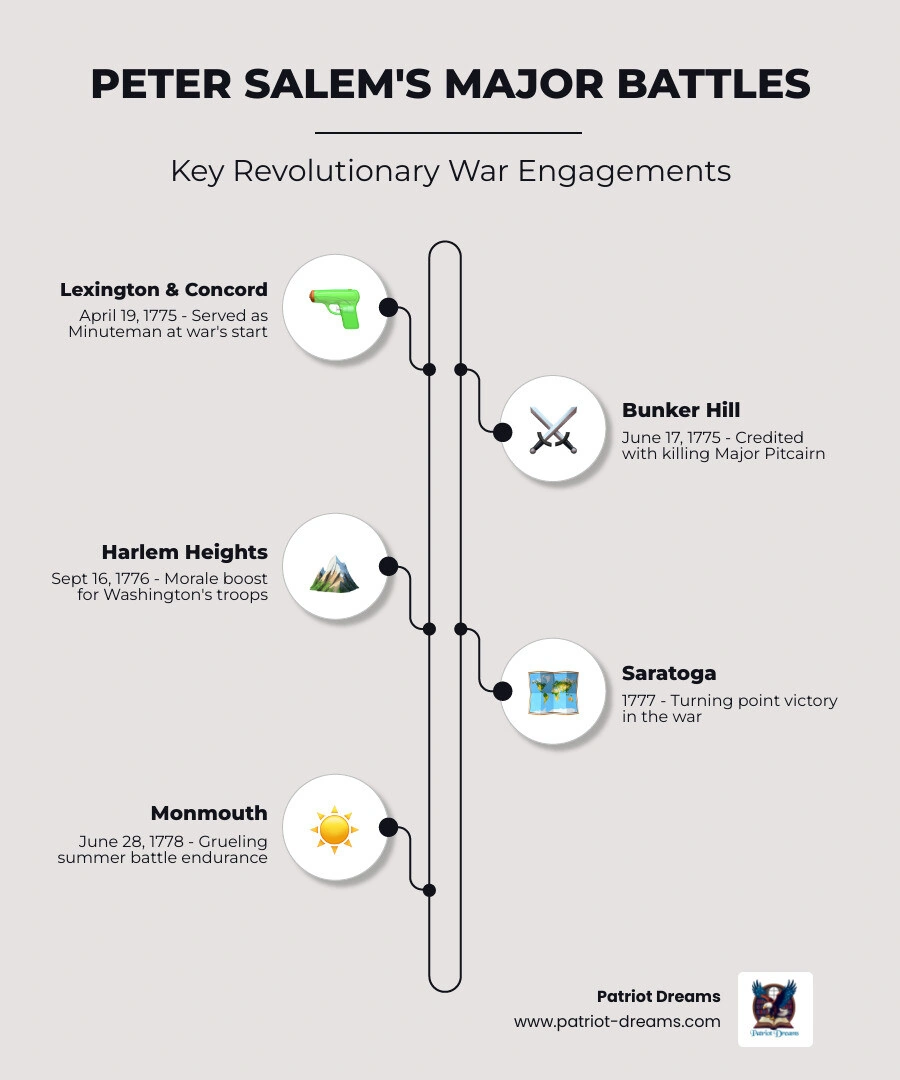
| Battle | Date | Significance |
|---|---|---|
| Lexington & Concord | April 19, 1775 | The start of the war; Peter served as a Minuteman. |
| Bunker Hill | June 17, 1775 | Credited with killing Major Pitcairn. |
| Harlem Heights | Sept 16, 1776 | A much-needed morale boost for Washington’s troops. |
| Battle of Trenton | Dec 26, 1776 | The famous crossing of the Delaware. |
| Battle of Saratoga | Sept/Oct 1777 | The turning point of the American Revolution. |
| Battle of Monmouth | June 28, 1778 | One of the largest and longest battles of the war. |
| Battle of Stony Point | July 16, 1779 | A daring midnight bayonet charge. |
From the early days of 1775 until his honorable discharge on March 1, 1780, Peter Salem stood by George Washington The General Who Became Americas First President. He saw the birth of a nation from the muddy trenches and the smoke-filled battlefields, proving his dedication to the American dream through nearly five years of continuous service.
Life After the Musket: Peter Salem’s Post-War Years
When the guns finally fell silent, Peter Salem returned to Massachusetts to build a life as a free man. In 1783, he married Katy Benson in Salem, Massachusetts. The couple eventually moved to Leicester, where Peter built a small cabin.
Life after the war was not easy for many veterans, and Peter was no exception. Despite his status as one of the Famous Figures In American History, he did not receive a pension or great wealth. He made a living through hard, honest work—weaving cane chair seats, making baskets, and tending to a garden filled with herbs and roses.
The 1790 U.S. Census lists Peter Salem as the head of a household in Framingham with two free people of color. He was a well-known figure in his community, often sought out by local children who wanted to hear stories of the war. He was described as having a "soldierly salute" and a courteous manner that endeared him to his neighbors.
Sadly, as he aged and his strength faded, Peter fell into poverty. In those days, there was little support for aging heroes. He spent his final days in the Framingham poorhouse, passing away on August 16, 1816, at the age of 66. It is a poignant reminder of the challenges faced by many who gave everything for their country, as explored in Peter Salem: A Revolutionary War Soldier's Story - Civics for Life.
Honoring a Hero: Monuments and Memorials
For many years, Peter Salem’s story was kept alive primarily through local oral tradition. However, as the centennial of the Revolution approached, the people of Framingham decided it was time for a permanent tribute.
In 1882, the town erected a granite monument at his burial site in the Old Burying Ground. The monument, which cost $150 at the time, stands as a testament to his service and lists the major battles in which he fought. June 17, 1882, was even declared "Peter Salem Day" in Framingham to coincide with the monument's dedication.
Other organizations have also worked to ensure his name is never forgotten. The Daughters of the American Revolution placed a memorial stone at the site of his former home in Leicester in 1909. Today, Peter Salem is recognized as one of the most significant Historical American Figures of the era. His image in the U.S. Capitol and his name on local landmarks serve as a bridge between our past and our present, as noted on the Peter Salem | City of Framingham, MA Official Website.
Frequently Asked Questions about Peter Salem
How did Peter Salem gain his freedom?
Peter Salem was born into slavery, but his path to freedom was tied directly to his desire to serve. His owner, Major Lawson Buckminster, emancipated him in early 1775 specifically so he could enlist in the Massachusetts Minutemen. This was a common, though complex, path to liberty for many Black men during the Revolutionary era. You can find more details on this transition at Peter Salem (ca.1750 -1816) - BlackPast.org.
Is Peter Salem the same person as Salem Poor?
No, they were two different men, though they are often confused because they both fought with great distinction at the Battle of Bunker Hill. While Peter Salem is credited with shooting Major Pitcairn, Salem Poor received a formal commendation signed by 14 officers who stated he "behaved like an experienced officer." Both men represent the incredible bravery of Black Patriots, but they have distinct individual legacies. For more on this distinction, see Unveiling the Heroics: Peter Salem's Impactful History - Thebostondaybook.com.
Where can I visit Peter Salem's memorial today?
The primary monument to Peter Salem is located in the Old Burying Ground in Framingham, Massachusetts. There is also a memorial marker in Leicester, Massachusetts, at the site where his cabin once stood. Both sites are open to the public and offer a quiet place to reflect on his life and service. Information on visiting can be found at the Peter Salem | City of Framingham, MA Official Website.
Conclusion
At Patriot Dreams, we believe that every story from our past is a thread in the beautiful, diverse tapestry of America. Peter Salem’s life is a story of perseverance, showing us that even in the most difficult circumstances, one person’s courage can change history.
His journey from enslavement to the front lines of the Revolution reminds us that the fight for independence was fought by people from all walks of life. By remembering Peter Salem, we honor the unity and the shared sacrifice that built this nation.
We hope this guide has inspired you to Explore more historical American figures and perhaps even look into your own family’s connection to the great American story. History isn't just in books; it's in the hearts of the people who lived it—and the people who remember it today. Thank you for joining us in celebrating the legacy of a true American hero.

Join the Patriot Dreams Community
Download the app today and start your journey through American history and personal legacy.

Explore Our Latest Insights
Dive into stories that shape our American legacy.