A – Z Guide to Homesteaders Old West Journeys

The Heart of America: Stories of Courage, Family, and the Open West
Homesteaders' Old West journeys are some of the most powerful stories in American history — tales of ordinary families who packed everything they owned, pointed their wagons west, and bet everything on a better life.
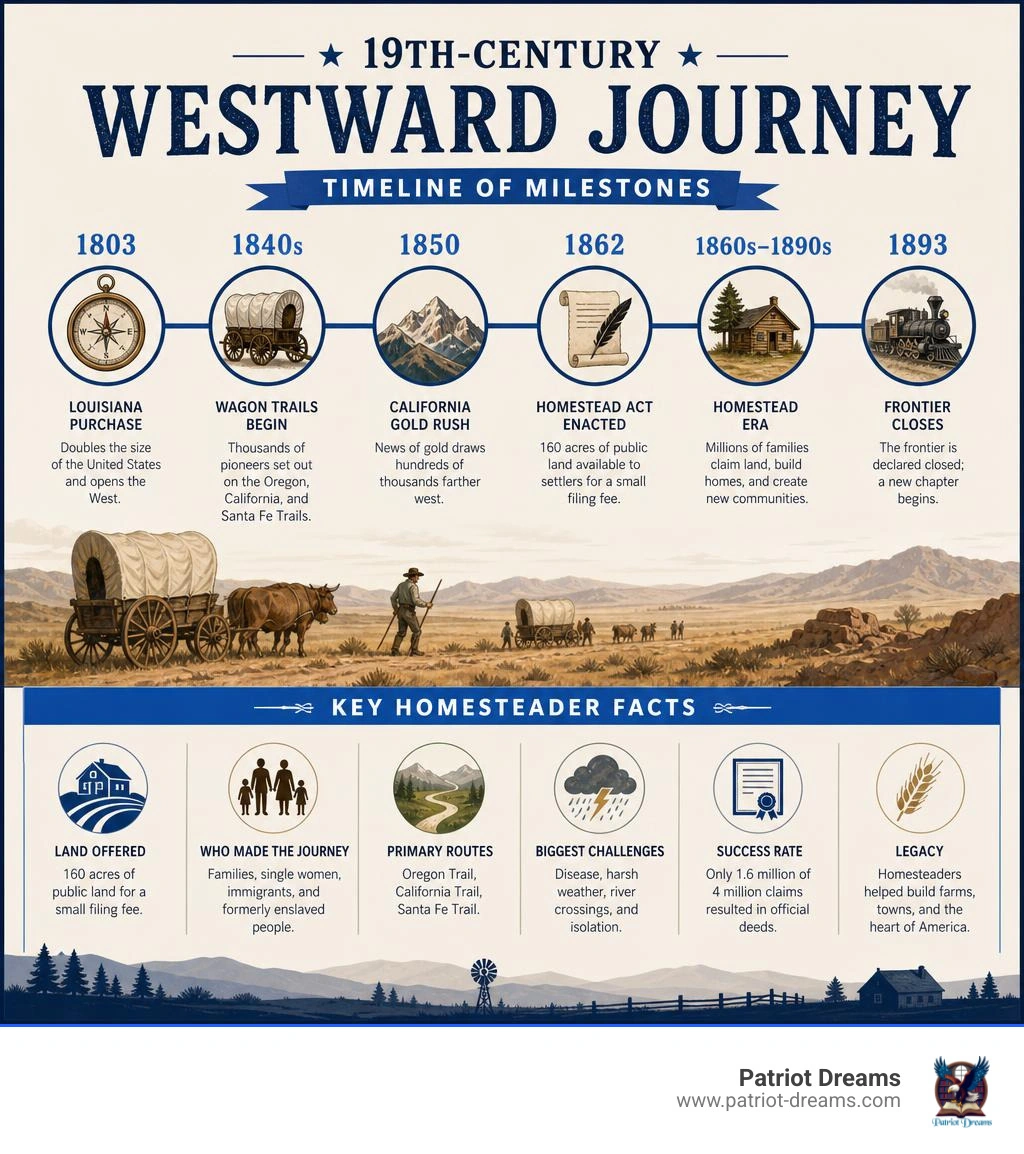
Here is a quick look at what these journeys were all about:
| Key Fact | Detail |
|---|---|
| Main motivation | Land ownership, freedom, and economic opportunity |
| Key legislation | Homestead Act of 1862 — 160 acres for a small fee |
| Primary routes | Oregon Trail, California Trail, Santa Fe Trail |
| Who made the journey | Families, single women, immigrants, formerly enslaved people |
| Biggest challenges | Disease, harsh weather, river crossings, isolation |
| Success rate | Only 1.6 million of 4 million claims resulted in official deeds |
These weren't just history-book events. They were real people — mothers, fathers, children, and grandparents — carrying their hopes across thousands of miles of open prairie, mountain passes, and desert.
One woman who made the journey in 1852, Lodisa Frizzell, sat down in a snowbound Sierra Nevada cabin months later and began writing it all out by candlelight — not wanting her family back home to forget what it felt like. That kind of love and courage runs through every single one of these stories.
At Patriot Dreams, we believe these journeys deserve to be remembered — and felt — not just studied.
Homesteaders old west journeys terms you need:
- Gunsmoke and Grit: Legends, Outlaws, and Lawmen of the Wild West
- mountain men frontier tales
- when was the wild west era
The Call of the Horizon: What Motivated Homesteaders Old West Journeys
What is it that makes a family look out at the horizon and decide to leave everything they know behind? In the 19th century, the pull of the American West was like a quiet, persistent song. Families were looking for a fresh start, a place where they could plant deep roots, watch their children grow, and own a piece of earth to call their own.
For many, the journey was about escaping the crowded cities of the East or rebuilding after the devastation of the Civil War. They wanted to build communities where neighbors helped neighbors and hard work was rewarded with a harvest. These inspiring American Pioneer Stories reflect a deep human desire for independence, resilience, and connection.
Of course, the West was also shaped by The Rugged Trades That Drew Settlers to the American West, such as fur trapping, mining, and cattle ranching. But while the miners chased sudden fortunes and the cowboys rode the open ranges, it was the homesteaders who brought the quiet determination to build permanent homes, schools, and churches. This pioneering spirit traces its roots back to legendary trailblazers like Daniel Boone, who first showed Americans how to look past the safety of the eastern settlements and find hope in the wilderness.
The Promise of the Homestead Act of 1862
The great catalyst for this massive movement was signed into law by President Abraham Lincoln on May 20, 1862. The Homestead Act was a simple but promise: any adult citizen, or even an immigrant who intended to become a citizen, could claim 160 acres of surveyed public land.

The requirements were straightforward:
- Pay a small filing fee (usually about $18, which is roughly equivalent to $560 in today's money).
- Build a home on the land.
- Cultivate and "improve" the soil.
- Live on the claim continuously for five years.
If you met these conditions, the land was yours, free and clear. On January 1, 1863, a man named Daniel Freeman filed the very first homestead claim in Beatrice, Nebraska. He went on to build a log cabin, plant fruit orchards, and establish a thriving farm, proving to the nation that the dream was possible.
The promise of the Homestead Act spread like wildfire, captured in the beautiful, historic images preserved in Go West! Incredible archive photos of America's pioneering homesteaders. These photographs show families standing proudly in front of their claims, clutching their land deeds as if they were holding the future itself.
Seeking Freedom and New Beginnings on Homesteaders Old West Journeys
The call of the West was heard by a remarkably diverse group of people. Among the most inspiring were the "Exodusters" — thousands of formerly enslaved African Americans who fled the harsh realities of the post-Reconstruction South in the late 1870s. Led by passionate organizers like Benjamin "Pap" Singleton, more than 20,000 Black homesteaders migrated to the Great Plains, seeking safety, dignity, and a place to govern themselves. Communities like Nicodemus, Kansas, became beacons of hope and self-reliance, where families could finally watch their children play in freedom on land they owned.
At the same time, waves of European immigrants crossed the Atlantic, drawn by the promise of fertile soil. By 1910, nearly half of the settlers in the northern plains states had traveled from Britain, Germany, Russia, and Scandinavia. They brought with them their languages, their traditional farming techniques, and a shared commitment to building a peaceful future together. These homesteaders' Old West journeys became a beautiful tapestry of different cultures, woven together by a common thread of hope and neighborly kindness.
Mapping the Sacred Trails: Routes, Hardships, and Shared Humanity
To reach their new homes, pioneers had to navigate a vast and often unforgiving landscape. They traveled along historic trails that had been carved out of the wilderness by Native Americans and early fur trappers.
| Trail Name | Primary Destination | Major Challenges | Unique Features |
|---|---|---|---|
| Oregon Trail | Willamette Valley, Oregon | Mountain passes, river crossings, cholera | The quintessential family route of hope |
| California Trail | Sacramento Valley, California | Desert heat, Sierra Nevada climbs | Popularized during the 1849 Gold Rush |
| Santa Fe Trail | New Mexico Territory | Arid stretches, water scarcity | A historic commercial and cultural highway |
These journeys were incredibly demanding, and pioneers quickly learned that they could not survive alone. Traveling in organized wagon trains, they shared chores, watched over each other's children, and pooled their resources. These shared experiences formed the heart of Oregon Trail Stories, reminding us of the incredible power of community in the face of hardship.
Navigating the Great Rivers and Mountain Passes
The journey officially began at "outfitting points" along the Missouri River, such as St. Joseph, Missouri, or Council Bluffs, Iowa. Here, families packed their sturdy wooden wagons with flour, bacon, coffee, tools, and cherished family heirlooms.
The first great challenges were the river crossings. Fording a wide, muddy river with heavy wagons and stubborn ox teams was terrifying. In The Project Gutenberg eBook of Across The Plains To California In 1852, by Lodisa Frizzell, Lodisa described the chaotic scenes at the ferries and the deep relief felt after safely reaching the other side. You can feel the emotional weight of these river crossings in her detailed day-by-day diary, also preserved in the Across The Plains To California In 1852 by Lodisa... (PDF).
Once across the rivers, the wagon trains moved slowly across the open plains toward the Rocky Mountains. The gentle slope of the South Pass in Wyoming offered a safe passage through the continental divide, but the physical toll on both the pioneers and their animals was immense. Yet, even in the midst of exhaustion, families found moments of joy — singing around the campfire, picking wildflowers, and marveling at natural landmarks like Chimney Rock.
The Changing Landscape of Homesteaders Old West Journeys
As the decades rolled on, the nature of these journeys began to shift. The completion of the transcontinental railroad in 1869 revolutionized western travel. What once took six months of grueling travel in a covered wagon could now be accomplished in just a few days.
To understand this dramatic evolution, we can look to The First Transcontinental Railroad: Railroads Ambition and the Making of a Nation. The iron horse opened up new territories for settlement and made it much easier for homesteaders to transport their crops to eastern markets.
We see this transition beautifully documented in the Enos and Jennie Culver Memoir, Travel Diary and Correspondence. Traveling in 1869, the Culvers took a train to the end of the line in Kansas before continuing their journey to New Mexico by wagon. Their letters and diaries capture a poignant moment in American history, when the old, slow ways of the trail were gently giving way to a modern, interconnected world.
Daily Life on the Frontier: Building Homes and Communities from the Ground Up
Arriving at a homestead claim was both thrilling and sobering. Often, there was nothing but a vast expanse of grass stretching to the horizon. With very few trees on the Great Plains, settlers had to be incredibly resourceful. They built "sod houses" (affectionately called "soddies") by cutting thick blocks of prairie turf and stacking them like bricks.

While sod houses were warm in the winter and cool in the summer, they had their challenges. Heavy rains could cause the dirt roofs to leak for days, and it was not uncommon for small prairie critters to drop from the ceiling! Yet, inside these humble structures, mothers hung handmade curtains, placed family Bibles on wooden tables, and filled the space with warmth and love.
The Gentle Strength of Pioneer Women and Children
The success of any homestead depended heavily on the courage and hard work of women and children. While men worked the fields, women managed the household, tended gardens, raised livestock, and cared for the sick.
A wonderful window into this life is found in Full text of "Mollie The Journal Of Mollie Dorsey Sanford In Nebraska And Colorado Territories 1957 1866". Mollie's journal is filled with humor, warmth, and a deep love for her family as she navigates the challenges of building a home in the Nebraska territory. She writes about the simple joys of neighborly visits, the excitement of community dances, and the quiet comfort of faith.
Children, too, played a vital role. From a young age, they helped collect water, gather fuel, and tend to the crops. On the treeless plains, one of the daily chores for children was gathering dried buffalo or cow "chips" to use as fuel for the cooking stove. Though it might sound unappealing to us today, it was a vital chore that kept families warm and fed.
Overcoming Adversity and Loss with Grace
Frontier life was filled with moments of deep trial. Illnesses like cholera, smallpox, and scarlet fever could sweep through a settlement, and with doctors often days away, families had to rely on simple home remedies and the gentle care of their neighbors.
We see this vulnerability in the life of Susan Shelby Magoffin, one of the first women to document her travels along the Santa Fe Trail. In Susan Magoffin – Recording the Santa Fe Trail, we learn of her deep trials, including a heartbreaking miscarriage at Bent's Fort. Yet, her writings also reflect an enduring appreciation for the beauty of the landscape and the kindness of the people she met.
Economic failures were also common. A sudden drought, an early frost, or a devastating swarm of grasshoppers could destroy an entire year's crop in a matter of hours. The biography of California pioneer DANIEL CULP shows how many settlers faced multiple failures — losing livestock to harsh winters or crops to dry spells — before finally establishing a successful ranch. Through it all, it was the spirit of mutual aid — of neighbors helping to rebuild a burned barn or sharing their meager food supplies — that allowed these communities to survive and ultimately thrive.
Walking Together: Native American Lands and the Impact of Migration
As we reflect on the history of homesteaders' Old West journeys, it is vital to open our hearts to the complex realities of this era. The land that the US government offered to homesteaders was not empty; it was the ancestral home of many Native American nations, who had lived in deep harmony with the earth for generations.
The influx of millions of settlers led to tragic cultural displacement, broken treaties, and the loss of sacred hunting grounds. It is a portion of our history that requires quiet reflection, empathy, and a commitment to understanding all perspectives.
At the same time, history is filled with beautiful, quiet moments of shared humanity, trade, and cooperation between pioneers and Native Americans. Many diaries, including those of Lodisa Frizzell and Susan Magoffin, record peaceful encounters where Native Americans traded fresh fish, wild berries, or moccasins for clothing or flour.
These moments remind us that even during times of systemic conflict, individuals often chose kindness, curiosity, and mutual respect. To explore how these historical relationships continue to shape our national identity, you can read The Frontier Myth Today: What the Old West Tells Us About Modern America.
From the 1850s to the Alaskan Frontier: How the Journey Evolved
The era of homesteading was not a brief, static moment in time. It evolved continuously over more than a century. The experiences of a family traveling by covered wagon in the 1850s were vastly different from those of a family taking a train to their claim in the 1880s.
As the Great Plains became settled, the homesteading spirit pushed even further north and west, eventually reaching the rugged wilderness of Alaska. In fact, the Homestead Act remained active in Alaska until 1986, with the very last land patent officially awarded to Ken Deardorff in 1988.
Whether in a sod house in Nebraska or a log cabin in the snowbound Alaskan interior, the core values remained exactly the same: a love for family, a willingness to work hard, and a quiet faith in tomorrow. To understand how this long-lasting era fits into the wider timeline of American history, take a look at our guide on When Was the Wild West Era.
For those curious about what it would actually feel like to live this lifestyle, modern media has occasionally tried to recreate it. For instance, the Magnolia Network launched a television series documenting modern families attempting to survive as 1880s homesteaders, as detailed in the New series alert! Journey back in time with three families as they .... These modern experiments only deepen our respect for the incredible resilience of the original pioneers.
Frequently Asked Questions about Homesteaders Old West Journeys
How many homesteaders successfully claimed their land?
Out of approximately 4 million homestead claims made over the life of the Act, only about 1.6 million deeds were officially obtained. Many families had to abandon their claims due to extreme weather, crop failures, or illness, but those who persevered helped build the foundation of the American Midwest.
Could single women claim land under the Homestead Act?
Yes! The Homestead Act was incredibly progressive for its time, allowing any head of a household, including single, widowed, or divorced women over the age of 21, to claim land. More than 100,000 brave women successfully claimed and farmed land in their own names, finding a level of independence that was rare in the 19th century.
What did homesteaders use for fuel on the treeless plains?
Because trees were incredibly scarce on the Great Plains, homesteaders used dried buffalo and cow dung (known as "buffalo chips") as fuel for cooking and heating. It burned slowly, produced a hot, odorless flame, and was a vital resource for daily survival.
Conclusion: A Living Legacy of Resilience and Community
The story of homesteaders' Old West journeys is not just a collection of dates and facts. It is a living legacy of resilience, family devotion, and neighborly love. These ordinary men, women, and children showed us that with a little courage and a lot of cooperation, we can build a warm, welcoming community anywhere.
Over time, these true stories of grit and determination became woven into the colorful tapestry of The Tall Tale Tradition: From Loggers and Lumberjacks to Today's Storytellers. But beneath the grand legends lies a simple, beautiful truth: America was built by everyday people who cared for one another and looked toward the future with hope.
Here at Patriot Dreams, we are dedicated to keeping these precious memories alive. Through our interactive audio stories, we invite you to walk in the footsteps of the pioneers, listen to their journals, and preserve your own family’s legacy of courage.
We invite you to join us in Preserving our shared American heritage so that the quiet, inspiring stories of the past can continue to guide and comfort us today.

Join the Patriot Dreams Community
Download the app today and start your journey through American history and personal legacy.

Explore Our Latest Insights
Dive into stories that shape our American legacy.