All About Audie Murphy


America's Most Decorated Soldier: The Story of Audie Murphy
Audie Murphy is one of the most remarkable figures in American military history — a quiet boy from a Texas sharecropper farm who became the most decorated U.S. combat soldier of World War II.
Here are the key facts, at a glance:
| Detail | Information |
|---|---|
| Full Name | Audie Leon Murphy |
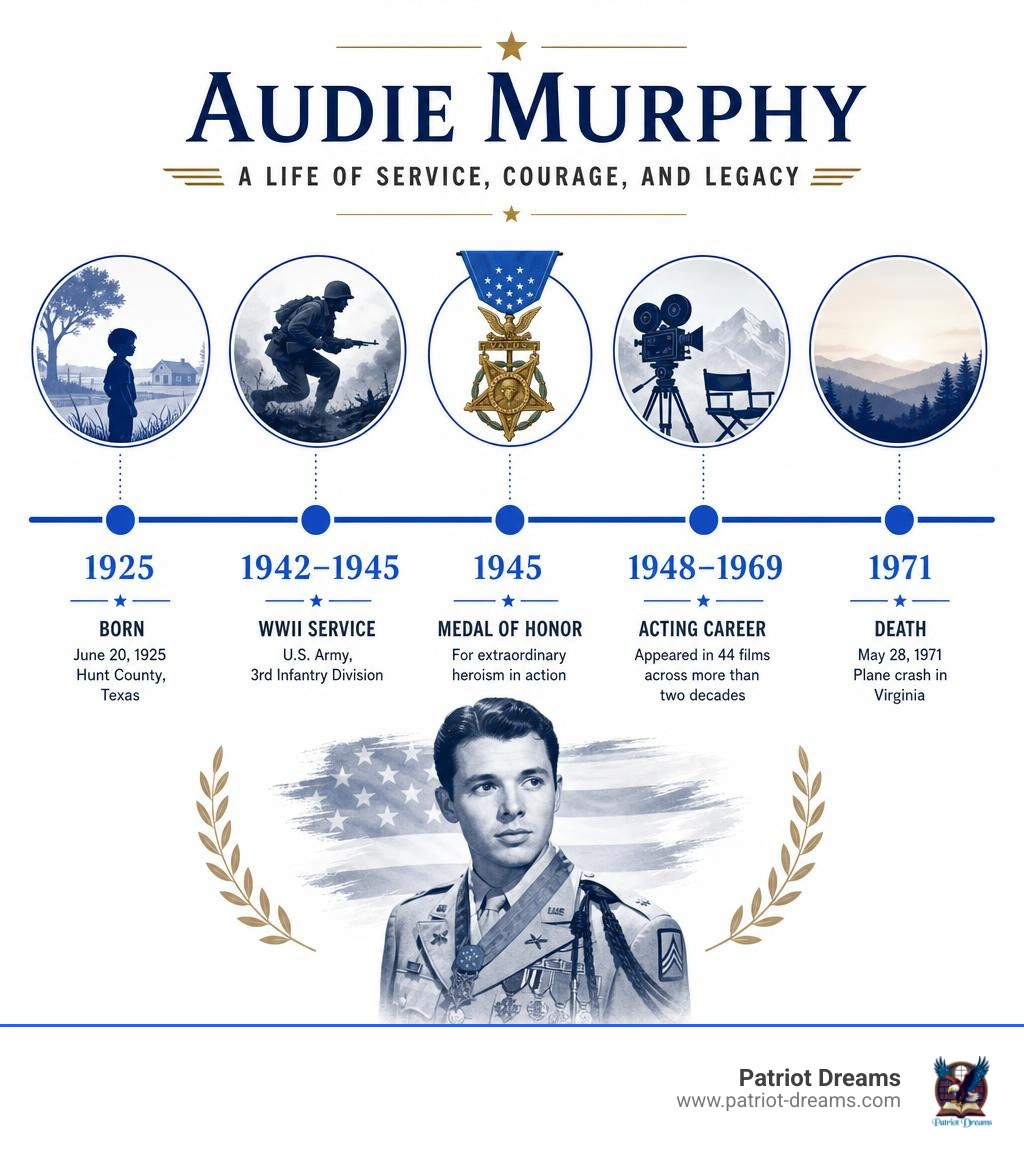
| Born | June 20, 1925, Hunt County, Texas |
| Died | May 28, 1971 (age 45), plane crash in Virginia |
| Service Branch | U.S. Army, 3rd Infantry Division |
| Highest Award | Medal of Honor |
| Total Decorations | 28 medals (including 3 French, 1 Belgian) |
| Enemy Soldiers Credited | 241 killed |
| Post-War Career | Actor (44 films), songwriter, veteran advocate |
| Buried | Arlington National Cemetery, Section 46 |
His story is one of those that stays with you. A boy who lost his mother at sixteen, who was turned away by the Marines and the Navy for being too small, who went on to single-handedly hold off German tanks and infantry from a burning vehicle — and then came home and quietly fought a very different kind of battle.
Murphy stood just 5 feet 5 inches tall. But what he carried — in courage, in heartbreak, and in grace — was larger than most of us can imagine.
At Patriot Dreams, we believe stories like his deserve to be told with warmth and care. Not just as a list of medals, but as a human story about resilience, family, and what it means to serve something bigger than yourself.
Glossary for Audie Murphy:
- General Jonathan Wainwright: The Hero of Bataan’s Defiance
- The Courage of Mitchell Red Cloud Jr.: A Native American Hero of the Korean War
- The Four Chaplains, George Fox, Alexander Goode, Clark Poling, John Washington
From Texas Sharecropper to Battlefield Hero
When we look back at the lives of those who shaped our nation, we often find that the grandest trees grow from the most rugged soil. The story of Audie Murphy did not begin in a grand military academy or a wealthy neighborhood. It began in the dusty cotton fields of Hunt County, Texas.
As we explore the tapestry of our nation's past through our American Historical Figures Complete Guide, we find that true heroism is rarely born of privilege. Instead, it is forged in the quiet, everyday struggles of ordinary people who simply refuse to give up.
A Humble Childhood in the Lone Star State
Audie Leon Murphy was born on June 20, 1925, the seventh of twelve children. His parents were sharecroppers, which meant the family worked hard on land they did not own, moving from farm to farm just to get by. Life was a constant lesson in resilience. When Audie was still quite young, his father abandoned the family, leaving his mother, Josie Bell, to care for the children on her own.
To help feed his brothers and sisters, young Audie dropped out of school after the fifth grade. He spent his days picking cotton and hunting in the Texas woods. Armed with a simple rifle, he became an incredibly accurate marksman. He had to be; if he missed a shot, it meant his family might go to bed hungry.
In 1941, when Audie was only sixteen, his beloved mother passed away. He often said that when she died, she took a part of him with her. Left to help care for his younger siblings, he learned the depth of family loyalty and sacrifice early on.
When the United States entered World War II, Audie felt a deep pull to serve his country. However, standing at just 5 feet 5.5 inches and weighing a mere 110 pounds, he faced rejection at every turn. The Marines and the Navy both turned him down, believing he was too small and frail for the rigors of combat.
But Audie was determined. With the help of his sister, who helped falsify his birth year on his enlistment papers to make him appear eighteen, he successfully enlisted in the U.S. Army just after his seventeenth birthday in June 1942. It is a story of quiet determination that places him among the most memorable Famous Figures in American History.
The Heroic World War II Service of Audie Murphy
Once in the Army, Audie Murphy quickly proved that courage is not measured in inches or pounds. Assigned to Company B, 15th Infantry Regiment of the legendary 3rd Infantry Division, he was shipped out to the Mediterranean Theater.
Over the next three years, Murphy participated in nine major campaigns across North Africa, Sicily, Italy, and France. He spent roughly 400 days on the front lines, surviving three combat wounds and rising from the rank of private to a battlefield commission as a second lieutenant. His division suffered unimaginable losses; at one point, his company was reduced from 235 men to just 18 due to casualties and disease. Yet, Murphy kept moving forward, fueled by a quiet devotion to his fellow soldiers.
His most legendary action occurred on a freezing, snow-covered day on January 26, 1945, near the town of Holtzwihr in the Colmar Pocket of France.
Our team at Patriot Dreams often reflects on the sheer weight of that day. Murphy’s company was attacked by six German tanks and waves of infantry. Recognizing that his men were in danger of being overwhelmed, Murphy ordered them to withdraw to the safety of the woods. He stayed behind alone at his forward command post to direct artillery fire by telephone.
As the enemy advanced, a nearby American M10 tank destroyer was hit and began to burn fiercely, threatened by an imminent explosion. In an act of breathtaking bravery, Murphy climbed aboard the burning vehicle. He took control of its .50-caliber machine gun and began firing on the advancing German forces.
Exposed to direct enemy fire, with the burning tank destroyer beneath him liable to blow up at any second, Murphy held his ground alone for an hour. He successfully repelled the enemy infantry and forced the tanks to retreat, killing or wounding approximately 50 German soldiers. Despite receiving a leg wound, he then led his company in a successful counterattack.
For this unbelievable display of valor, as detailed in the official Medal of Honor Monday: Army Maj. Audie Murphy profile, he was awarded the nation's highest military decoration. His incredible journey through the war is fully documented in the Military career of Audie Murphy records, cementing his place as a true American legend.
The Legacy of Audie Murphy
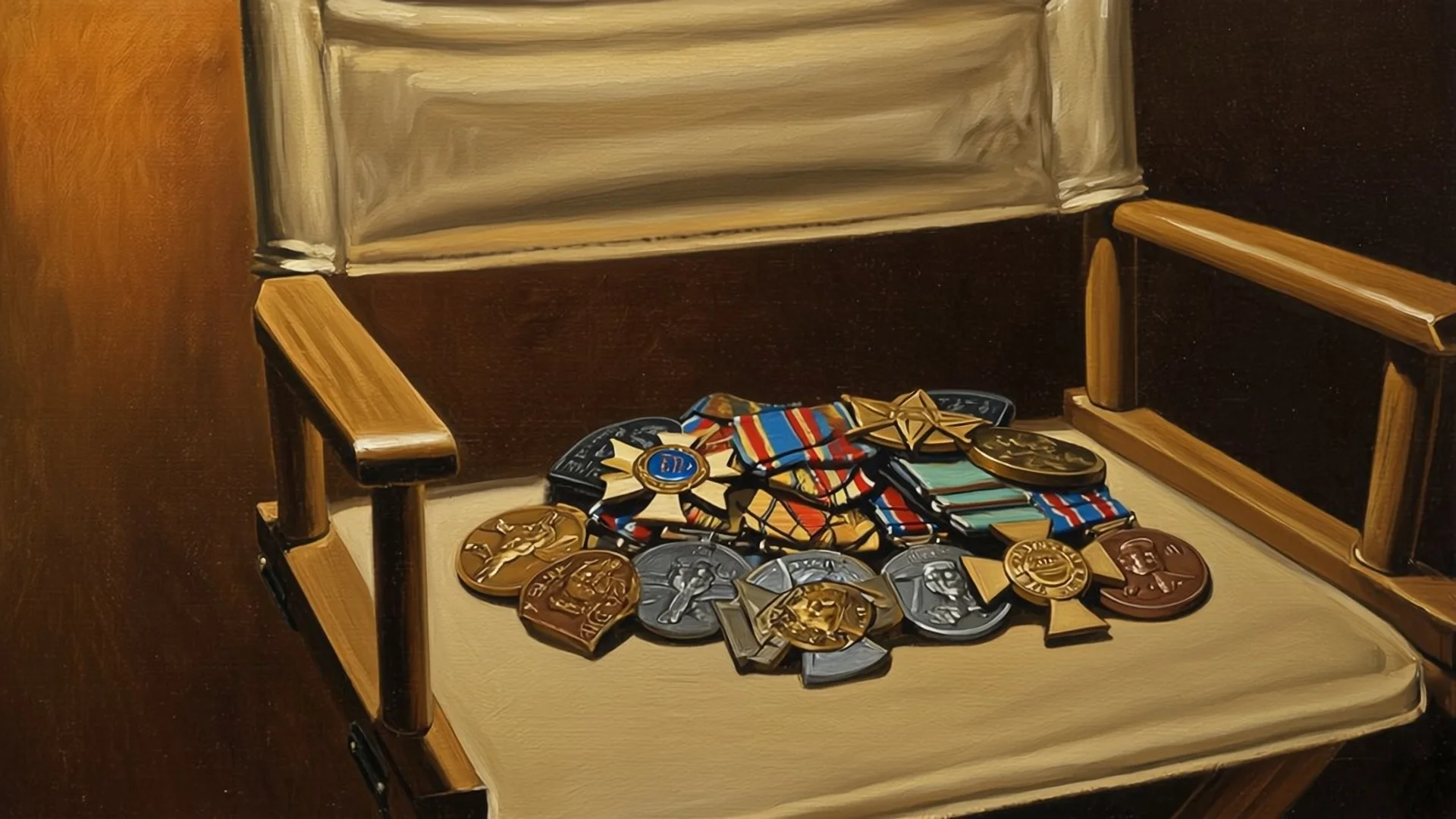
By the end of World War II, Audie Murphy had earned an unparalleled 28 military medals, including every U.S. Army combat award for valor available at the time. He also received high honors from foreign governments, including three decorations from France—such as the Legion of Honor and the Croix de Guerre—and one from Belgium.
Yet, when he returned home to Texas, he remained remarkably humble. He did not view himself as a larger-than-life hero, but simply as a survivor who had done his duty to his friends. This humility is what makes him stand out so brightly among US Historical Figures.
From the Front Lines to the Silver Screen
When the war ended, America was eager to celebrate its young hero. Murphy's boyish, handsome face graced the cover of Life magazine, which caught the eye of Hollywood legend James Cagney. Cagney invited the young veteran to California, launching Murphy into an unexpected career as an actor.
Between 1948 and 1969, Murphy starred in more than 40 feature films, primarily Westerns, where his natural riding skills and quiet presence made him a favorite of moviegoers. His most famous role, however, was playing himself in the 1955 biographical film To Hell and Back, based on his best-selling autobiography.
The film was a massive success, setting a box office record for Universal Studios that stood for twenty years until it was finally broken by Jaws in 1975. You can read more about his extensive filmography and creative endeavors on the Audie Murphy - Wikipedia page.
Despite his fame, Murphy remained deeply committed to being a positive role model. He wrote the lyrics to 16 country-western songs and consistently refused lucrative offers to appear in alcohol or cigarette commercials, simply because he did not want to set a poor example for the young people who looked up to him.
How Audie Murphy Championed Veterans' Mental Health
While Murphy's public life was filled with movie sets and red carpets, his private life was a battleground of a different kind. Like so many who survive the horrors of combat, he brought the war home with him.
Today, we understand post-traumatic stress disorder (PTSD), but in the 1940s and 1950s, it was often quietly referred to as "battle fatigue" or "shell shock." Murphy suffered from severe nightmares, flashbacks, and sleep deprivation. For years, he slept with a loaded pistol under his pillow and struggled with sudden bursts of anger.
Rather than hiding his struggles, Murphy did something incredibly brave for his time: he spoke out. He used his fame to shine a light on the mental health challenges faced by returning servicemen, publicly urging the U.S. government and the Department of Veterans Affairs to provide better medical and psychological support for veterans.
His advocacy broke down barriers and paved the way for a more compassionate understanding of combat stress, showing a deep sense of Military Patriotism that extended far beyond the battlefield.
Remembering a True American Patriot
As we look back from our vantage point in May 2026, we mark a solemn milestone. This month marks the 55th anniversary of the tragic passing of Audie Murphy.
On May 28, 1971, Murphy was traveling on a business trip when his private plane crashed under poor weather conditions near Catawba, Virginia. He was only 45 years old. The news sent a wave of grief across a nation that had come to love the gentle Texan who stood so tall in the face of danger. His life and legacy remain a cornerstone of our study of Historical American Figures.
A Final Resting Place at Arlington
On June 7, 1971, Audie Murphy was buried with full military honors at Arlington National Cemetery.
Typically, the gravesites of Medal of Honor recipients are decorated with gold leaf or special embellishments to highlight their extraordinary service. However, before his passing, Murphy had requested a simple, plain tombstone, identical to those of the ordinary soldiers buried around him. He wanted to rest as he had served—as one of many, side-by-side with his brothers-in-arms.
Today, his grave in Section 46 is the second most-visited gravesite at Arlington National Cemetery, surpassed only by that of President John F. Kennedy. Visitors from all over the world come to pay their respects to the quiet hero who asked for nothing more than a simple stone. You can view his official citation and cemetery records through the Audie Leon Murphy | World War II | U.S. Army registry.
Commemorations and Lasting Tributes
The memory of Audie Murphy continues to inspire new generations. In his home state of Texas, "Audie Murphy Day" is celebrated to honor his life, and the U.S. Army established the prestigious Sergeant Audie Murphy Award to recognize non-commissioned officers who demonstrate outstanding leadership and care for their soldiers.
For those who wish to explore his letters, enlistment records, and eyewitness accounts from the battles of World War II, the Audie L. Murphy Memorial Website serves as a beautiful, volunteer-run archive dedicated to keeping his memory alive with historical accuracy.
Frequently Asked Questions About a WWII Legend
How many enemy soldiers was he credited with killing?
During his service in World War II, Audie Murphy was officially credited with killing 241 enemy soldiers. While this statistic highlights his extraordinary combat record, Murphy himself rarely spoke of these numbers, preferring to focus on the bravery of the friends he lost along the way.
What specific action earned him the Medal of Honor?
On January 26, 1945, near Holtzwihr, France, Murphy climbed aboard a burning American tank destroyer that was in danger of exploding. Alone and wounded in the leg, he used the vehicle's .50-caliber machine gun to hold off six German tanks and waves of advancing infantry for an hour, saving his company from being overrun.
How did he die and where is he buried?
Audie Murphy died in a tragic plane crash in the mountains near Catawba, Virginia, on May 28, 1971. He is buried in Section 46 of Arlington National Cemetery. At his own request, his tombstone remains plain and simple, matching those of the everyday soldiers buried around him.
Conclusion
At Patriot Dreams, we believe that the heart of America is found in the stories of people like Audie Murphy—people who came from the humblest beginnings, faced the greatest challenges with quiet courage, and never forgot the value of kindness, family, and community.
Through our interactive maps and unique audio storytelling platform, we bring these incredible journeys to life. We invite you to explore our heritage, preserve your own family's legacy, and join us in honoring the American heroes who shaped our world by visiting Patriot Dreams. Let us walk together, remembering the gentle strength of those who came before us.

Join the Patriot Dreams Community
Download the app today and start your journey through American history and personal legacy.

Explore Our Latest Insights
Dive into stories that shape our American legacy.